
GENETICS NOTES 1 What is heredity The transmission
- Slides: 35
GENETICS NOTES
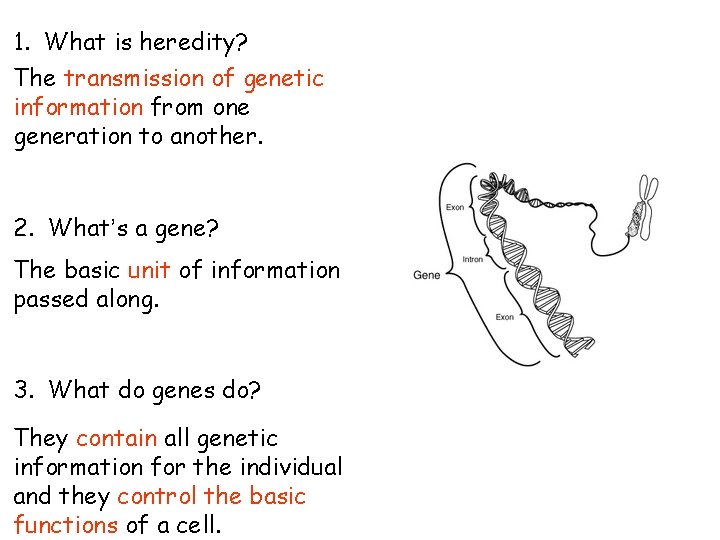
1. What is heredity? The transmission of genetic information from one generation to another. 2. What’s a gene? The basic unit of information passed along. 3. What do genes do? They contain all genetic information for the individual and they control the basic functions of a cell.
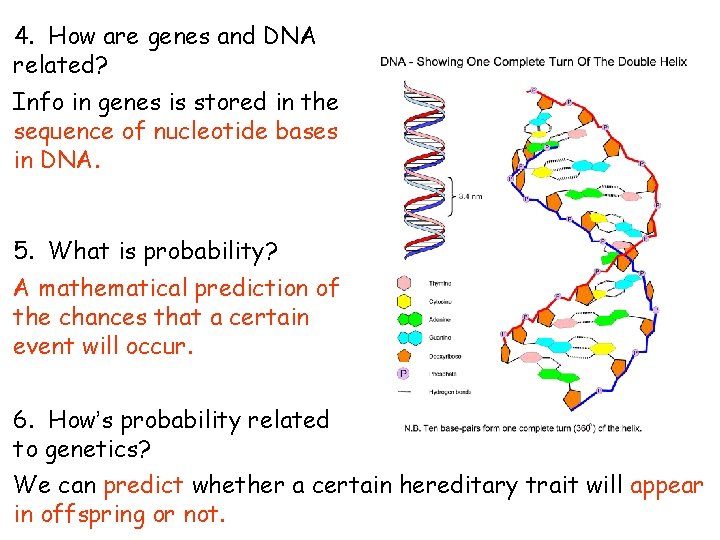
4. How are genes and DNA related? Info in genes is stored in the sequence of nucleotide bases in DNA. 5. What is probability? A mathematical prediction of the chances that a certain event will occur. 6. How’s probability related to genetics? We can predict whether a certain hereditary trait will appear in offspring or not.
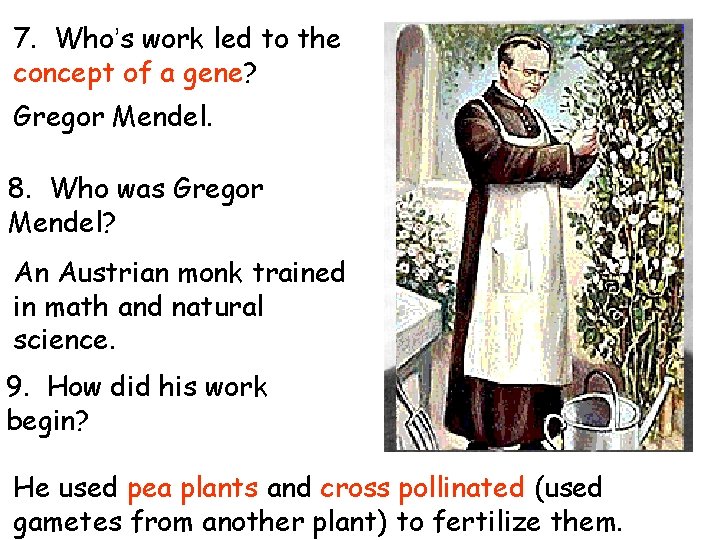
7. Who’s work led to the concept of a gene? Gregor Mendel. 8. Who was Gregor Mendel? An Austrian monk trained in math and natural science. 9. How did his work begin? He used pea plants and cross pollinated (used gametes from another plant) to fertilize them.
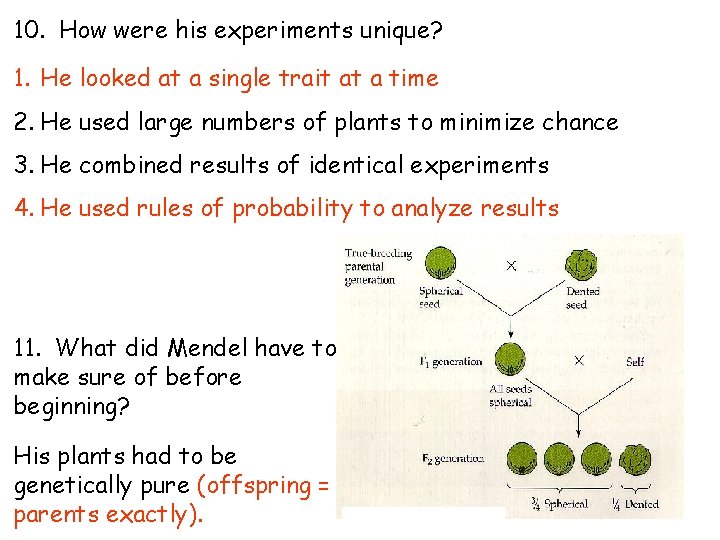
10. How were his experiments unique? 1. He looked at a single trait at a time 2. He used large numbers of plants to minimize chance 3. He combined results of identical experiments 4. He used rules of probability to analyze results 11. What did Mendel have to make sure of before beginning? His plants had to be genetically pure (offspring = parents exactly).
Test For Understanding What is the genetic unit? Gene or Chromosome? What is a probability? A chance or a guarantee?
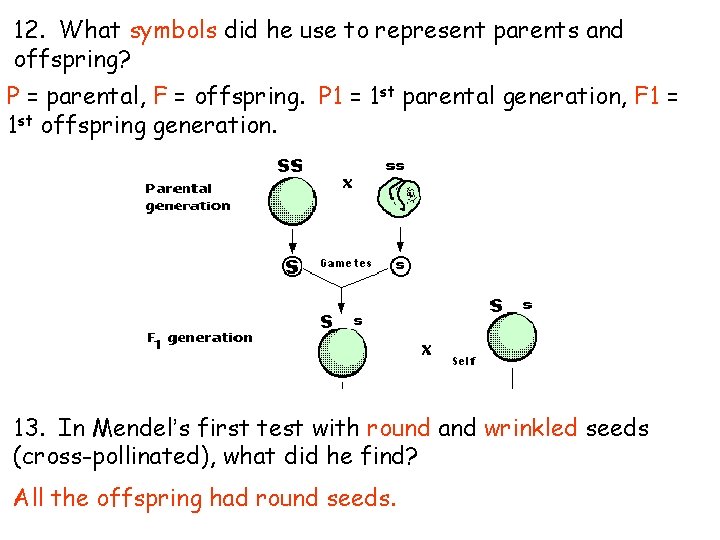
12. What symbols did he use to represent parents and offspring? P = parental, F = offspring. P 1 = 1 st parental generation, F 1 = 1 st offspring generation. 13. In Mendel’s first test with round and wrinkled seeds (cross-pollinated), what did he find? All the offspring had round seeds.
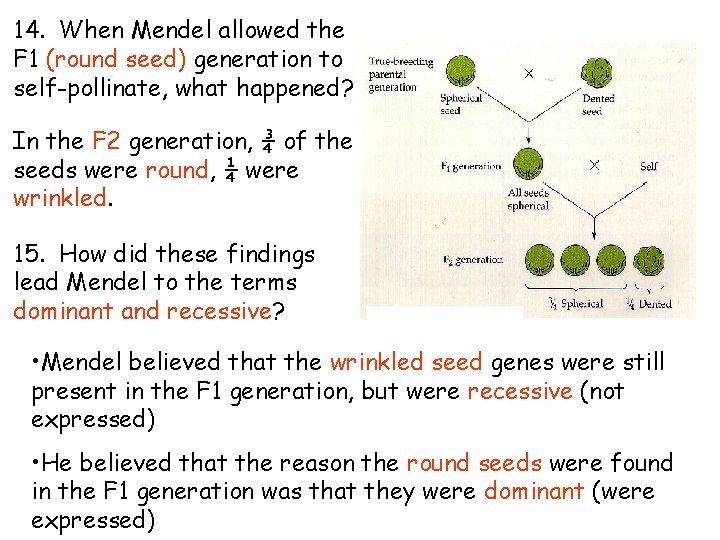
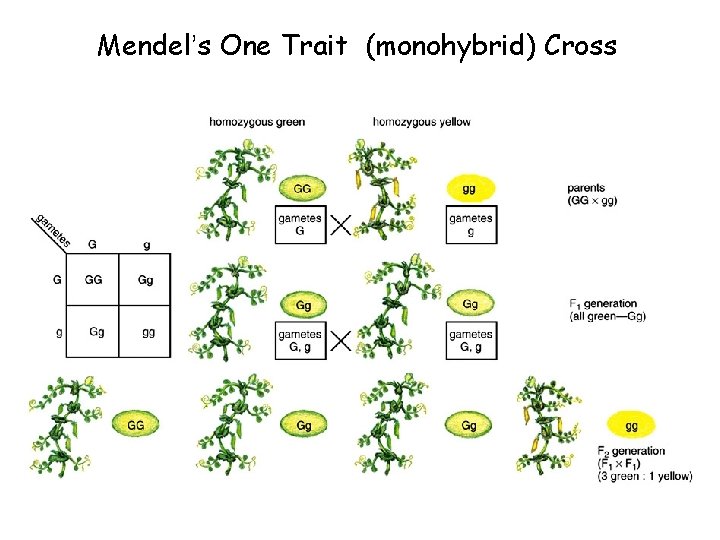
14. When Mendel allowed the F 1 (round seed) generation to self-pollinate, what happened? In the F 2 generation, ¾ of the seeds were round, ¼ were wrinkled. 15. How did these findings lead Mendel to the terms dominant and recessive? • Mendel believed that the wrinkled seed genes were still present in the F 1 generation, but were recessive (not expressed) • He believed that the reason the round seeds were found in the F 1 generation was that they were dominant (were expressed)
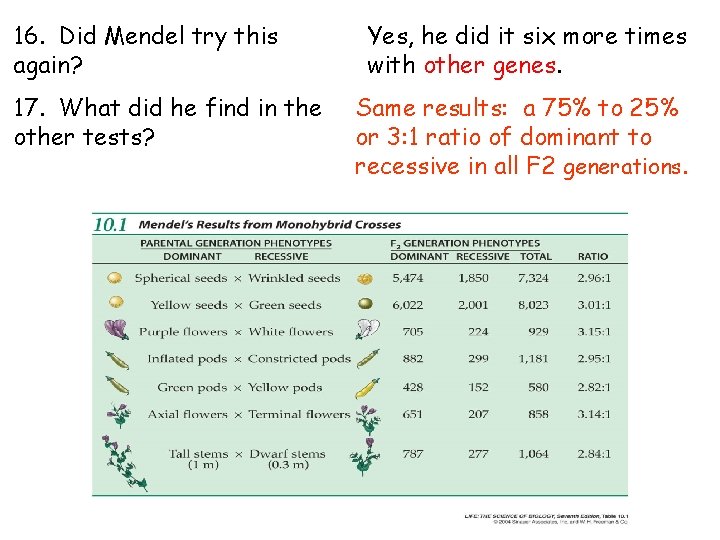
16. Did Mendel try this again? 17. What did he find in the other tests? Yes, he did it six more times with other genes. Same results: a 75% to 25% or 3: 1 ratio of dominant to recessive in all F 2 generations.
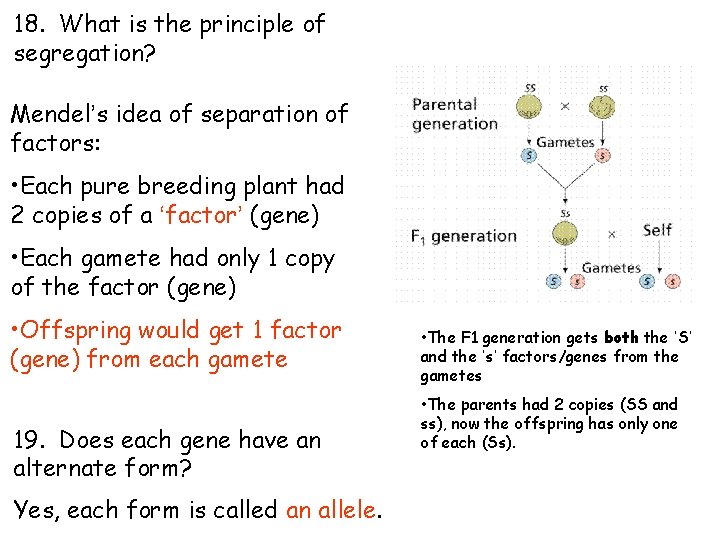
18. What is the principle of segregation? Mendel’s idea of separation of factors: • Each pure breeding plant had 2 copies of a ‘factor’ (gene) • Each gamete had only 1 copy of the factor (gene) • Offspring would get 1 factor (gene) from each gamete 19. Does each gene have an alternate form? Yes, each form is called an allele. • The F 1 generation gets both the ‘S’ and the ‘s’ factors/genes from the gametes • The parents had 2 copies (SS and ss), now the offspring has only one of each (Ss).
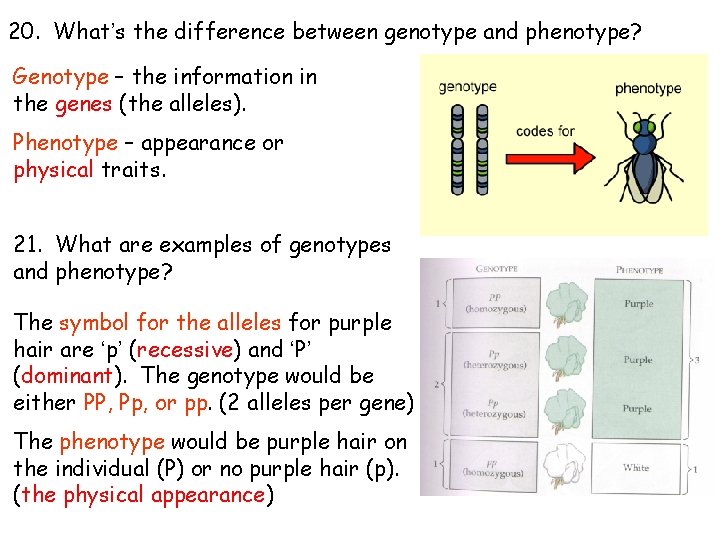
20. What’s the difference between genotype and phenotype? Genotype – the information in the genes (the alleles). Phenotype – appearance or physical traits. 21. What are examples of genotypes and phenotype? The symbol for the alleles for purple hair are ‘p’ (recessive) and ‘P’ (dominant). The genotype would be either PP, Pp, or pp. (2 alleles per gene) The phenotype would be purple hair on the individual (P) or no purple hair (p). (the physical appearance)
Test For Understanding How many alleles does a gene have? 1 or 2? Which is the way you look (or the way your genes are expressed)? Genotype or Phenotype?
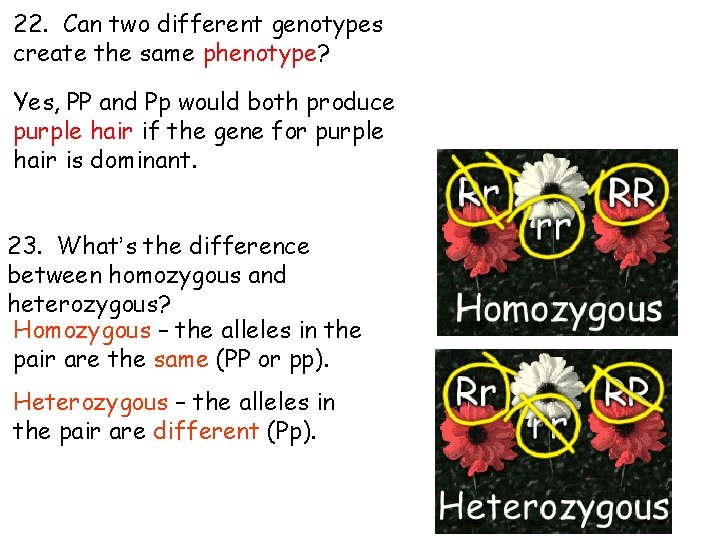
22. Can two different genotypes create the same phenotype? Yes, PP and Pp would both produce purple hair if the gene for purple hair is dominant. 23. What’s the difference between homozygous and heterozygous? Homozygous – the alleles in the pair are the same (PP or pp). Heterozygous – the alleles in the pair are different (Pp).
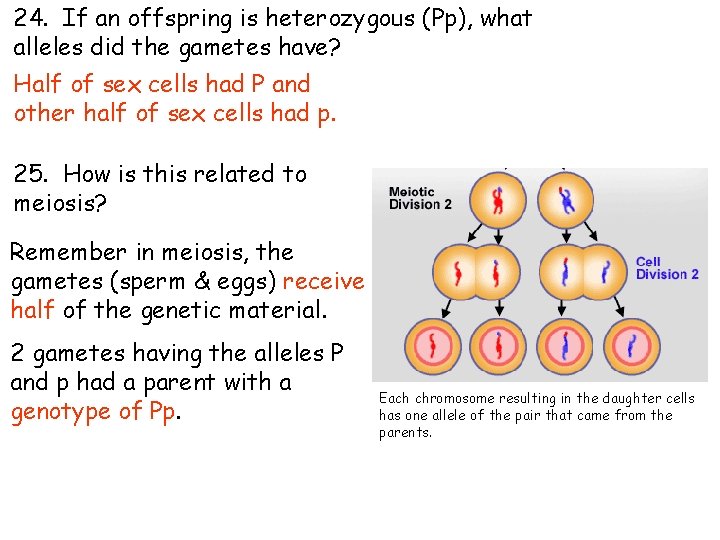
24. If an offspring is heterozygous (Pp), what alleles did the gametes have? Half of sex cells had P and other half of sex cells had p. 25. How is this related to meiosis? Remember in meiosis, the gametes (sperm & eggs) receive half of the genetic material. 2 gametes having the alleles P and p had a parent with a genotype of Pp. Each chromosome resulting in the daughter cells has one allele of the pair that came from the parents.
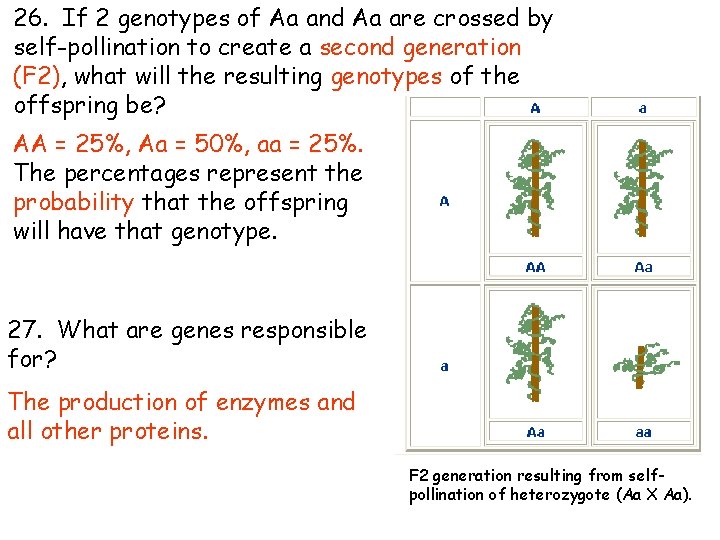
26. If 2 genotypes of Aa and Aa are crossed by self-pollination to create a second generation (F 2), what will the resulting genotypes of the offspring be? AA = 25%, Aa = 50%, aa = 25%. The percentages represent the probability that the offspring will have that genotype. 27. What are genes responsible for? The production of enzymes and all other proteins. F 2 generation resulting from selfpollination of heterozygote (Aa X Aa).
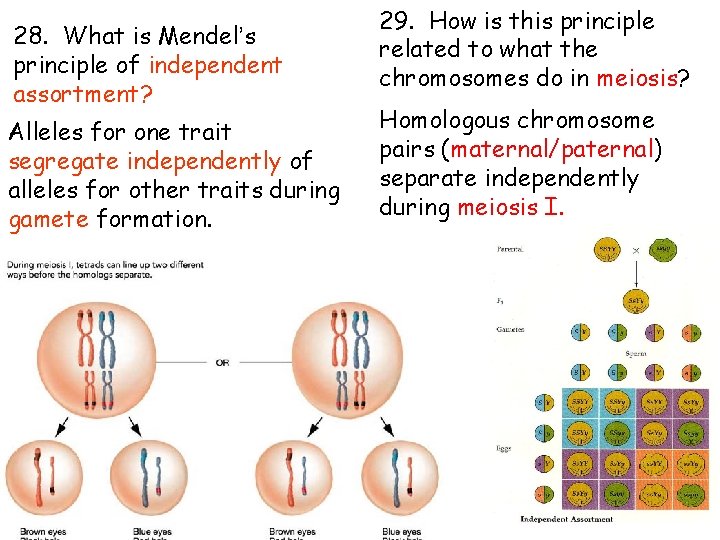
28. What is Mendel’s principle of independent assortment? Alleles for one trait segregate independently of alleles for other traits during gamete formation. 29. How is this principle related to what the chromosomes do in meiosis? Homologous chromosome pairs (maternal/paternal) separate independently during meiosis I.
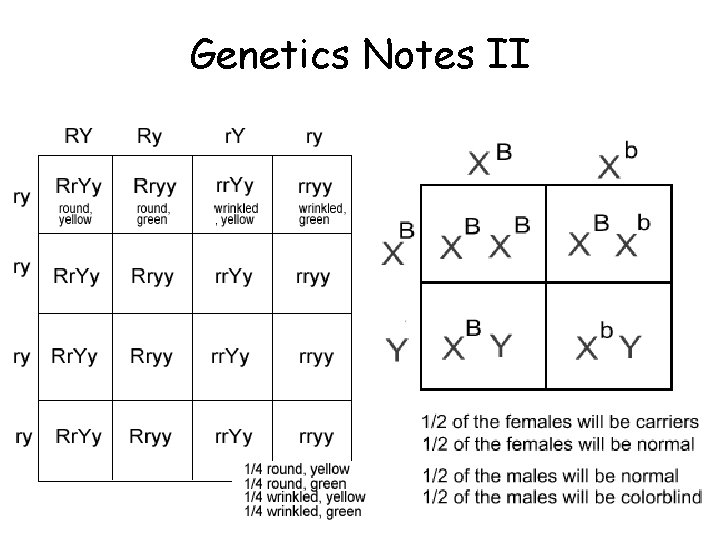
Genetics Notes II
Mendel’s One Trait (monohybrid) Cross
Test For Understanding What is the expected ratio in a monohybrid cross where green is dominant to yellow?
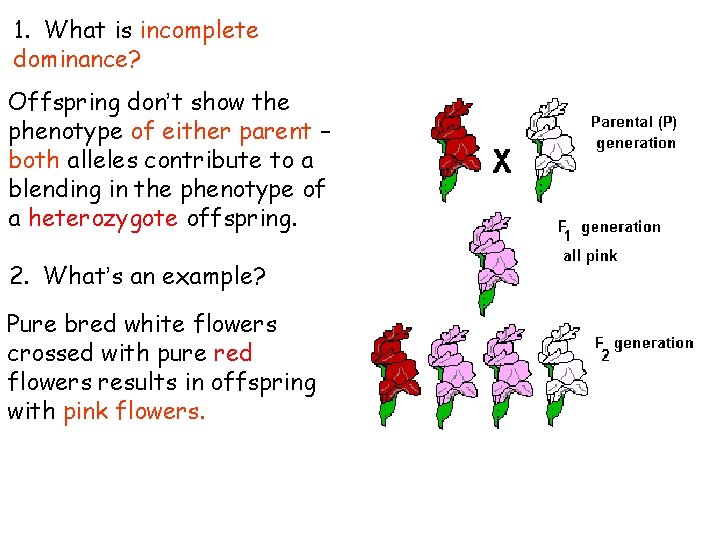
1. What is incomplete dominance? Offspring don’t show the phenotype of either parent – both alleles contribute to a blending in the phenotype of a heterozygote offspring. 2. What’s an example? Pure bred white flowers crossed with pure red flowers results in offspring with pink flowers.
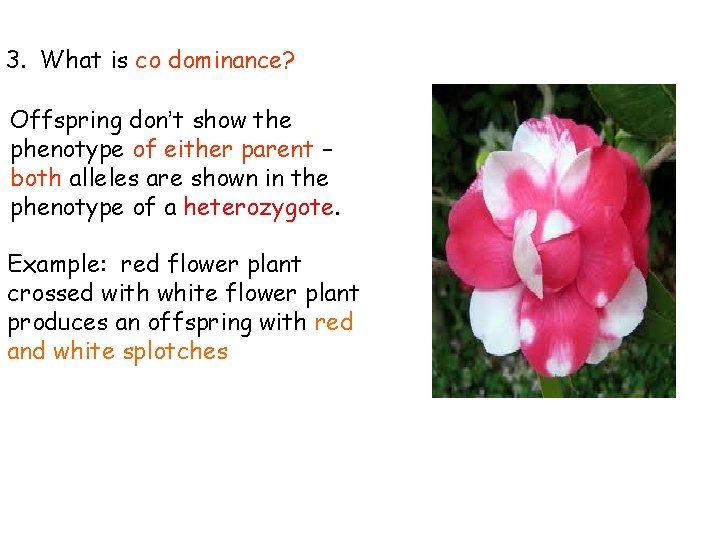
3. What is co dominance? Offspring don’t show the phenotype of either parent – both alleles are shown in the phenotype of a heterozygote. Example: red flower plant crossed with white flower plant produces an offspring with red and white splotches
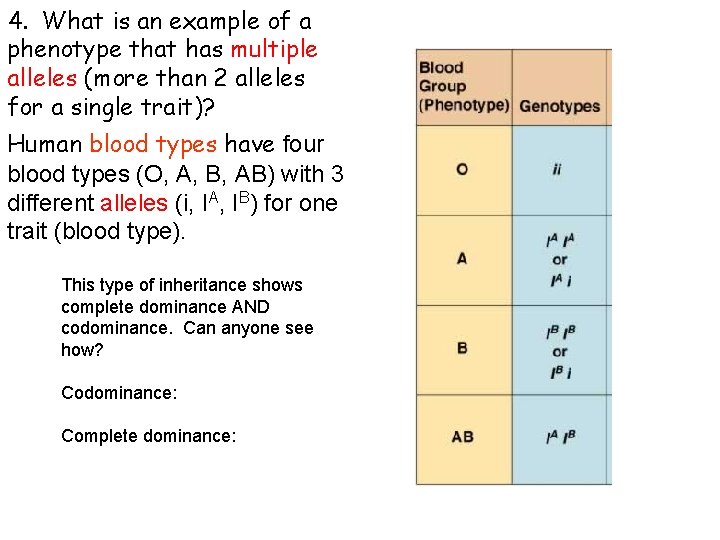
4. What is an example of a phenotype that has multiple alleles (more than 2 alleles for a single trait)? Human blood types have four blood types (O, A, B, AB) with 3 different alleles (i, IA, IB) for one trait (blood type). This type of inheritance shows complete dominance AND codominance. Can anyone see how? Codominance: Complete dominance:
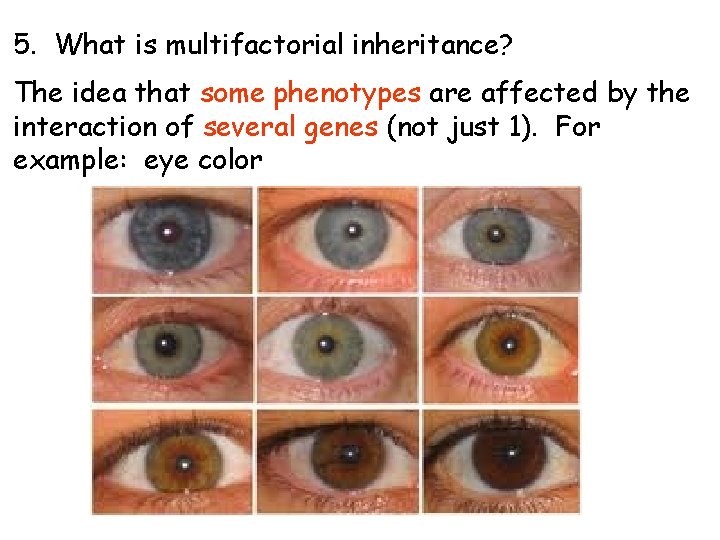
5. What is multifactorial inheritance? The idea that some phenotypes are affected by the interaction of several genes (not just 1). For example: eye color
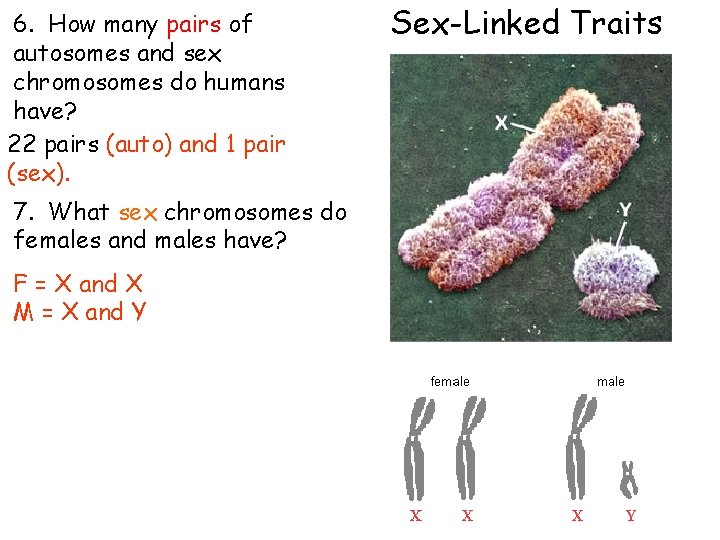
6. How many pairs of autosomes and sex chromosomes do humans have? 22 pairs (auto) and 1 pair (sex). 7. What sex chromosomes do females and males have? F = X and X M = X and Y Sex-Linked Traits
8. If the Y sperm of the male fertilizes the egg (X), what will the sex of the child be? Male. 9. Do the male’s X and Y chromosomes have the same genes as those on the female’s X and X chromosome? No, there are some genes unique to the X chromosome. So, the males will have 1 allele for this gene as they only have 1 X chromosome.
Test For Understanding If two dominant genes are crossed and the offspring don’t resemble either of the parents, what is this an example of? Impartial Dominance OR Codominance? Do genes ever work together? Yes or No?
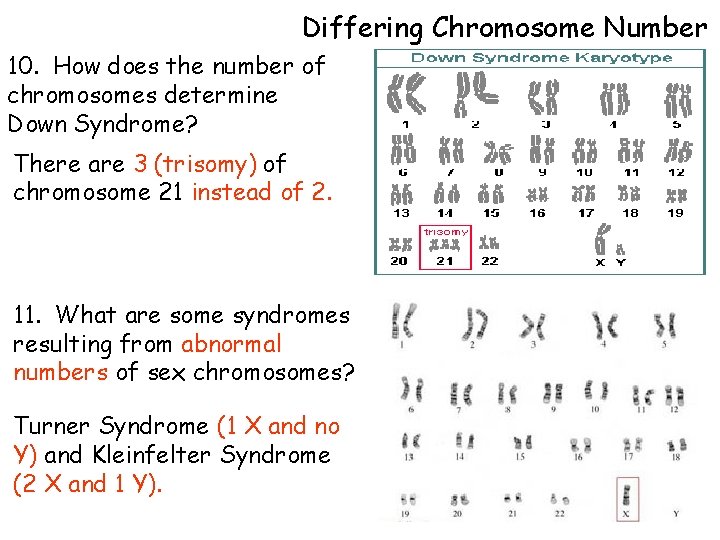
Differing Chromosome Number 10. How does the number of chromosomes determine Down Syndrome? There are 3 (trisomy) of chromosome 21 instead of 2. 11. What are some syndromes resulting from abnormal numbers of sex chromosomes? Turner Syndrome (1 X and no Y) and Kleinfelter Syndrome (2 X and 1 Y).
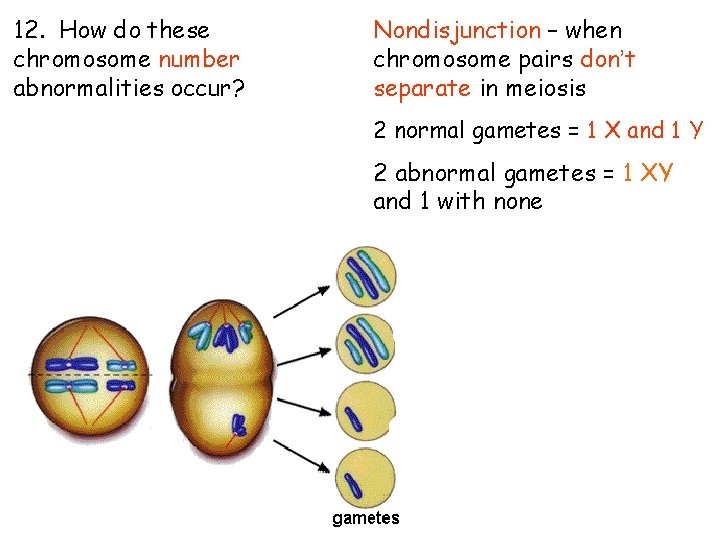
12. How do these chromosome number abnormalities occur? Nondisjunction – when chromosome pairs don’t separate in meiosis 2 normal gametes = 1 X and 1 Y 2 abnormal gametes = 1 XY and 1 with none
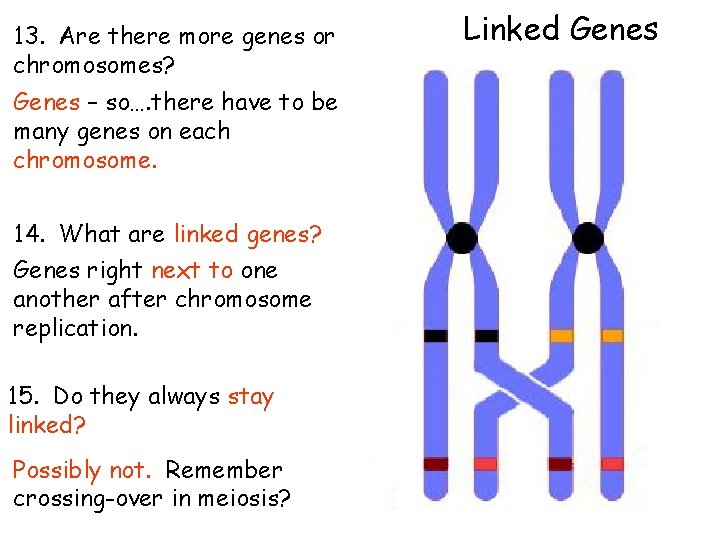
13. Are there more genes or chromosomes? Genes – so…. there have to be many genes on each chromosome. 14. What are linked genes? Genes right next to one another after chromosome replication. 15. Do they always stay linked? Possibly not. Remember crossing-over in meiosis? Linked Genes
Test For Understanding Which of the following causes abnormalities and syndromes in humans? Different number of sex chromosomes OR Different number of automsomes OR Both
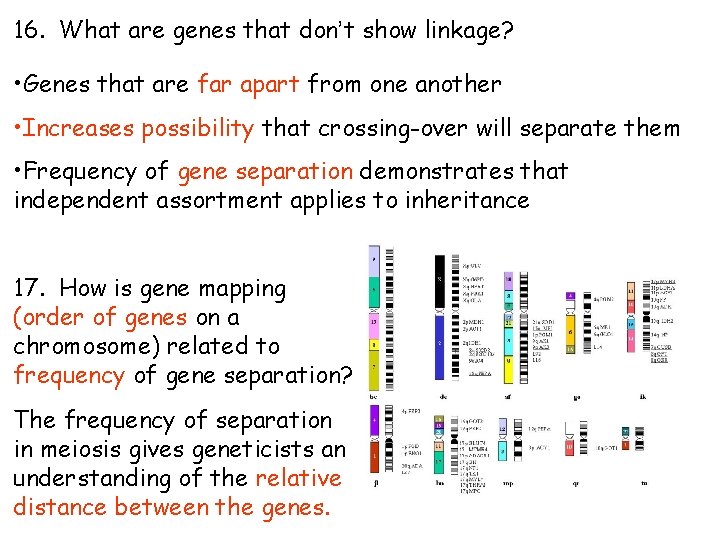
16. What are genes that don’t show linkage? • Genes that are far apart from one another • Increases possibility that crossing-over will separate them • Frequency of gene separation demonstrates that independent assortment applies to inheritance 17. How is gene mapping (order of genes on a chromosome) related to frequency of gene separation? The frequency of separation in meiosis gives geneticists an understanding of the relative distance between the genes.
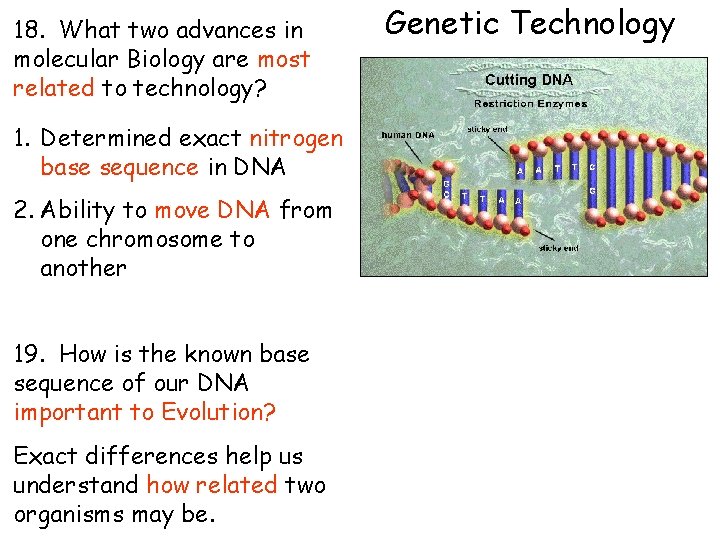
18. What two advances in molecular Biology are most related to technology? 1. Determined exact nitrogen base sequence in DNA 2. Ability to move DNA from one chromosome to another 19. How is the known base sequence of our DNA important to Evolution? Exact differences help us understand how related two organisms may be. Genetic Technology
20. How is a bacterium used to produce insulin for humans? • Take circular DNA (plasmid) from bacterium • Plasmid cut open with cutting enzyme at an exact spot • Human DNA for insulin cut out with cutting enzymes • Human DNA spliced into plasmid • Plasmid inserted back into bacterium • Bacterium produce clones asexually (more and more insulin)
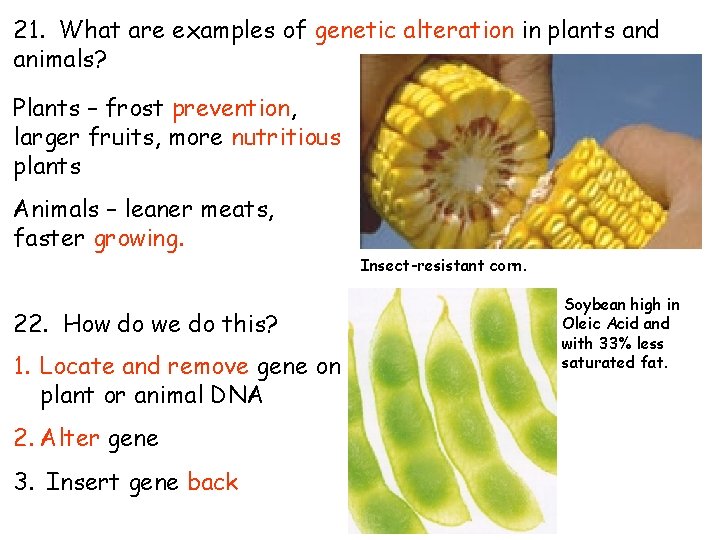
21. What are examples of genetic alteration in plants and animals? Plants – frost prevention, larger fruits, more nutritious plants Animals – leaner meats, faster growing. Insect-resistant corn. 22. How do we do this? 1. Locate and remove gene on plant or animal DNA 2. Alter gene 3. Insert gene back Soybean high in Oleic Acid and with 33% less saturated fat.
Test For Understanding Are linked genes going to be linked forever? Yes OR Maybe OR No