
Genetics Lab 3 point mapping How to use
Genetics Lab 3 -point mapping How to use F 2 data to create a map of 3 -linked genes
• There are further limitations to recombination mapping • Consider again, genes that are distantly spaced on the same chromosome. They are more likely to have more than one X. 0. occur between them.

Figure 5. 7 ab

Consider genes a, b, and c • Offspring should show new (non parental) combinations of a and b alleles. • Offspring should show new (non parental) combinations of b and c alleles. • a and c alleles remain in parental combinations. *Depending on the gene(s)/trait(s) analyzed, it’s difficult or impossible to note XO occurred.
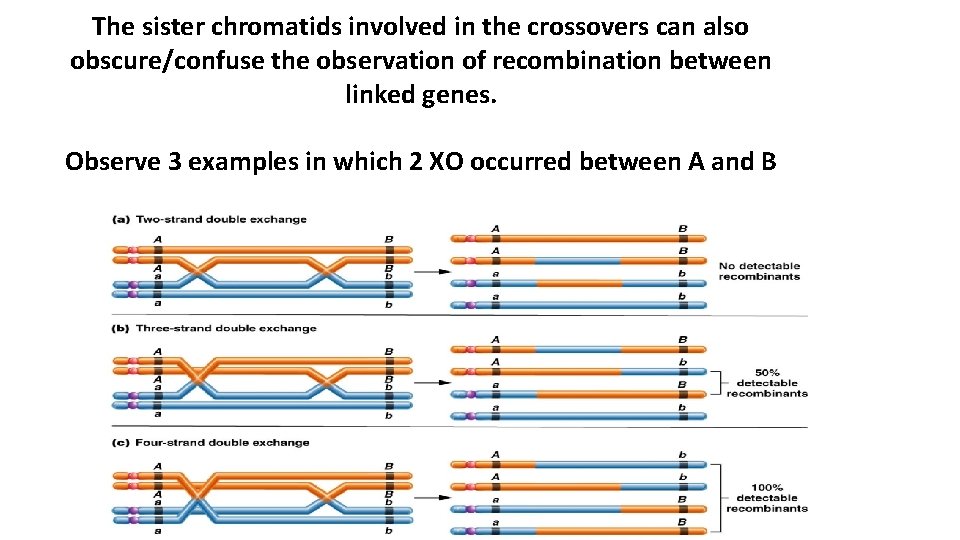
The sister chromatids involved in the crossovers can also obscure/confuse the observation of recombination between linked genes. Observe 3 examples in which 2 XO occurred between A and B Figure 5. 12

Reminder… Recombination mapping has limitations • We may over- or underestimate the distance between 2 genes. • Bottom line…recombination mapping is most accurate for more closely spaced loci. • However…multiple cross-overs help us in certain aspects of mapping----Putting genes in a linear order.
Recall… Initially mapping required multiple, 2 -point crosses. Then the 2 point crosses could be put together to make a map with gene order and distances. • Sturtevant noted that recombination frequencies were approximately additive, allowing the order of genes to be determined. • In 3 separate crosses: • y-w frequency is 0. 5% • w-m frequency is 35. 4 • y-m frequency is 34. 5 % **Which genes are on the outside? Which gene is in the middle?

Figure 5. 4
• Discovery that multiple X. O can occur between loci actually simplified chromosome mapping, allowing multiple loci to be mapped in a single cross.

Consider again, genes that are distantly spaced on the same chromosome. They are more likely to have more than one X. 0. occur between them.
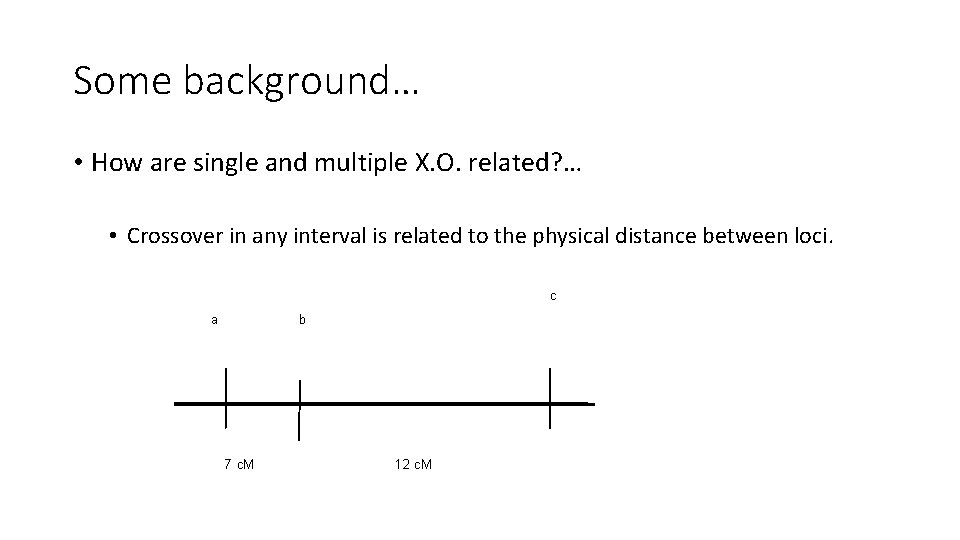
Some background… • How are single and multiple X. O. related? … • Crossover in any interval is related to the physical distance between loci. c a b 7 c. M 12 c. M

c a b 7 c. M 12 c. M The map was made by observing recombination frequencies. a-b 0. 07 b-c 0. 12 What is the expected frequency of double crossover in the interval a-c? (One X. O. in a-b and one X. O. in b-c)
• Assuming X. O in one interval does not influence X. O. in the other interval we can use the product rule. • a-b (0. 07) X b-c (0. 12) =0. 0084 Frequency of double cross over (DCO) is only. 84%
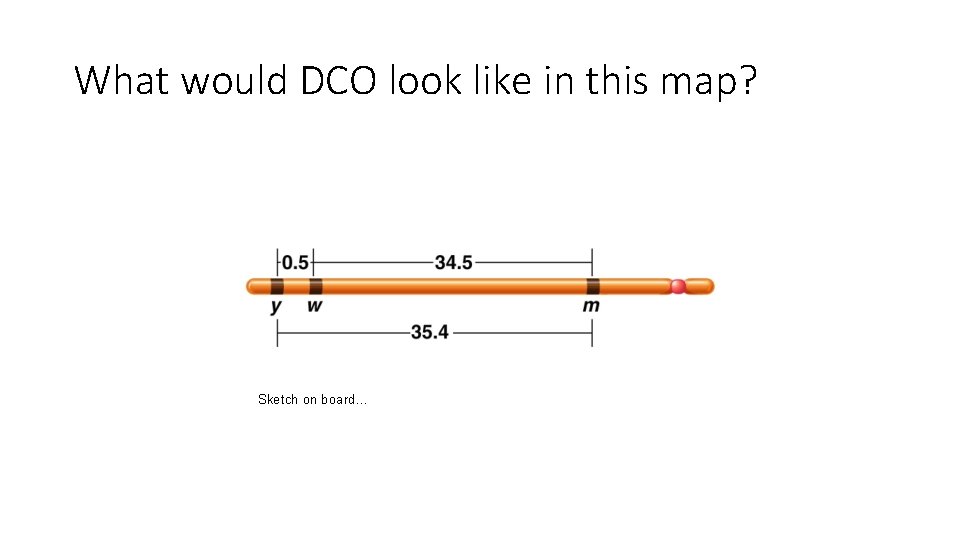
What would DCO look like in this map? Sketch on board…
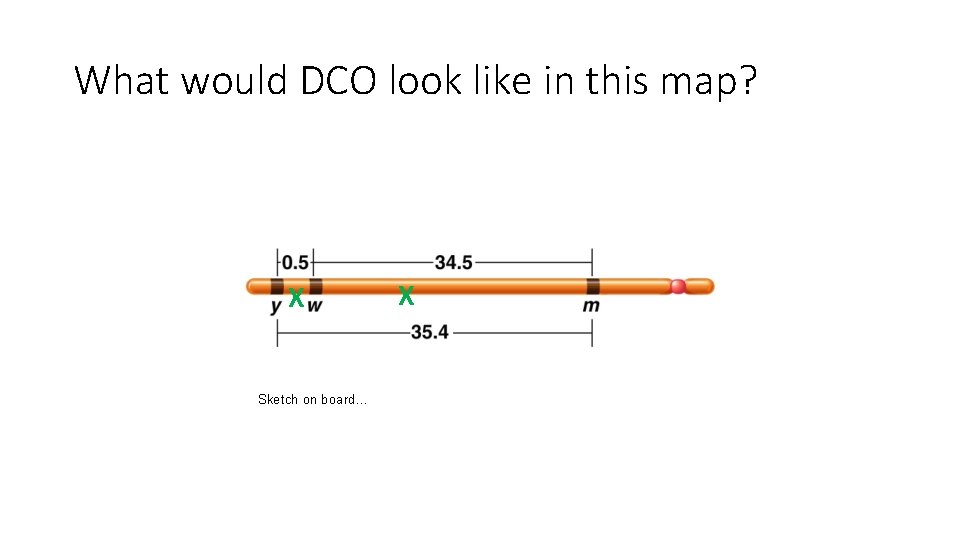
What would DCO look like in this map? X Sketch on board… X
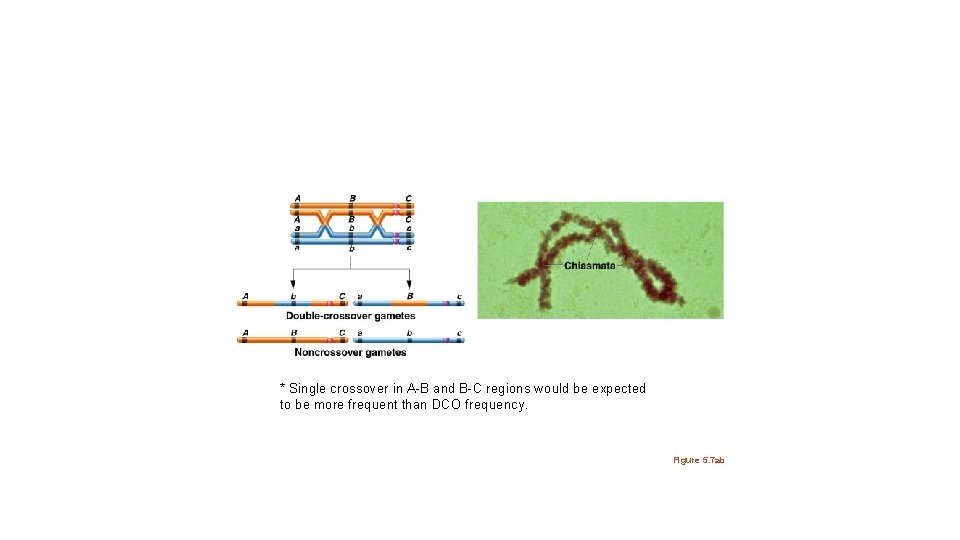
* Single crossover in A-B and B-C regions would be expected to be more frequent than DCO frequency. Figure 5. 7 ab
• Knowing DCO occur much more rarely than SCO allows us to determine gene order in a multi-point cross. • Start with 3 -point cross…
3 basic requirements for successful 3 -point mapping • Organism doing the X. O/ recombination must be heterozygous for all loci under consideration
• Cross design must allow for direct observation of crossing over in gametes as a phenotype in offspring. • Usually the mate contributes only recessive alleles.
• Sufficient numbers of offspring must be examined to recover a representative sample of all crossover classes.

Knowing the design of the cross, 3 types of offspring should be evident. • Non-crossover (NCO). Offspring derived from gametes in which no crossover occurred in the interval of interest. • Single-cross-over (SCO) Offspring derived from gametes in which crossover occurred in one of the 2 intergene regions. **2 different SCO are produced. • Double cross-over (DCO) Offspring derived from gametes in which crossover occurred in both intergene regions of interest.
NCO (parental combinations) will be the most frequent—Although XO happens, it can happen anywhere along the chromosome. Not always in the interval you are analyzing. DCO will be the least frequent SCO 1 SCO 2 will show intermediate frequencies reflecting the intergene distances.
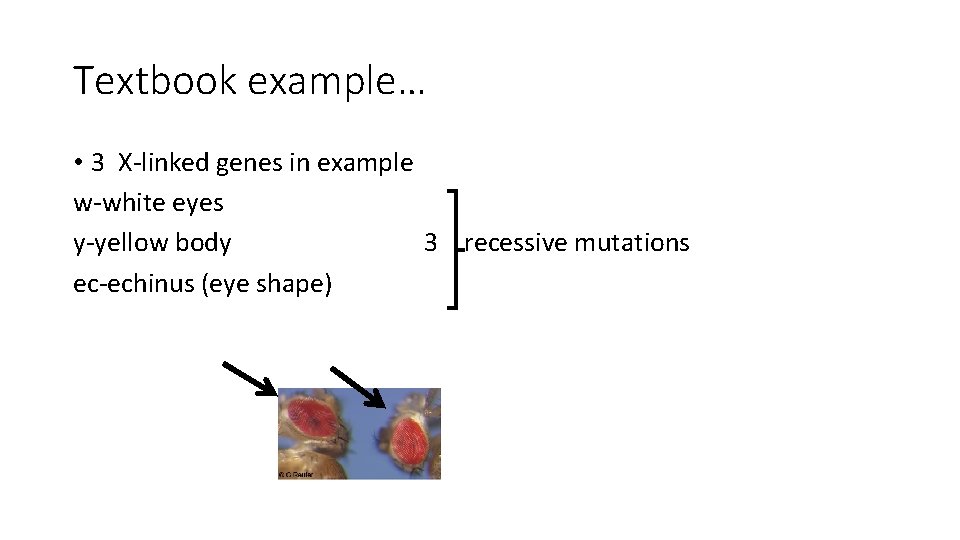
Textbook example… • 3 X-linked genes in example w-white eyes y-yellow body 3 recessive mutations ec-echinus (eye shape)
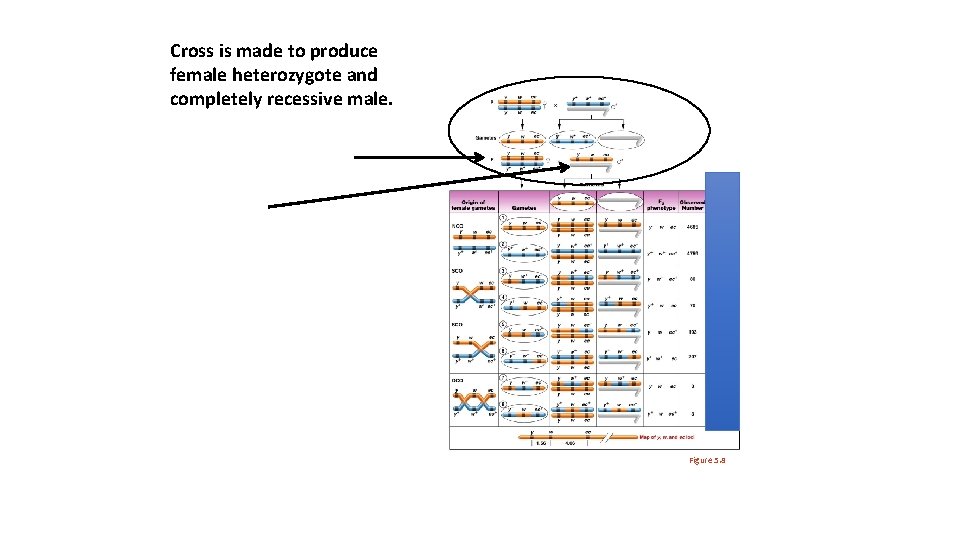
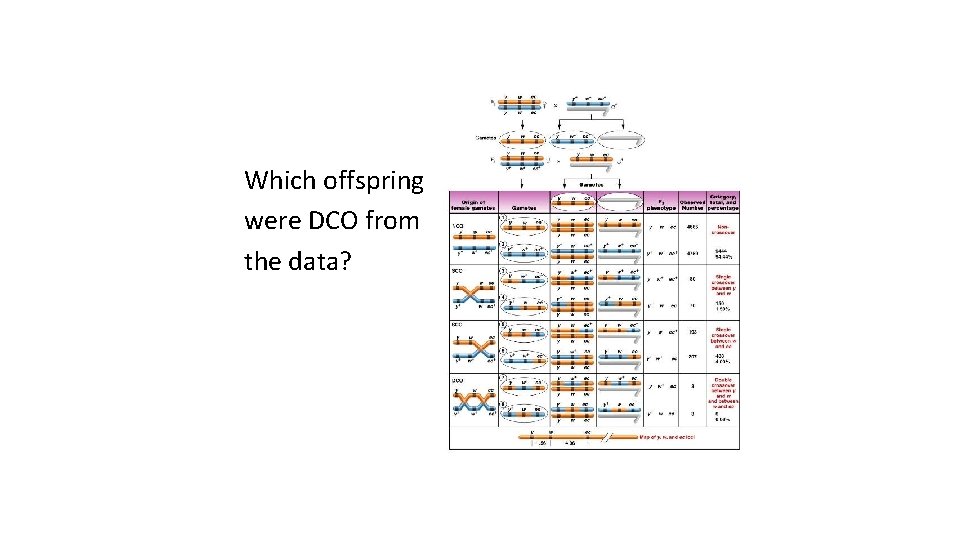
Cross is made to produce female heterozygote and completely recessive male. Figure 5. 8
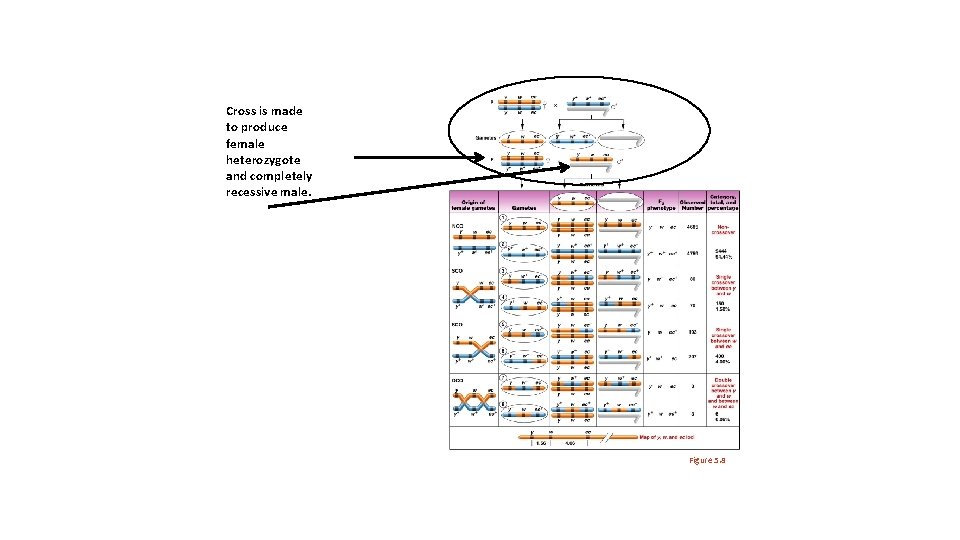
Cross is made to produce female heterozygote and completely recessive male. Figure 5. 8

What are the possible orders for 3 genes? • y-ec-w (w-ec-y) • y-w-ec (ec-w-y) • w-y-ec (ec-y-w)
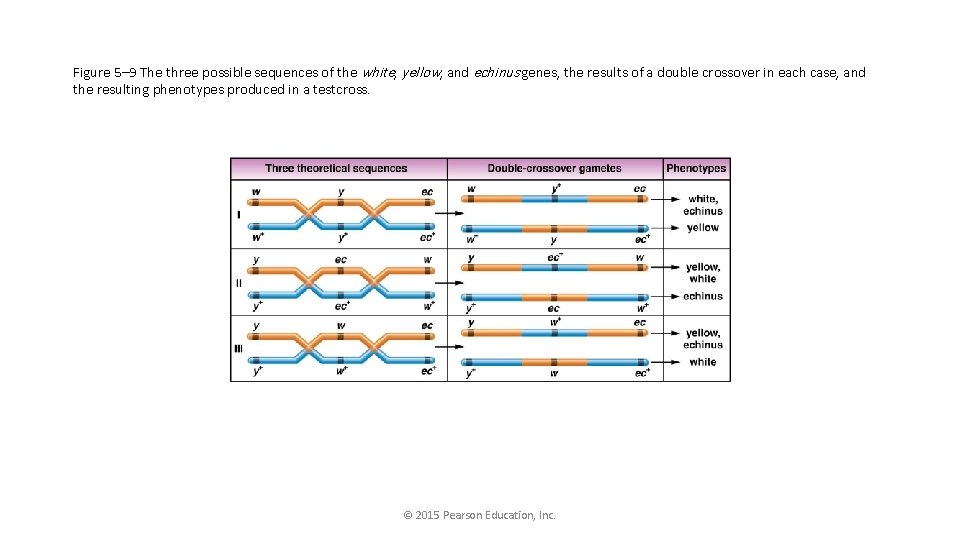
Figure 5– 9 The three possible sequences of the white, yellow, and echinus genes, the results of a double crossover in each case, and the resulting phenotypes produced in a testcross. © 2015 Pearson Education, Inc.
• Go back to the table, and identify how the genes would change to make DCO. • Play with the orders to turn NCO to DCO. • The order should be revealed.
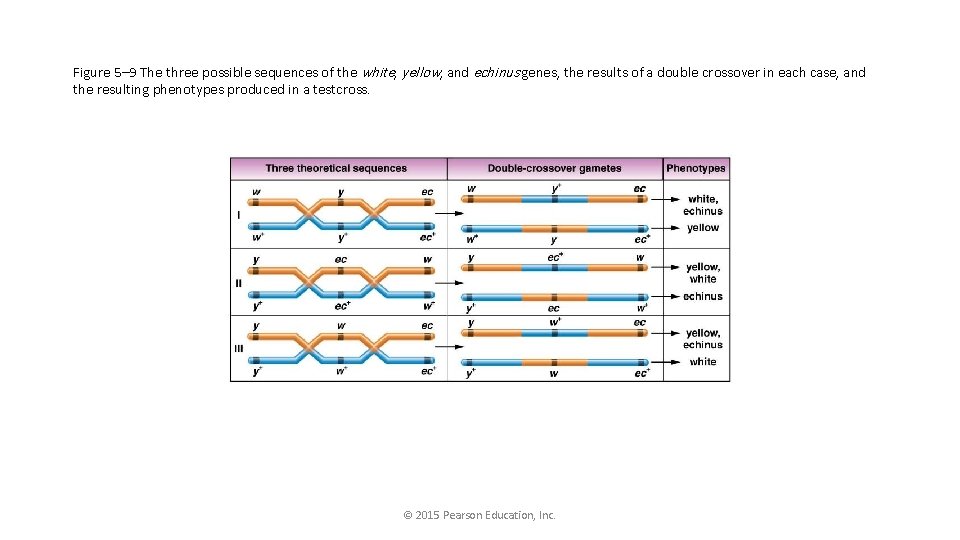
Figure 5– 9 The three possible sequences of the white, yellow, and echinus genes, the results of a double crossover in each case, and the resulting phenotypes produced in a testcross. © 2015 Pearson Education, Inc.
Which offspring were DCO from the data?
• Your data shows DCO are consistent with w in the middle. • Reorder your data to identify the 2 different SCO categories….
Determining the distances… • Distance is determined as before…using recombination frequency. • Recombination is sum of SCO (for that interval) and DCO, since DCO occur in both intervals.
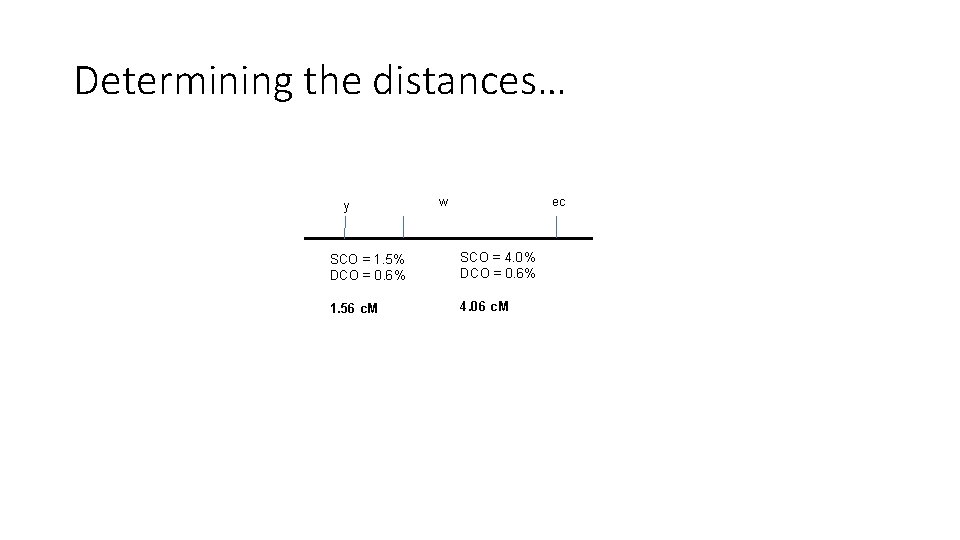
Determining the distances… y w ec SCO = 1. 5% DCO = 0. 6% SCO = 4. 0% DCO = 0. 6% 1. 56 c. M 4. 06 c. M
• Now sketch the cross (cross A) that we have set up with our flies and review how we will be able to map the X-linked genes, y, m, and w.
- Slides: 34