
GENETICS INHERITANCE Questions to keep in mind What
- Slides: 8
GENETICS & INHERITANCE Questions to keep in mind: • What is the difference between sexual and asexual reproduction? • What are genes? • Why do offspring resemble both their parents? • How can dark haired parents have a red-haired child?
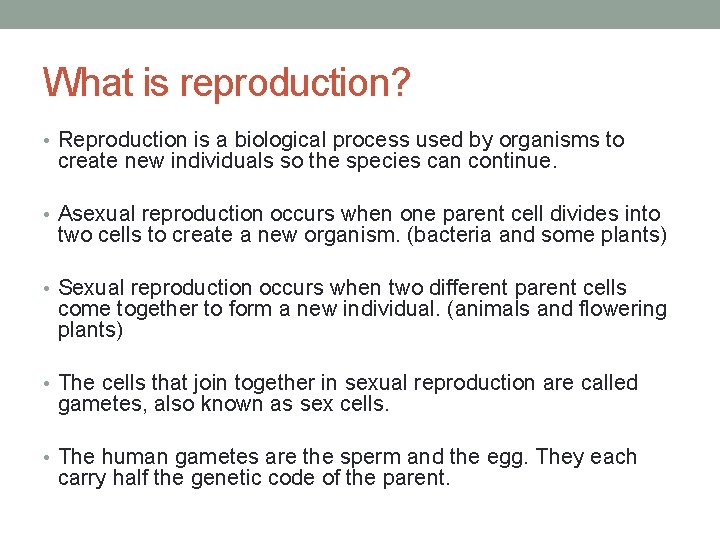
What is reproduction? • Reproduction is a biological process used by organisms to create new individuals so the species can continue. • Asexual reproduction occurs when one parent cell divides into two cells to create a new organism. (bacteria and some plants) • Sexual reproduction occurs when two different parent cells come together to form a new individual. (animals and flowering plants) • The cells that join together in sexual reproduction are called gametes, also known as sex cells. • The human gametes are the sperm and the egg. They each carry half the genetic code of the parent.
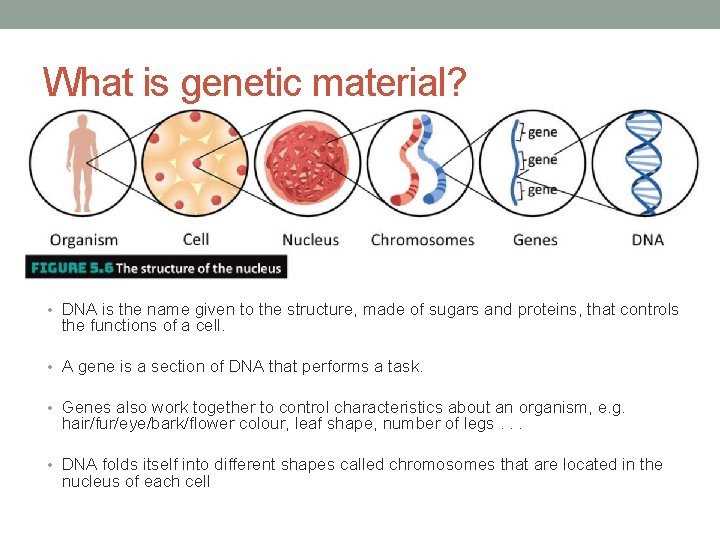
What is genetic material? • DNA is the name given to the structure, made of sugars and proteins, that controls the functions of a cell. • A gene is a section of DNA that performs a task. • Genes also work together to control characteristics about an organism, e. g. hair/fur/eye/bark/flower colour, leaf shape, number of legs. . . • DNA folds itself into different shapes called chromosomes that are located in the nucleus of each cell
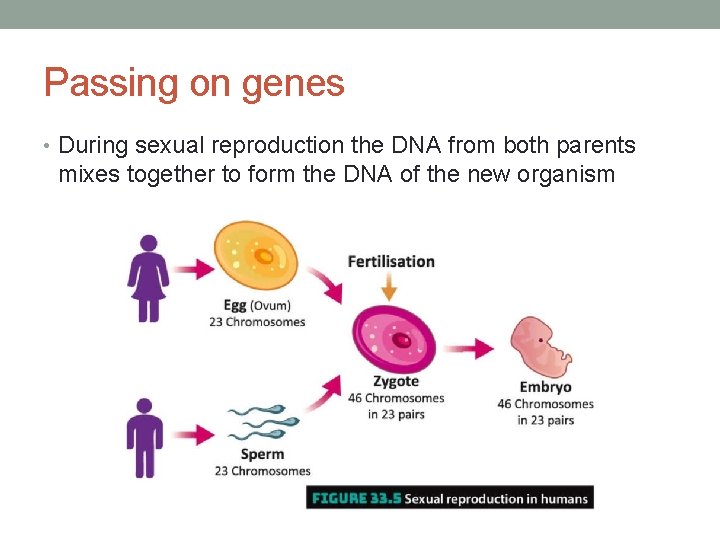
Passing on genes • During sexual reproduction the DNA from both parents mixes together to form the DNA of the new organism
Which to gene choose? • When the DNA mixes, there will be two of each gene, one from each parent. • Depending on the gene, sometimes both can work together or sometimes one gene will control everything itself. • We call genes that win out over other genes dominant genes. • Genes that lose out to dominant genes are called recessive genes.
Which to gene choose? • In genetics, dominant genes are given a capital letter and recessive genes are given the same letter but in lower case letter. • For example, dark hair is dominant over red hair. In this case we will call dark hair D and red hair d. • Each parent will itself have inherited two copies of each gene from its parents. As a result a when a sperm/egg is made it will have either one gene or the other. • Remember sex cells only carry half of the genetic code of the parent.
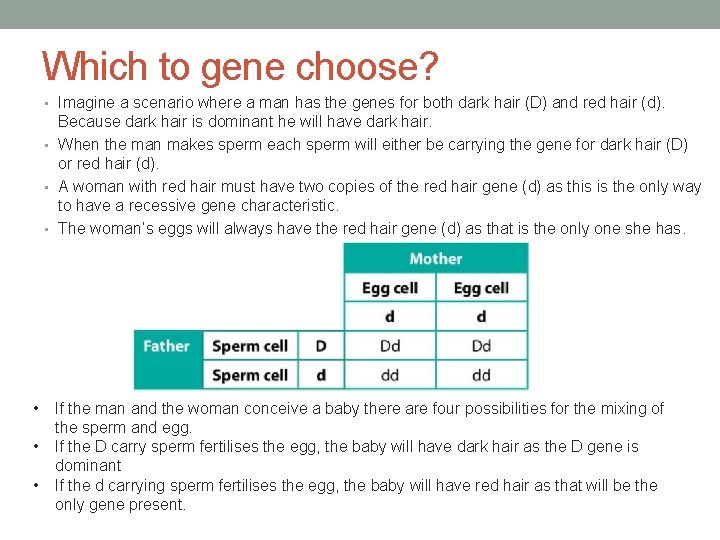
Which to gene choose? • Imagine a scenario where a man has the genes for both dark hair (D) and red hair (d). Because dark hair is dominant he will have dark hair. • When the man makes sperm each sperm will either be carrying the gene for dark hair (D) or red hair (d). • A woman with red hair must have two copies of the red hair gene (d) as this is the only way to have a recessive gene characteristic. • The woman’s eggs will always have the red hair gene (d) as that is the only one she has. • • • If the man and the woman conceive a baby there are four possibilities for the mixing of the sperm and egg. If the D carry sperm fertilises the egg, the baby will have dark hair as the D gene is dominant If the d carrying sperm fertilises the egg, the baby will have red hair as that will be the only gene present.
Inheritance • The way genes get passed onto offspring explains why offspring usually have characteristics of both parents. It depends on which genes are dominant/recessive. • It also explains how characteristics, such as red hair, can skip a generation. It is possible, and very common, to carry recessive genes that then get passed onto offspring. Get Thinking How does this process of passing on genes lead to natural selection and evolution?