
Genetics Genotypes Phenotype Punnett Genetics Diagrams Mendel s









- Slides: 42
Genetics
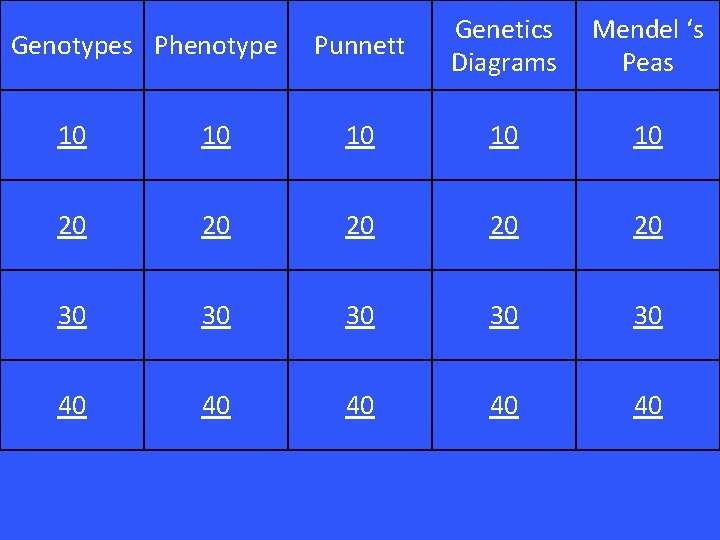
Genotypes Phenotype Punnett Genetics Diagrams Mendel ‘s Peas 10 10 10 20 20 20 30 30 30 40 40 40
Question 1 - 10 What is the name for the combination of alleles that an organism inherits from its parents? • Answer 1 – 10
Answer 1 – 10 • Genotype
Question 1 - 20 • If you have 2 dominant alleles for a particular trait, what are the words that describe that genotype? • Answer 1 – 20
Answer 1 – 20 • Homozygous dominant
Question 1 - 30 • The allele for the dominant freckles trait is F. If you have no freckles, what is your genotype? • Answer 1 – 30
Answer 1 – 30 • Homozygous recessive or ff.
Question 1 - 40 • What genotype means that you got a dominant allele from one parent and a recessive allele from the other parent? • Answer 1 – 40
Answer 1 – 40 • Heterozygous
Question 2 - 10 • Having a straight thumb is a recessive trait, represented by h. If someone has a straight thumb, what is their genotype? • Answer 2 - 10
Answer 2 – 10 • hh
Question 2 - 20 • What does an organism need only one of, in order to express a dominant phenotype? • Question 2 - 20
Answer 2 – 20 • A dominant allele
Question 2 - 30 • In what kind of inheritance will a red flower and a white flower produce seeds that will grow into pink-flowered plants? • Answer 2 – 20
Answer 2 – 30 • Incomplete (incomplete = in between)
Question 2 - 40 • In what kind of inheritance does the offspring show phenotypes of both parents? • Question 2 - 40
Answer 2 – 40 • Codominance (co = they both show)
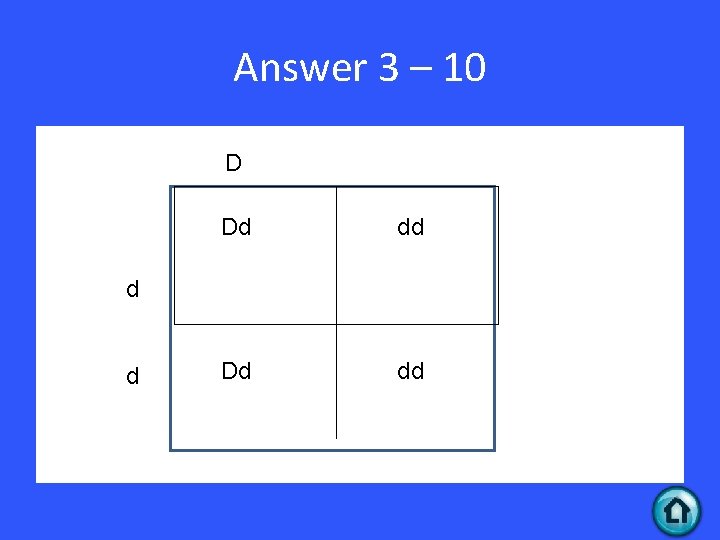
Question 3 - 10 Draw a Punnett square in which one parent is heterozygous for the dominant trait Dimples and the other parent is homozygous recessive. Fill in the Punnett square with the possible genotypes of the offspring. • Answer 3 – 10
Answer 3 – 10 » D D Dd dd d d
Question 3 - 20 • In a genetic cross of 2 homozygous dominant parents, what is the probability that the offspring will have the recessive phenotype? • Answer 3 – 20
Answer 3 – 20 • 0%
Question 3 - 30 • In a genetic cross of homozygous dominant parent with a homozygous recessive parent, what is the probability that the offspring will have the dominant phenotype? • Answer 3 – 30
Answer 3 – 30 • 100%
Question 3 - 40 • A genetic cross between 2 parents shows that the offspring have a 50% chance of being able to taste PTC. If they have 4 children, how many children will be able to taste PTC? • Answer 3 – 40
Answer 3 – 40 • There’s no way to know. Each child has a 50/50 chance of being a taster or non-taster.
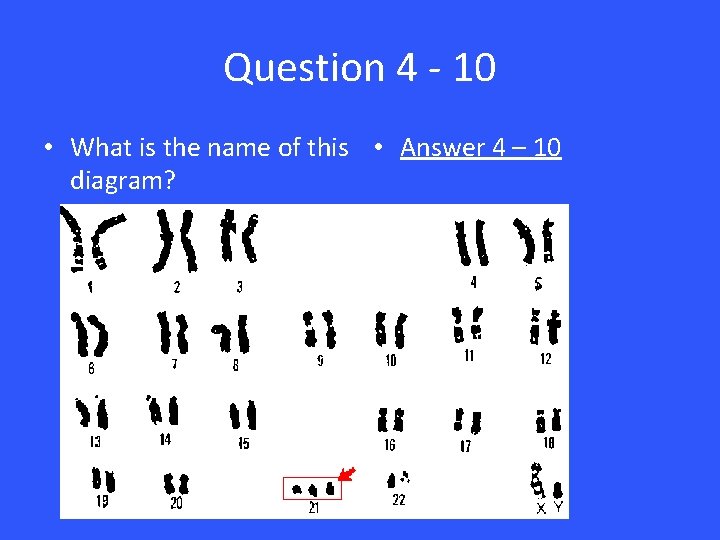
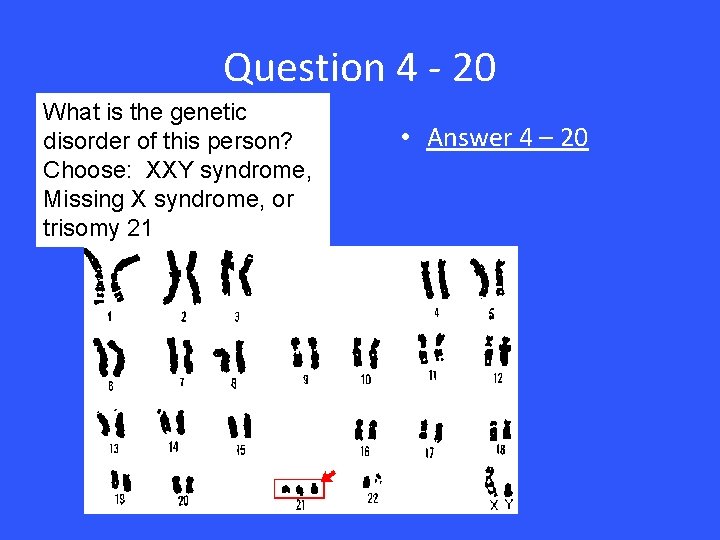
Question 4 - 10 • What is the name of this • Answer 4 – 10 diagram?
Answer 4 – 10 • Karyotype
Question 4 - 20 What is the genetic disorder of this person? Choose: XXY syndrome, Missing X syndrome, or trisomy 21 • Answer 4 – 20
Answer 4 – 20 Trisomy 21
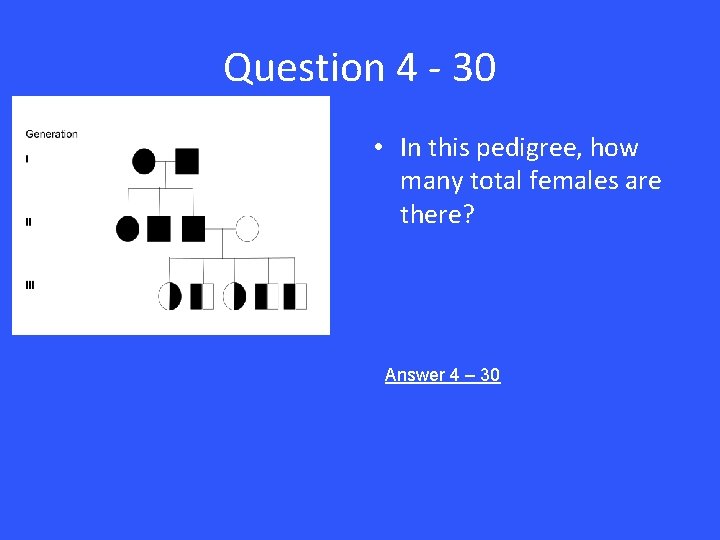
Question 4 - 30 • In this pedigree, how many total females are there? Answer 4 – 30
Answer 4 – 30 • 5
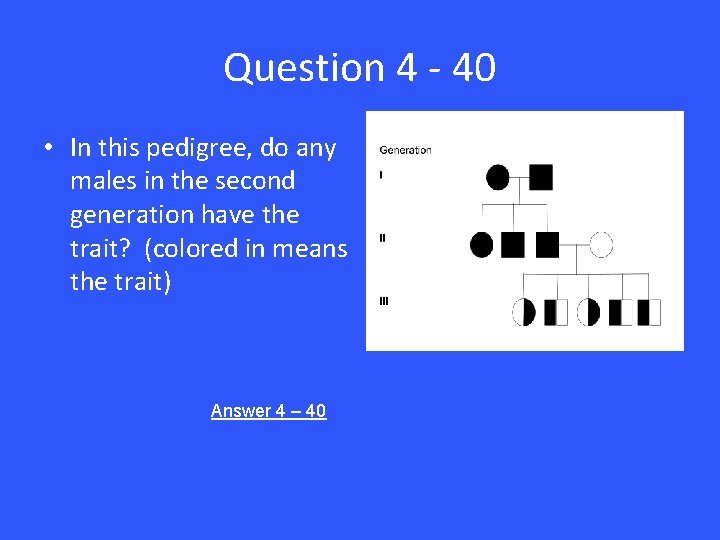
Question 4 - 40 • In this pedigree, do any males in the second generation have the trait? (colored in means the trait) Answer 4 – 40
Answer 4 – 40 • Yes.
Question 5 -10 • What did Mendel find out about recessive traits, when he crossed a purebred dominant pea with a purebred recessive pea? • Answer 5 -10
Answer 5 -10 • The recessive traits seemed to disappear • Home
Questions 5 -20 • Are all human traits Mendelian? • Answer 5 -20
Answer 5 – 20 • No.
Question 5 -30 • Mendel discovered that some traits would always be expressed, even if only one of the 2 alleles was present in the offspring. What do we call these alleles today? • Answer 5 -30
Answer 5 – 30 Dominant
Question 5 -40 • Mendel discovered that some traits, such as white flowers, would not be expressed in the offspring, even if the allele for that trait was present. What do we call those traits today? • Answer 5 -40
Answer 5 – 40 Recessive