
GENETICS Genetics INTRODUCTION TO is a branch of
GENETICS Genetics INTRODUCTION TO is a branch of biology devoted to the study of genes and heredity. The science of genetics has mada great advance in the recent past. The foundation for modern day genetics was laid down by Gregor Mendel. The science that deals with the mechanism responsible for inheritance similarities and differences in a species is called genetics. It is abranch of biology that encompasses the study of the , mechanism of transmission of characters from parent to offsprings. The word genetics derived from the greek word genesis
NUCLEIC ACIDS Nucleic acid are the chemical basis of life and heredity. They serve as transmitters of genetic information. Nucleic acids are colourless, complex, amorphous compound made up of nitrogenous bases, sugar and phosphoric acid. The nucleic acids are of two types ; They are Ribonucleic acid and deoxyribonucleic acid. As the name implies their location is mainly the nucleus. It is also present in other intraceiiular organelles such as mitochondria and chloroplast. RNA is also seen in nucleus, ribosomes and cytoplasm.
structural components of nucleic acids Deoxyribose is a Pentose sugar with five carbon atoms four of the five carbon atom plus a single atom of oxygen from a five –membered ring. The fifth carbon atom is outside the ring and forms a part of a –CH 2 group. The four atoms of the ring are numbered 1’ 2’, 3’and 4’. The carbon atom of –CH 2 is numbered 5’. There are three –OH groups in positions 1’, 3’and 5’. Hydrogen atoms are attached to carbon atoms 1’, 2’, 3’and 4’.
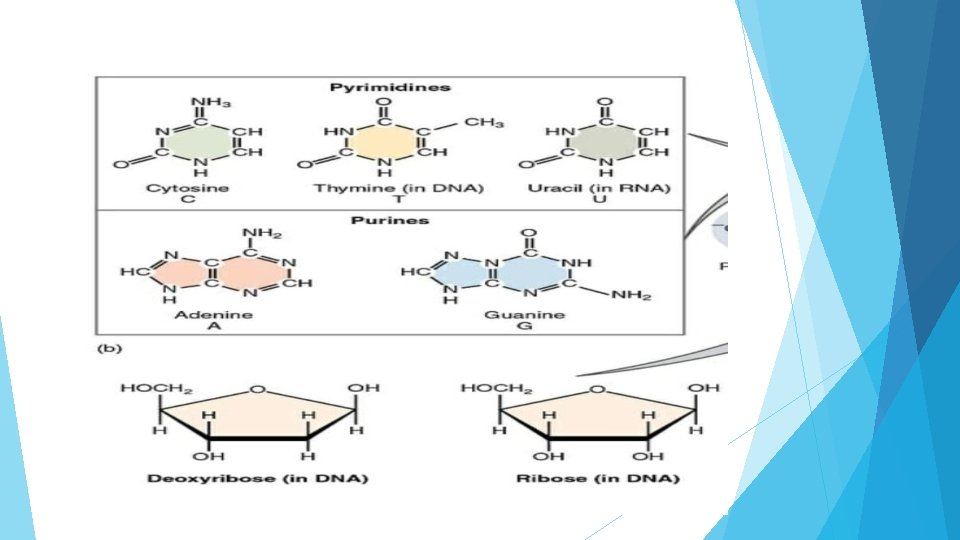
Ribose, the Pentose sugar of RNA, Has an identical structure except that there is an –OH group instead of H on carbon atom 2’. All the sugars in one strand are directed to one end. The sugars of the two strands are directed in opposite directions. Nitrogenous bases There are two types of nitrogenous bases, pyrimidine s and purines. The pyrimidine s are single ring compounds With nitrogen in position 1’and 3’ of a 6 membered benzene ring. The two most common pyrimidines of DNA are cytosine and thymine.
The purine are double ring compounds. A purinemolecule consists of a 5 -membered imidazole ring joined to a pyrimidine ring at odition 4’and 5’. The two most common purines of DNA are adenine (A) and guanine to (G).
Phosphate In the DNA strand the phosphate groups alternate with deoxyribose. Each phosphate group is joined to carbon atom 3’ of one deoxyribose and to carbon atom 5’ of another. Thus each strand has 3’ end And a 5’ of another. Thus each strand has a 3’ end a 5’end. The two strands are oriented in opposite directions. The 3’end of one strand correspond to the 5’ end of the other. Consequently the oxygen atoms of deoxyribose point in opposite directions in the two strands.
Nucleosides and nucleotides A sugar molecule and a nitrogenous base form a nucleoside and a nucleoside plus a phosphate group form a nucleotide. The nucleotides of RNA are called ribonucleotides and those of DNA deoxyribonucleotides. Ribonucleotides contain the sugar ribose, and deoxyribonucleotides the sugar deoxyribose.
Deoxyribo Nucleic Acid DNA It is the heredity material. is found in all cells except few viruses. DNA present mainly in the chromosomes.
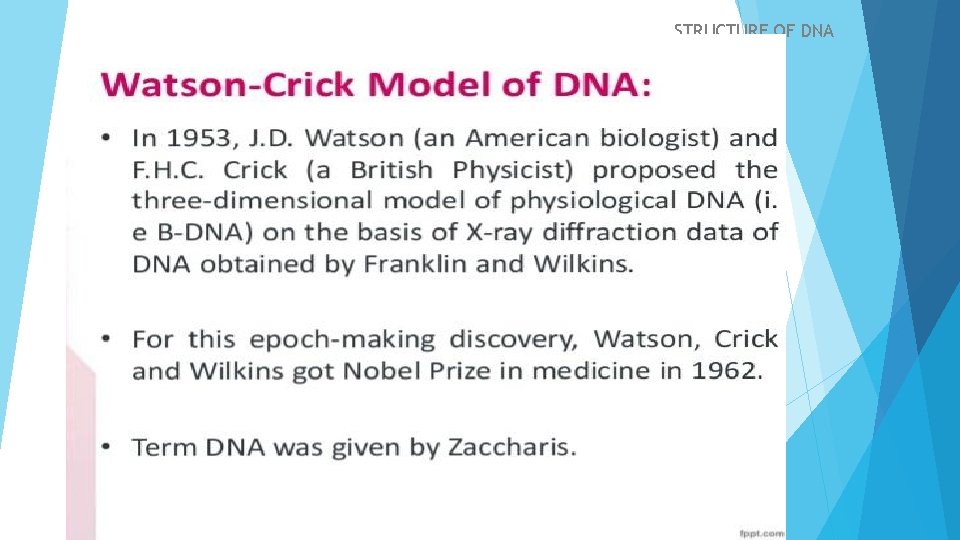
STRUCTURE OF DNA

THA NK YOU
- Slides: 19