
Genetics and Heredity Genetics Vocabulary 1 dominant trait
Genetics and Heredity
Genetics Vocabulary 1) dominant trait 2) recessive trait 3) heredity 4) allele 5) gene 6) genotype 7) phenotype 8) probability 9) sexual reproduction 10. Punnett squares 11. offspring 12. zygote 13. homozygous(purebred) 14. heterozygous(hybrid)
Objective � SWBAT describe the structure of DNA. Essential Question What is DNA and what does the DNA structure look like? https: //www. youtube. com/watch? v=V 9 BZ 3 zx 8 b 8 I
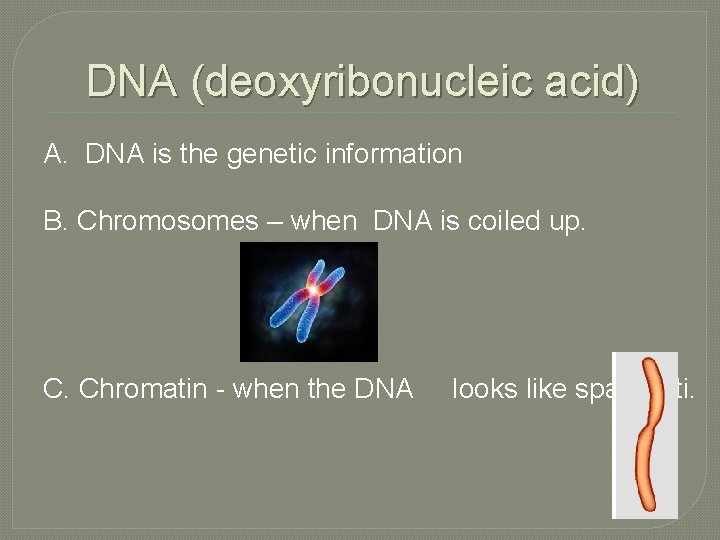
DNA (deoxyribonucleic acid) A. DNA is the genetic information B. Chromosomes – when DNA is coiled up. C. Chromatin - when the DNA looks like spaghetti.
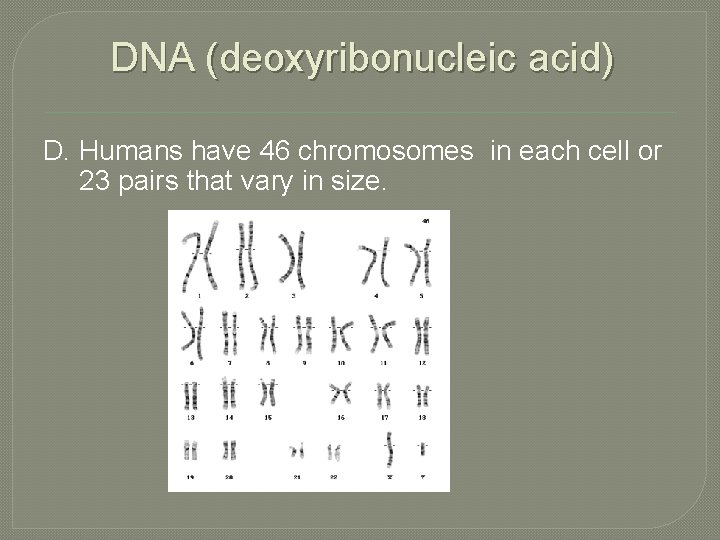
DNA (deoxyribonucleic acid) D. Humans have 46 chromosomes in each cell or 23 pairs that vary in size.
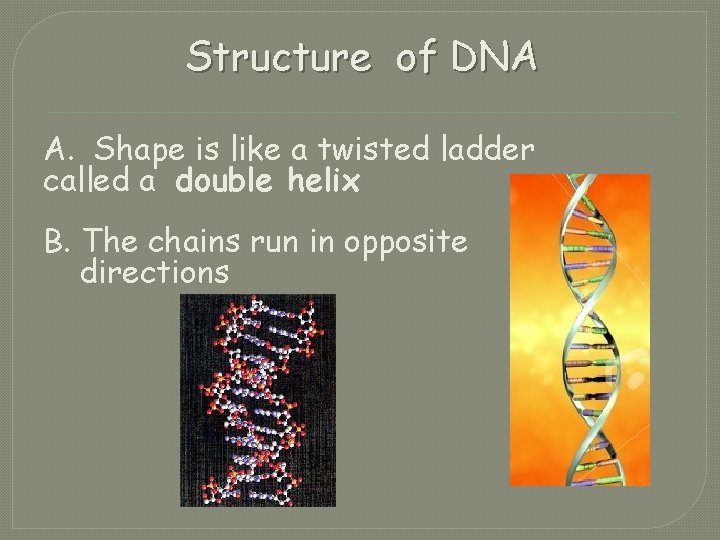
Structure of DNA A. Shape is like a twisted ladder called a double helix B. The chains run in opposite directions
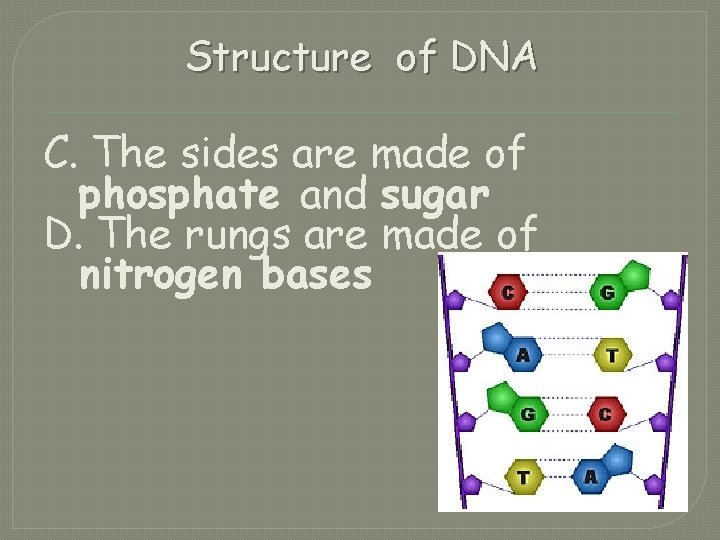
Structure of DNA C. The sides are made of phosphate and sugar D. The rungs are made of nitrogen bases
Think Pair Share The shape of DNA can be described as _____________. The sides of the DNA are made up of ______________, whereas, the ______ are made of __________.
DNA Summary DNA is ____________ made up of _________. It can be described as a ________. The _____ are made up of _______ whereas, the ______ are made up of _____.
Genetics Standard 2 d: Students know plant and animal cells contain many thousands of different genes and typically have two copies of every gene. The two copies (or alleles) of the gene may or may not be identical, and one may be dominant in determining the phenotype while the other is recessive
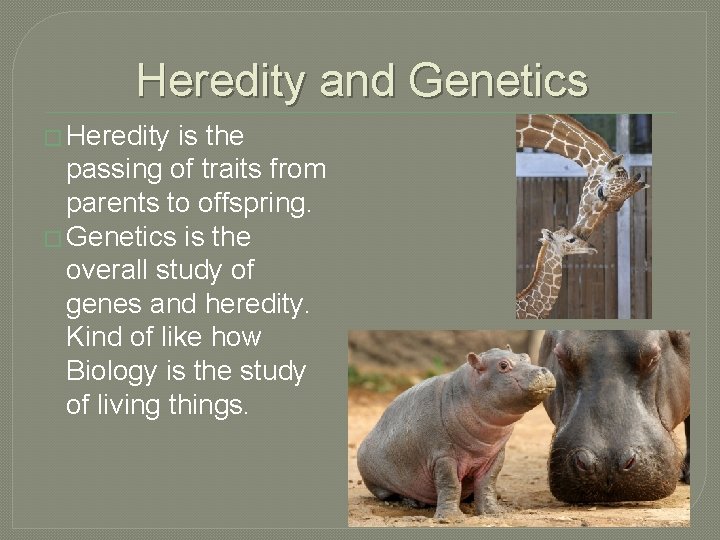
Heredity and Genetics � Heredity is the passing of traits from parents to offspring. � Genetics is the overall study of genes and heredity. Kind of like how Biology is the study of living things.
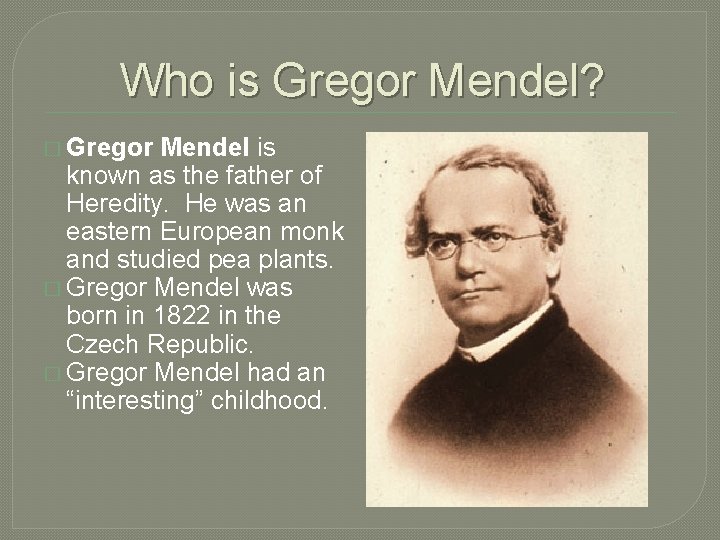
Who is Gregor Mendel? � Gregor Mendel is known as the father of Heredity. He was an eastern European monk and studied pea plants. � Gregor Mendel was born in 1822 in the Czech Republic. � Gregor Mendel had an “interesting” childhood.
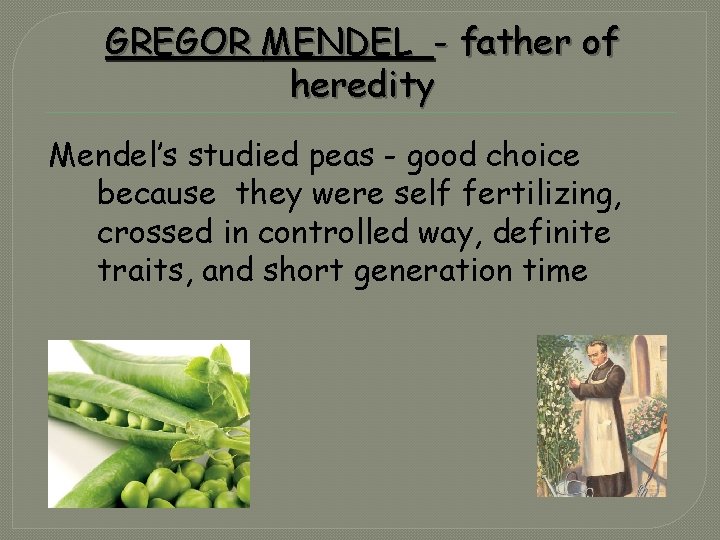
GREGOR MENDEL - father of heredity Mendel’s studied peas - good choice because they were self fertilizing, crossed in controlled way, definite traits, and short generation time
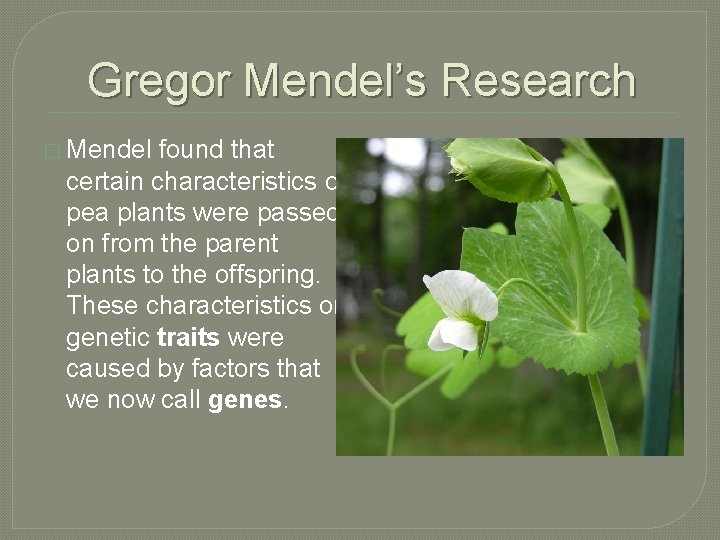
Gregor Mendel’s Research � Mendel found that certain characteristics of pea plants were passed on from the parent plants to the offspring. These characteristics or genetic traits were caused by factors that we now call genes.
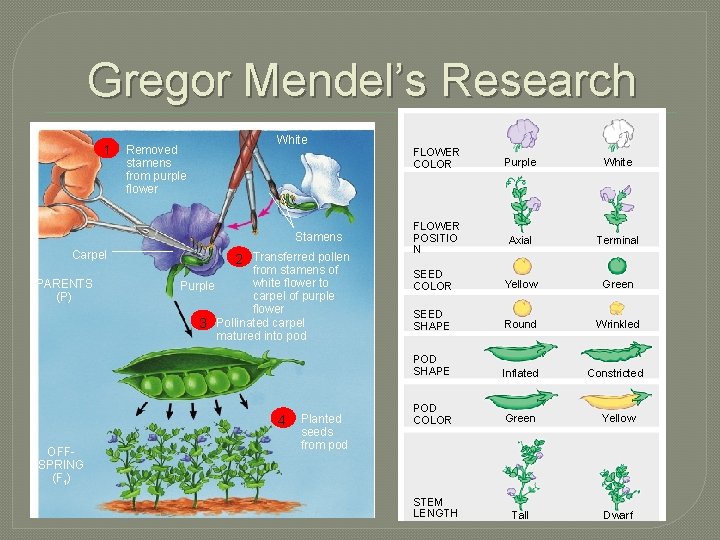
Gregor Mendel’s Research 1 Removed stamens from purple flower White Stamens Carpel PARENTS (P) 2 Transferred pollen from stamens of white flower to Purple carpel of purple flower 3 Pollinated carpel matured into pod 4 OFFSPRING (F 1) Planted seeds from pod FLOWER COLOR Purple White FLOWER POSITIO N Axial Terminal SEED COLOR Yellow Green SEED SHAPE Round Wrinkled POD SHAPE Inflated Constricted POD COLOR Green Yellow STEM LENGTH Tall Dwarf
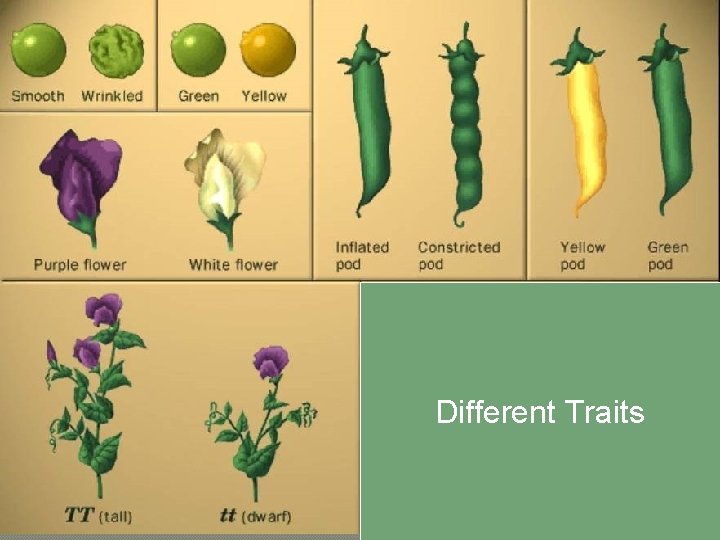
Different Traits
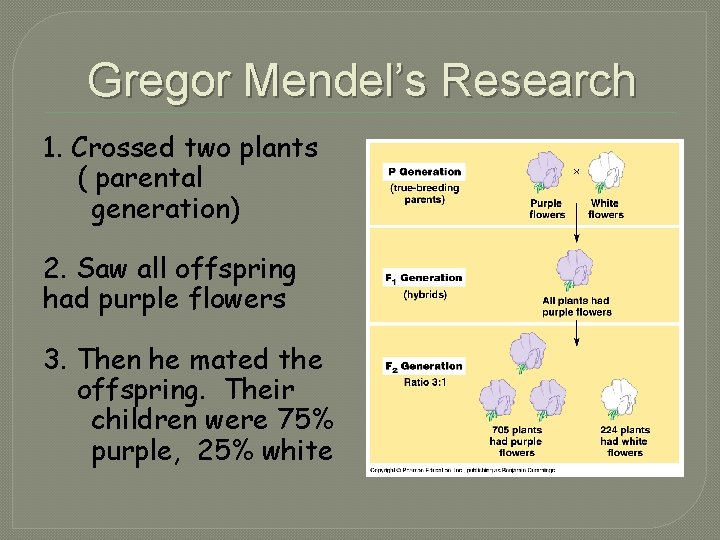
Gregor Mendel’s Research 1. Crossed two plants ( parental generation) 2. Saw all offspring had purple flowers 3. Then he mated the offspring. Their children were 75% purple, 25% white
Traits and Genes � Traits are simply characteristics that an organism has. Gregor Mendel experimented with observable traits or characteristics. � Each trait can be is controlled by at least two genes. Traits can be dominant or recessive depending upon the genes that make them up.
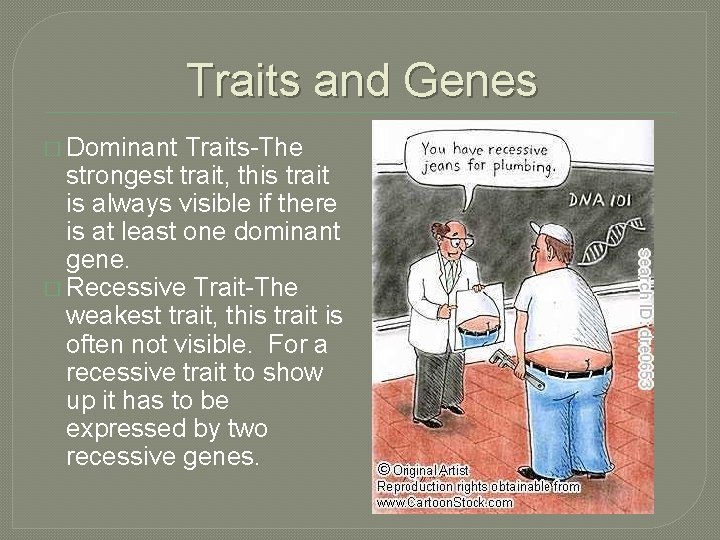
Traits and Genes � Dominant Traits-The strongest trait, this trait is always visible if there is at least one dominant gene. � Recessive Trait-The weakest trait, this trait is often not visible. For a recessive trait to show up it has to be expressed by two recessive genes.
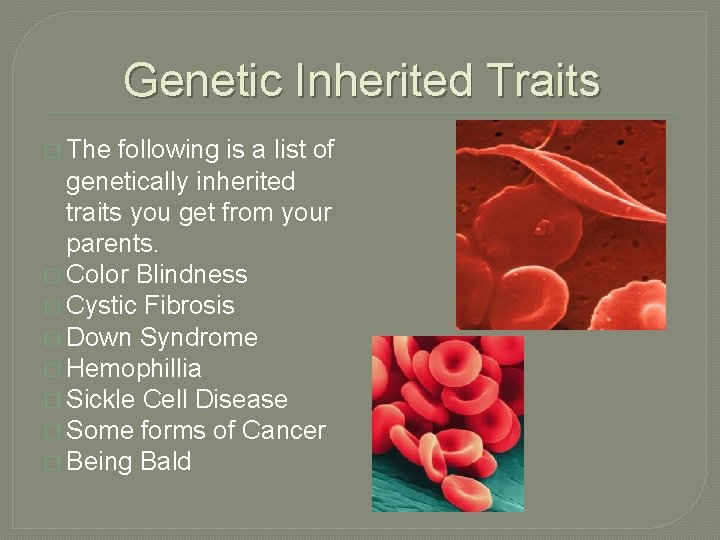
Genetic Inherited Traits � The following is a list of genetically inherited traits you get from your parents. � Color Blindness � Cystic Fibrosis � Down Syndrome � Hemophillia � Sickle Cell Disease � Some forms of Cancer � Being Bald
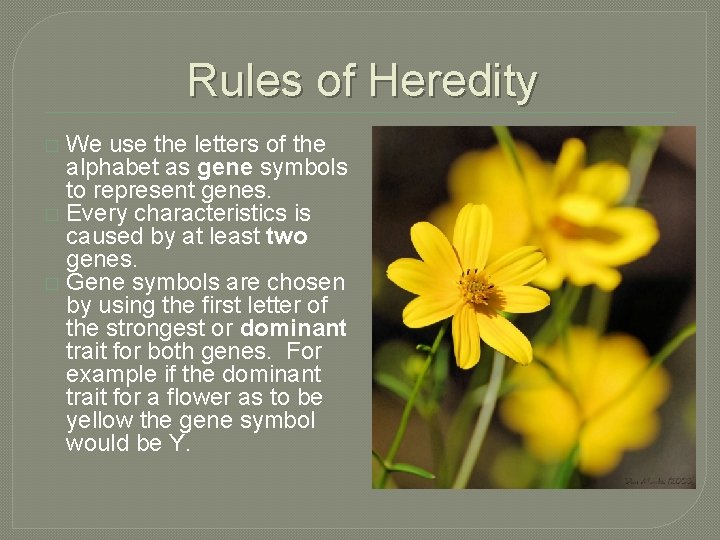
Rules of Heredity We use the letters of the alphabet as gene symbols to represent genes. � Every characteristics is caused by at least two genes. � Gene symbols are chosen by using the first letter of the strongest or dominant trait for both genes. For example if the dominant trait for a flower as to be yellow the gene symbol would be Y. �
Rules of Heredity �A capital letter is used for the strong trait (gene) and a lower cased letter is used for the weak trait. � A strong trait is called dominant and a weak one is called recessive.
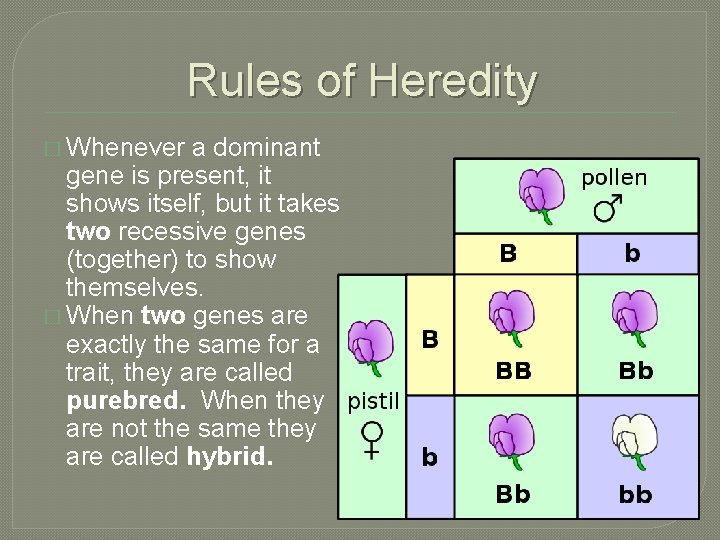
Rules of Heredity � Whenever a dominant gene is present, it shows itself, but it takes two recessive genes (together) to show themselves. � When two genes are exactly the same for a trait, they are called purebred. When they are not the same they are called hybrid.
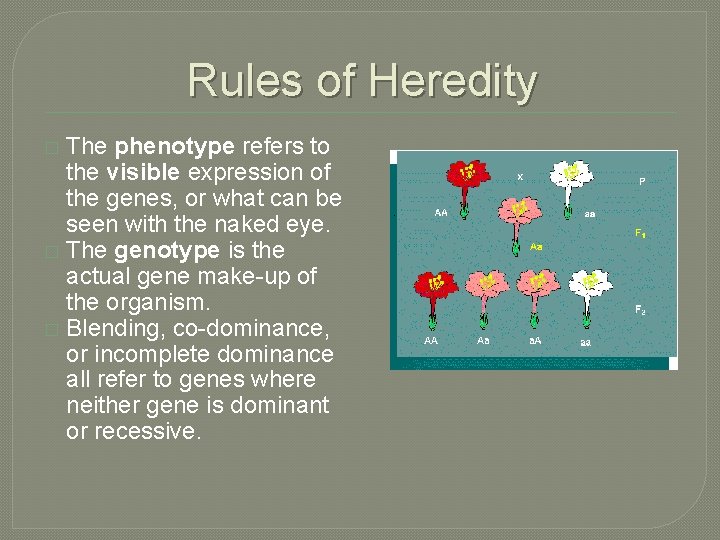
Rules of Heredity The phenotype refers to the visible expression of the genes, or what can be seen with the naked eye. � The genotype is the actual gene make-up of the organism. � Blending, co-dominance, or incomplete dominance all refer to genes where neither gene is dominant or recessive. �
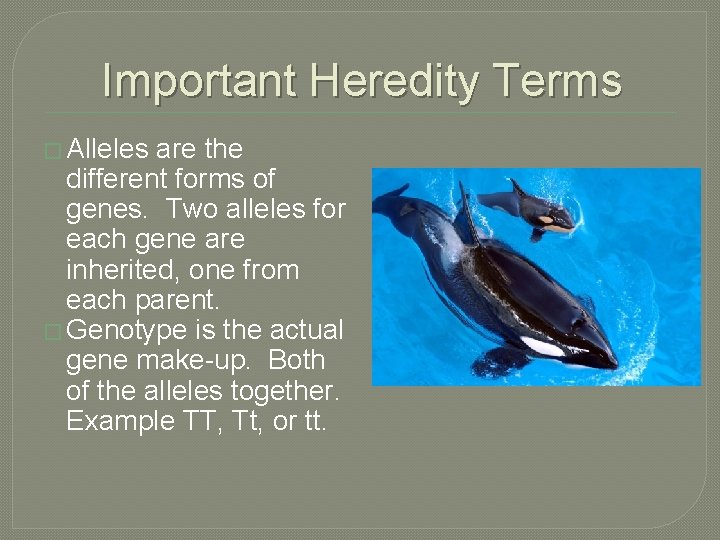
Important Heredity Terms � Alleles are the different forms of genes. Two alleles for each gene are inherited, one from each parent. � Genotype is the actual gene make-up. Both of the alleles together. Example TT, Tt, or tt.
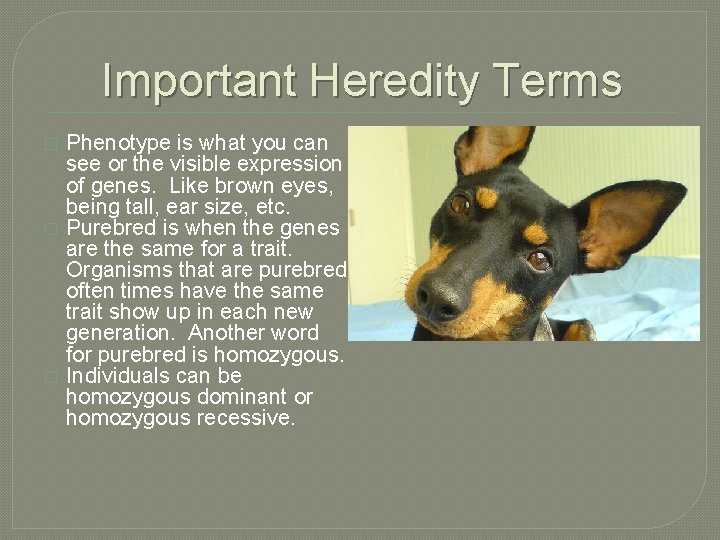
Important Heredity Terms � � � Phenotype is what you can see or the visible expression of genes. Like brown eyes, being tall, ear size, etc. Purebred is when the genes are the same for a trait. Organisms that are purebred often times have the same trait show up in each new generation. Another word for purebred is homozygous. Individuals can be homozygous dominant or homozygous recessive.
Important Heredity Terms Hybrid is when genes are mixed. This is when individuals have on dominant and one recessive gene. The dominant gene or trait expresses itself and shows up. Another term for hybrid is heterozygous. � Probability is the mathematical chance that something will happen. �
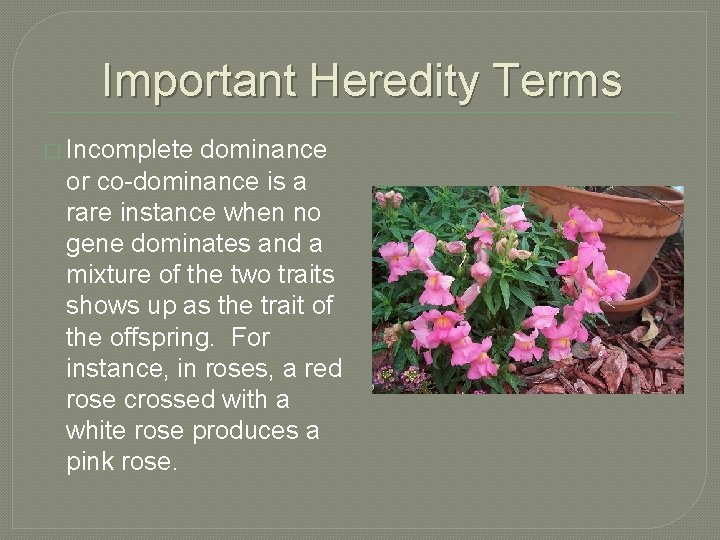
Important Heredity Terms � Incomplete dominance or co-dominance is a rare instance when no gene dominates and a mixture of the two traits shows up as the trait of the offspring. For instance, in roses, a red rose crossed with a white rose produces a pink rose.
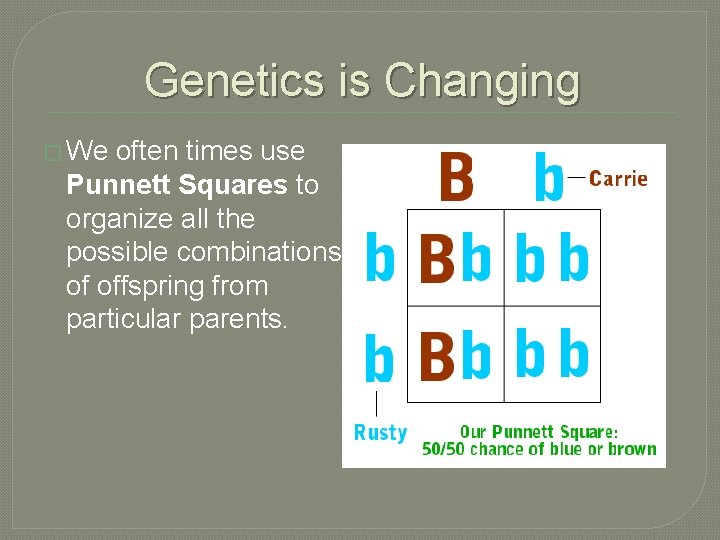
Genetics is Changing � We often times use Punnett Squares to organize all the possible combinations of offspring from particular parents.
Using Punnett Squares In flowers yellow is dominant over white. A white homozygous recessive flower is crossed with a yellow homozygous flower. � What are the genotypes and phenotype probabilities for this hybrid x purebred cross? � Let’s start with the basics………… �
Cracking the Code of Life � PBS Video � 1. Instructions for a Human Being. � 3. One Wrong Letter
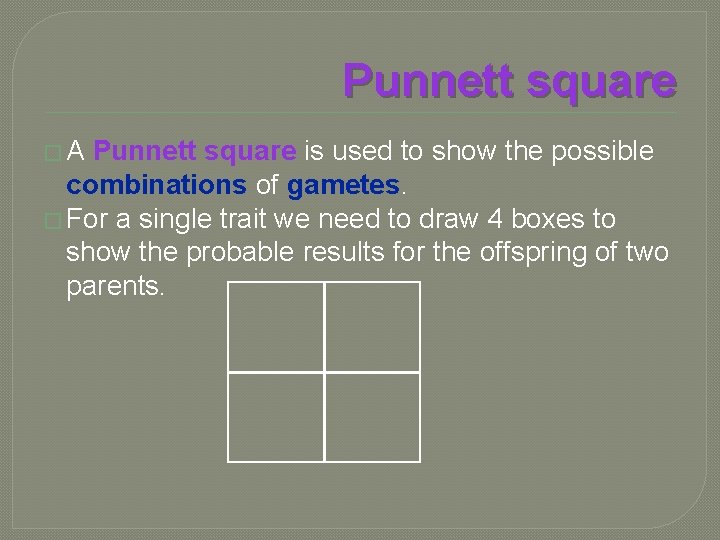
Punnett square �A Punnett square is used to show the possible combinations of gametes. � For a single trait we need to draw 4 boxes to show the probable results for the offspring of two parents.
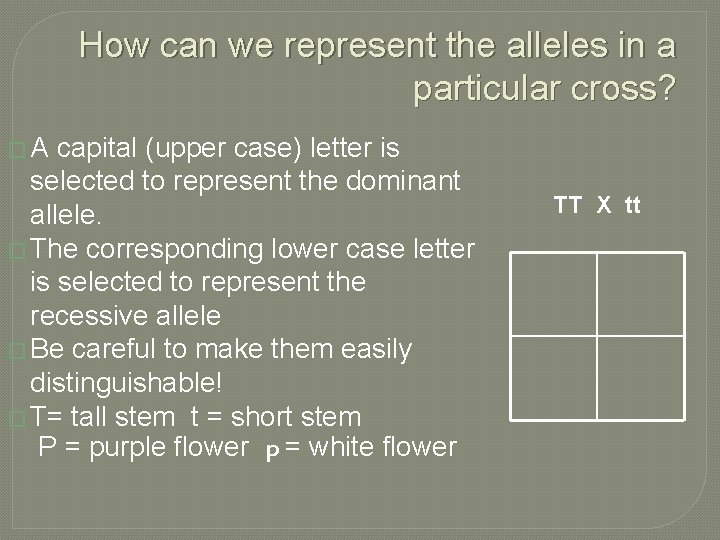
How can we represent the alleles in a particular cross? �A capital (upper case) letter is selected to represent the dominant allele. � The corresponding lower case letter is selected to represent the recessive allele � Be careful to make them easily distinguishable! � T= tall stem t = short stem P = purple flower p = white flower TT X tt
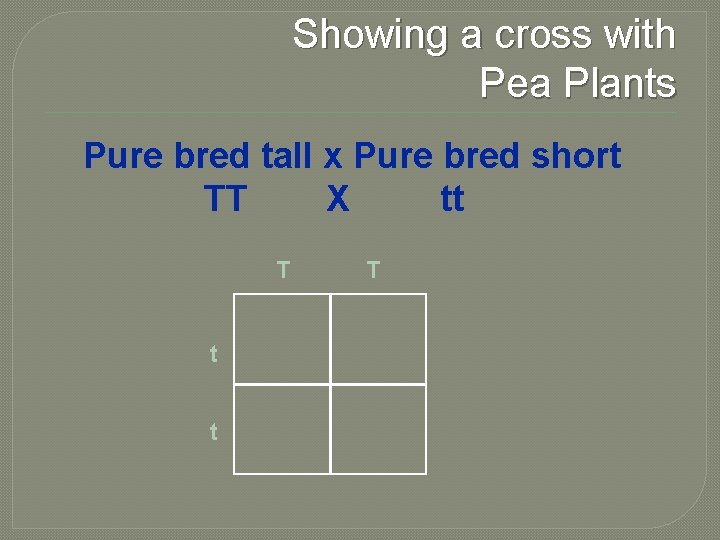
Showing a cross with Pea Plants Pure bred tall x Pure bred short TT X tt T t t T
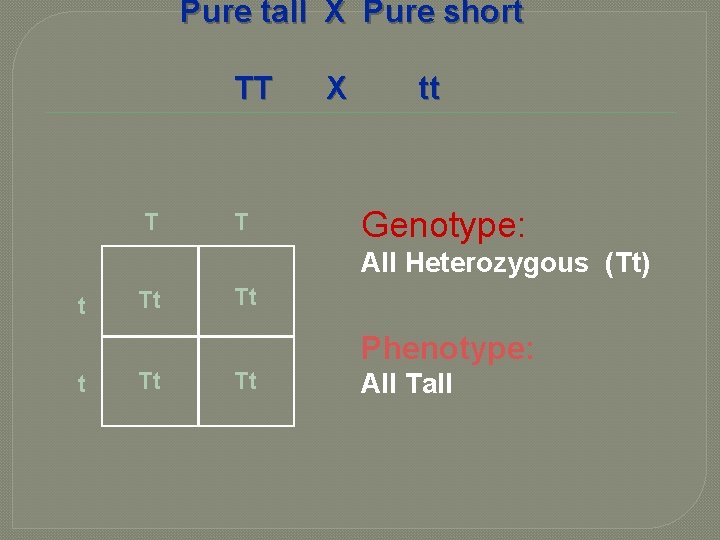
Pure tall X Pure short TT T T X tt Genotype: All Heterozygous (Tt) t Tt Tt Phenotype: t Tt Tt All Tall
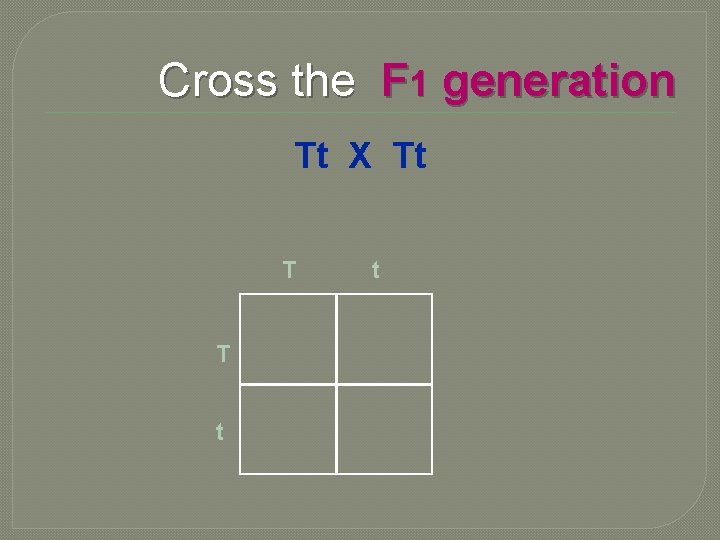
Cross the F 1 generation Tt X Tt T T t t
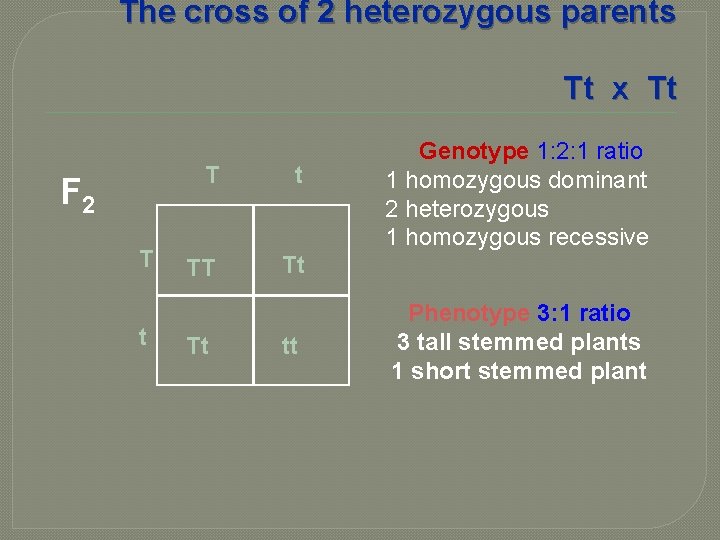
The cross of 2 heterozygous parents Tt x Tt F 2 T t TT Tt Tt tt Genotype 1: 2: 1 ratio 1 homozygous dominant 2 heterozygous 1 homozygous recessive Phenotype 3: 1 ratio 3 tall stemmed plants 1 short stemmed plant
Wait a minute! More terms � Phenotype : The appearance of the organism. The expression of the genotype � Genotype: the genetic makeup of the organism. � If I have a purple pea flower the phenotype is purple flower. What are the possible genotypes? � Since purple is dominant it could be PP or Pp! � What if the flower is white? � It has to be pp because white is recessive!
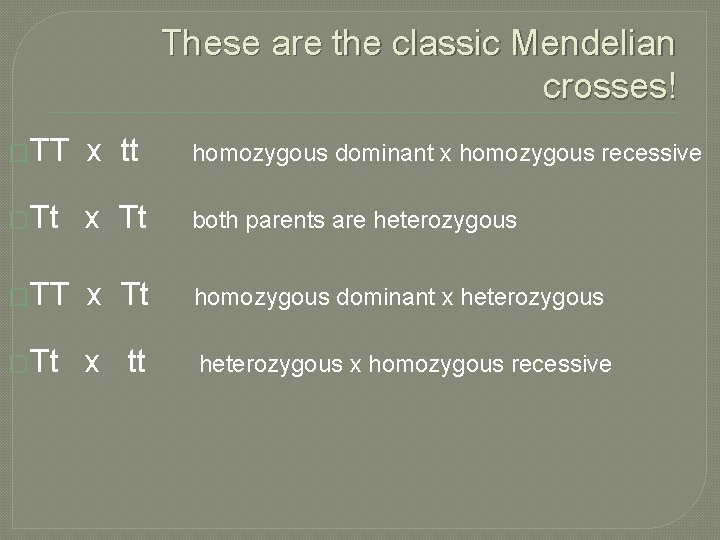
These are the classic Mendelian crosses! �TT x tt homozygous dominant x homozygous recessive �Tt x Tt both parents are heterozygous �TT x Tt homozygous dominant x heterozygous �Tt x tt heterozygous x homozygous recessive
See if you can figure these out! �A heterozygous purple flowered plant with a white flowered plant �A black Labrador Retriever with a yellow Labrador Retriever where black is dominant and the black Lab had a yellow mom.
- Slides: 40