
Genetics and Genomics DNA and RNA Thomas D
- Slides: 13
Genetics and Genomics DNA and RNA Thomas D Dayspring, MD, FACP, FNLA Director of Cardiovascular Education The Foundation for Health Improvement and Technology Richmond, VA 4
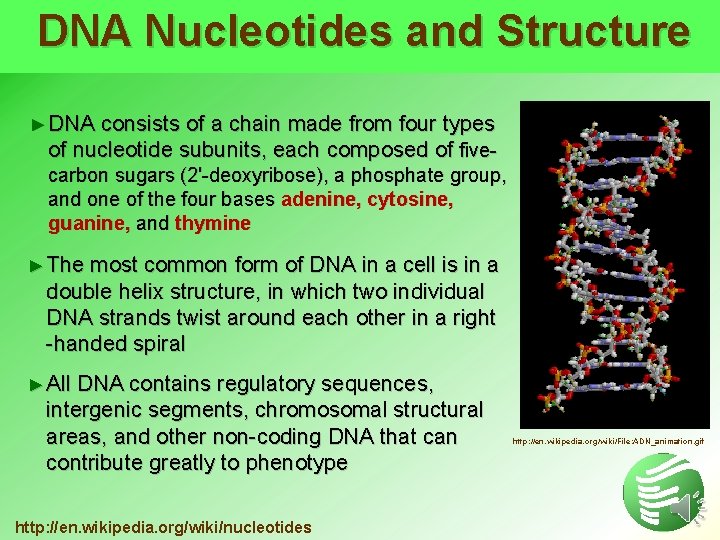
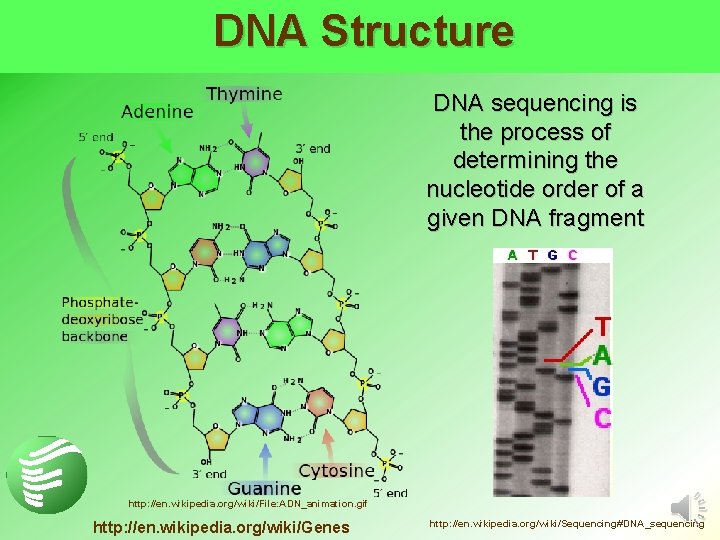
DNA Nucleotides and Structure ► DNA consists of a chain made from four types of nucleotide subunits, each composed of fivecarbon sugars (2'-deoxyribose), a phosphate group, and one of the four bases adenine, cytosine, guanine, and thymine ► The most common form of DNA in a cell is in a double helix structure, in which two individual DNA strands twist around each other in a right -handed spiral ► All DNA contains regulatory sequences, intergenic segments, chromosomal structural areas, and other non-coding DNA that can contribute greatly to phenotype http: //en. wikipedia. org/wiki/nucleotides http: //en. wikipedia. org/wiki/File: ADN_animation. gif
Nucleotides ►Nucleotides are molecules that, when joined together, make up the structural units of RNA and DNA ►In addition, nucleotides play central roles in metabolism. In that capacity, they: ► Serve as sources of chemical energy (adenosine triphosphate and guanosine triphosphate) ► Participate in cellular signaling (cyclic guanosine monophosphate and cyclic adenosine monophosphate) ► Are incorporated into important cofactors of enzymatic reactions (coenzyme A, flavin adenine dinucleotide, flavin mononucleotide and nicotinamide adenine dinucleotide phosphate) http: //en. wikipedia. org/wiki/nucleotides
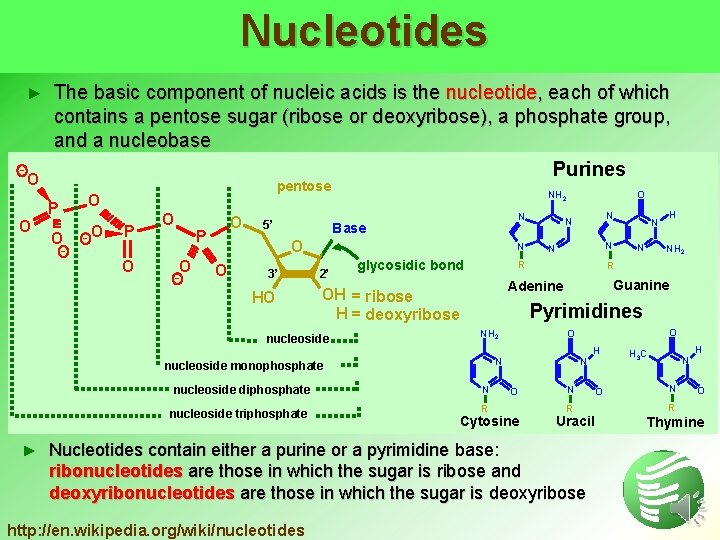
Nucleotides ► Nucleic acids are polymeric macromolecules made from nucleotide monomers: In DNA, the purine bases are adenine and guanine, while the pyrimidines are thymine and cytosine: RNA uses uracil in place of thymine ►A nucleotide is composed of a nucleobase (nitrogenous base), a five-carbon sugar (either ribose or 2’-deoxyribose), and one to three phosphate groups ►Together, the nucleobase and sugar comprise a nucleoside ►The phosphate groups form bonds with either the 2, 3, or 5 -carbon of the sugar, with the 5 -carbon site most common ►Cyclic nucleotides form when the phosphate group is bound to two of the sugar's hydroxyl groups ► Ribonucleotides are nucleotides where the sugar is ribose whereas deoxyribonucleotides contain the sugar deoxyribose: nucleotides can contain either a purine or pyrimidine base http: //en. wikipedia. org/wiki/nucleotides
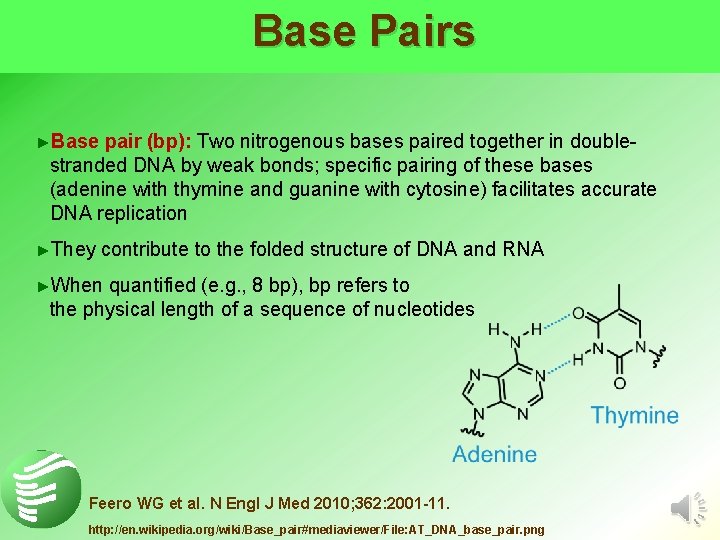
Base Pairs ►Base pair (bp): Two nitrogenous bases paired together in doublestranded DNA by weak bonds; specific pairing of these bases (adenine with thymine and guanine with cytosine) facilitates accurate DNA replication ►They contribute to the folded structure of DNA and RNA ►When quantified (e. g. , 8 bp), bp refers to the physical length of a sequence of nucleotides Feero WG et al. N Engl J Med 2010; 362: 2001 -11. http: //en. wikipedia. org/wiki/Base_pair#mediaviewer/File: AT_DNA_base_pair. png
Nucleotides ► - O The basic component of nucleic acids is the nucleotide, each of which contains a pentose sugar (ribose or deoxyribose), a phosphate group, and a nucleobase Purines O P O pentose O - -O P O O O P O - 5’ NH 2 N Base O O 3’ HO N 2’ glycosidic bond N N N H NH 2 Guanine Pyrimidines N N N nucleoside triphosphate R O O NH 2 nucleoside diphosphate O Cytosine H N R Uracil Nucleotides contain either a purine or a pyrimidine base: ribonucleotides are those in which the sugar is ribose and deoxyribonucleotides are those in which the sugar is deoxyribose http: //en. wikipedia. org/wiki/nucleotides N R Adenine nucleoside monophosphate ► N N R OH = ribose H = deoxyribose nucleoside O O H 3 C N N H O R Thymine
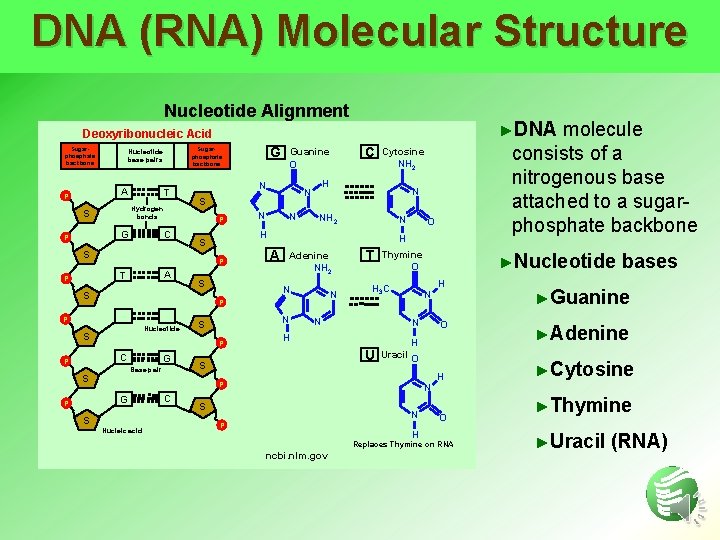
DNA (RNA) Molecular Structure Nucleotide Alignment ►DNA molecule consists of a nitrogenous base attached to a sugarphosphate backbone Deoxyribonucleic Acid Nucleotide base pairs T Hydrogen bonds S G P P C S S A S O N T Thymine O H 3 C N N H Uracil O N P H O N S Nucleic acid C ►Nucleotide N P G S Adenine NH 2 S G Base pair S P A N P C N H N S Nucleotide S P NH 2 P P N H P T P N Cytosine NH 2 H N N C Guanine O N S A P G Sugarphosphate backbone S Sugarphosphate backbone H H O Replaces Thymine on RNA ncbi. nlm. gov bases ►Guanine ►Adenine ►Cytosine ►Thymine ►Uracil (RNA)
DNA Structure DNA sequencing is the process of determining the nucleotide order of a given DNA fragment http: //en. wikipedia. org/wiki/File: ADN_animation. gif http: //en. wikipedia. org/wiki/Genes http: //en. wikipedia. org/wiki/Sequencing#DNA_sequencing
Oligonucleotides ► Oligonucleotides are short, single-stranded DNA or RNA molecules that have a wide range of applications in genetic testing, research, and forensics ► Oligonucleotides are characterized by the sequence of nucleotide residues that comprise the entire molecule the length of which is usually denoted by "-mer" (from Greek meros, "part") ► For example, an oligonucleotide of six nucleotides (nt) is an hexamer, while one of 25 nt would usually be called a “ 25 -mer” ► Oligonucleotides readily bind, in a sequence-specific manner, to their respective complementary oligonucleotides, DNA, or RNA to form duplexes or, less often, hybrids of a higher order http: //en. wikipedia. org/wiki/Oligonucleotide
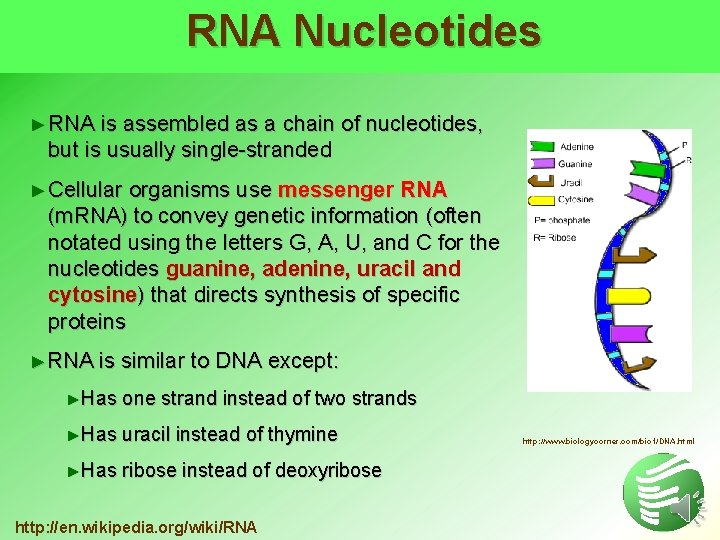
RNA Nucleotides ► RNA is assembled as a chain of nucleotides, but is usually single-stranded ► Cellular organisms use messenger RNA (m. RNA) to convey genetic information (often notated using the letters G, A, U, and C for the nucleotides guanine, adenine, uracil and cytosine) that directs synthesis of specific proteins ►RNA is similar to DNA except: ►Has one strand instead of two strands ►Has uracil instead of thymine ►Has ribose instead of deoxyribose http: //en. wikipedia. org/wiki/RNA http: //www. biologycorner. com/bio 1/DNA. html
Sense / Antisense ► ► Sense is a concept used to compare the polarity of nucleic acid molecules, such as DNA or RNA A single strand of DNA sense is called sense if an RNA version of the same sequence is translated or translatable into protein Its complementary strand is called antisense The two complementary strands of double-stranded DNA are usually differentiated as the "sense" strand the "antisense" strand http: //en. wikipedia. org/wiki/Sense_(molecular_biology)
Sense / Antisense ► ► The DNA sense strand looks like the messenger RNA (m. RNA) and can be used to read the expected protein code by human eyes (e. g. ATG codon = Methionine amino acid) However, the DNA sense strand itself is not used to make protein by the cell but rather it is the DNA antisense strand which serves as the source for the protein code, because, with bases complementary to the DNA sense strand, it is used as a template for the m. RNA Since transcription results in an RNA product complementary to the DNA template strand, the m. RNA is complementary to the DNA antisense strand The m. RNA is what is used for translation (protein synthesis) http: //en. wikipedia. org/wiki/Sense_(molecular_biology)
Thank you for listening FOUNDATION for HEALTH IMPROVEMENT AND TECHNOLOGY