
GENETIC TESTING PATHWAYS MEDULLARY THYROID CANCER SOUTH WEST
- Slides: 2
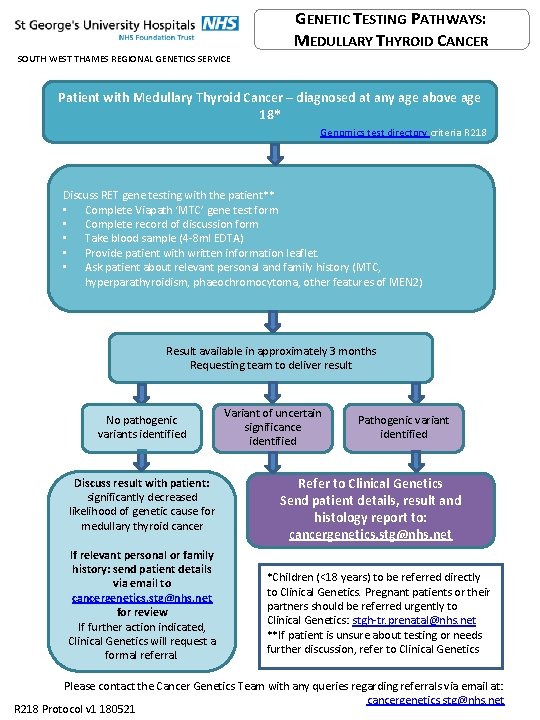
GENETIC TESTING PATHWAYS: MEDULLARY THYROID CANCER SOUTH WEST THAMES REGIONAL GENETICS SERVICE Patient with Medullary Thyroid Cancer – diagnosed at any age above age 18* Genomics test directory criteria R 218 Discuss RET gene testing with the patient** • Complete Viapath ‘MTC’ gene test form • Complete record of discussion form • Take blood sample (4 -8 ml EDTA) • Provide patient with written information leaflet. • Ask patient about relevant personal and family history (MTC, hyperparathyroidism, phaeochromocytoma, other features of MEN 2) Result available in approximately 3 months Requesting team to deliver result No pathogenic variants identified Discuss result with patient: significantly decreased likelihood of genetic cause for medullary thyroid cancer If relevant personal or family history: send patient details via email to cancergenetics. stg@nhs. net for review If further action indicated, Clinical Genetics will request a formal referral. Variant of uncertain significance identified Pathogenic variant identified Refer to Clinical Genetics Send patient details, result and histology report to: cancergenetics. stg@nhs. net *Children (<18 years) to be referred directly to Clinical Genetics. Pregnant patients or their partners should be referred urgently to Clinical Genetics: stgh-tr. prenatal@nhs. net **If patient is unsure about testing or needs further discussion, refer to Clinical Genetics Please contact the Cancer Genetics Team with any queries regarding referrals via email at: cancergenetics. stg@nhs. net R 218 Protocol v 1 180521
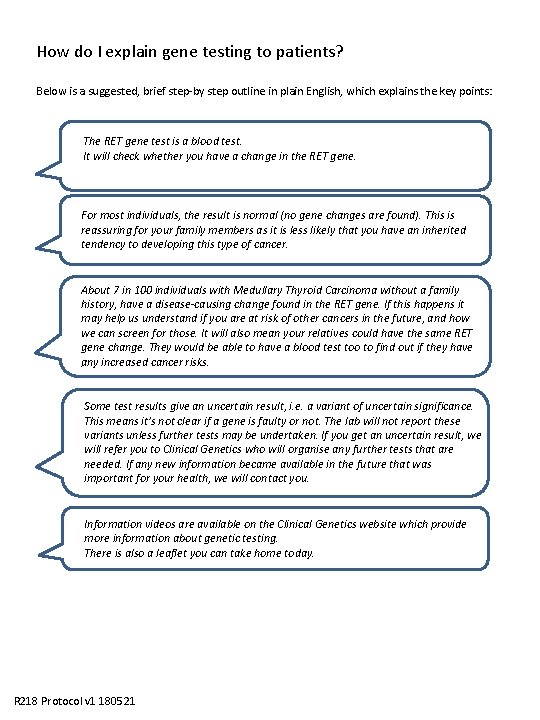
How do I explain gene testing to patients? Below is a suggested, brief step-by step outline in plain English, which explains the key points: The RET gene test is a blood test. It will check whether you have a change in the RET gene. For most individuals, the result is normal (no gene changes are found). This is reassuring for your family members as it is less likely that you have an inherited tendency to developing this type of cancer. About 7 in 100 individuals with Medullary Thyroid Carcinoma without a family history, have a disease-causing change found in the RET gene. If this happens it may help us understand if you are at risk of other cancers in the future, and how we can screen for those. It will also mean your relatives could have the same RET gene change. They would be able to have a blood test too to find out if they have any. increased cancer risks. Some test results give an uncertain result, i. e. a variant of uncertain significance. This means it’s not clear if a gene is faulty or not. The lab will not report these variants unless further tests may be undertaken. If you get an uncertain result, we will refer you to Clinical Genetics who will organise any further tests that are needed. If any new information became available in the future that was important for your health, we will contact you. Information videos are available on the Clinical Genetics website which provide more information about genetic testing. There is also a leaflet you can take home today. R 218 Protocol v 1 180521