
Genetic Syndromes Part 1 Dr Tabrez Associate Professor
Genetic Syndromes Part- 1 Dr. Tabrez Associate Professor Dept. of Anatomy MBBS Batch : 2019 -20 6/7/2020
CLASSIFICATION OF GENETIC DISORDERS A. Disorders of the autosomes: 1) Chromosomal deletion syndromes 2) Trisomy syndromes B. Disorders of sex chromosomes : A. Disorders of the autosomes: 1) Chromosomal deletion syndromes a) Cri-du-chat syndrome b) Wolf Hirschonn Syndrome c) Prader – Willi Syndrome d) Angelmans syndrome e) WAGR Syndrome f) Retinoblastoma g) Digeorge syndrome h) Philadelphia chromosome
a) CRI-DU-CHAT SYNDROME • Introduction : It is derived from a French word means cat’s cry. It occurs in 1 in 50, 000 births. It is more common in females, ratio being 4 : 3. • CAUSE : It is due to deletion of the terminal portion of short arm of chromosome 5 (5 p-). • MANIFESTATION: • Round face • Hypertelorism • Micrognathia
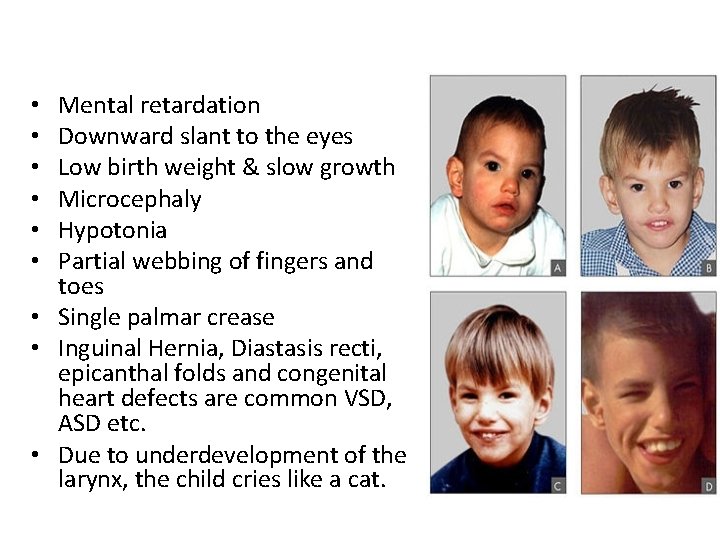
Mental retardation Downward slant to the eyes Low birth weight & slow growth Microcephaly Hypotonia Partial webbing of fingers and toes • Single palmar crease • Inguinal Hernia, Diastasis recti, epicanthal folds and congenital heart defects are common VSD, ASD etc. • Due to underdevelopment of the larynx, the child cries like a cat. • • •
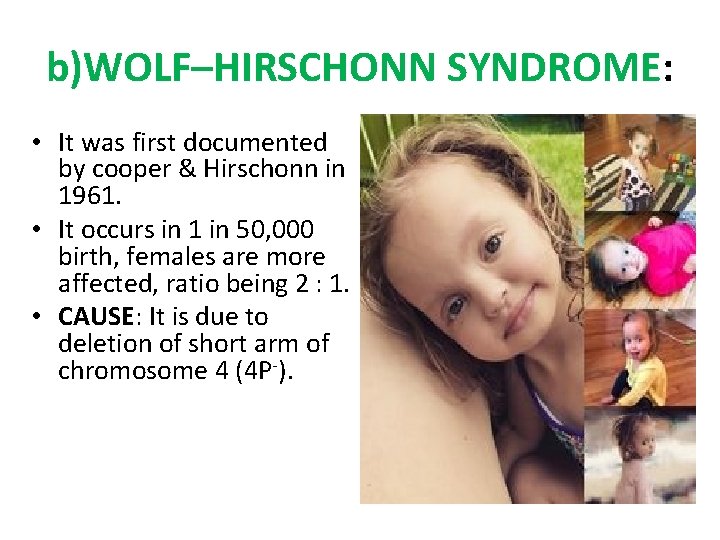
b)WOLF–HIRSCHONN SYNDROME: • It was first documented by cooper & Hirschonn in 1961. • It occurs in 1 in 50, 000 birth, females are more affected, ratio being 2 : 1. • CAUSE: It is due to deletion of short arm of chromosome 4 (4 P-).
• MANIFESTATIONS : a) Growth retardation b) Micrognathia c) Microcephaly with hypoplasia of cerebellum, absence of septum pellucidum, agenesis of Corpus callosum, absence of olfactory bulbs & tracts, hydrocephalus. d) Seizures are common between 5 months to 2 years of age e) Greek Helmet facies – Microcephaly Eyes widely spaced Downturned mouth Bilateral cleft lip Micrognathia
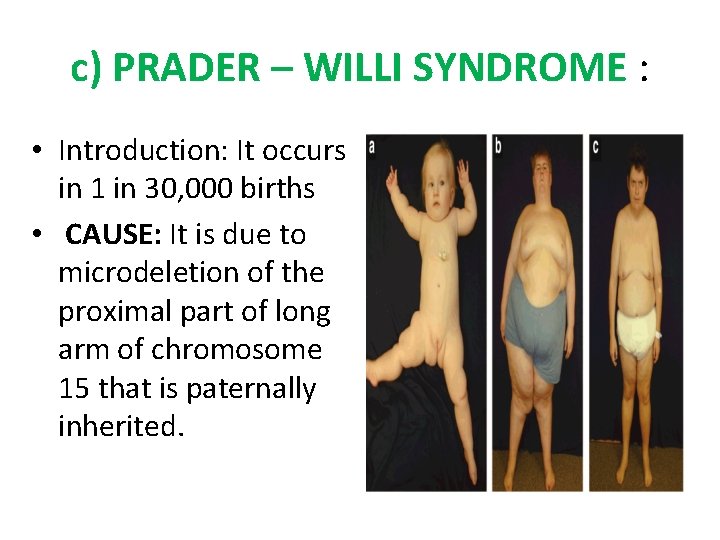
c) PRADER – WILLI SYNDROME : • Introduction: It occurs in 1 in 30, 000 births • CAUSE: It is due to microdeletion of the proximal part of long arm of chromosome 15 that is paternally inherited.
• MANIFESTATIONS: • • Hypotonia Feeding difficulties Poor growth and development Voracious appetite & obesity Type II DM Learning disabilities Temper tantrums Puberty is delayed & males & females are infertile
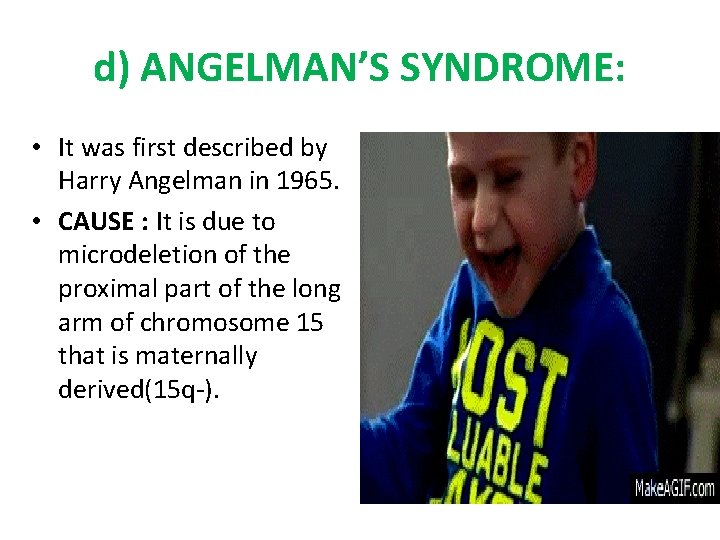
d) ANGELMAN’S SYNDROME: • It was first described by Harry Angelman in 1965. • CAUSE : It is due to microdeletion of the proximal part of the long arm of chromosome 15 that is maternally derived(15 q-).
• MANIFESTATIONS: • • • Mental retardation Ataxia Convulsions Speech impairment Development is delayed Intellectual disability
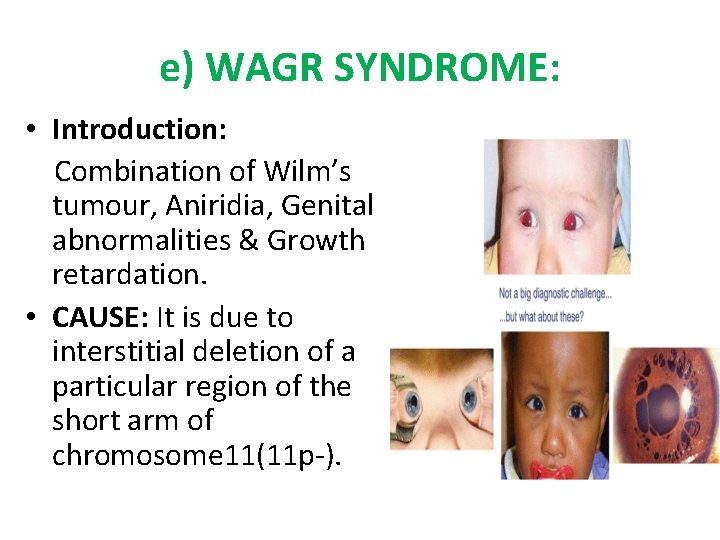
e) WAGR SYNDROME: • Introduction: Combination of Wilm’s tumour, Aniridia, Genital abnormalities & Growth retardation. • CAUSE: It is due to interstitial deletion of a particular region of the short arm of chromosome 11(11 p-).
• MANIFESTATIONS: a) Hypernephroma b) Aniridia - Absence of Iris results in decrease in Visual acuity, glaucoma, cataracts, optic nerve hypoplasia, nystagmus in infants. c) Genito-Urinary abnormalities- Cryptorchidism, hypospadias, renal and ureteral malformations, streak ovaries and bicornuate uterus. d) Growth retardation
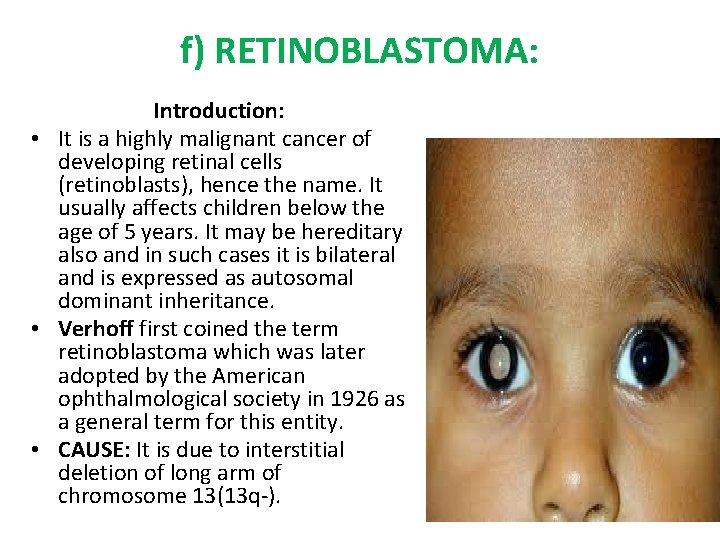
f) RETINOBLASTOMA: Introduction: • It is a highly malignant cancer of developing retinal cells (retinoblasts), hence the name. It usually affects children below the age of 5 years. It may be hereditary also and in such cases it is bilateral and is expressed as autosomal dominant inheritance. • Verhoff first coined the term retinoblastoma which was later adopted by the American ophthalmological society in 1926 as a general term for this entity. • CAUSE: It is due to interstitial deletion of long arm of chromosome 13(13 q-).
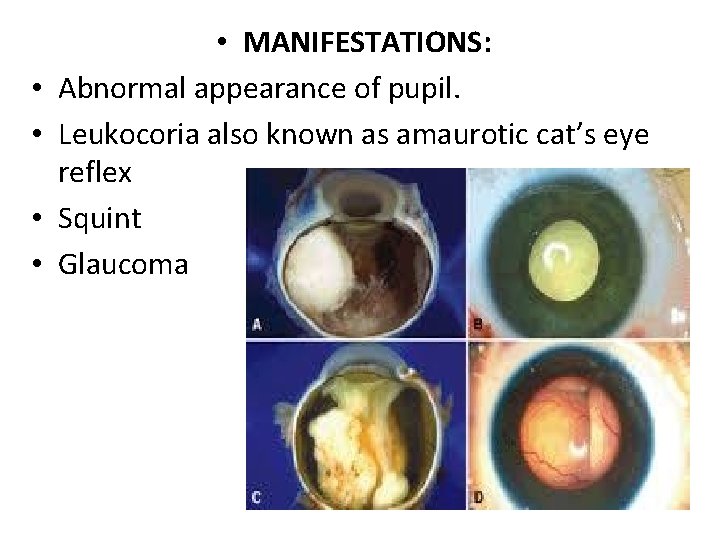
• • • MANIFESTATIONS: Abnormal appearance of pupil. Leukocoria also known as amaurotic cat’s eye reflex Squint Glaucoma
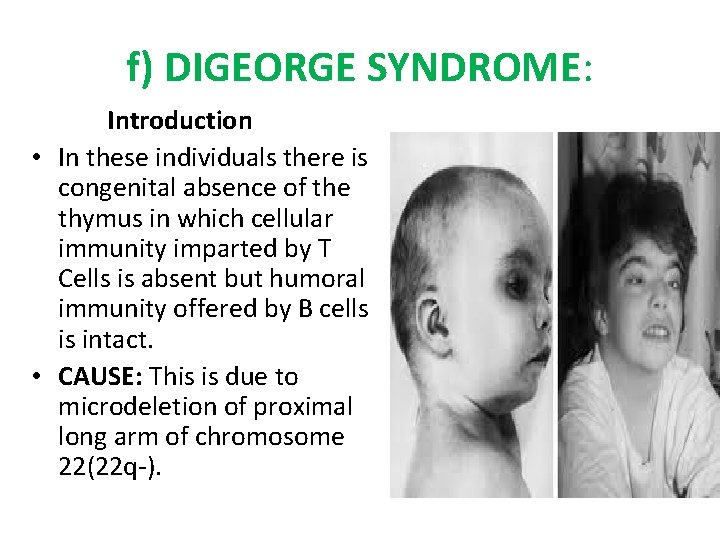
f) DIGEORGE SYNDROME: Introduction • In these individuals there is congenital absence of the thymus in which cellular immunity imparted by T Cells is absent but humoral immunity offered by B cells is intact. • CAUSE: This is due to microdeletion of proximal long arm of chromosome 22(22 q-).
• • MANIFESTATIONS: Thymic hypoplasia - (due to defect in 3 rd & 4 th Hypoparathyroidism pharyngeal pouches Recurrent infections during embryogenesis) Cardiac anomalies Craniofacial dysmorphology Learning dysfunctions.
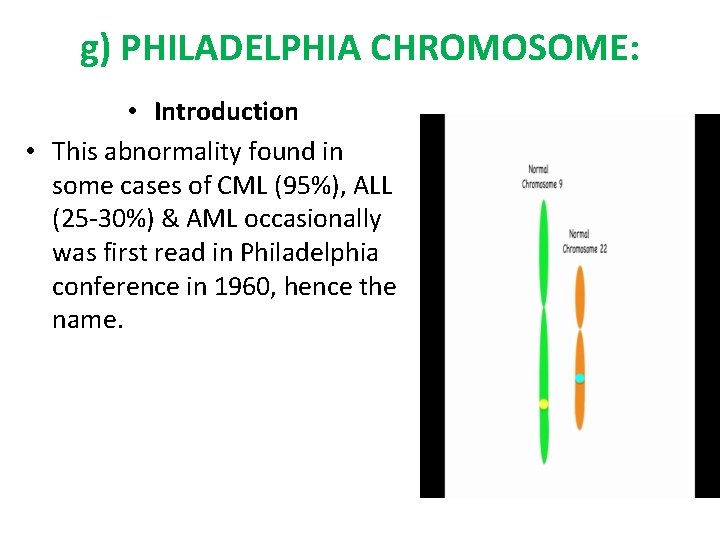
g) PHILADELPHIA CHROMOSOME: • Introduction • This abnormality found in some cases of CML (95%), ALL (25 -30%) & AML occasionally was first read in Philadelphia conference in 1960, hence the name.
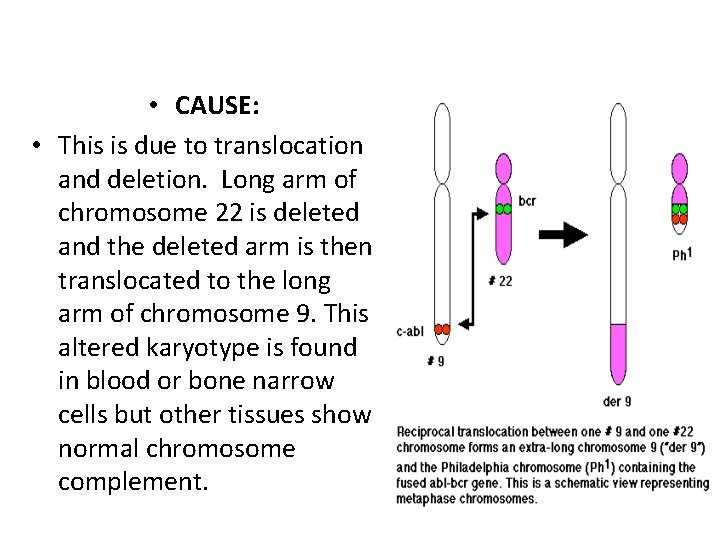
• CAUSE: • This is due to translocation and deletion. Long arm of chromosome 22 is deleted and the deleted arm is then translocated to the long arm of chromosome 9. This altered karyotype is found in blood or bone narrow cells but other tissues show normal chromosome complement.

- Slides: 19