
Genetic Syndromes Carol Rousseau M A CCCA Rochester

- Slides: 41
Genetic Syndromes Carol Rousseau, M. A. , CCC-A Rochester Hearing and Speech Center Rochester, New York 15 October 2004
Genetic Syndromes b Syndrome is a pattern of abnormalities and/or symptoms that result from the same cause. b More than 400 hereditary syndromes that involve hearing loss have been identified. b Different syndromes are associated with various types and degrees of hearing loss.
Genetic Syndromes (Cont) b Congenital vs. delayed onset and/or progressive. b Other physical and/or cognitive abnormalities. b Genetic locations.
Genetic Syndromes b. Four Categories of Inheritance: • Autosomal Dominant • Autosomal Recessive • X-linked • Chromosome Abnormality
Autosomal Dominant b Waardenburg’s Syndrome b Treacher-Collins Syndrome b Alpert Syndrome b Alport Syndrome (types I, V, VI) b Crouzon Syndrome b Osteogenesis Imperfecta b Stickler Syndrome
Autosomal Dominant (cont) b Brancbio-Oto-Renal Syndrome (BOR) b CHARGE b Clefting Syndrome b Klippel-Feil Syndrome b Marfan’s Syndrome b Alport’s Syndrome
Waardenburg’s Syndrome b 2 -5% of individuals with congenital hearing loss have this syndrome b Two types have been defined b Congenital b Sensorineural, however hearing ranges from normal to profound unitlateral or bilateral
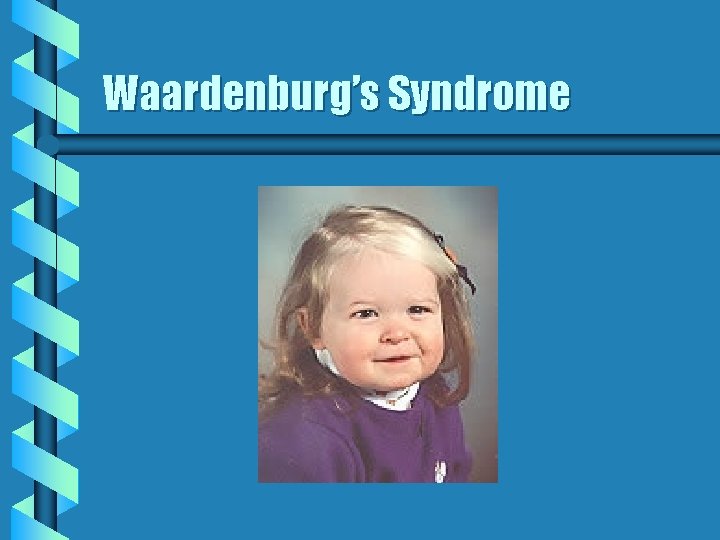
Waardenburg’s Syndrome (Cont) b Other characteristics: • • • White forelock in hair or premature greying Prominent root of nose Different colored eyes Inner ear dysplasia Usually normal intelligence
Waardenburg’s Syndrome -- Type I b Almost total deafness with some residual hearing in the low frequencies b Always includes lateral displacement of the inner corner of the eye b 2 q
Waardenburg’s Syndrome -- Type II b Moderate deafness with uniform hearing loss in the lower and middle frequencies but with improvement in the higher tones b Progressive hearing loss b 3 q
Waardenburg’s Syndrome -- Type III b A severe form, also called Klein- Waardenburg b Partial albinism
Waardenburg’s Syndrome
Treacher Collins Syndrome b Congenital b Bilateral Conductive or mixed
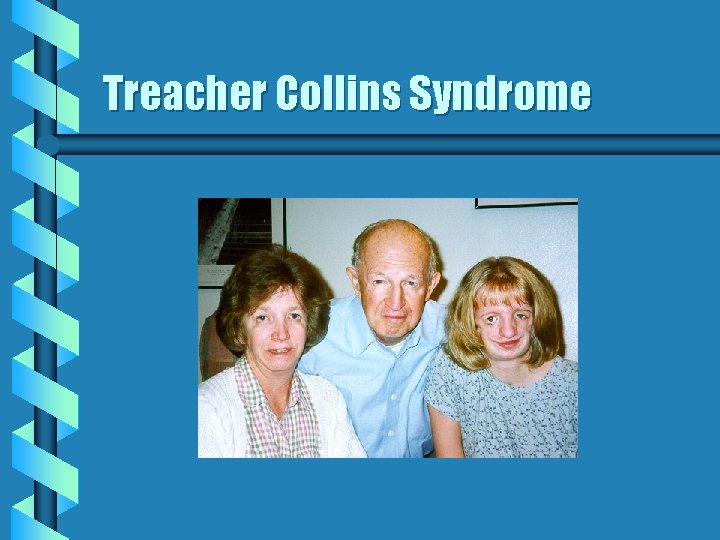
Treacher Collins Syndrome (Cont) b Other characteristics: • Facial anomalies (depressed zygomatics, eyes slant downward laterally, receding mandible, mouth large and fish-like, dental anomalies, cleft palate). • Outer and middle ear deformities. • Typically normal intelligence, though mild mental retardation has been reported. b 5 q
Treacher Collins Syndrome
Alpert Syndrome b Congenital b Mild to moderate Conductive Hearing Loss b Other characteristics: • Craniofacial anomalies affecting the ears (lowset) • Stapes fixations • Fused fingers & toes • Spina bifida • Most have some degree of mental retardation
Alport Syndrome (Types I, V, VI) b Delayed onset; progressive b Sensorineural hearing loss b Other characteristics (varies by type): • Renal disease • Ocular disorders • Blood platelet defect b 2 q
Stickler Syndrome b Congenital or progressive b Conductive or Sensorineural b Other characteristics: • • Cleft palate Myopia Renal detachment Often associated with Pierre Robin Sequence (30% of infants with Pierre Robin have Stickler) • Normal intelligence
Bronchio-Oto-Renal Syndrome (BOR) b Congenital or delayed onset b Sensorineural, Conductive, or Mixed (depending on area affected) b Other characteristics: • • Outer, middle, and/or inner ear deformities Brancial fistulas/cysts Renal disorders Normal intelligence b 8 q
CHARGE Association b b b Acronym for a group of anomalies that often appear together 85% have some degree of hearing loss (conductive, sensorineural, or mixed Stands for: • • • Coloboma (defect of Iris, retina, or optic disc Heart disease (congenital) Atresia of the choanae (nasal passage) (Growth) Retardation Genital defects Ear anomolies
Crouzon Syndrome b Congenital b Conductive or Mixed Hearing loss b Other characteristics: • • • Prematurely fused cranial suture Protrusion of eyes and beak-shaped nose Variable outer/middle ear anomalies Normal intelligence Incidence with increased paternal age b 10 q
Kippel-Feil Sequence b Congenital b Sensorineural and/or conductive hearing loss b Other characteristics: • • • Fused cervical vertebrae Paralysis of VIth cranial nerve Short Neck Decreased head mobility Ossicle abnormalities
Oseogenesis Imperfecta b Progressive b Sensorineural, conductive and/or mixed hearing loss b Other characteristics: • • Fragile Bones Large Skull Hemorrhage tendency Stapes fixation b 17 q or 5 p
Autosomal Recessive b Usher Syndrome b Goldenhar Syndrome b Hurler Syndrome Pendred’s Syndrome b Alstrom Syndrome b
Autosomal Recessive (Cont) b Frederick’s Ataxia b Fanconi Syndrome b Jervelland Lange-Nielsen Syndrome b Mobius’ Suyndrome
Usher Syndrome b Most common cause of profound hereditary deafness among children b Main cause of deaf-blindness b Congenital b Sensorineural b Three types
Usher I b Born with a complete, Profound hearing loss at all frequencies b Retinitis pigmentosa begins in early teens b Vestibular Dysfunction b Motor delays b Ia -- 14 q b Ib & Ic -- 11 q
Usher II b Born with moderate hearing loss in the low frequencies sloping to severe hearing loss in the high frequencies b Hearing loss progresses slightly over time b Progressive Retinitis pigmentosa • Occurs later in life and less severe than type 1 b Usually no vestibular problems b Iia -- 1 q
Usher III b Rarest form of the disorder b Born with normal hearing and vision, and they progressively lose both senses b Mild hearing loss develops in early 20 s and becomes progressively worse b Vision loss starts in young adulthood and becomes progressively worse b Most cases documented in Finland
Goldenhar Syndrome b Congenital b Unilateral of bilateral Conductive b Close relationship with Treacher Collins
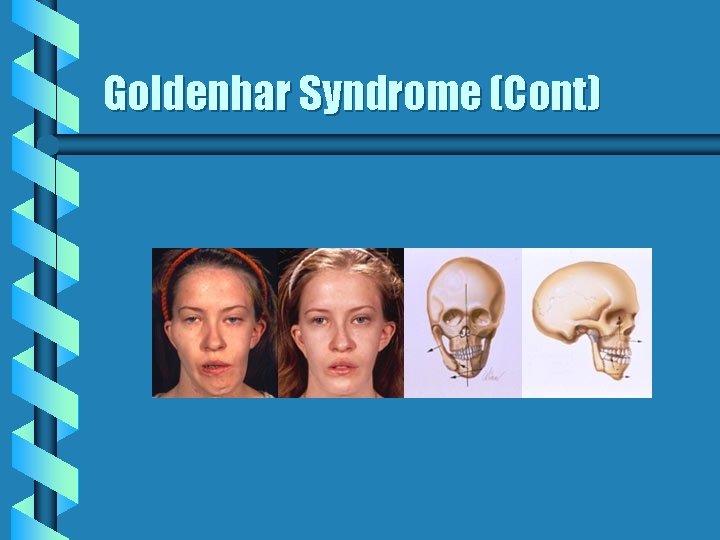
Goldenhar Syndrome (Cont) b Other characteristics: • • • Facial asymmetry Unilateral Microtiaand atresia Preauricular tags Eye anomalies Oral defects Club foot Congenital heart disease Abnormal semicircular canals Mental retardation in 15% of cases
Goldenhar Syndrome (Cont)
Hurler Syndrome (Mucopolysaccaridosis I) b Progressive b Sensorineural, Conductive or Mixed b Skeletal deformities b Dwarfism b Coarse facial features b Corneal clouding b Cardiogvascular disorders b Mental retardation
Pendred Syndrome b May be autosomal dominant with incomplete penetrance and variable expression b Variable -- congenital or progressive b Sensorineural b Other characteristics: • Thyroid enlargement (goiter)
Alstrom Syndrome b Delayed onset; progressive b Sensorineural b Other characteristics: • • Retinitis pigmentosa Cataract Diabetes mellitus Obesity
Frederick’s Ataxia b Delayed onset; progressive b Sensorineural b Other characteristics: • Ataxia • Nystagmus • Optic atrophy
X-Linked Syndromes b Alport Syndrome (Types II, IV) b Hunter Syndrome
Alport Syndrome (Types II, IV) b Delayed onset; progressive b Sensorineural b Affects only males b Other characteristics (varies by type) • • • Renal disease Ocular disorders blood platelet defect b Xq
Hunter Syndrome b Similar to Hurler Syndrome, but may be less severe and affects only males b Progressive b Sensorineural, conductive, mixed
Hunter Syndrome (Cont) b Other characteristics: • • • Skeletal deformities Dwarfism Coarse facial features Cardiovascular disorders Mental retardation
Chromosomal Abnormalities b Down Syndrome (Trisomy 21) b Trisomy 13 b Trisomy 18