
Genetic Screening for Cystic Fibrosis A New Choice
Genetic Screening for Cystic Fibrosis A New Choice for You and Your pregnancy
Goals for this Discussion • Present information about a new screening test for a common genetic disease • Discuss the nature of this disease, cystic fibrosis • Discuss how testing can be accomplished • Discuss what the test will tell you • Discuss what the test won’t tell you • Discuss the risks of genetic testing • Discuss how the test results can be managed
What is Cystic Fibrosis (CF)? • Cystic fibrosis is an inherited disease which may lead to the development of very thick, easily dried out mucous in nose, lungs, and intestines • Disease may be mild or very severe – Generally it is a chronic life-long illness requiring some kind of lifetime treatment – No present cure
Areas affected by CF • Lungs – Thick clogging mucous – Frequent coughing and wheezing – Frequent pneumonia and bronchitis • Chronic sinus infections • Digestion problems • Altered reproduction – Men may be infertile; pregnancy may be risky for affected women
Healthcare for CF patients • Daily breathing treatments, chest therapy, and medications • Daily vitamins, enzymes for digestion, and careful diet • Treatment or preventative treatment for infections • Treatment for development of diabetes
Outcome of Effective Treatment for CF • Normal or near normal growth • Normal intellectual development • Increasing lifespan – About 50% of people with CF live to age 30 – Babies born now may have average length of life to over 50
Diagnosing CF • About 1 in 2500 to 1 in 3000 Caucasian babies have CF • In a child, the diagnosis is made by measuring the amount of salt in the sweat • Also made by the clinical appearance of the condition • DNA testing may determine the genetic cause of the disease
What causes CF? • CF is an inherited (genetic) condition causes by a pair of genes which are not working properly – Genes are genetic material passed from parents to children – Genes determine how and what proteins are made in the body – Genes are made up of DNA – Changes in DNA which change the protein the gene makes are called mutations
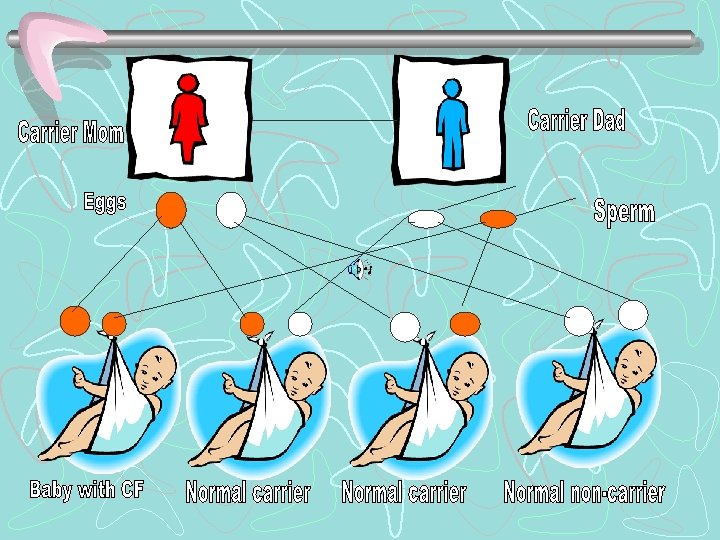
Genetics of CF • Genes are inherited in pairs, one from the mother, one from the father – If the parents carry one mutated gene and one normal gene, they are called carriers • Carriers of one mutated gene are completely normal
Genetics of CF • Cystic fibrosis occurs when both genes for the CF protein are changed (mutated) – Only if the baby gets an abnormal gene from mother AND father will it have cystic fibrosis
What is your chance of being a CF carrier? • The chance for a person to be a carrier of CF depends largely on their ethnic background – Highest carrier rates in people of Caucasian and Ashkenazi Jewish background • Chance is 1 in 29 that people in those groups carry CF • Includes people whose background is from England, Scotland, Wales, Scandinavia, Europe
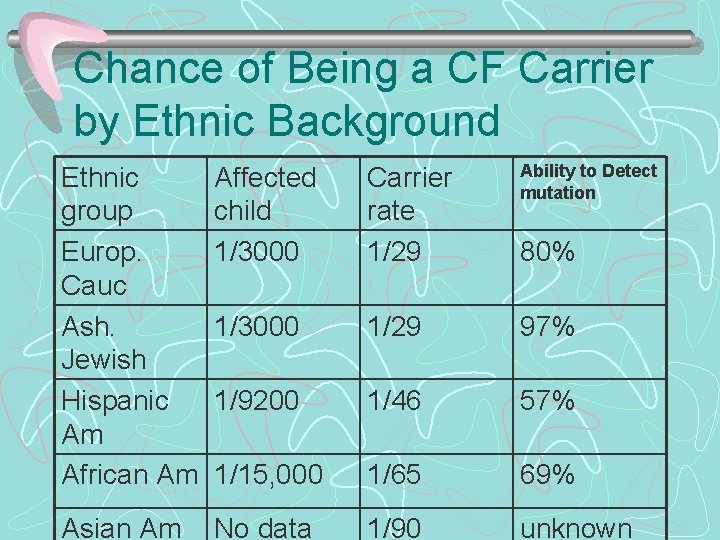
Chance of Being a CF Carrier by Ethnic Background Ethnic group Europ. Cauc Ash. Jewish Hispanic Am African Am Affected child 1/3000 Carrier rate 1/29 Ability to Detect mutation 1/3000 1/29 97% 1/9200 1/46 57% 1/15, 000 1/65 69% Asian Am No data 1/90 unknown 80%
Other Effects of Ethnic Background • The likelihood that testing can detect a mutation depends on the ethnic group – Non-Caucasian or non-Jewish groups are already at low risk for having children with CF – Testing may not add much additional information about these groups
CF Carrier Screening • Testing is available to provide information about your risk for being a CF carrier • This is termed “screening” testing because it is testing people who do not have the condition
What if there is a family history of CF? • You and your husband will need genetic counseling about the family history • Genetic testing for CF will be offered if desired • You do not fall into the general screening program for CF because you are already a higher risk
Is there a benefit to me to have Genetic Screening for CF? • Genetic screening can identify if you are at higher risk than you thought for having a baby with cystic fibrosis • Genetic screening may be reassuring to you that you have a lower chance of having a baby with this serious problem
How do I find out if I am a carrier for CF? • You must sign a consent form stating that you understand what testing means and that you want to be tested • A blood specimen is needed – May be part of New Mothers’ labs if not yet drawn – If those labs already drawn, another tube must be drawn • If you need to think about testing and want to wait, fresh blood may need to be drawn later
Genetic Testing Process • IF the mother gives consent (checks “Yes” on the consent form), then the blood is tested – DNA testing is done on the blood – Results come back in approximately 3 weeks • IF the mother does NOT give consent (checks “No” on the consent form), then no blood is drawn and no testing for CF
The results show: a mutation is not found – If no mutation is found, the risk is reduced and no further testing is done • No further CF testing is needed in any other pregnancy unless the father changes and has a family history of CF
What does it really mean: No mutation? • No mutation means that no abnormality was found when your DNA was studied to see if it showed multiple different mutations • HOWEVER, testing cannot say 100% you are not a carrier; it just reduces your chance of being a carrier and having an affected baby – A woman of European Caucasian background without family history of CF is tested for CF. No mutations are found • Her risk of being a carrier changes from 1 in 29 to 1 in 140 with a very low chance for an affected baby
The results show: a mutation is found • If the test finds a mutation (it is a positive test), then you are a carrier of a specific known change in the DNA for CF • The next step is to find out if your partner is also a carrier • Only if both parents are carriers can you have a baby with CF
What if my partner is also a carrier? • If both parents are found to be carriers of mutations in CF, then they need further information – Detailed genetic counseling about their 1 in 4 risk of having an affected baby – Prenatal diagnosis including amniocentesis or other testing to identify if the baby is affected may be of interest to some couples – The baby can also have genetic testing at birth
Benefits of Prenatal Diagnosis for CF • Family can prepare for the birth of a baby with special needs • Baby will benefit from early treatment from birth to improve health • Some couples may not wish to continue a pregnancy if they know their baby is affected with cystic fibrosis
New advances in CF • Even if mutations are found in both parents, it does not always predict how severely affected a child will be – Medical advances have improved the lifetime care for CF patients and will continue to do so
What if my baby’s father is unavailable or unknown? • If the father is not available because he is stationed somewhere else, blood can be drawn from him and mailed back for testing • If the father is unknown, the risk to the baby is based only on the mother’s carrier risk – It is possible that an affected baby may be missed if the father is not tested
Should I get Genetic screening for CF? • The choice is up to you! – The greatest value is if you belong to an ethnic group which has a higher risk of having CF • Includes European Caucasian and Ashkenazi Jewish – Other ethnic groups have such a low risk of CF that testing may add very little to their knowledge • Includes African Americans, Hispanic Americans, and Asian Americans
Do I have to have Genetic Screening for CF? • No! • If you do not want genetic screening for CF, mark “NO” on the consent form – Your blood will not be tested unless you consent • If you decide later you want testing, you can give your consent and a new specimen of blood will be drawn • If you don’t want to be tested, you will still get the same good prenatal care that you would get if you did get tested – There’s no penalty for not testing!
Reminder about testing • All genetic tests are specific—they only look for one particular condition – If you do not have a mutation for CF, it does not mean that you could not have a mutation for some other genetic condition entirely • There is no testing available for all genetic disorders • If you have a family history of some other genetic problem, you may benefit from genetic counseling to discuss what is your risk of being a carrier of that problem
- Slides: 29