
Genetic Screen and Analysis of Regulators of Sexually
- Slides: 1
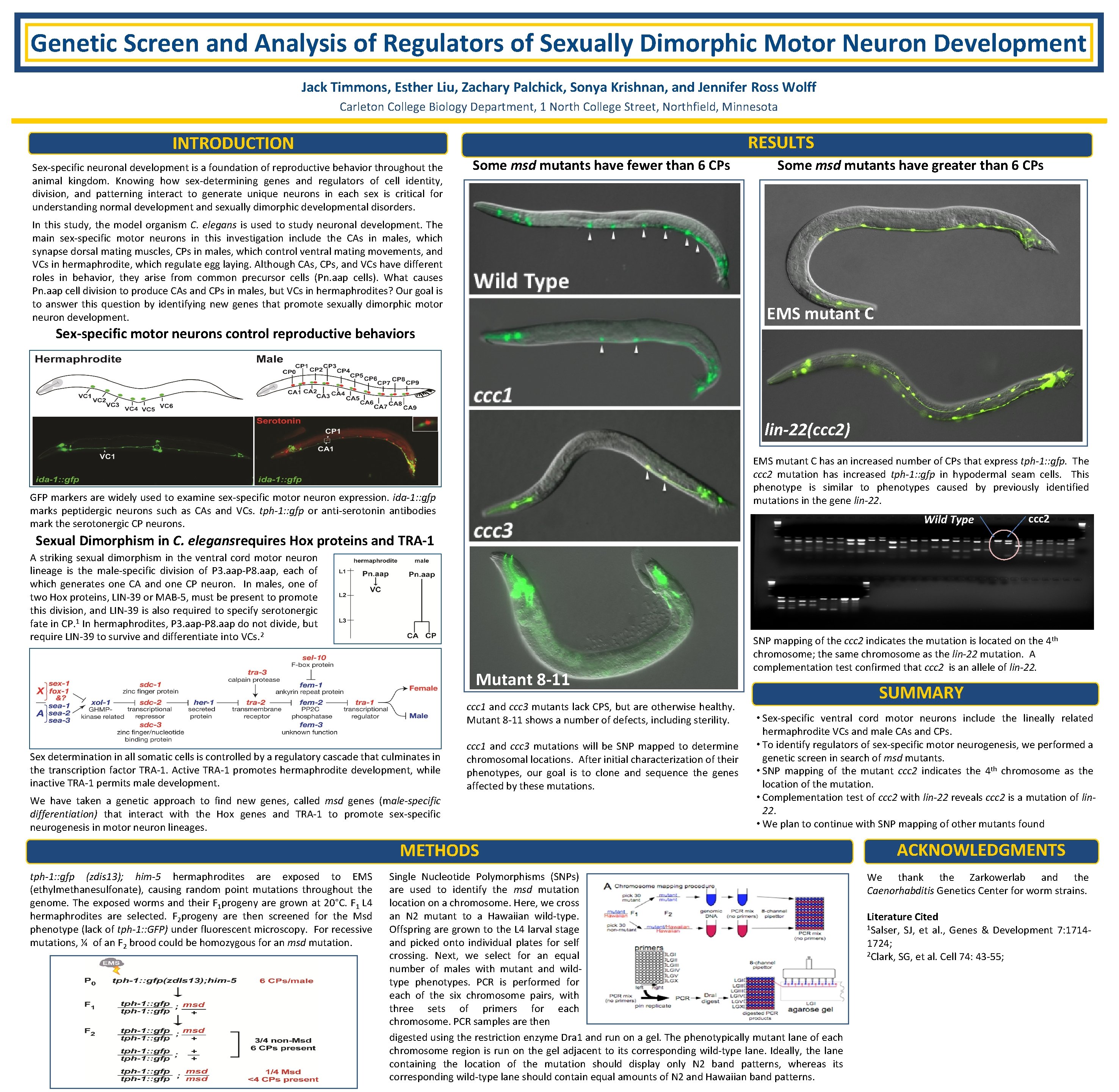
Genetic Screen and Analysis of Regulators of Sexually Dimorphic Motor Neuron Development Jack Timmons, Esther Liu, Zachary Palchick, Sonya Krishnan, and Jennifer Ross Wolff Carleton College Biology Department, 1 North College Street, Northfield, Minnesota RESULTS INTRODUCTION Sex-specific neuronal development is a foundation of reproductive behavior throughout the animal kingdom. Knowing how sex-determining genes and regulators of cell identity, division, and patterning interact to generate unique neurons in each sex is critical for understanding normal development and sexually dimorphic developmental disorders. Some msd mutants have fewer than 6 CPs In this study, the model organism C. elegans is used to study neuronal development. The main sex-specific motor neurons in this investigation include the CAs in males, which synapse dorsal mating muscles, CPs in males, which control ventral mating movements, and VCs in hermaphrodite, which regulate egg laying. Although CAs, CPs, and VCs have different roles in behavior, they arise from common precursor cells (Pn. aap cells). What causes Pn. aap cell division to produce CAs and CPs in males, but VCs in hermaphrodites? Our goal is to answer this question by identifying new genes that promote sexually dimorphic motor neuron development. Some msd mutants have greater than 6 CPs EMS mutant C Sex-specific motor neurons control reproductive behaviors lin-22(ccc 2) EMS mutant C has an increased number of CPs that express tph-1: : gfp. The ccc 2 mutation has increased tph-1: : gfp in hypodermal seam cells. This phenotype is similar to phenotypes caused by previously identified mutations in the gene lin-22. GFP markers are widely used to examine sex-specific motor neuron expression. ida-1: : gfp marks peptidergic neurons such as CAs and VCs. tph-1: : gfp or anti-serotonin antibodies mark the serotonergic CP neurons. Wild Type ccc 2 Sexual Dimorphism in C. elegansrequires Hox proteins and TRA-1 A striking sexual dimorphism in the ventral cord motor neuron lineage is the male-specific division of P 3. aap-P 8. aap, each of which generates one CA and one CP neuron. In males, one of two Hox proteins, LIN-39 or MAB-5, must be present to promote this division, and LIN-39 is also required to specify serotonergic fate in CP. 1 In hermaphrodites, P 3. aap-P 8. aap do not divide, but require LIN-39 to survive and differentiate into VCs. 2 ccc 3 Mutant 8 -11 ccc 1 and ccc 3 mutants lack CPS, but are otherwise healthy. Mutant 8 -11 shows a number of defects, including sterility. Sex determination in all somatic cells is controlled by a regulatory cascade that culminates in the transcription factor TRA-1. Active TRA-1 promotes hermaphrodite development, while inactive TRA-1 permits male development. ccc 1 and ccc 3 mutations will be SNP mapped to determine chromosomal locations. After initial characterization of their phenotypes, our goal is to clone and sequence the genes affected by these mutations. We have taken a genetic approach to find new genes, called msd genes (male-specific differentiation) that interact with the Hox genes and TRA-1 to promote sex-specific neurogenesis in motor neuron lineages. Wild Type SNP mapping of the ccc 2 indicates the mutation is located on the 4 th chromosome; the same chromosome as the lin-22 mutation. A complementation test confirmed that ccc 2 is an allele of lin-22. SUMMARY • Sex-specific ventral cord motor neurons include the lineally related hermaphrodite VCs and male CAs and CPs. ccc 1 • To identify regulators of sex-specific motor neurogenesis, we performed a genetic screen in search of msd mutants. • SNP mapping of the mutant ccc 2 indicates the 4 th chromosome as the location of the mutation. • Complementation test of ccc 2 with lin-22 reveals ccc 2 is a mutation of lin 22. • We plan to continue with SNP mapping of other mutants found METHODS tph-1: : gfp (zdis 13); him-5 hermaphrodites are exposed to EMS (ethylmethanesulfonate), causing random point mutations throughout the genome. The exposed worms and their F 1 progeny are grown at 20°C. F 1 L 4 hermaphrodites are selected. F 2 progeny are then screened for the Msd phenotype (lack of tph-1: : GFP) under fluorescent microscopy. For recessive mutations, ¼ of an F 2 brood could be homozygous for an msd mutation. Single Nucleotide Polymorphisms (SNPs) are used to identify the msd mutation location on a chromosome. Here, we cross an N 2 mutant to a Hawaiian wild-type. Offspring are grown to the L 4 larval stage and picked onto individual plates for self crossing. Next, we select for an equal number of males with mutant and wildtype phenotypes. PCR is performed for each of the six chromosome pairs, with three sets of primers for each chromosome. PCR samples are then digested using the restriction enzyme Dra 1 and run on a gel. The phenotypically mutant lane of each chromosome region is run on the gel adjacent to its corresponding wild-type lane. Ideally, the lane ccc 2 x lin-22 containing the location of the mutation should display only N 2 band patterns, whereas its corresponding wild-type lane should contain equal amounts of N 2 and Hawaiian band patterns. ACKNOWLEDGMENTS We thank the Zarkowerlab and the Caenorhabditis Genetics Center for worm strains. Literature Cited 1 Salser, SJ, et al. , Genes & Development 7: 17141724; 2 Clark, SG, et al. Cell 74: 43 -55;