
Genetic Engineering Biot2081 1 Chapter 2 Host cells
Genetic Engineering (Biot-2081) 1
Chapter 2 Host cells and vectors 2
BASIC STEPS OF GENE CLONING v Construction of recombinant DNA molecule v Transport of the recombinant DNA to the host cell v Multiplication of recombinant DNA molecule v Division of the host cell v Numerous cell division resulting in a clone 3
Host cell types 4
v. Gene engineering utilises the characteristics of living systems to propagate recombinant DNA molecules; v. Gene cloning is achieved by using a vector (carrier) to propagate the desired sequence in a host cell. v. Choosing the right vector/host combination is one of the critical stages of a cloning procedure. 5
v. The type of host cell used for a particular application will depend mainly on the purpose of the cloning experiment. v. The host cell types are ü Prokaryotic hosts ü Eukaryotic hosts 6
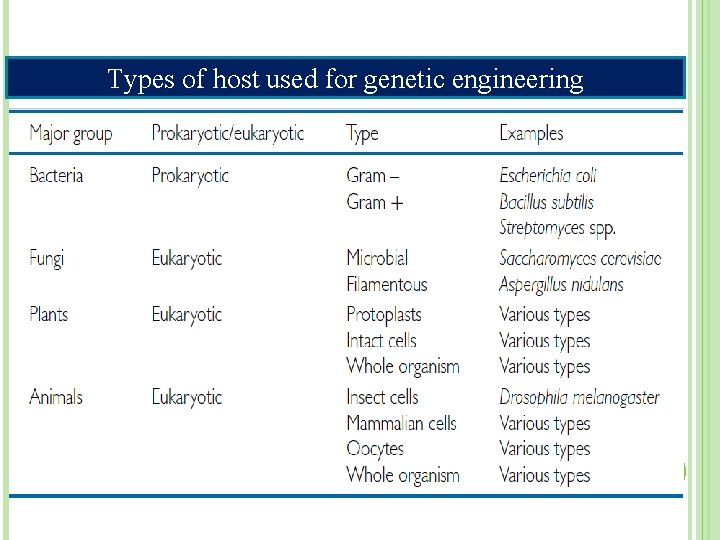
Types of host used for genetic engineering 7
Prokaryotic hosts v. An ideal host cell should be easy to handle and propagate, vshould be available as a wide variety of genetically defined strains, and should accept a range of vectors v. The bacterium Escherichia coli fulfils these requirements and is used in many cloning protocols. 8
v. The bacterium Escherichia coli is the most commonly used prokaryotic host cell, with a wide variety of different strains available for particular applications, v. Bacillus, Pseudomonas, and Streptomyces May be used as hosts for gene enineering experiments, v. Prokaryotic host cells have certain limitations when the cloning and expression of genes from eukaryotes 9

Eukaryotic hosts v. Eukaryotic cells range from microbes, such as yeast and algae, to cells from complex multicellular organisms, such as ourselves. v. Microbes (such as yeast) and mammalian cell lines are two examples of eukaryotic host cells that have become widely used in gene manipulation. v. Plant and animal cells may also be used as hosts for gene manipulation experiments 10
Vectors 11
GENE ENGINEERIN REQUIRES SPECIALIZED TOOLS AND TECHNIQUES: Vehicles: The central component of a gene cloning experiment is the vehicle, which transport the gene into the host cell and is responsible for its replication. To act as a cloning vehicle a DNA molecule must be capable of entering a host cell and, once inside, replicating to produce multiple copies of itself. Vector: A DNA molecule, capable of replication in a host organism, into which a gene is inserted to construct a recombinant DNA molecule. 12
CHARACTERISTIC OF A VECTOR: v Ability to promote autonomous replication. v Contain a genetic marker (usually dominant) for selection. v Unique restriction sites to facilitate cloning of insert DNA. v Minimum amount of nonessential DNA to 13 optimize cloning
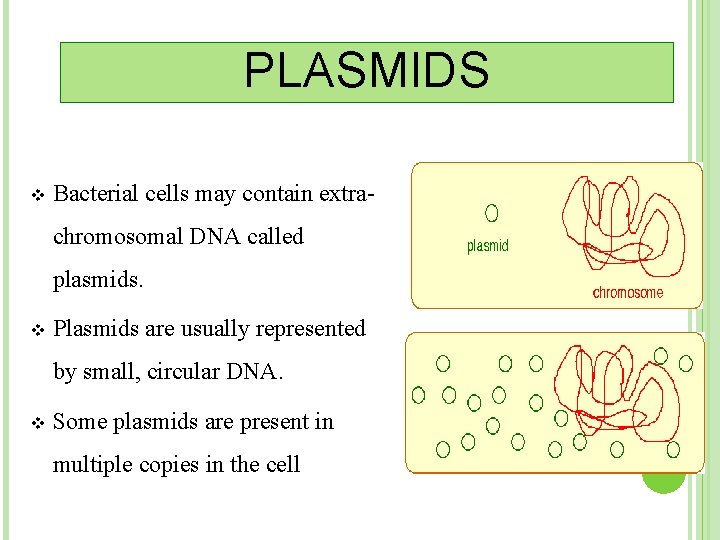
PLASMIDS v Bacterial cells may contain extrachromosomal DNA called plasmids. v Plasmids are usually represented by small, circular DNA. v Some plasmids are present in multiple copies in the cell 14
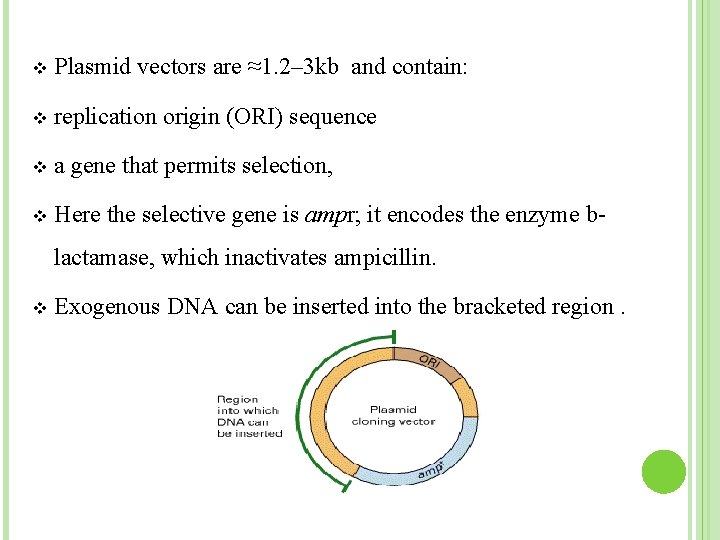
v Plasmid vectors are ≈1. 2– 3 kb and contain: v replication origin (ORI) sequence v a gene that permits selection, v Here the selective gene is ampr; it encodes the enzyme blactamase, which inactivates ampicillin. v Exogenous DNA can be inserted into the bracketed region. 15
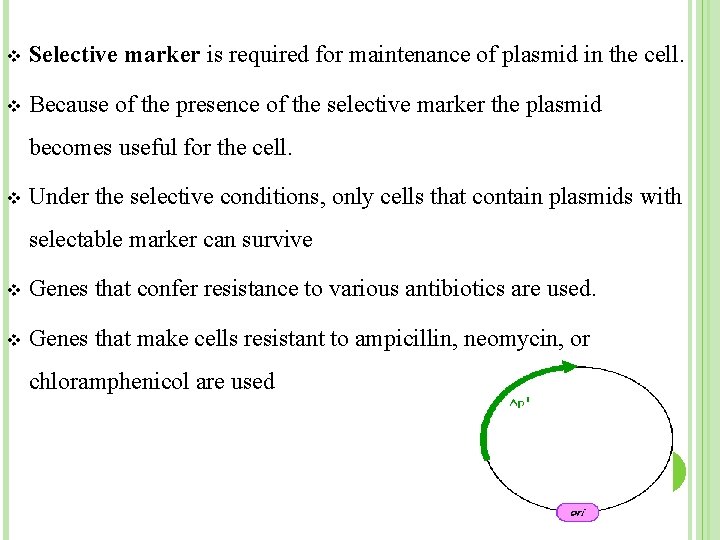
v Selective marker is required for maintenance of plasmid in the cell. v Because of the presence of the selective marker the plasmid becomes useful for the cell. v Under the selective conditions, only cells that contain plasmids with selectable marker can survive v Genes that confer resistance to various antibiotics are used. v Genes that make cells resistant to ampicillin, neomycin, or chloramphenicol are used 16
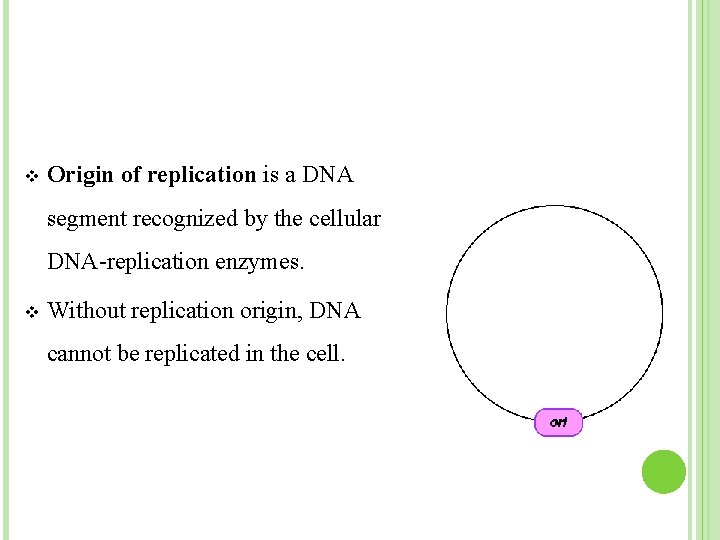
v Origin of replication is a DNA segment recognized by the cellular DNA-replication enzymes. v Without replication origin, DNA cannot be replicated in the cell. 17
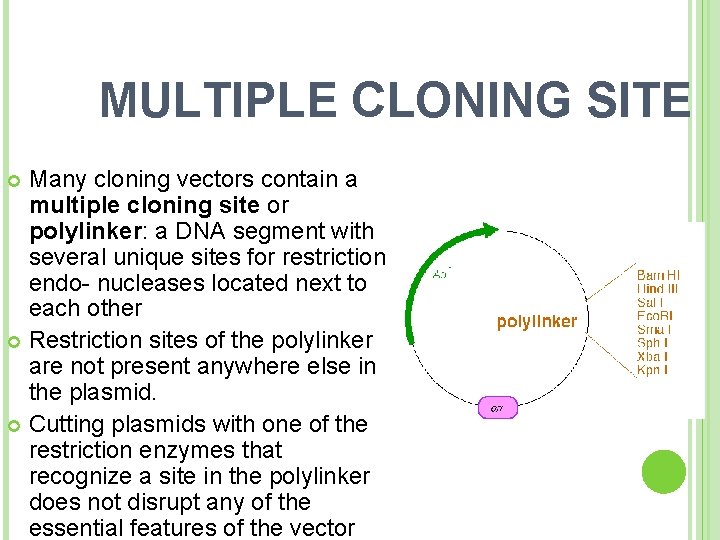
MULTIPLE CLONING SITE Many cloning vectors contain a multiple cloning site or polylinker: a DNA segment with several unique sites for restriction endo- nucleases located next to each other Restriction sites of the polylinker are not present anywhere else in the plasmid. Cutting plasmids with one of the restriction enzymes that recognize a site in the polylinker does not disrupt any of the essential features of the vector 18
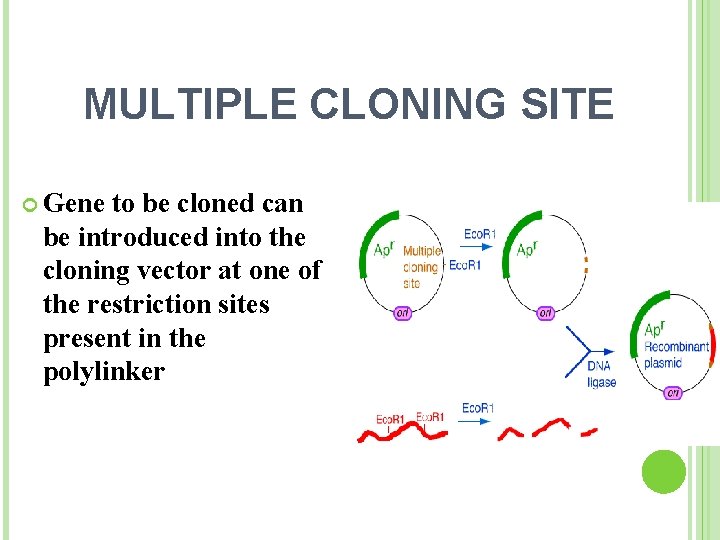
MULTIPLE CLONING SITE Gene to be cloned can be introduced into the cloning vector at one of the restriction sites present in the polylinker 19
20
WHY PLASMIDS ARE GOOD CLONING VECTORS v small size (easy to manipulate and isolate) v circular (more stable) v replication independent of host cell v several copies may be present (facilitates replication) v frequently have antibody resistance (detection easy) 21
DISADVANTAGES USING PLASMIDS Cannot accept large fragments Sizes range from 0 - 10 kb Standard methods of transformation are inefficient 22
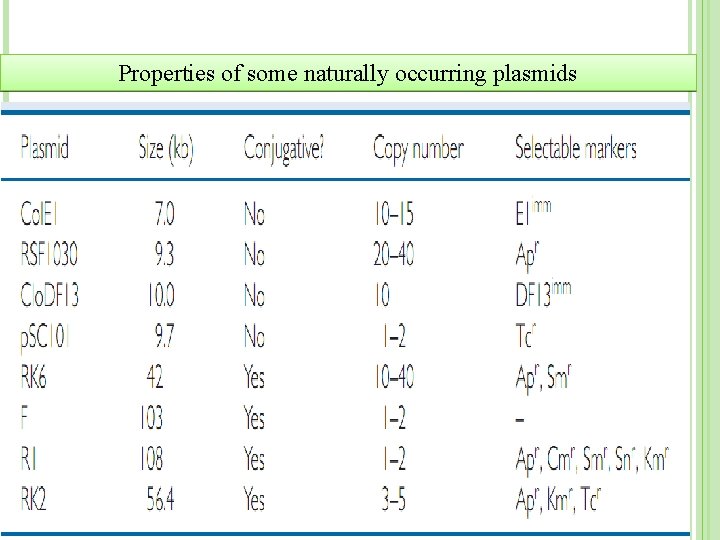
Properties of some naturally occurring plasmids 23
BACTERIOPHAGE LAMBDA Phage lambda is a bacteriophage or phage, i. e. bacterial virus, that uses E. coli as host. Its structure is that of a typical phage: head, tail fibres. Lambda viral genome: 48. 5 kb linear DNA with a 12 base ss. DNA "sticky end" at both ends; these ends are complementary in sequence and can hybridize to each other (this is the cos site: cohesive ends). Infection: lambda tail fibres adsorb to a cell surface receptor, the tail contracts, and the DNA is injected. The DNA circularizes at the cos site, and lambda begins its life cycle in the E. coli host. 24
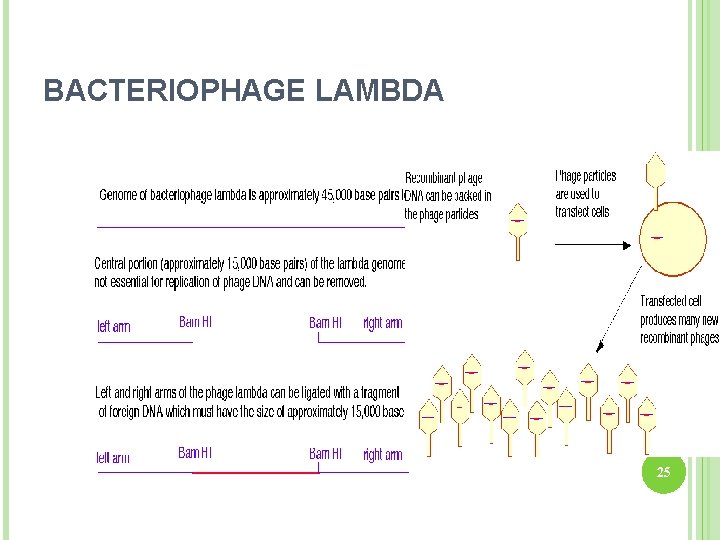
BACTERIOPHAGE LAMBDA 25
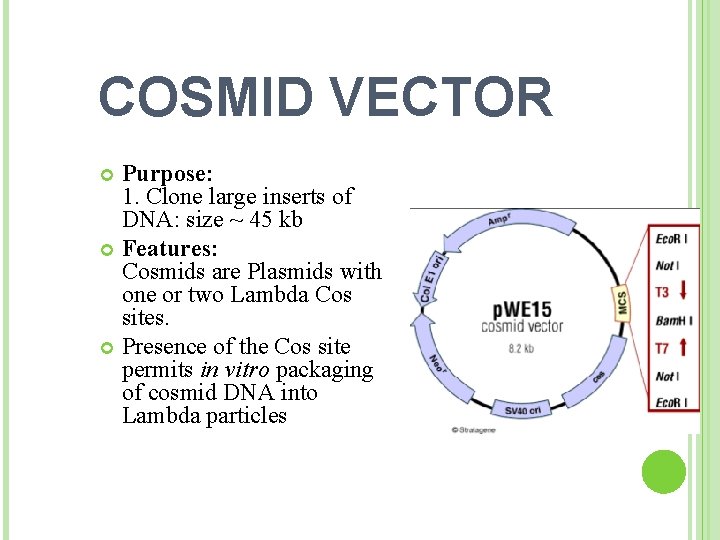
COSMID VECTOR Purpose: 1. Clone large inserts of DNA: size ~ 45 kb Features: Cosmids are Plasmids with one or two Lambda Cos sites. Presence of the Cos site permits in vitro packaging of cosmid DNA into Lambda particles 26
COSMID VECTOR Thus, have some advantages of Lambda as Cloning Vehicle: Strong selection for cloning of large inserts Infection process rather than transformation for entry of chimeric DNA into E. coli host Maintain Cosmids as phage particles in solution But Cosmids are Plasmids: Thus do NOT form plaques but rather cloning proceeds via E. coli colony formation 27
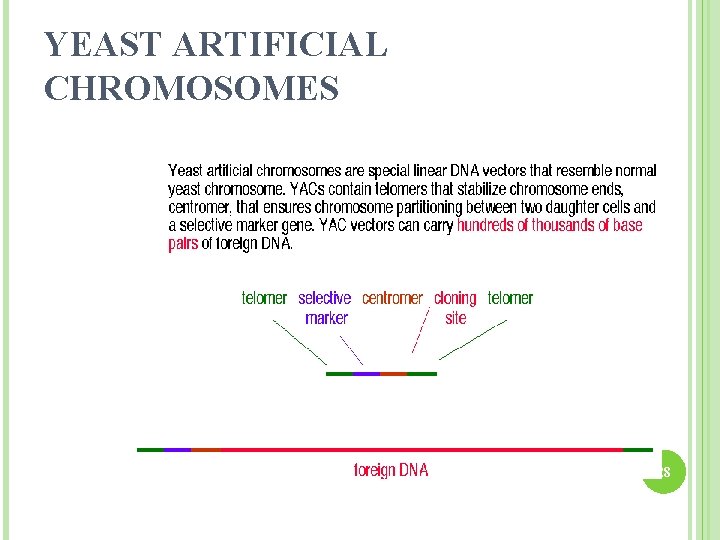
YEAST ARTIFICIAL CHROMOSOMES 28
YEAST ARTIFICIAL CHROMOSOMES Purpose: Cloning vehicles that propogate in eukaryotic cell hosts as eukaryotic Chromosomes Clone very large inserts of DNA: 100 kb - 10 Mb Features: YAC cloning vehicles are plasmids Final chimeric DNA is a linear DNA molecule with telomeric ends: Artificial Chromosome 29
Additional features: Often have a selection for an insert YAC cloning vehicles often have a bacterial origin of DNA replication (ori) and a selection marker for propogation of the YAC through bacteria. The YAC can use both yeast and bacteria as a host 30
PACS AND BACS PACs - P 1 -derived Artificial Chromosomes E. coli bacteriophage P 1 is similar to phage lambda in that it can exist in E. coli in a prophage state. Exists in the E. coli cell as a plasmid, NOT integrated into the E. coli chromosome. P 1 cloning vehicles have been constructed that permit cloning of large DNA fragments- few hundred kb of DNA Cloning and propogation of the chimeric DNA as a P 1 plasmid inside E. coli cells BACs - Bacterial Artificial Chromosomes These chimeric DNA molecules use a naturallyoccurring low-copy number bacterial plasmid origin of replication, such as that of F -plasmid in E. coli. Can be cloned as a plasmid in a bacterial host, and its natural stability generally permits cloning of large pieces of insert DNA, i. e. up to a few hundred kb of DNA. 31
RETROVIRAL VECTORS Retroviral vectors are used to introduce new or altered genes into the genomes of human and animal cells. Retroviruses are RNA viruses. The viral RNA is converted into DNA by the viral reverse transcriptase and then is efficiently integrated into the host genome Any foreign or mutated host gene introduced into the retroviral genome will be integrated into the host chromosome and can reside there practically indefinitely. Retroviral vectors are widely used to study oncogenes and other human genes. 32
TYPES OF EXPRESSION SYSTEMS Bacterial: plasmids, phages Yeast: expression vectors: plasmids, yeast artifical chromosomes (YACs) Insect cells: baculovirus, plasmids Mammalian: viral expression vectors (gene therapy): SV 40 vaccinia virus adenovirus retrovirus Stable cell lines (CHO, HEK 293) 33
EXPRESSION VECTORS Allows a cloned segment of DNA to be translated into protein inside a bacterial or eukaryotic cell. Vectors will contain the ff: (a) in vivo promoter (b) Ampicillin selection (c) Sequencing primers 34
EXPRESSION VECTORS Produces large amounts of a specific protein Permits studies of the structure and function of proteins Can be useful when proteins are rare cellular components or difficult to isolate 35

COMMON PROBLEMS WITH BACTERIAL EXPRESSION SYSTEMS Low expression levels: ▪ change promoter ▪ change plasmid ▪ change cell type ▪ add rare t. RNAs for rare codons on second plasmid Severe protein degradation: use proteasome inhibitors and other protease inhibitors try induction at lower temperature Missing post-translational modification: co-express with kinases etc. Glycosylation will not be carried out: use yeast or mammalian expression system Misfolded protein (inclusion bodies): co-express with Gro. EL, a chaperone try refolding buffers 36
REPORTER GENE VECTORS A gene that encodes a protein whose activity can be easily assayed in a cell in which it is not normally expressed These genes are linked to regulatory sequences whose function is being tested Changes in transcriptional activity from the regulatory sequences are detected by changes in the level of reporter gene expression 37
SHUTTLE VECTORS Shuttle vectors can replicate in two different organisms, e. g. bacteria and yeast, or mammalian cells and bacteria. They have the appropriate origins of replication. Hence one can clone a gene in bacteria, maybe modify it or mutate it in bacteria, and test its function by introducing it into yeast or animal cells. 38
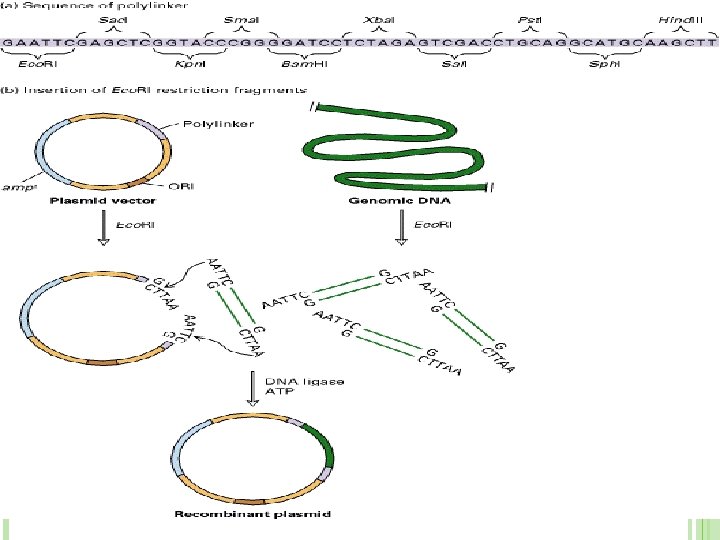
HOW IS FOREIGN DNA INSERTED INTO A PLASMID? To open up the DNA a restriction enzyme is used. Cut the DNA at a specific place called a restriction site. The result is a set of double-stranded DNA pieces with single-stranded ends These ends that jut out are not only "sticky" but they have gaps that can be now be filled with a piece of foreign DNA For DNA from an outside source to bond with an original fragment, one more enzyme is needed DNA ligase seals any breaks in the DNA molecule 39
End!! 40
- Slides: 40