
GENETIC ENGINEERING Biological Manipulation Changing the Living World
GENETIC ENGINEERING Biological Manipulation
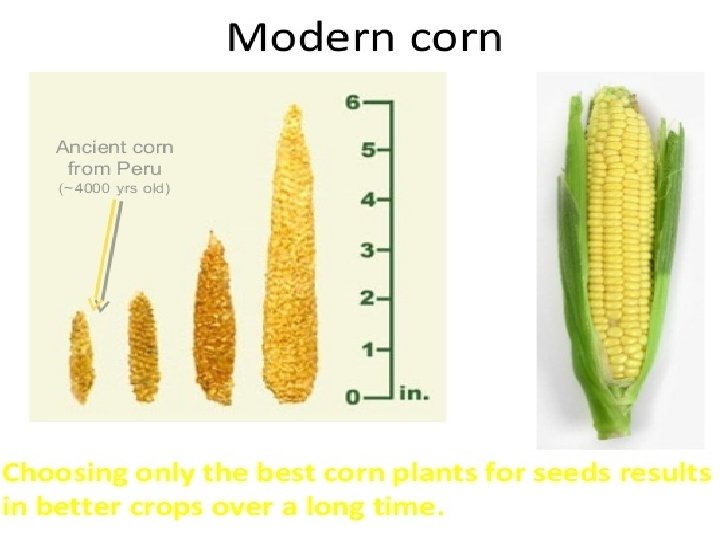
Changing the Living World • Selective breeding takes advantages of naturally occurring genetic variation to pass desired traits on to the next generation. • Domestic animals: • Horses • Cats • Dogs • Farm animals • Crops: • Corn • Potatoes • Tomatoes • Etc… • Hybridization is crossing dissimilar individuals to bring together the best of both organisms. Hybrids are often hardier than either of the parents. • Crossing a disease-resistant plant with a plant that has high food-producing capacity. • Inbreeding is the continued breeding of individuals with similar characteristics which helps to preserve a desirable characteristic in a species. However, it can be problematic. How? • A recessive allele for a genetic defect could show up in a genotype as homozygous.
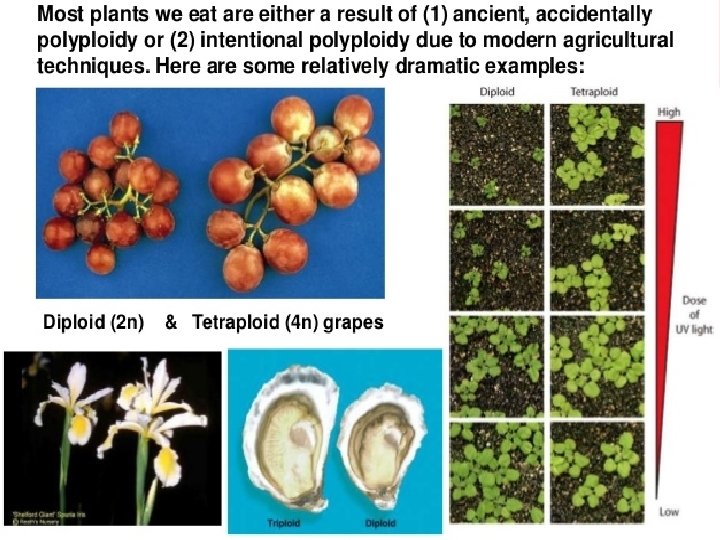
Changing the Living World • INCREASING VARIATION • Genetic variation can be increased in a population by inducing mutations. • Radiation • Chemicals • The goal is to produce mutants with desirable characteristics that are not found in the original population. • Particularly useful with bacteria. • Millions of organisms can be treated with chemicals or radiation at the same time. • This increases the chances of producing a useful mutant. • Oil-eating bacteria were produced and used to help clean up oil spills. (Now, however, naturally occurring bacteria are used for this purpose) • New kinds of plants & polyploidy • There are drugs that prevent chromosomal separation during meiosis and can double or triple the number of chromosomes in an organism. • This induces polyploidy – which is usually fatal in animals. For reasons unknown, plants often benefit from this condition. • Polyploid species of plants are often stronger and larger than their diploid relatives. • Many important crops have been produced this way including bananas and citrus fruits.
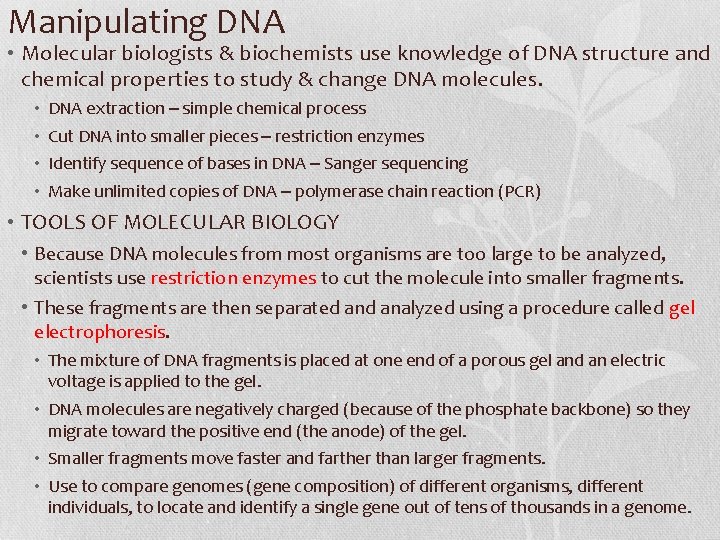
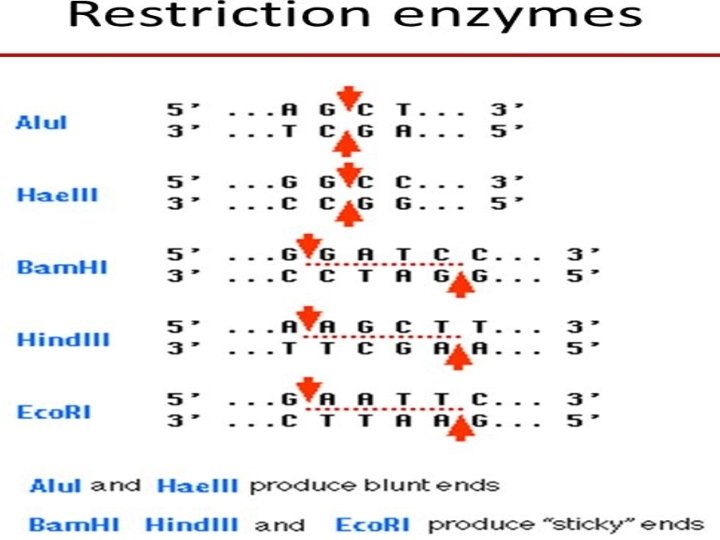
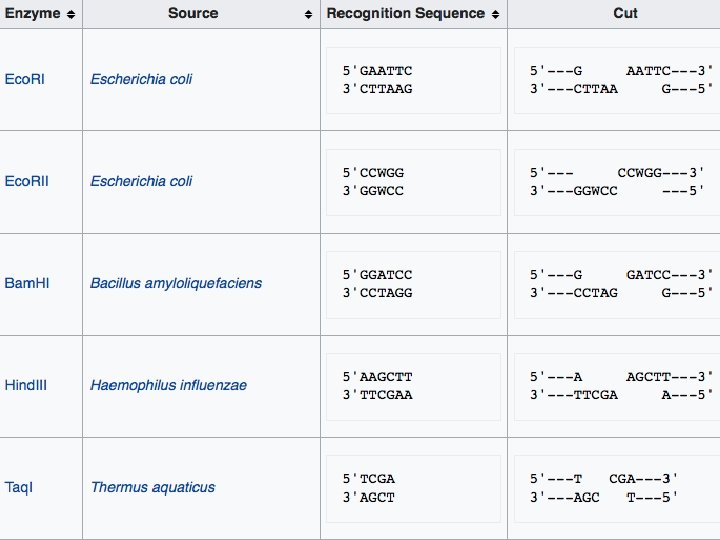
Manipulating DNA • Molecular biologists & biochemists use knowledge of DNA structure and chemical properties to study & change DNA molecules. • • DNA extraction – simple chemical process Cut DNA into smaller pieces – restriction enzymes Identify sequence of bases in DNA – Sanger sequencing Make unlimited copies of DNA – polymerase chain reaction (PCR) • TOOLS OF MOLECULAR BIOLOGY • Because DNA molecules from most organisms are too large to be analyzed, scientists use restriction enzymes to cut the molecule into smaller fragments. • These fragments are then separated analyzed using a procedure called gel electrophoresis. • The mixture of DNA fragments is placed at one end of a porous gel and an electric voltage is applied to the gel. • DNA molecules are negatively charged (because of the phosphate backbone) so they migrate toward the positive end (the anode) of the gel. • Smaller fragments move faster and farther than larger fragments. • Use to compare genomes (gene composition) of different organisms, different individuals, to locate and identify a single gene out of tens of thousands in a genome.
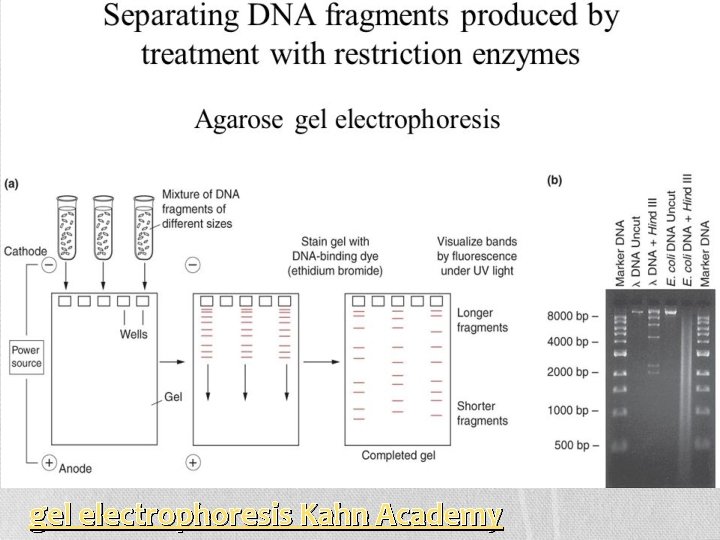
gel electrophoresis Kahn Academy
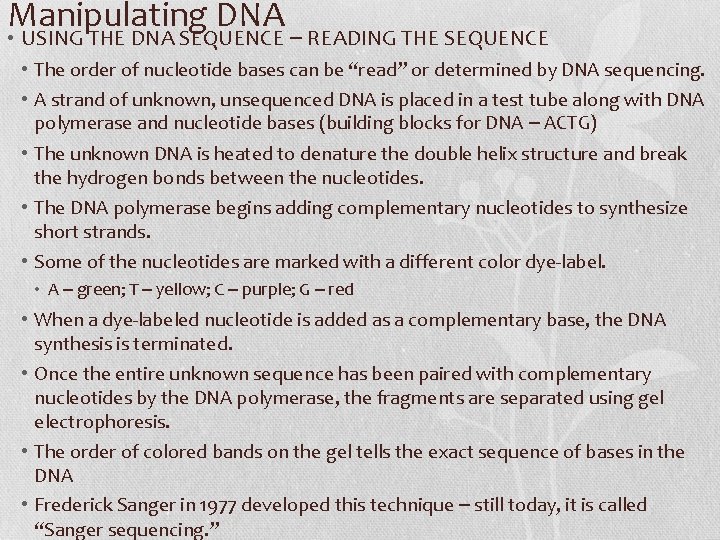
Manipulating DNA • USING THE DNA SEQUENCE – READING THE SEQUENCE • The order of nucleotide bases can be “read” or determined by DNA sequencing. • A strand of unknown, unsequenced DNA is placed in a test tube along with DNA polymerase and nucleotide bases (building blocks for DNA – ACTG) • The unknown DNA is heated to denature the double helix structure and break the hydrogen bonds between the nucleotides. • The DNA polymerase begins adding complementary nucleotides to synthesize short strands. • Some of the nucleotides are marked with a different color dye-label. • A – green; T – yellow; C – purple; G – red • When a dye-labeled nucleotide is added as a complementary base, the DNA synthesis is terminated. • Once the entire unknown sequence has been paired with complementary nucleotides by the DNA polymerase, the fragments are separated using gel electrophoresis. • The order of colored bands on the gel tells the exact sequence of bases in the DNA • Frederick Sanger in 1977 developed this technique – still today, it is called “Sanger sequencing. ”
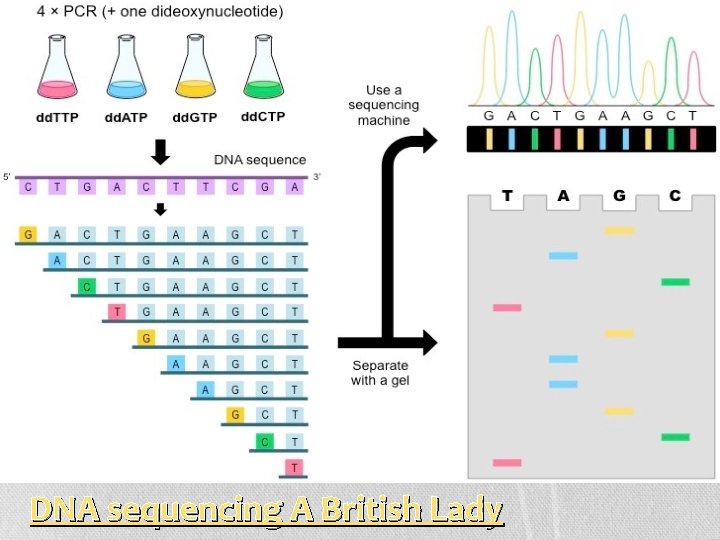
DNA sequencing A British Lady
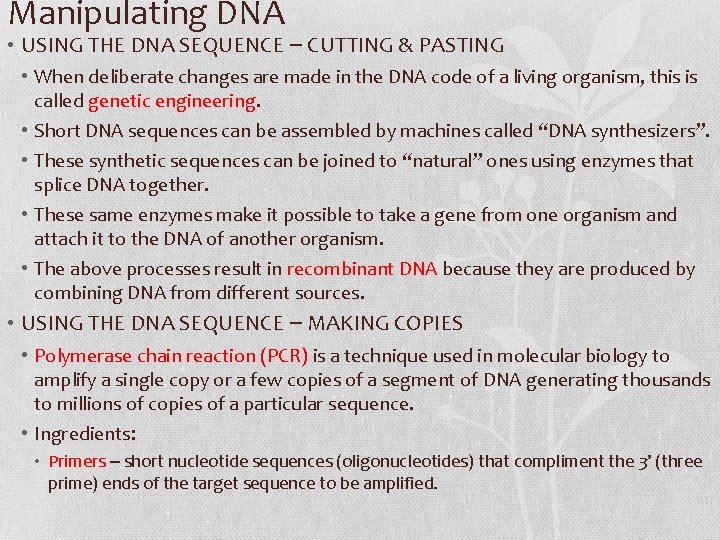
Manipulating DNA • USING THE DNA SEQUENCE – CUTTING & PASTING • When deliberate changes are made in the DNA code of a living organism, this is called genetic engineering. • Short DNA sequences can be assembled by machines called “DNA synthesizers”. • These synthetic sequences can be joined to “natural” ones using enzymes that splice DNA together. • These same enzymes make it possible to take a gene from one organism and attach it to the DNA of another organism. • The above processes result in recombinant DNA because they are produced by combining DNA from different sources. • USING THE DNA SEQUENCE – MAKING COPIES • Polymerase chain reaction (PCR) is a technique used in molecular biology to amplify a single copy or a few copies of a segment of DNA generating thousands to millions of copies of a particular sequence. • Ingredients: • Primers – short nucleotide sequences (oligonucleotides) that compliment the 3’ (three prime) ends of the target sequence to be amplified.
Manipulating DNA • USING THE DNA SEQUENCE – MAKING COPIES • PCR ingredients continued: • Taq DNA polymerase – isolated from a bacteria found in hot springs geysers, Thermus aquaticus, important because this enzyme can withstand high temperatures needed to denature DNA. This is the enzyme that synthesizes the complimentary strand from the original template strand. • Free nucleotides – adenine, cytosine, guanine and thymine – the building blocks of the DNA molecule. • Target DNA – sequence of interest that is to be amplified for analysis. • PCR procedure: Thermal Cycling • 1) Denaturation – ingredients are heated to 94 – 98 degrees C to break the hydrogen bonds between the nucleotide bases. This lasts about 20 – 30 seconds. • 2) Annealing – ingredients are cooled to 50 – 60 degrees C to allow the primers to attach at the 2, now single strands, 3’ ends of the DNA sequence of interest. This lasts about 20 – 40 seconds. • 3) Elongation – ingredients are heated to 72 degrees C and Taq DNA polymerase begins making new complimentary DNA strands starting with the primers at the 3’ ends of the single-stranded target DNA sequences. • PCR applications: • Medical, forensics, infectious disease detection & identification, biological research
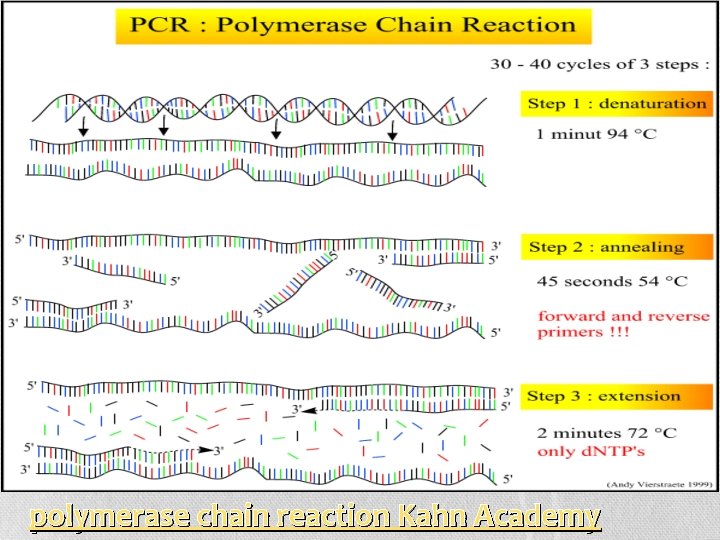
polymerase chain reaction Kahn Academy
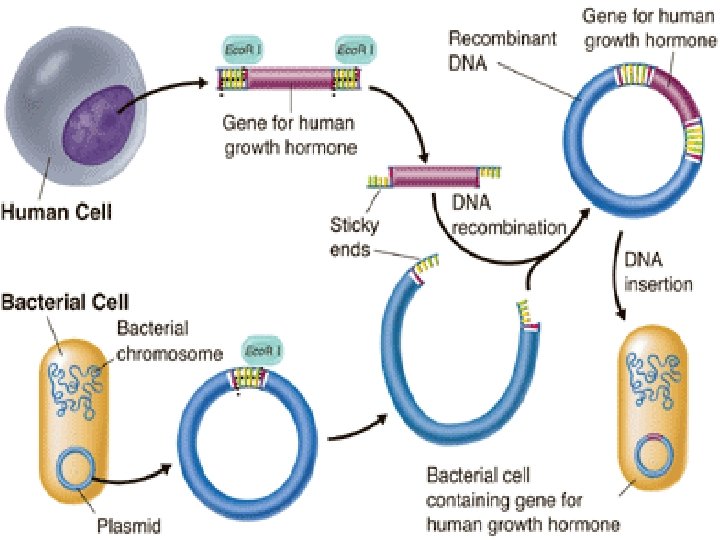
Cell Transformation • …is when a cell takes in DNA from outside the cell – the external DNA becomes a component of the cell’s DNA. • TRANSFORMING BACTERIA • A plasmid is a small DNA molecule within a cell that is physically separated from a chromosomal DNA and can replicate independently. They are most commonly found as small circular, double-stranded DNA molecules in bacteria. In nature, plasmids often carry genes that may benefit the survival of the organism, for example antibiotic resistance. • Bacteria can be used to produce human growth hormone, h. GH. • 1) the gene that codes for the synthesis of h. GH in a human cell is extracted from the nucleus • 2) a plasmid is extracted from a bacterial cell and Eco. RI (restriction enzyme) is used to open the plasmid at a specific sequence • 3) “sticky ends” on the plasmid pair up with sticky ends of the extracted human gene • 4) through DNA recombination, the plasmid now has inserted into its genetic code, the instructions to synthesize h. GH • 5) the newly recombined plasmid is reinserted back into the original bacterial cell • 6) as the bacteria replicates, so does the plasmid as well as the new gene • 7) now the bacteria produces h. GH
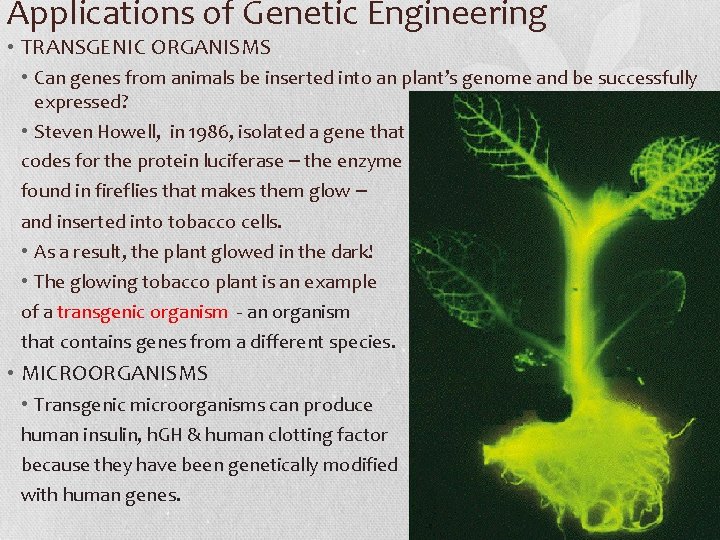
Applications of Genetic Engineering • TRANSGENIC ORGANISMS • Can genes from animals be inserted into an plant’s genome and be successfully expressed? • Steven Howell, in 1986, isolated a gene that codes for the protein luciferase – the enzyme found in fireflies that makes them glow – and inserted into tobacco cells. • As a result, the plant glowed in the dark! • The glowing tobacco plant is an example of a transgenic organism - an organism that contains genes from a different species. • MICROORGANISMS • Transgenic microorganisms can produce human insulin, h. GH & human clotting factor because they have been genetically modified with human genes.
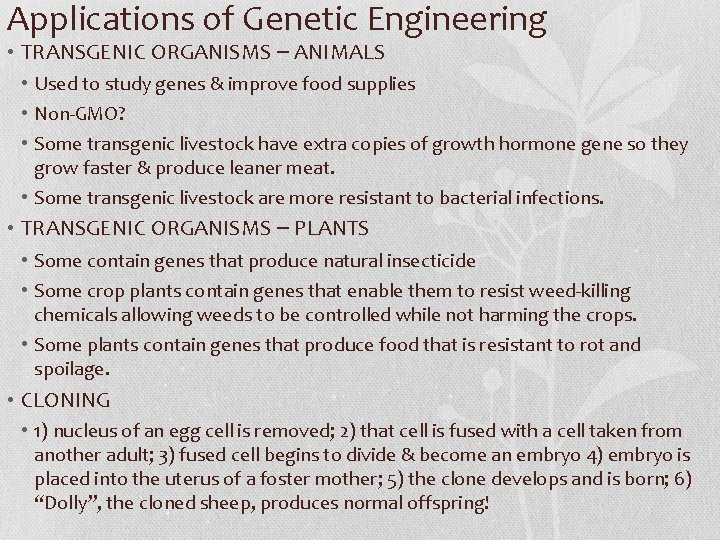
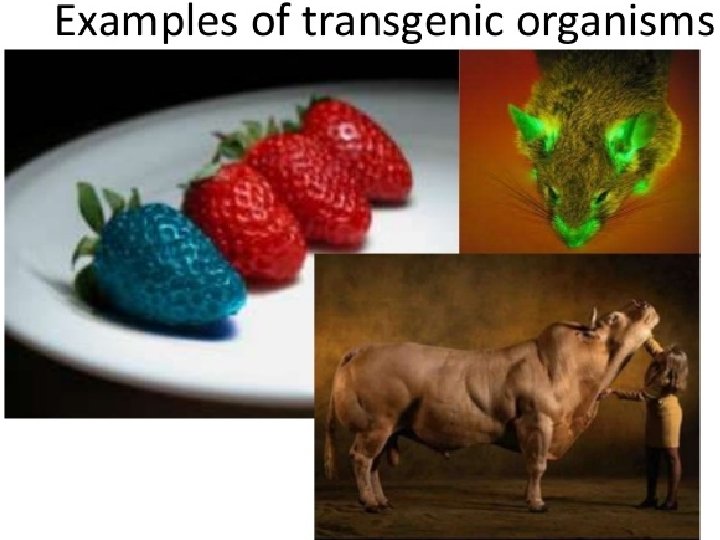
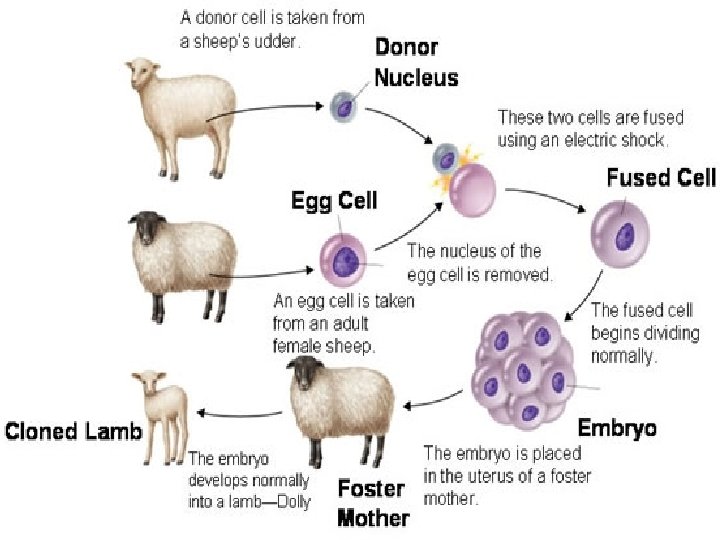
Applications of Genetic Engineering • TRANSGENIC ORGANISMS – ANIMALS • Used to study genes & improve food supplies • Non-GMO? • Some transgenic livestock have extra copies of growth hormone gene so they grow faster & produce leaner meat. • Some transgenic livestock are more resistant to bacterial infections. • TRANSGENIC ORGANISMS – PLANTS • Some contain genes that produce natural insecticide • Some crop plants contain genes that enable them to resist weed-killing chemicals allowing weeds to be controlled while not harming the crops. • Some plants contain genes that produce food that is resistant to rot and spoilage. • CLONING • 1) nucleus of an egg cell is removed; 2) that cell is fused with a cell taken from another adult; 3) fused cell begins to divide & become an embryo 4) embryo is placed into the uterus of a foster mother; 5) the clone develops and is born; 6) “Dolly”, the cloned sheep, produces normal offspring!
- Slides: 20