
Genetic diversity Genetic resources and conservation BS Biotechnology
Genetic diversity Genetic resources and conservation BS Biotechnology (6 th Semester) University of Sargodha
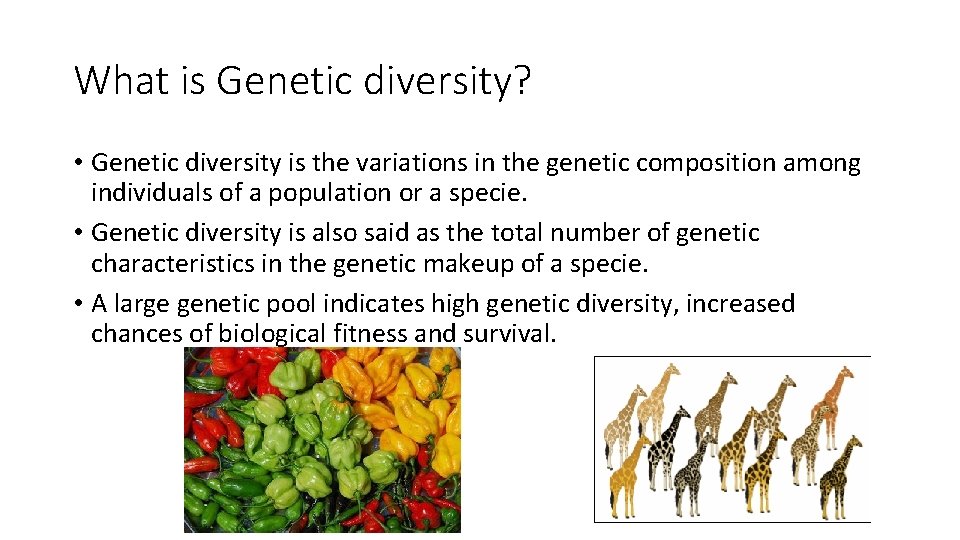
What is Genetic diversity? • Genetic diversity is the variations in the genetic composition among individuals of a population or a specie. • Genetic diversity is also said as the total number of genetic characteristics in the genetic makeup of a specie. • A large genetic pool indicates high genetic diversity, increased chances of biological fitness and survival.
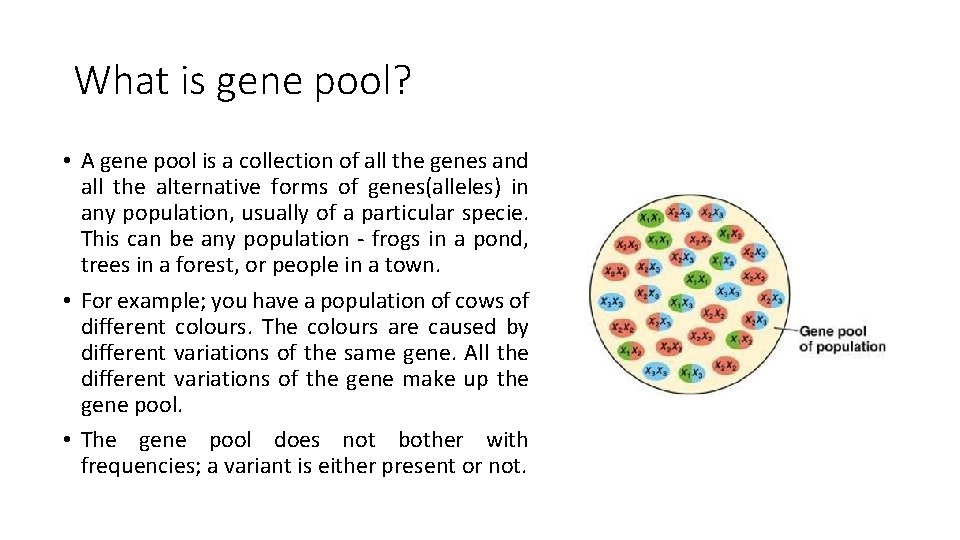
What is gene pool? • A gene pool is a collection of all the genes and all the alternative forms of genes(alleles) in any population, usually of a particular specie. This can be any population - frogs in a pond, trees in a forest, or people in a town. • For example; you have a population of cows of different colours. The colours are caused by different variations of the same gene. All the different variations of the gene make up the gene pool. • The gene pool does not bother with frequencies; a variant is either present or not.
Gene pool • The composition of a population’s gene pool can change over time through evolution. • The result is a gene pool that is altered to be attuned to the needs of the population’s specific environment • For example, the migration of human populations from equatorial regions toward northern climates, where they were exposed to relatively low amounts of sunlight, resulted in changes over time in skin pigmentation, with skin becoming lighter in colour to augment vitamin D absorption (vitamin D is critical for proper bone development). The genetic modifications underlying the change in pigmentation ultimately became a part of many of those populations’ gene pools.

Causes of Genetic variations • Genetic variation are generally referred to the variations in genes between different individuals of a population • Genetic variation is important for the survival and adaptation of a species, as it helps in terms of natural selection and evolution. • Genetic variations are caused by • • • Mutations Genetic drift Gene flow Non-random mating Natural selection
Mutations • Gene mutations • Chromosomal mutations Gene mutations are small changes affecting the nucleotide sequence of one gene. The two main types of gene mutations are point mutations and frameshift mutations. Chromosome mutations are substantial alterations of the genetic material of an organism. They change either the number or the structure of chromosomes. Types of chromosomal mutations are deletions, duplications, insertions, inversions, and translocations.
Gene mutations • Insertion: the addition of single or very few nucleotides in DNA sequence. • Deletion: Removal of single or very few nucleotides in DNA sequence. • Substitution: Replacement of single or very few nucleotides in DNA sequence with other nucleotides. These changes can lead to point mutations (silent mutation, missense mutation or nonsense mutation). Insertion/deletion can also cause frameshift mutation.
Gene mutations: Point mutations • Silent mutations: Silent mutations do not have any effect on the cell’s metabolism because the change in codon does not lead to the change in amino acid. • Missense mutations: Missense mutations code for different amino acids. The result of these type of gene mutations can be altered but still functional protein. • Nonsense mutations: Nonsense mutations code for premature stop codons which lead to producing non-functional shortened proteins.
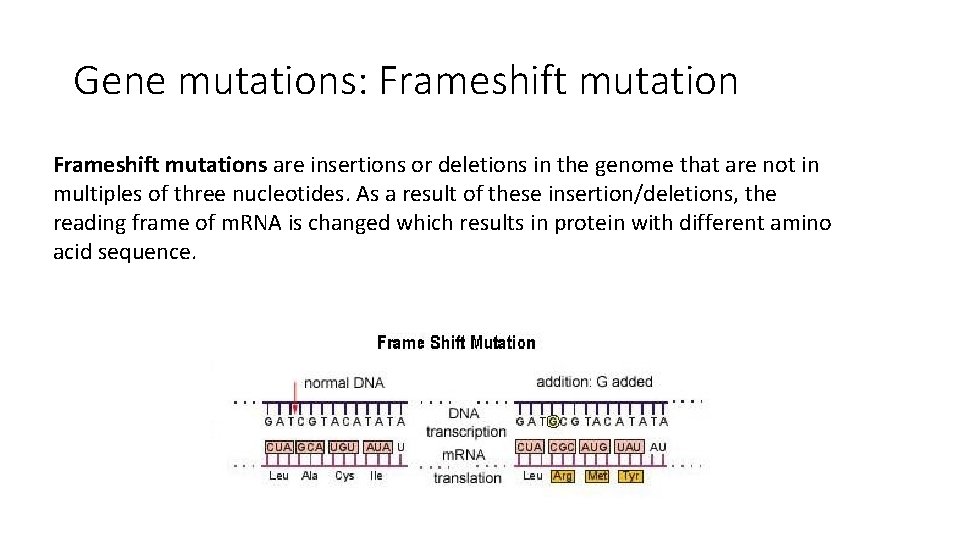
Gene mutations: Frameshift mutations are insertions or deletions in the genome that are not in multiples of three nucleotides. As a result of these insertion/deletions, the reading frame of m. RNA is changed which results in protein with different amino acid sequence.
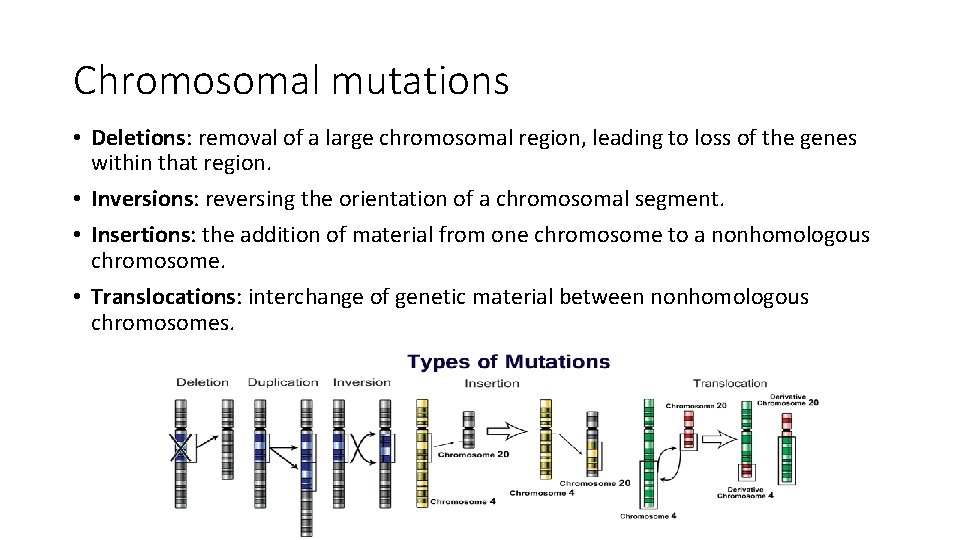
Chromosomal mutations • Deletions: removal of a large chromosomal region, leading to loss of the genes within that region. • Inversions: reversing the orientation of a chromosomal segment. • Insertions: the addition of material from one chromosome to a nonhomologous chromosome. • Translocations: interchange of genetic material between nonhomologous chromosomes.
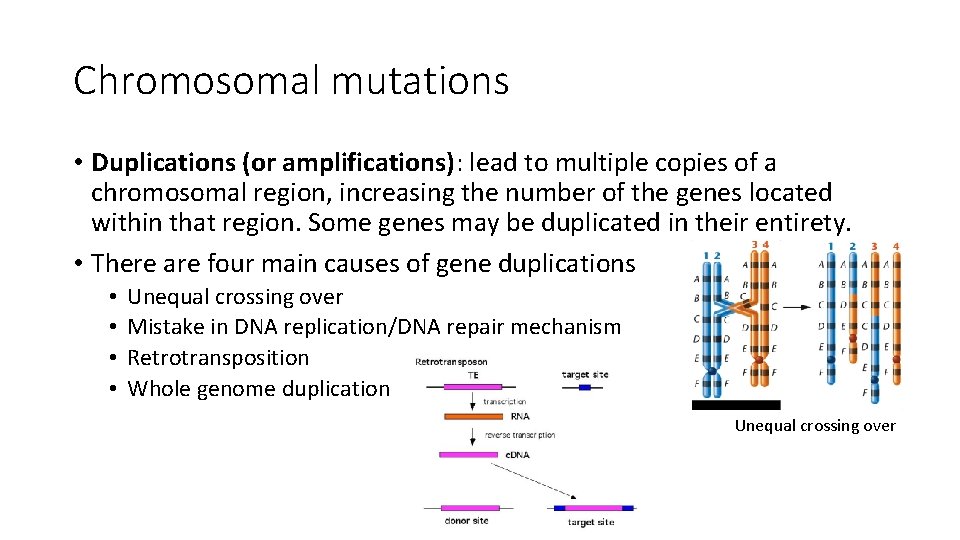
Chromosomal mutations • Duplications (or amplifications): lead to multiple copies of a chromosomal region, increasing the number of the genes located within that region. Some genes may be duplicated in their entirety. • There are four main causes of gene duplications • • Unequal crossing over Mistake in DNA replication/DNA repair mechanism Retrotransposition Whole genome duplication Unequal crossing over
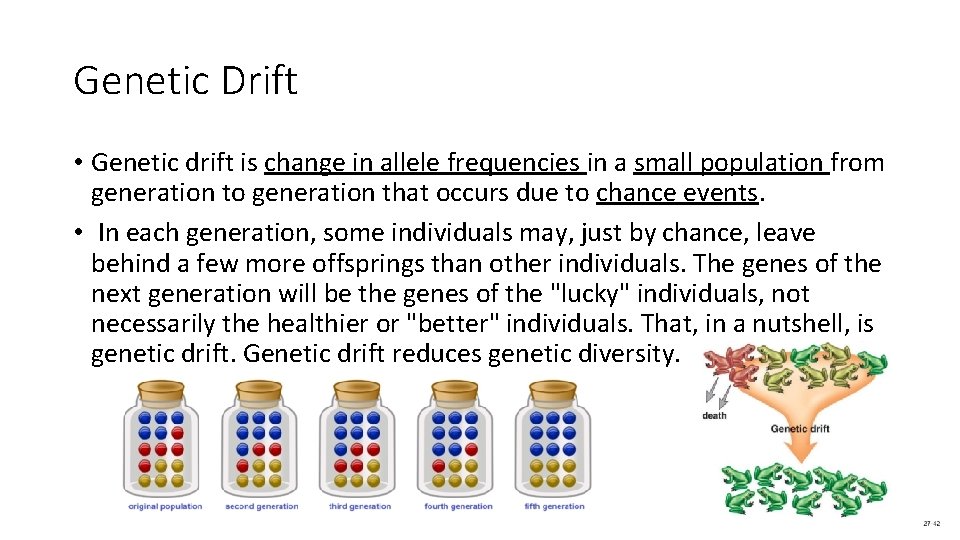
Genetic Drift • Genetic drift is change in allele frequencies in a small population from generation to generation that occurs due to chance events. • In each generation, some individuals may, just by chance, leave behind a few more offsprings than other individuals. The genes of the next generation will be the genes of the "lucky" individuals, not necessarily the healthier or "better" individuals. That, in a nutshell, is genetic drift. Genetic drift reduces genetic diversity.
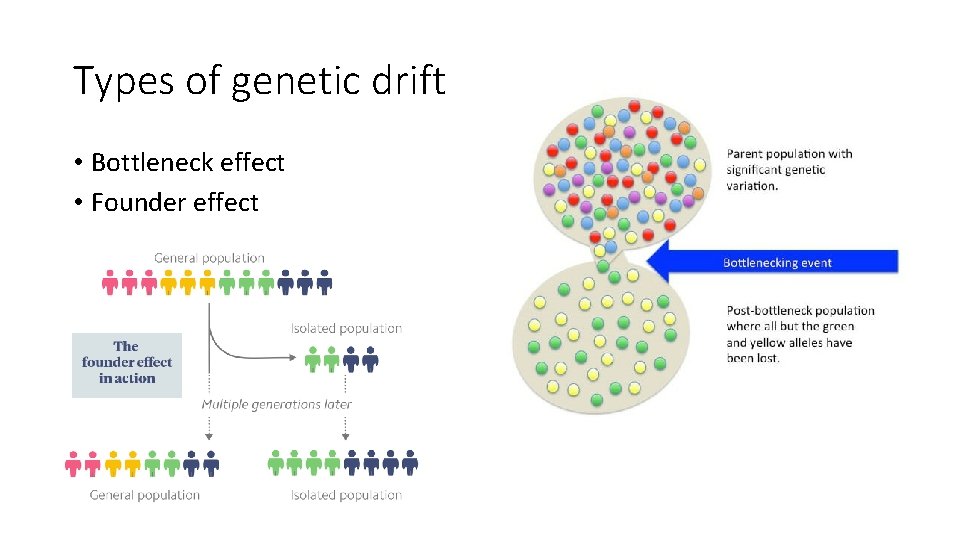
Types of genetic drift • Bottleneck effect • Founder effect
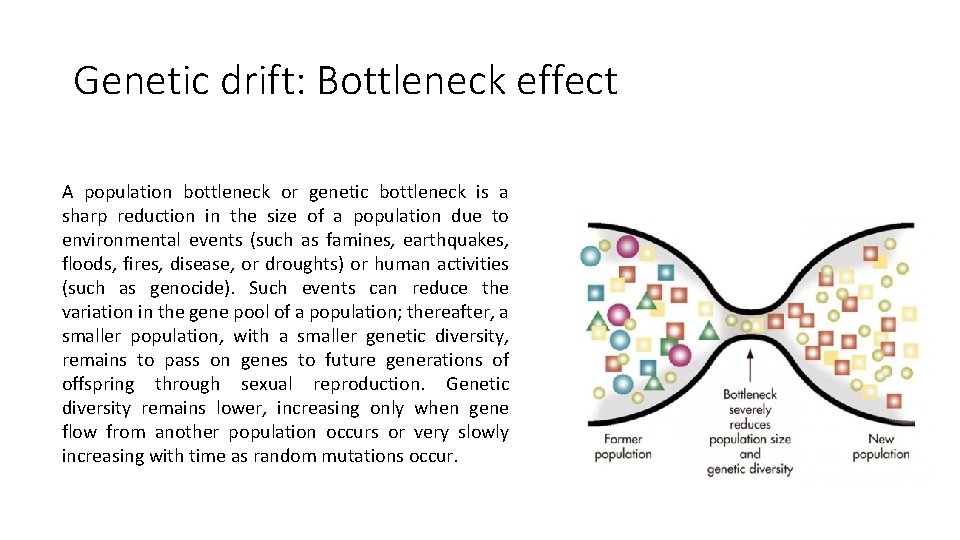
Genetic drift: Bottleneck effect A population bottleneck or genetic bottleneck is a sharp reduction in the size of a population due to environmental events (such as famines, earthquakes, floods, fires, disease, or droughts) or human activities (such as genocide). Such events can reduce the variation in the gene pool of a population; thereafter, a smaller population, with a smaller genetic diversity, remains to pass on genes to future generations of offspring through sexual reproduction. Genetic diversity remains lower, increasing only when gene flow from another population occurs or very slowly increasing with time as random mutations occur.
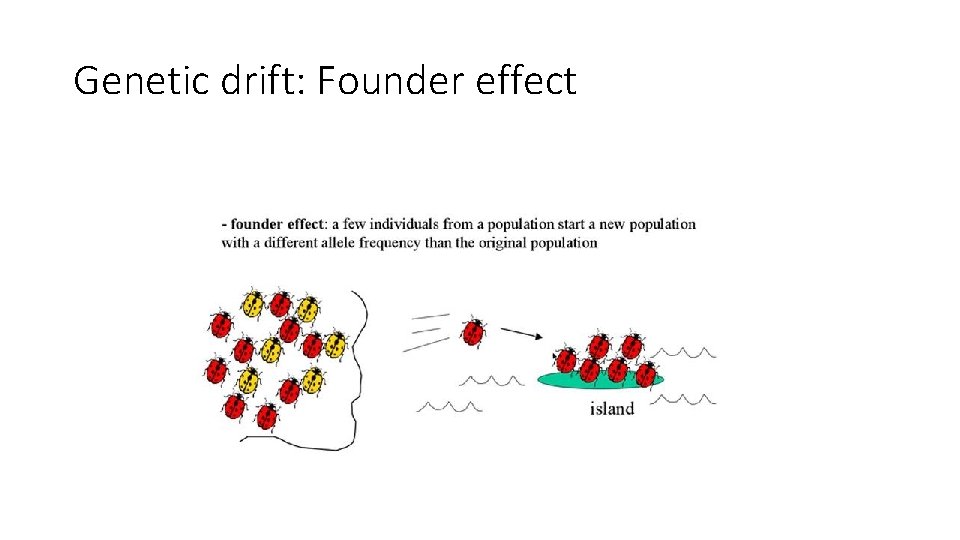
Genetic drift: Founder effect • the founder effect is the loss of genetic variation that occurs when a new population is established by a very small number of individuals from a larger population. • For example: • Huntington's disease also occurs in unusually high frequency near Lake Maraciabo, Venezuela. After much research, scientists were not only able to discover the mutation that causes the devastating disease, but also trace it back to the founder herself. 200 years ago, a women had 10 children all of whom stayed in the area to raise their own children. Unfortunately, Huntington's is a dominant allele meaning that if one parent carries it, there is a 50: 50 chance it will be passed to the offspring. The disease has been able to persist for so long because natural selection no longer acts after reproduction, which is when Huntington's begins to take its effects.
Genetic drift: Founder effect
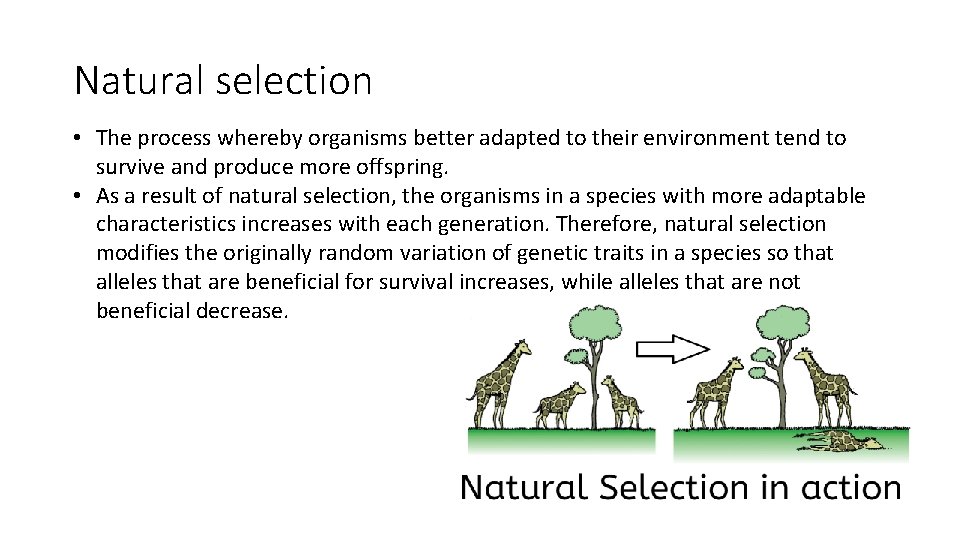
Natural selection • The process whereby organisms better adapted to their environment tend to survive and produce more offspring. • As a result of natural selection, the organisms in a species with more adaptable characteristics increases with each generation. Therefore, natural selection modifies the originally random variation of genetic traits in a species so that alleles that are beneficial for survival increases, while alleles that are not beneficial decrease.
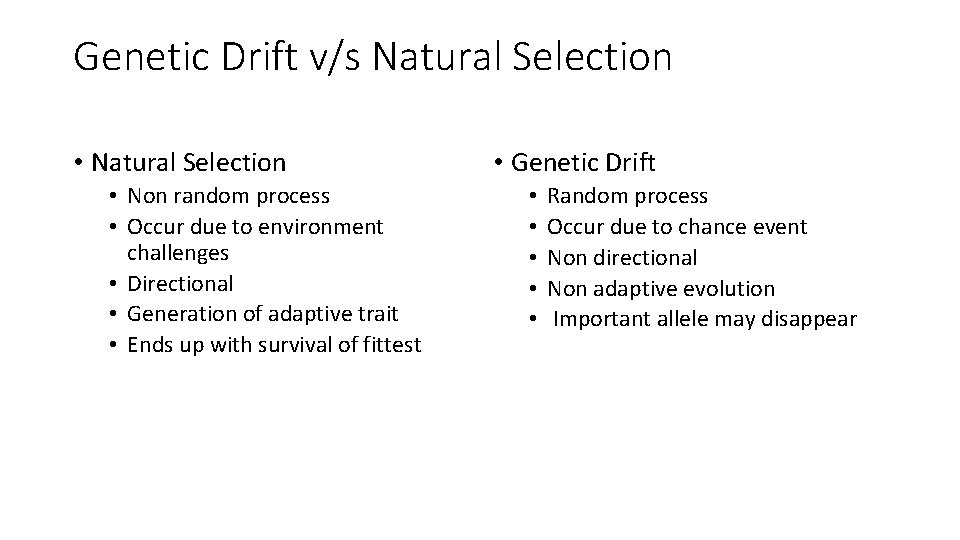
Genetic Drift v/s Natural Selection • Non random process • Occur due to environment challenges • Directional • Generation of adaptive trait • Ends up with survival of fittest • Genetic Drift • • • Random process Occur due to chance event Non directional Non adaptive evolution Important allele may disappear
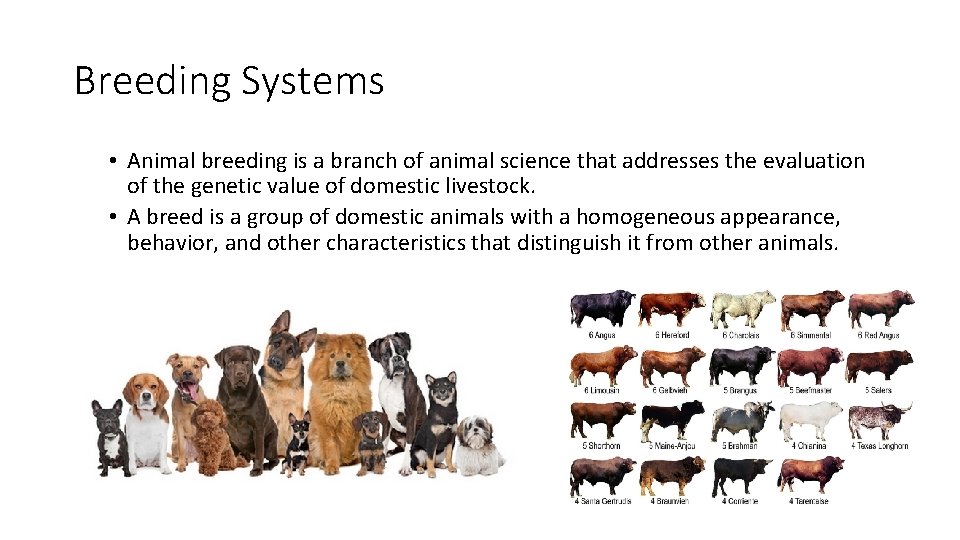
Breeding Systems • Animal breeding is a branch of animal science that addresses the evaluation of the genetic value of domestic livestock. • A breed is a group of domestic animals with a homogeneous appearance, behavior, and other characteristics that distinguish it from other animals.
Difference between specie and breed Specie: A fundamental category of taxonomic classification, ranking below a genus or subgenus and consisting of related organisms capable of interbreeding Breed: A group of usually domesticated animals or plants presumably related by descent from common ancestors and visibly similar in most characters Same species can have different breeds. Different breeds of the same species can "cross-breed" together, and their offspring will be fertile. It is not the same case when the "cross" is between different species. Like, mule (cross between donkey and horse). These cross-species breeding usually result in offspring which are infertile.
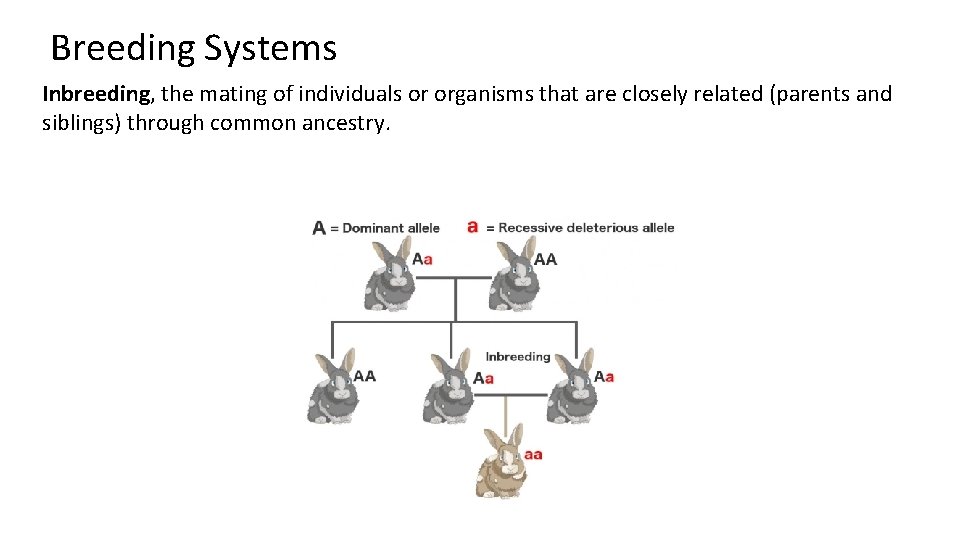
Breeding Systems Inbreeding, the mating of individuals or organisms that are closely related (parents and siblings) through common ancestry.
Breeding systems: inbreeding • Increased inbreeding is accompanied by reduced fertility, slower growth rates, greater susceptibility to disease, and higher mortality rates. • In a small population, matings between close relatives are common. This inbreeding may lower the population's ability to survive and reproduce, this phenomenon is called as inbreeding depression.

Breeding Systems Linebreeding, the mating of individuals or organisms that are distantly related (other than parents and siblings) through common ancestry.
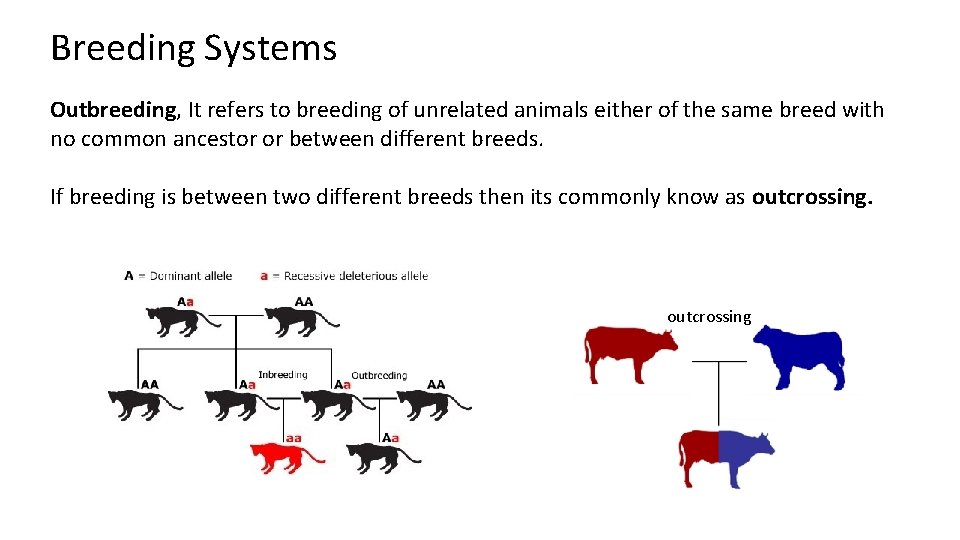
Breeding Systems Outbreeding, It refers to breeding of unrelated animals either of the same breed with no common ancestor or between different breeds. If breeding is between two different breeds then its commonly know as outcrossing
- Slides: 24