
GENETIC DISORDERS I The chromosomal abnormalities A Autosomal

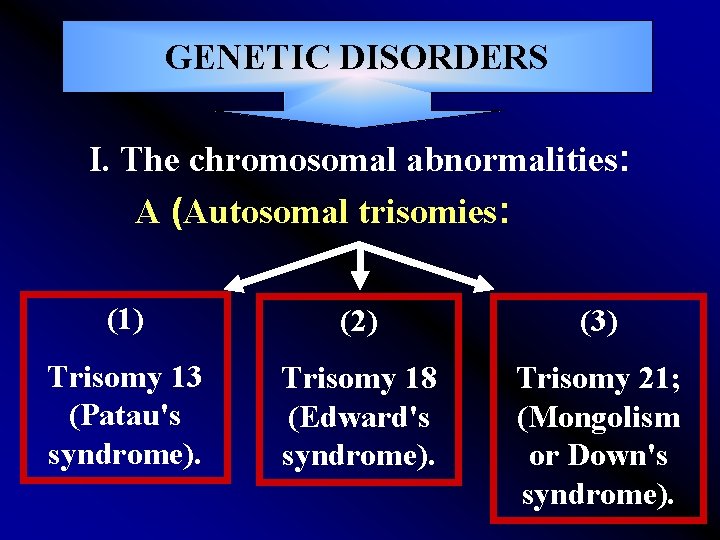
GENETIC DISORDERS I. The chromosomal abnormalities: A (Autosomal trisomies: (1) (2) (3) Trisomy 13 (Patau's syndrome). Trisomy 18 (Edward's syndrome). Trisomy 21; (Mongolism or Down's syndrome).
GENETIC DISORDERS I. The chromosomal abnormalities: B (Sex chromosome abnormalities : (1) (2) Turner's syndrome: Klinfelter syndrome.
GENETIC DISORDERS I. The chromosomal abnormalities: C (Partial deletion syndromes : (1) (2) Walf-Hirschhorn syndrome (4 p-). Cri-du-chat syndrome (5 p-).
GENETIC DISORDERS I. The chromosomal abnormalities: D (Tuberous sclerosis :
GENETIC DISORDERS I. The chromosomal abnormalities: E (Neurofibromatosis :
GENETIC DISORDERS II. Specific gene defects: 1) Autosomal dominant conditions: a) Osteogenesis imperfecta: 2) Autosomal recessive conditions: a) Hurler's syndrome (gargoylism, mucopoly saccharidosis I): b) Phenylketonuria: c) Werding-Hoffmann disease (Spinalmuscular atrophy):

3) Sex-linked inherited disorders: a) Muscular dystrophy (Duchene or Pseudohyper-trophic type). b) Hemophilia: c) Lesch-Nyhan syndrome (hereditary hyperuricemia choreoathetosis): or hereditary
Summary of the common clinical physical symptoms: 1) Muscle tone disorders: 2) Skeletal deformities: 3) Delayed motor development: 4) Mental retardation: 5) Cerebellar dysfunction:

The pediatric therapist dealing with genetic disorders, is usually concerned with habilitation rather than rehabilitation. Sensorimotor, emotional-affective, and cognitiveperceptual.
Evaluation • The aims of the physical therapy evaluation in such a multiple handicap child are: 1. To establish the child's developmental level. 2. To provide the cause of developmental delay. 3. To develop long-term programming goals and short term objectives.
Treatment procedures 1. Normalization of muscle tone. 2. Facilitation of normal postural pattern. 3. Facilitation of normal movement pattern.
4. Normalization of sensorimotor development. 5. To instruct the parents, teachers and other caregivers with the proper handling techniques. 6. To integrate physical therapy into the classroom or infant stimulation.

- Slides: 19