
Genetic Changes in gene pool Evolution Natural Selection
- Slides: 7
Genetic Changes in gene pool = Evolution
Natural Selection on Populations • Natural Selection on single gene traits can lead to changes in allele frequency…that’s evolution • Natural selection can affect the distribution of phenotypes (in a polygenic trait) in three basic ways – Directional selection – Stabilizing selection – Disruptive selection
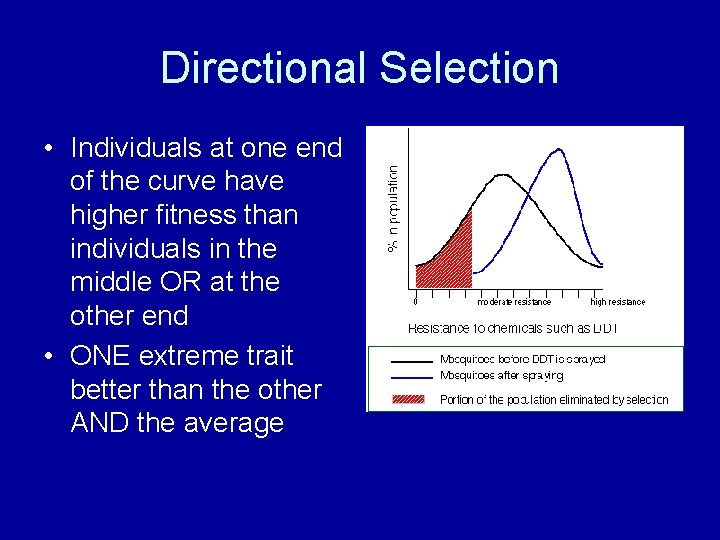
Directional Selection • Individuals at one end of the curve have higher fitness than individuals in the middle OR at the other end • ONE extreme trait better than the other AND the average
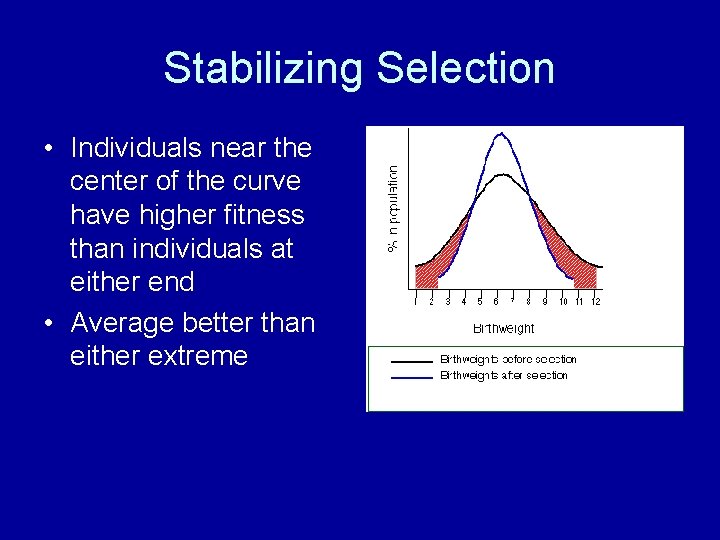
Stabilizing Selection • Individuals near the center of the curve have higher fitness than individuals at either end • Average better than either extreme
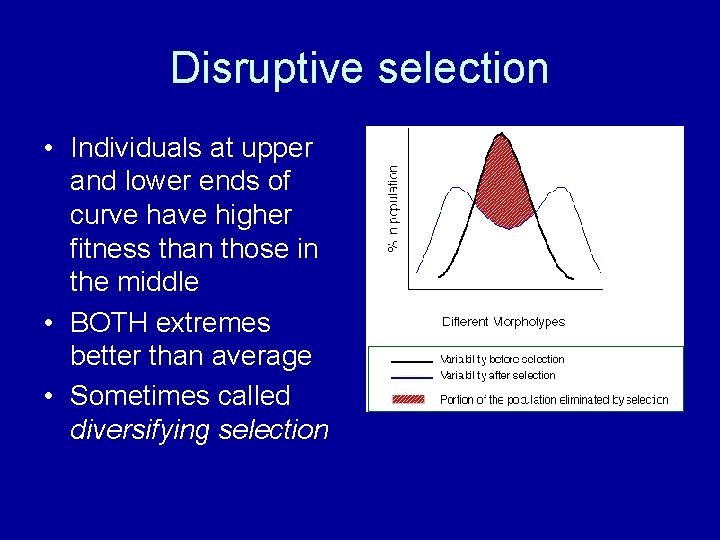
Disruptive selection • Individuals at upper and lower ends of curve have higher fitness than those in the middle • BOTH extremes better than average • Sometimes called diversifying selection
Genetic Drift • Alleles can become more or less common simply by chance rather than as a result of evolution (very common in small populations) • This is called genetic drift • In small populations, individuals that carry a particular allele may leave more descendants than other individuals, just by chance. Over time, a series of chance occurrences of this type can cause an allele to become common in a population
Genetic equilibrium • If allele frequencies remain constant no change takes place…a population will not evolve • This is called genetic equilibrium • The Hardy-Weinberg principle states five conditions under which no change will occur 1. There must be random mating 2. The population must be very large 3. There can be no movement into or out of population 4. No mutations can occur 5. There can be no natural selection