
Genetic and Evolutionary Computation Conference Montral Canada 6

![Wide Range of Applications 3 D RECONSTRUCTION Object Recognition [1 -6] Image Retrieval [7](https://slidetodoc.com/presentation_image_h2/fd20aa94c871549fab7329afd7c4d6df/image-5.jpg "Wide Range of Applications 3 D RECONSTRUCTION Object Recognition [1 -6] Image Retrieval [7")
![References [1] D. G. Lowe. Object recognition from local scale-invariant features. In Proceedings of](https://slidetodoc.com/presentation_image_h2/fd20aa94c871549fab7329afd7c4d6df/image-23.jpg "References [1] D. G. Lowe. Object recognition from local scale-invariant features. In Proceedings of")
![References [8] S. Lazebnik, C. Schmid and J. Ponce. A Sparse Texture Representation Using](https://slidetodoc.com/presentation_image_h2/fd20aa94c871549fab7329afd7c4d6df/image-24.jpg "References [8] S. Lazebnik, C. Schmid and J. Ponce. A Sparse Texture Representation Using")
![References [15] E. Tola, V. Lepetit and P. Fua. A fast descriptor for dense](https://slidetodoc.com/presentation_image_h2/fd20aa94c871549fab7329afd7c4d6df/image-25.jpg "References [15] E. Tola, V. Lepetit and P. Fua. A fast descriptor for dense")
- Slides: 26
Genetic and Evolutionary Computation Conference Montréal, Canada 6 th ANNUAL “HUMIES” AWARDS Evolutionary Learning of Local Descriptor Operators for Object Recognition Present : Cynthia B. Pérez and Gustavo Olague Evo. Visión Laboratory Computer Science Department, CICESE Research, Ensenada B. C. México July 2009
Related Publications Perez C. B. , Olague G. “Learning Invariant Region Descriptor Operators with Genetic Programming and the F-Measure”. International Conference on Pattern Recognition (ICPR). December 8 -11, 2008. Perez C. B. , Olague G. “Evolutionary Learning of Local Descriptor Operators for Object Recognition”. Genetic and Evolutionary Computation Conference (GECCO). July 8 -12, 2009. 2
Human Competitiveness This work fullfils 7 of the 8 criteria for human competitiveness: (A) The result was patented as an invention in the past, is an improvement over a patented invention, invention or would qualify today as a patentable new invention. (B) The result is equal to or better than a result that was accepted as a new scientific result at the time when it was published in a peer-reviewed scientific journal. (C) The result is equal to or better than a result that was placed into a database or archive of results maintained by an internationally recognized panel of scientific experts. (D) The result is publishable in its own right as a new scientific result 3/4 independent of the fact that the result was mechanically created. (E) The result is equal to or better than the most recent human-created solution to a long-standing problem for which there has been a succession of increasingly better human-created solutions. (F) The result is equal to or better than a result that was considered an achievement in its field at the time it was first discovered. (G) The result solves a problem of indisputable difficulty in its field. 3
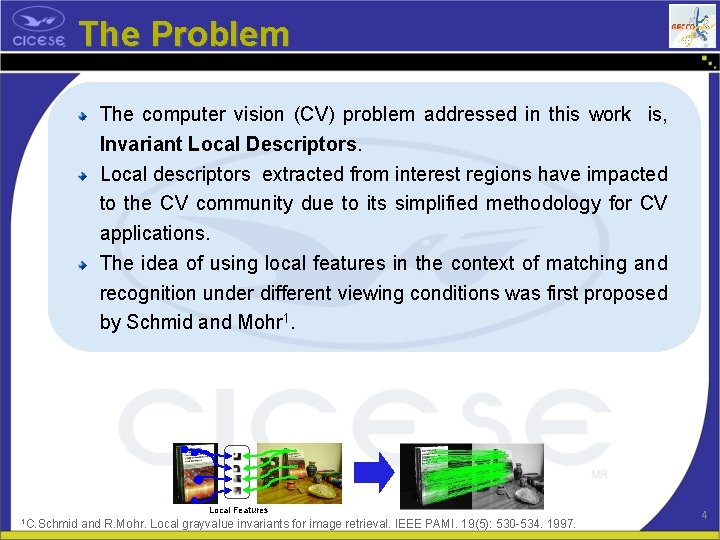
The Problem The computer vision (CV) problem addressed in this work is, Invariant Local Descriptors. Local descriptors extracted from interest regions have impacted to the CV community due to its simplified methodology for CV applications. The idea of using local features in the context of matching and recognition under different viewing conditions was first proposed by Schmid and Mohr 1. Local Features 1 C. Schmid and R. Mohr. Local grayvalue invariants for image retrieval. IEEE PAMI. 19(5): 530 -534. 1997. 4
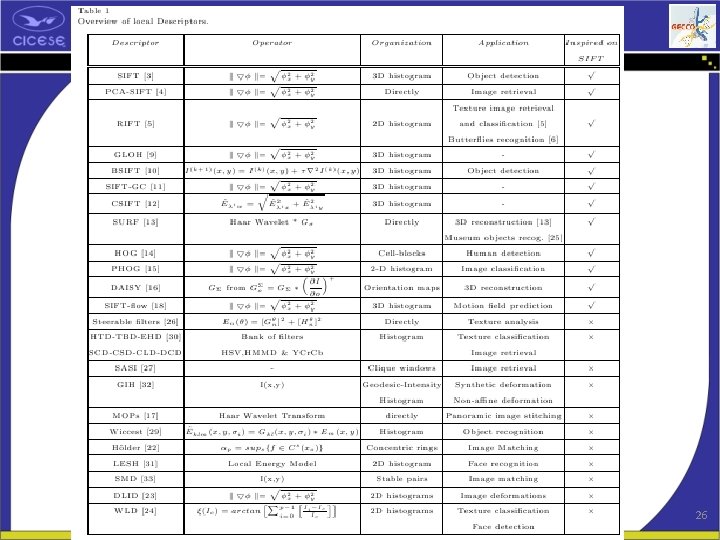
Wide Range of Applications 3 D RECONSTRUCTION Object Recognition [1 -6] Image Retrieval [7 -10] Human Detection [11] MOTION FIELD PREDICTION Texture Classification [9, 12, 13] 3 D Reconstruction [14, 15] HUMAN DETECTION Motion Field Prediction [16] Image Deformation [17, 18] FACE DETECTION Image Panoramic Assembly [19] Face Detection [13, 20] IMAGE PANORAMIC ASSEMBLY 5
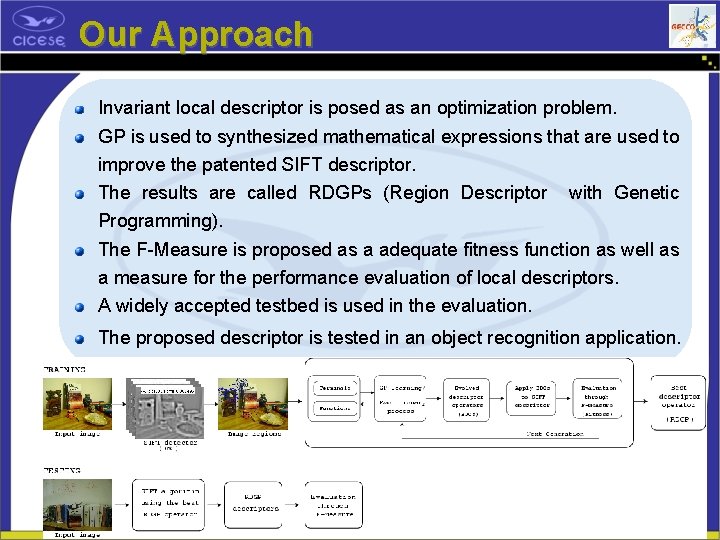
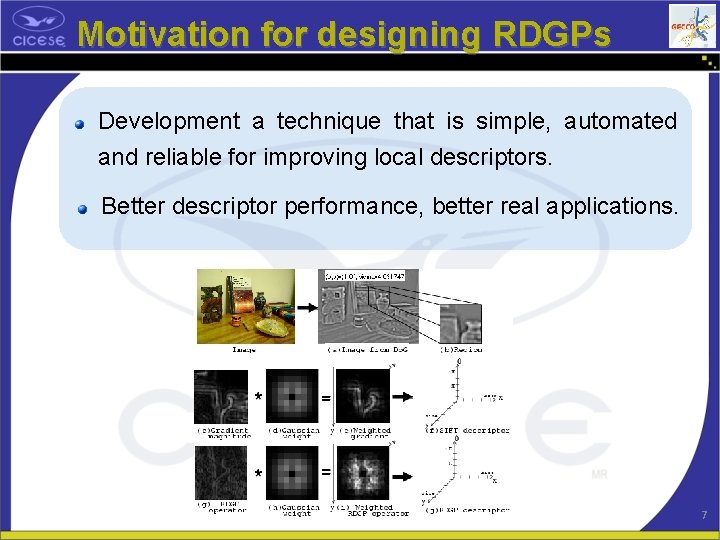
Our Approach Invariant local descriptor is posed as an optimization problem. GP is used to synthesized mathematical expressions that are used to improve the patented SIFT descriptor. The results are called RDGPs (Region Descriptor with Genetic Programming). The F-Measure is proposed as a adequate fitness function as well as a measure for the performance evaluation of local descriptors. A widely accepted testbed is used in the evaluation. The proposed descriptor is tested in an object recognition application. 6
Motivation for designing RDGPs Development a technique that is simple, automated and reliable for improving local descriptors. Better descriptor performance, better real applications. 7
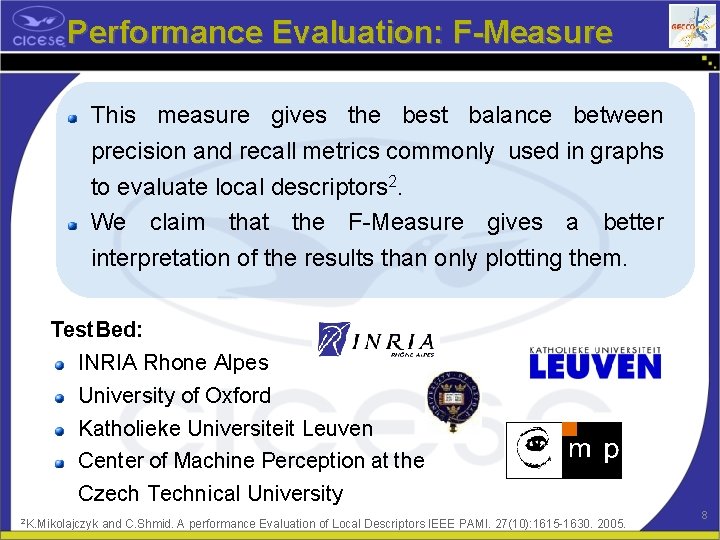
Performance Evaluation: F-Measure This measure gives the best balance between precision and recall metrics commonly used in graphs to evaluate local descriptors 2. We claim that the F-Measure gives a better interpretation of the results than only plotting them. Test. Bed: INRIA Rhone Alpes University of Oxford Katholieke Universiteit Leuven Center of Machine Perception at the Czech Technical University 2 K. Mikolajczyk and C. Shmid. A performance Evaluation of Local Descriptors IEEE PAMI. 27(10): 1615 -1630. 2005. 8
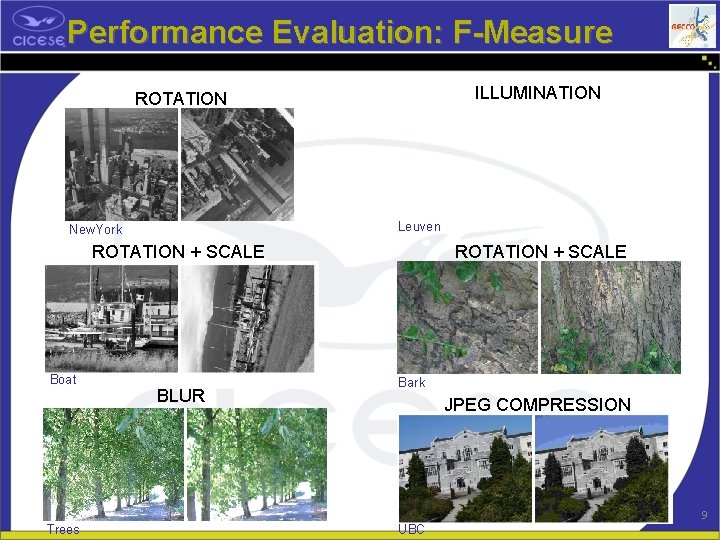
Performance Evaluation: F-Measure ILLUMINATION ROTATION Leuven New. York ROTATION + SCALE Boat BLUR ROTATION + SCALE Bark JPEG COMPRESSION 9 Trees UBC
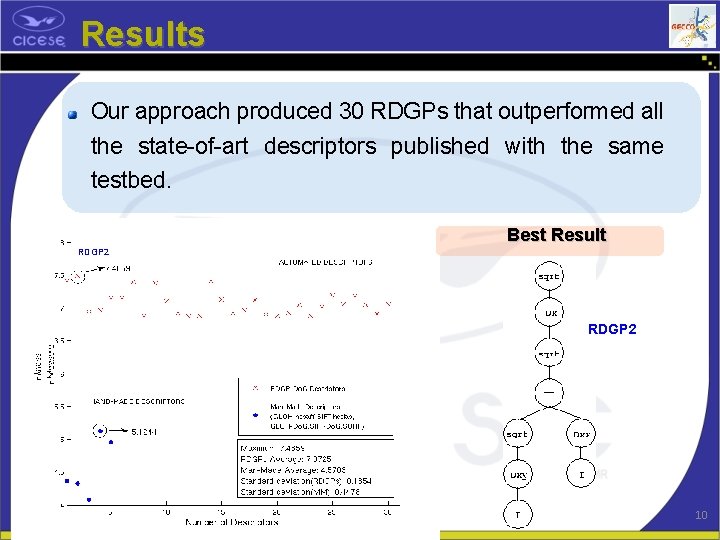
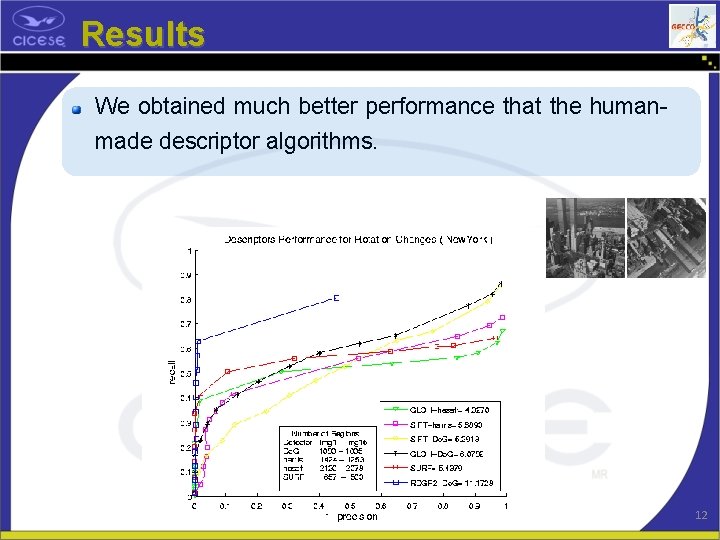
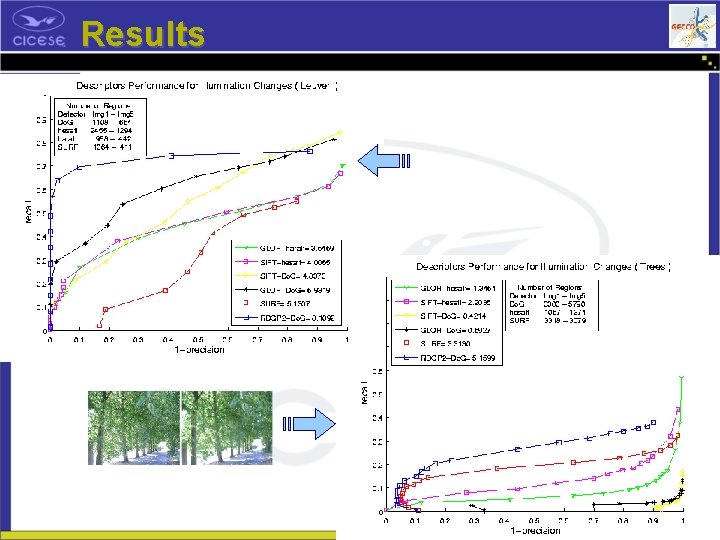
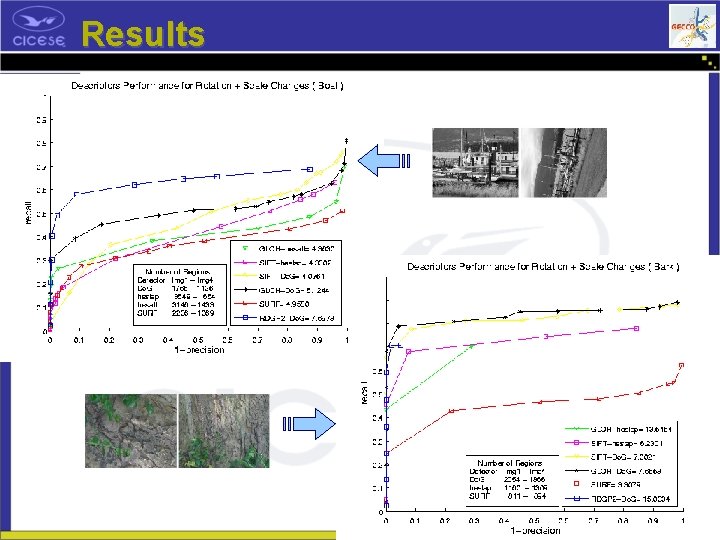
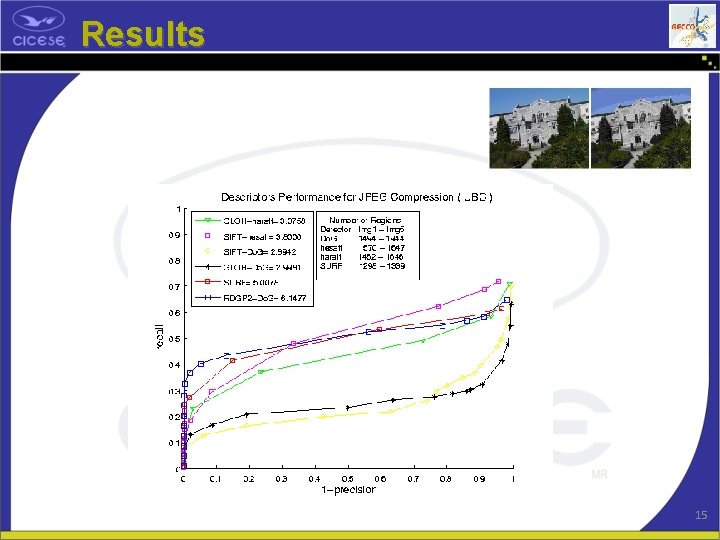
Results Our approach produced 30 RDGPs that outperformed all the state-of-art descriptors published with the same testbed. Best Result RDGP 2 10
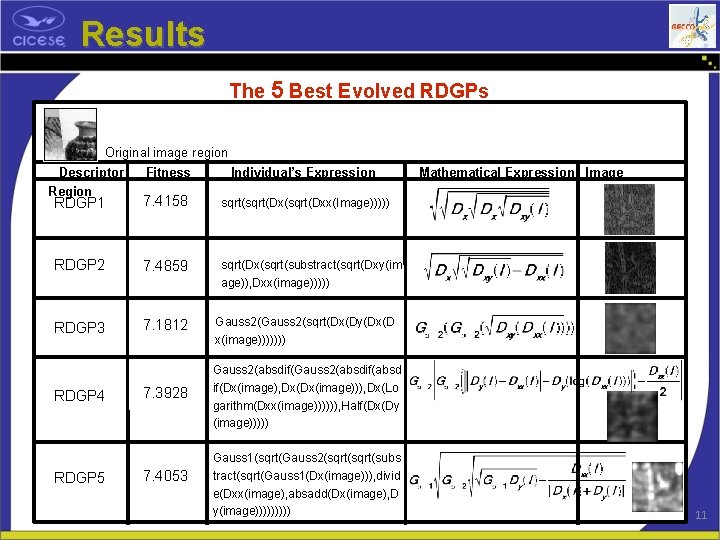
Results The 5 Best Evolved RDGPs Original image region Descriptor Region Fitness Individual’s Expression RDGP 1 7. 4158 sqrt(Dx(sqrt(Dxx(Image))))) RDGP 2 7. 4859 sqrt(Dx(sqrt(substract(sqrt(Dxy(im age)), Dxx(image))))) RDGP 3 7. 1812 Gauss 2(sqrt(Dx(Dy(Dx(D x(image))))))) 7. 3928 Gauss 2(absdif(absd if(Dx(image), Dx(Dx(image))), Dx(Lo garithm(Dxx(image)))))), Half(Dx(Dy (image))))) RDGP 4 RDGP 5 7. 4053 Gauss 1(sqrt(Gauss 2(sqrt(subs tract(sqrt(Gauss 1(Dx(image))), divid e(Dxx(image), absadd(Dx(image), D y(image))))) Mathematical Expression Image 11
Results We obtained much better performance that the humanmade descriptor algorithms. 12
Results 13
Results 14
Results 15
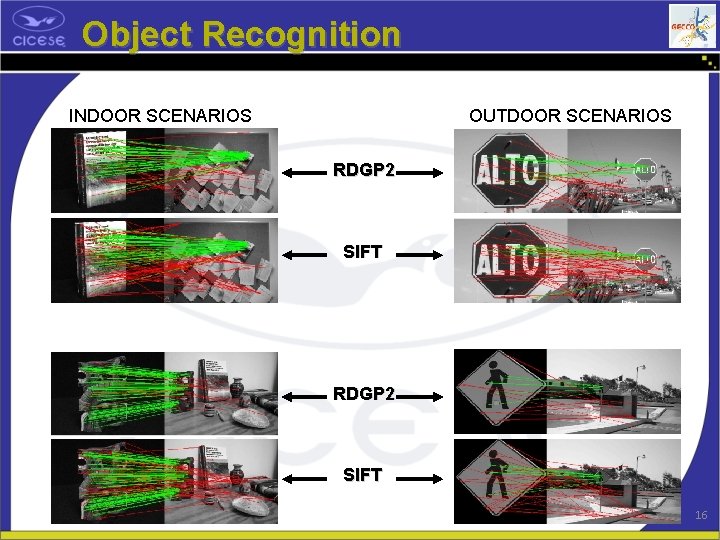
Object Recognition INDOOR SCENARIOS OUTDOOR SCENARIOS RDGP 2 SIFT 16
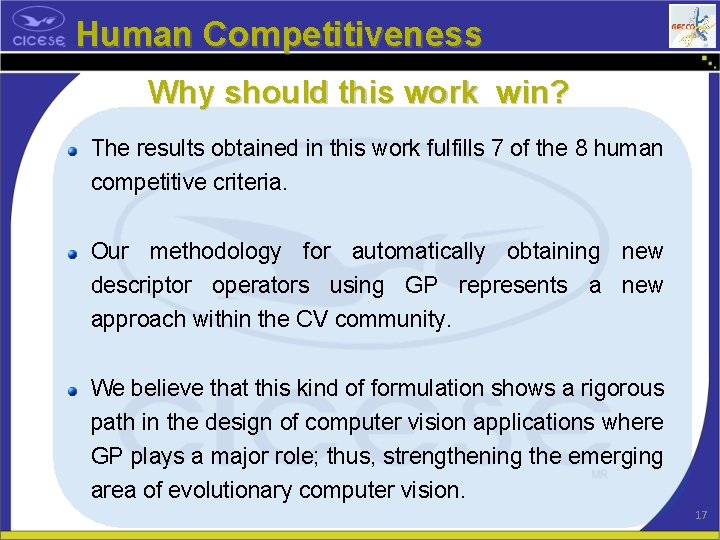
Human Competitiveness Why should this work win? The results obtained in this work fulfills 7 of the 8 human competitive criteria. Our methodology for automatically obtaining new descriptor operators using GP represents a new approach within the CV community. We believe that this kind of formulation shows a rigorous path in the design of computer vision applications where GP plays a major role; thus, strengthening the emerging area of evolutionary computer vision. 17
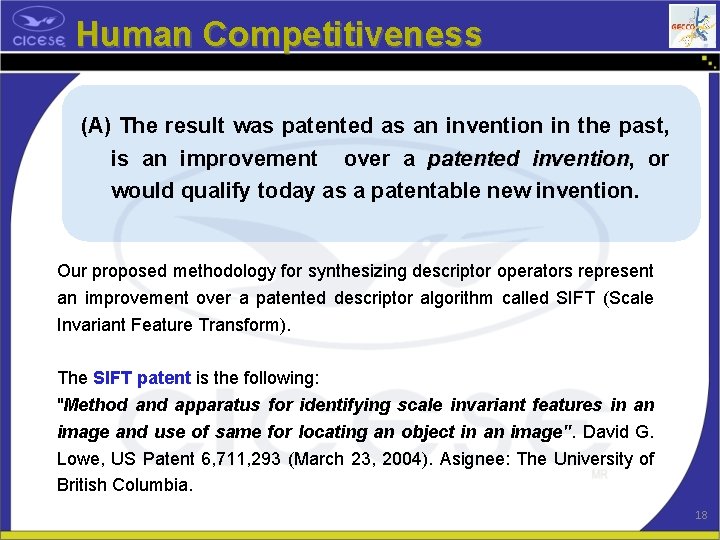
Human Competitiveness (A) The result was patented as an invention in the past, is an improvement over a patented invention, invention or would qualify today as a patentable new invention. Our proposed methodology for synthesizing descriptor operators represent an improvement over a patented descriptor algorithm called SIFT (Scale Invariant Feature Transform). The SIFT patent is the following: "Method and apparatus for identifying scale invariant features in an image and use of same for locating an object in an image". David G. Lowe, US Patent 6, 711, 293 (March 23, 2004). Asignee: The University of British Columbia. 18
Human Competitiveness (B) The result is equal to or better than a result that was accepted as a new scientific result at the time when it was published in a peer-reviewed scientific journal. Here, we compared our results with previous published descriptors from which their evaluation technique was based on a recall vs 1 -precision space. Thus, we tested several works to compare our descriptor algorithm and in particular we found that our results surpassed the overall performance of previous local descriptors including the following: David G. Lowe, "Distinctive image features from scale-invariant keypoints, " International Journal of Computer Vision, 60(2): 91 -110, 2004. K. Mikolajczyk, C. Schmid, A performance evaluation of local descriptors. IEEE Transactions on Pattern Analysis and Machine Learning, 27(10): 1615 -1630, 2005. Herbert Bay, Andreas Ess, Tinne Tuytelaars, Luc Van Gool, "SURF: Speeded Up Robust Features", Computer Vision and Image Understanding (CVIU), 110(3): 346 -359, 2008. 19
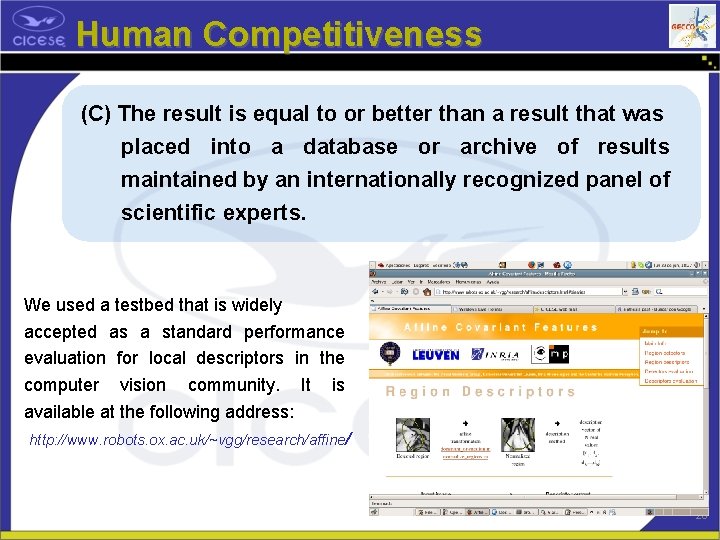
Human Competitiveness (C) The result is equal to or better than a result that was placed into a database or archive of results maintained by an internationally recognized panel of scientific experts. We used a testbed that is widely accepted as a standard performance evaluation for local descriptors in the computer vision community. It is available at the following address: http: //www. robots. ox. ac. uk/~vgg/research/affine/ 20
Human Competitiveness (D), (E) and (F) (D) The result is publishable in its own right as a new scientific result 3/4 independent of the fact that the result was mechanically created. (E) The result is equal to or better than the most recent human-created solution to a long-standing problem for which there has been a succession of increasingly better human-created solutions. (F) The result is equal to or better than a result that was considered an achievement in its field at the time it was first discovered. Our methodology for automatically obtaining new descriptor operators using genetic programming represents a new approach within the computer vision field; in particular, it address a new approach where local descriptors could be synthesized through GP. As a by product, the results found by genetic programming in the experimental stage surpassed our initial expectations; indeed, we obtained much better performance than the human-made descriptor algorithms. As a conclusion, we have improved the SIFT algorithm which has been considered until now, an achievement in its field using GP. 21
Human Competitiveness (G) The result solves a problem of indisputable difficulty in its field. Today, most computer vision conferences and journals devote a special session or section to local descriptors research because it has became a powerful technique for solving real-world vision problems. Thus, our proposed technique opens a research avenue towards evolutionary learning of local descriptors Here, we demostrated the effectiveness of our GP approach through an extensive experimental study and its application using an object recognition problem. 22
References [1] D. G. Lowe. Object recognition from local scale-invariant features. In Proceedings of the IEEE Conference on Computer Vision. pp. 1150 -- 1157. 1999. [2] S. Lazebnik, C. Schmid and J. Ponce. Semi-local affine parts for object recognition. In Proceedings of the BMVC. Vol. 2, pp. 959 -- 968. 2004. [3] A. Stein and M. Hebert. Incorporating background invariance into feature-based object recognition. IEEE Workshops on Application of Computer Vision. pp. 37 -- 44. 2005. [4] E. Mortensen, H. Deng and L. Shapiro. A SIFT descriptor with global context. In Proceedings of the IEEE Conference on CVPR. Vol. 1, pp. 184 -- 190. 2005. [5] H. Bay, B. Fasel and L. Van Gool. Interactive museum guide: fast and robust recognition of museum objects. In Proceedings of the first International Workshop on Mobile Vision. 2006. [6] J. Geusebroek. Compact object descriptors from local colour invariant histograms. In British Machine Vision Conference. Vol. 3, pp. 1029 -- 1038. 2006. [7] Yan Ke, Rahul Sukthankar. “PCA-SIFT: A More distinctive representation for local image descriptors”. Computer Vision and Pattern Recognition, CVPR 2004 23
References [8] S. Lazebnik, C. Schmid and J. Ponce. A Sparse Texture Representation Using Affine-Invariant Regions. CVPR. Vol. 2, pp. 319 -- 324. 2003. [9] B. S. Manjunath, J. Ohm, V. Vasudevan and A. Yamada. Color and texture descriptors. IEEE Transactions on Circuits and Systems for Video Techonology. 11(6): 703 -- 715. 2001. [10] A. Carkacioglu and F. Yarman-Vural. SASI: a generic texture descriptor for image retrieval. Pattern Recognition. 33(11): 2615 -- 2633. 2003. [11] Navneet Dalal and Bill Trigs. Histograms of oriented gradients for human detection. In Proceedings of the IEEE CVPR. pp. 886 -- 893. 2006. [12] A. Bosch, A. Zisserman, X. Munoz. Representing shape with a spatial pyramid kernel. International Conference on Image and Video Retrieval. pp. 401 -- 408. 2007. [13] J. Chen, S. Shan, G. Zhao, X. Chen, W. Gao and M. Pietikainen. A robust descriptor based on Weber's law. CVPR 2008. [14] H. Bay, T. Tuytelaars and L. Van Gool. SURF: Speeded up robust features. In Proceedings of the European Conference on Computer Vision. LNCS 3951, pp. 404 -- 417. 2006. 24
References [15] E. Tola, V. Lepetit and P. Fua. A fast descriptor for dense matching. In Proceedings of the IEEE Conference on Computer Vision and Pattern Recognition. 2008. [16] C. Liu, J. Yuen, A. Torralba and J. Sivic. SIFT flow: dense correspondence across different scenes. European Conference on Computer Vision. Marseille, France. October 2008. [17] H. Ling and D. Jacobs. Deformation invariant image matching. In Proceedings on the International Conference on Computer Vision. Vol. 2. pp. 1466 -- 1473. 2005. [18] H. Cheng, Z. Liu, N. Zheng and J. Yang. A deformable local image descriptor. In Proceedings of the IEEE Conference on Computer Vision and Pattern Recognition. 2008. [19] M. Brown. R. Szeliski and S. Winder. Multi-image matching using multi-scale oriented patches. Conference on Computer Vision and Pattern Recognition. pp. 510 -- 517. 2005. [20] S. Sarfraz and O. Hellwich. Head pose estimation in face recognition across pose scenarios. International Conference on Computer Vision Theory and Applications. pp. 235 -- 242. 2008. 25
26