
Genetic and Cultural Underpinnings Is Ethnicity a Primordial





- Slides: 28
Genetic and Cultural Underpinnings Is Ethnicity a Primordial Feature of Human Society?
Population Genetics § § § Sometimes known as archaeo-genetics Genetic History of Populations Usually focuses on ethnic groups Looks at fissions and fusions of groups Dating fissions requires comparison with paleontological evidence based on pottery & fossils (dating) § Also comparisons with historical evidence
How Have We Arrived at Today's Ethno-Genetic Map? § Role of mutation, followed by demographic expansion § OR – role of technological change, followed by demographic expansion § Survival of the 'fittest' § Question of whether people kill each other or mix as populations meet through expansion and war
Present Time TCGAGGTATTAAC TCTAGGTATTAAC TCGAGGCATTAAC TCTAGGTGTTAAC TCGAGGTATTAGC TCTAGGTATCAAC Most recent common ancestor (MRCA)
Fossil Hunters vs DNA Hunters § Until recently, many paleontologists believed that different human 'races' may have had different origins (i. e. Java Man, Peking man, Cro-Magnon Man) § Belief that Europeans related to the Neanderthals § Subsequent evidence shows Neanderthals became extinct § Genetic Research shows humans all descended from common ancestor, 'Eve' § Racial/Political sensitivities as well as disciplinary battles attached to competing theories
Out of Africa § § § Small groups left Africa 146, 000 years ago These few spawned all non-Africans Europe settled by African and Asian pioneers 40, 000 years ago § New environments lead to genetic drift and new physical characteristics § Had cultural differences and lived in groups, but were these groups ethnic or merely loose tribes?
Are Genetic Populations Culturally Distinct? § Walter Wallace suggests that human populations diverged between 100, 000 and 10, 000 years ago § They then began to meet and converge, forming ethnies, then nations, then supranations and will recombine into a global whole § But do genetically distinct groups mix as easily as those that are similar? § Were cultures linked to genes?
But Culture Can Affect Evolution § In Wales, cultural division maintained genetic division vis a vis the English § High correlation between language evolution and genetic evolution § Only a few exceptions like the Lapps, Ethiopians, Tibetans (where fusion with genetic neighbours occurred even as languages remained apart) § So human cultures can affect genetic evolution and prevent mixing – OR – mixing can occur, often under conditions of inequality
Stronger Cultures Expand § 10, 000 -6000 BC middle east agricultural expansion § Greek expansion of first millennium BC § Cattle cultures (ie Bantu, European) bring disease, are linked with hierarchical and complex social systems § Push out hunter-gatherers (ie San, Aborigines) § How self-conscious were these 'cultures' or are these just our scientific labels § Culture is not necessarily ethnic consciousness
Assimilation or Extermination? § Question of whether ruling group imposes its culture or becomes assimilated § Does ruling group spread its genes more due to mate selection and better access to resources? § Some studies suggest this (ie 50 -100% of English gene contribution from Anglo-Saxons, despite historical evidence of small Anglo-Saxon settlement) § In North America, Natives lost 95% of their numbers. In tropical Latin America, native stock remains a majority
'Populations' vs Ethnic Groups § 'Populations' and 'cultures' are observed by the traveller or scientist (i. e. archaeologist, genetic anthropologist) § But were these populations self-conscious? § Native Indians of North America culturally close – but not united. Some side with French, others with English § Culture zones vs. ethnic groups
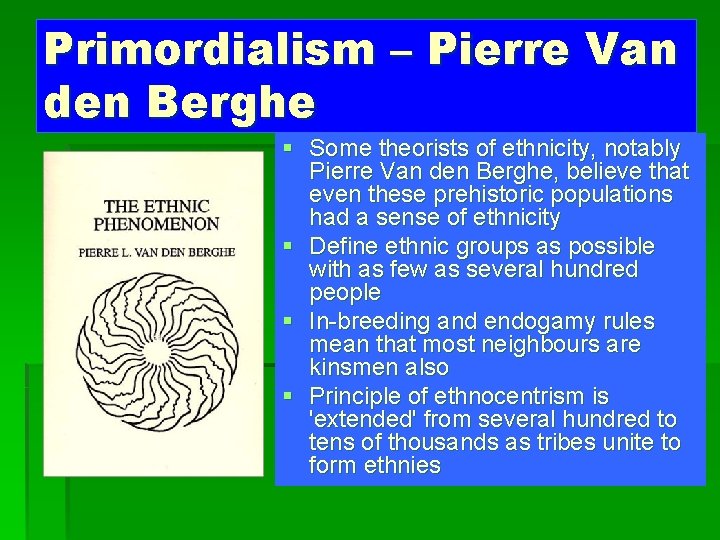
Primordialism – Pierre Van den Berghe § Some theorists of ethnicity, notably Pierre Van den Berghe, believe that even these prehistoric populations had a sense of ethnicity § Define ethnic groups as possible with as few as several hundred people § In-breeding and endogamy rules mean that most neighbours are kinsmen also § Principle of ethnocentrism is 'extended' from several hundred to tens of thousands as tribes unite to form ethnies
Ethnicity and Evolution § As with animals, people who cooperated survived to pass on their genes § Evolved a disposition for 'collective nepotism' to favour own § This instinct survives in phenomena like ethnicity and nationalism
Passion Groups vs Interest Groups § Type I groups based on genetic relatedness: family, kin, lineage, tribe, ethnie, nation, 'race'/civilisation § Type II groups based on interest: parties, trade unions, classes, associations § Can have blend of I and II: ie. ethnic parties or ethnic associations
Passion Groups vs Interest Groups § Type I groups more easily mobilised, arouse stronger passion § Genetically-rooted in the evolutionary experience of premodern humanity § Type II groups more amenable to calculation and rational self-interest § Culturally-driven and products of only the very recent period in human evolution (ie modern period post-1789)
Ethnic Groups and Culture § Neighbouring groups physically similar in premodernity § So group boundaries based on other criteria § Relatedness ‘read’ off cultural markers
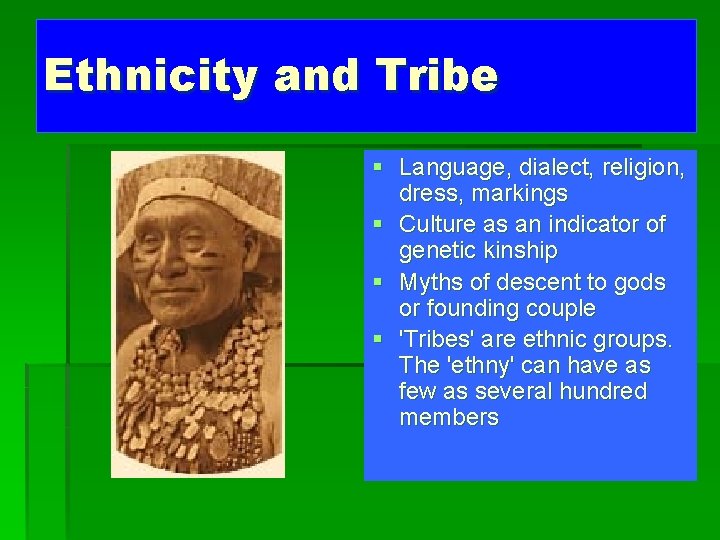
Ethnicity and Tribe § Language, dialect, religion, dress, markings § Culture as an indicator of genetic kinship § Myths of descent to gods or founding couple § 'Tribes' are ethnic groups. The 'ethny' can have as few as several hundred members
Ethnicity as Primordial § Origin of ethnicity is in our evolutionary pre-history, before written records § Biological impulses – not culture or material interest - drive ethnocentric psychology § Culture can shape, but cannot override our biology, which we share with other primates § Thus any talk about ethnicity as modern, or as constructed by culture, power or interest is Utopian
Other Primordialists § Geertz – Cross-cultural anthropology shows primordialism to be psychologically universal and cannot be suppressed by the state § Grosby – cultural beliefs can shape the form that primordial impulses take ('traditions of belief and action towards primordial objects') § Fishman – psychological power of biological and kinship metaphors, and of appeals to blood
Criticisms: Reynolds 1978 § Reynolds: Van den Berghe has only provided a plausible theory based on generalisation from animals § Evidence and testing of Van den Berghe's theory is lacking § Relations between non-genetic kin often stronger than kin § Often no genetic difference between neighbouring tribes due to exchange – and often no enmity (ie San Bushmen)
Criticisms § Sentiments of ethnicity and nationalism vary over time, whereas biology does not § What is important is to explain the institutions, beliefs and situations which use the biological/psychological instincts § So in looking for what varies, we must focus on cultural changes, institutional changes or economic changes § For example, biological impulses could be satisfied by a multicultural state or a monocultural state;
Criticisms § Perhaps cosmopolitan states (ie socialist, hybridised, the EU) are more problematic, but as long as the basic primordial unit of family loyalties is intact, perhaps every other loyalty/identity can be constructed or deconstructed in the name of ideology, power or wealth (? ? ) § We might come to respond to our new constructed identity in 'primordial ways'
Are Humans Like Animals? § 'In a classic study of bees, Greenberg (1979) bred for fourteen degrees of closeness to a guard bee, which blocks the nest to intruders. Only the more genetically similar intruders got through. ' § 'Squirrels produce litters that contain both full-siblings and half-siblings. Even though they have the same mother, share the same womb, and inhabit the same nest, full siblings fight less often than do half-siblings. Full-siblings also come to each other's aid more often' (Hauber and Sherman 2001).
Recent Primordial Research § Social assortment studies – friendship, spouse choice based on genetic over cultural similarity § Twin and adoption studies – genetic twins have more similar preferences in terms of friends and spouses § This proves primordialism at the level of face-to -face groups, but what about imagined ones?
Recent Primordial Research § Salter (2003) looks at coefficient of relatedness between ethnic groups § shows that degree of relatedness between two members of a given ethnic group is similar to that between half-siblings § Vanhanen (1999) found that levels of ethnic conflict are best predicted by ethnic heterogeneity in a country, with wealth, democracy and freedom far less important
Wider Criticisms § Controlled studies of twins and others show only that we favour close relatives rather than imagined coethnics § Animals lack culture and institutions so studies of animals cannot disprove the argument that cultural overpowers biology § Biology provides impulses which can be fooled, redirected, manipulated (ie. we can behave in a primordial way in defense of trans-ethnic identities like class or team) § Even sociobiologists like Van den Berghe do not claim that their theory drives all – or even most - of the social interactions that fall under the rubric of ethnicity
Conclusion § We consider the prehistorical and premodern context § History of Human Population shows that some genetic groups have expanded, others contracted § Culture and Genetics have been linked, suggesting that they matter, but the fit is not perfect § Not clear how self-conscious these premodern 'populations' or 'cultures' were – especially beyond small groups (i. e. the 'Celts', 'Goths', 'Bantu')
Conclusion § Primordialists suggest that ethnic sentiment goes back into human prehistory § That ethnic sentiment is an extension of kinship instincts § Collective nepotism which drives animal and human family behaviour is what explains the ease with which ethnic sentiments are mobilised and the passions they arouse § Socially constructed ties of ideology and material interest are weaker § Critics allege that primordialism only explains at the micro level (ie family) and that there are no convincing studies which show sociobiology can explain present-day ethnic conflict better than sociological or historical theories