
Genetic and Chromosomal Abnormalities Human chromosomes Most cells
Genetic and Chromosomal Abnormalities
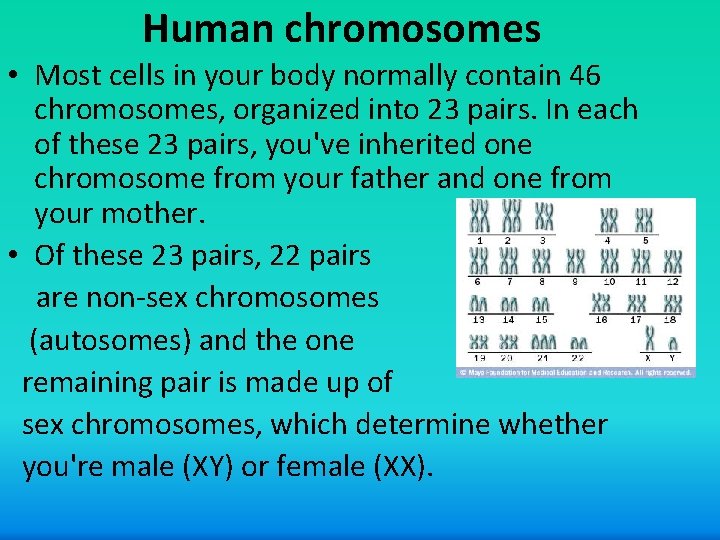
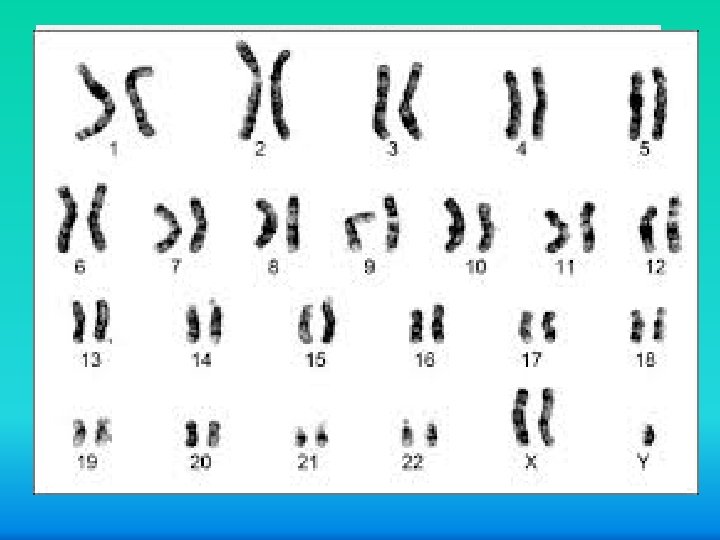
Human chromosomes • Most cells in your body normally contain 46 chromosomes, organized into 23 pairs. In each of these 23 pairs, you've inherited one chromosome from your father and one from your mother. • Of these 23 pairs, 22 pairs are non-sex chromosomes (autosomes) and the one remaining pair is made up of sex chromosomes, which determine whether you're male (XY) or female (XX).
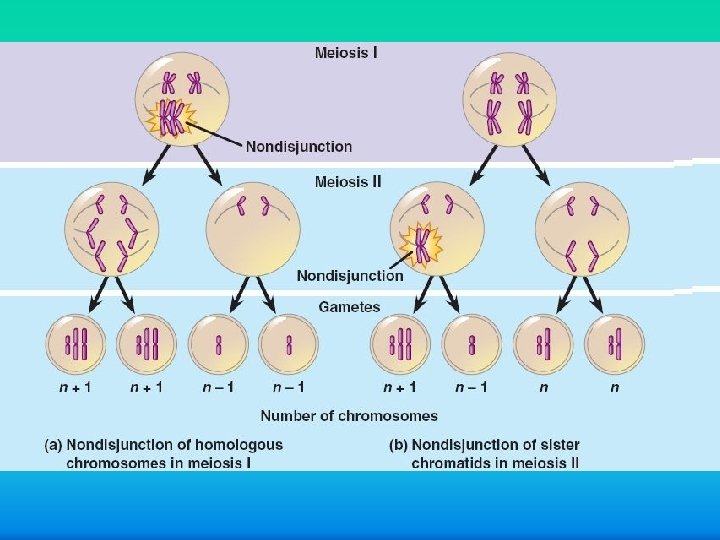
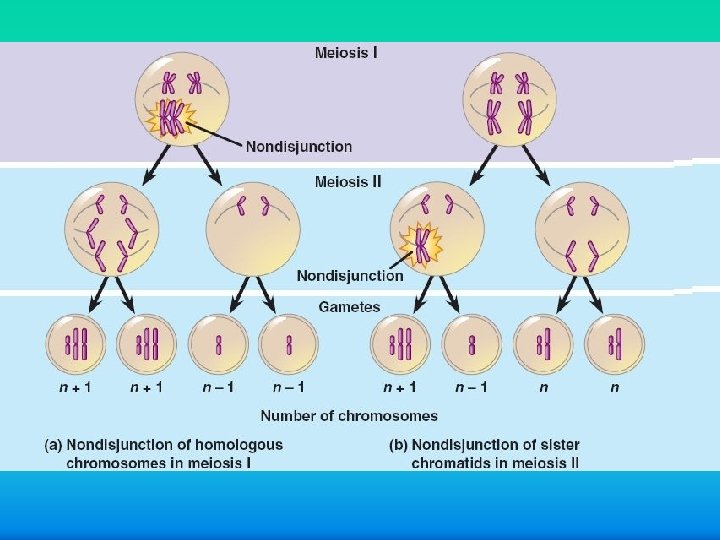
Chromosomal Abnormalities • Result from non-disjunction • Cause too few or too many chromosomes • Can be an autosome or sex chromosome
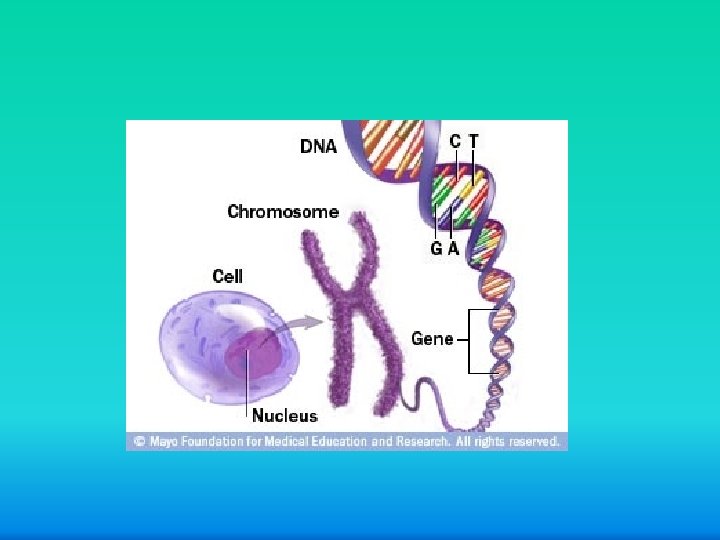
How Genetic Disorders are Inherited • Your body is made up of trillions of cells. Each cell has a nucleus that contains your chromosomes. • Each chromosome is made up of tightly coiled strands of DNA makes up your genes • Genes are segments of DNA that determine specific traits, such as eye or hair color. • A gene mutation is an alteration in your DNA. It can be inherited or acquired during your lifetime, as cells age or are exposed to certain chemicals. Some changes in your genes result in genetic disorders.
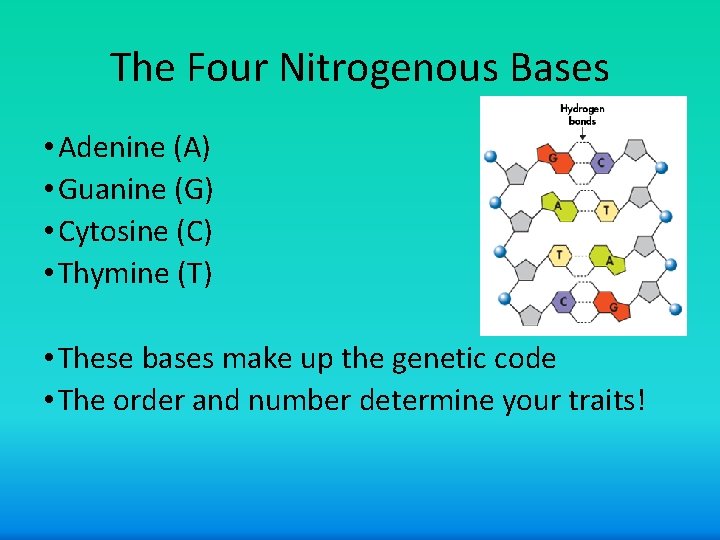
The Four Nitrogenous Bases • Adenine (A) • Guanine (G) • Cytosine (C) • Thymine (T) • These bases make up the genetic code • The order and number determine your traits!
How does your genetic sequence of A, T, C and G control your traits? PROTEIN SYNTHESIS -The sequence directs the proteins that are made, such as pigments, neurotransmitters, enzymes, etc.
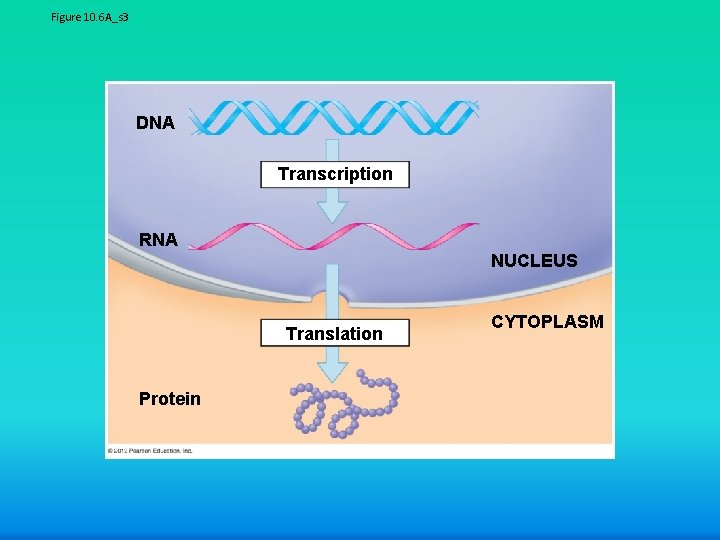
Figure 10. 6 A_s 3 DNA Transcription RNA NUCLEUS Translation Protein CYTOPLASM
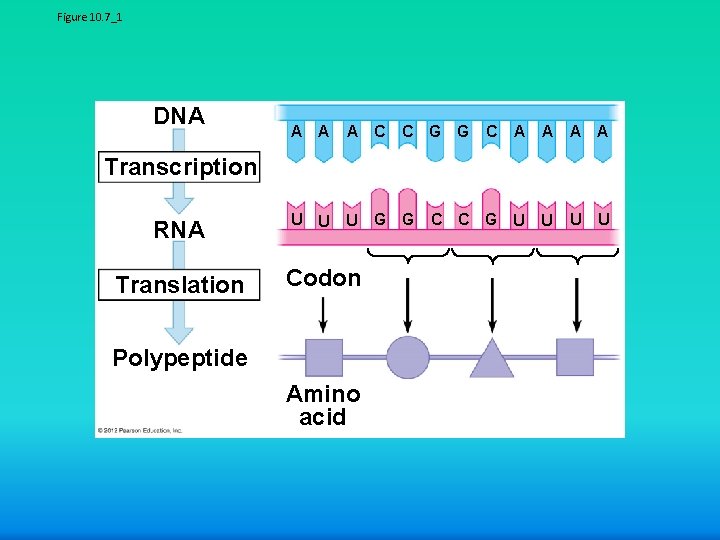
Figure 10. 7_1 DNA A C U U U C G G C A A C G U U U Transcription RNA Translation Codon Polypeptide Amino acid G G C U
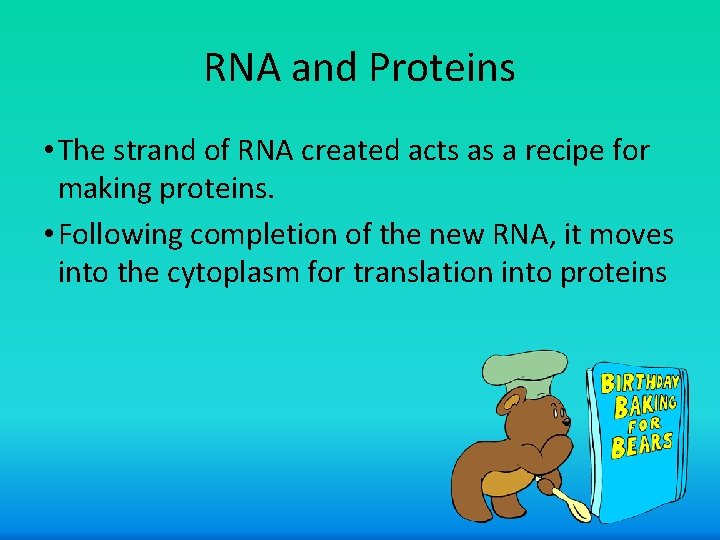
RNA and Proteins • The strand of RNA created acts as a recipe for making proteins. • Following completion of the new RNA, it moves into the cytoplasm for translation into proteins
What is a protein? Amino acids make up Polypeptides make up Proteins
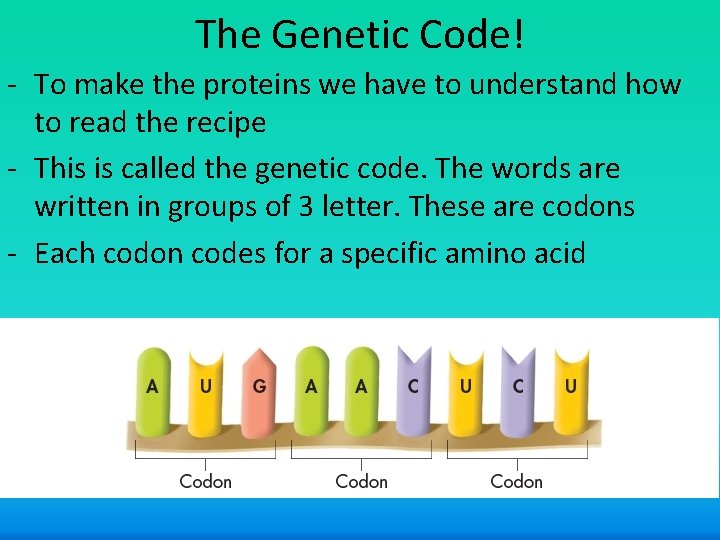
The Genetic Code! - To make the proteins we have to understand how to read the recipe - This is called the genetic code. The words are written in groups of 3 letter. These are codons - Each codon codes for a specific amino acid
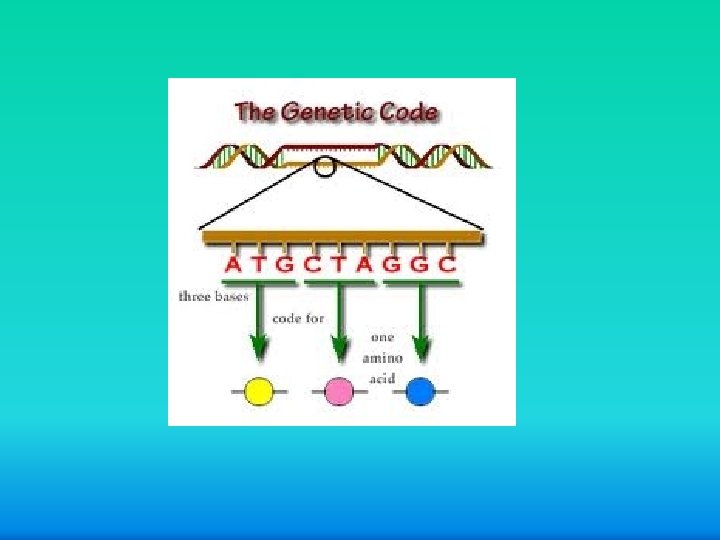
The Genetic Code • Each combination of three base pairs (AUGC) codes for a amino acid • Each “word” in the code is made of three “letters” (AUG)- these are called codons • These codons tell us what amino acids will be added to the polypeptide chain
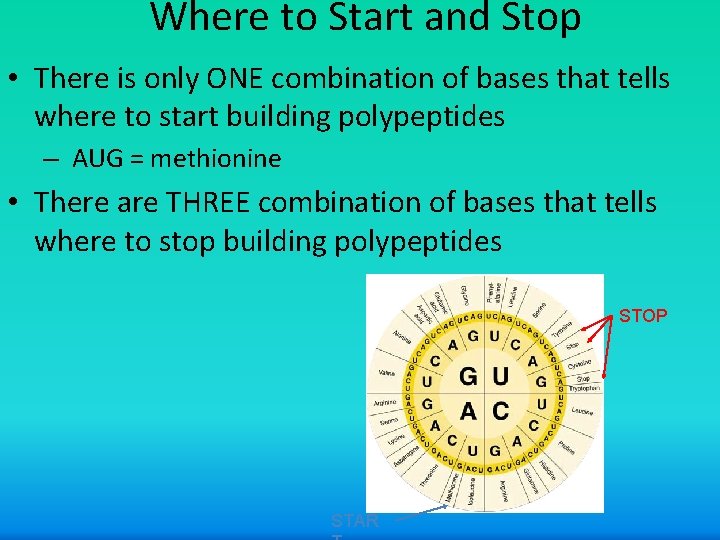
Where to Start and Stop • There is only ONE combination of bases that tells where to start building polypeptides – AUG = methionine • There are THREE combination of bases that tells where to stop building polypeptides STOP STAR
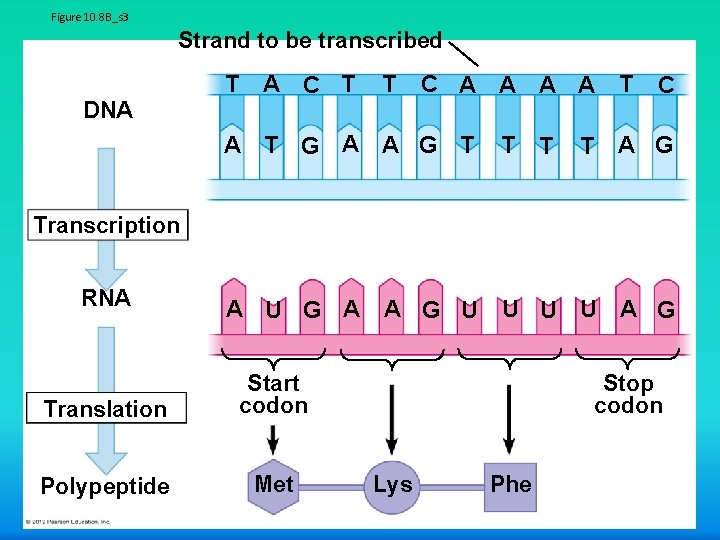
Figure 10. 8 B_s 3 Strand to be transcribed DNA T A C T T C A A T A T G A A G T T T C T A G Transcription RNA A U G A A G U U A G Translation Start codon Polypeptide Met Stop codon Lys Phe
Practice 1: http: //bioweb. uwlax. edu/Gen. Web/Molecular/Theory/Transla tion/trans 1. swf Practice 2: http: //learn. genetics. utah. edu/content/molecules/transcribe/ Practice 3: http: //www. zerobio. com/drag_oa/protein/transcription. htm
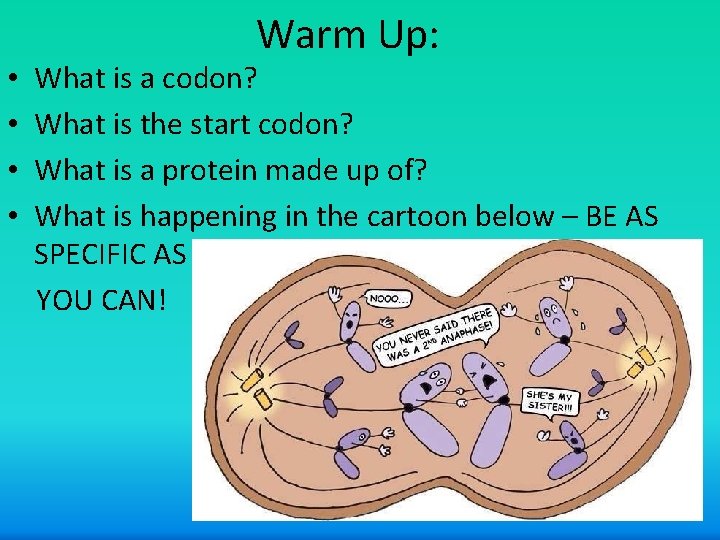
• • Warm Up: What is a codon? What is the start codon? What is a protein made up of? What is happening in the cartoon below – BE AS SPECIFIC AS YOU CAN!
HOMEWORK Go to my website, sandorabiology. weebly. com, watch the Bozeman Science Mutation video. This will give you a good overview of mutations that will help you understand mutations better. All students are responsible for understanding mutations, as they relate to presentations, for the test. For example, types of mutation that cause the disorders presented.
Practice 1: http: //bioweb. uwlax. edu/Gen. Web/Molecular/Theory/Transla tion/trans 1. swf Practice 2: http: //learn. genetics. utah. edu/content/molecules/transcribe/ Practice 3: http: //www. zerobio. com/drag_oa/protein/transcription. htm
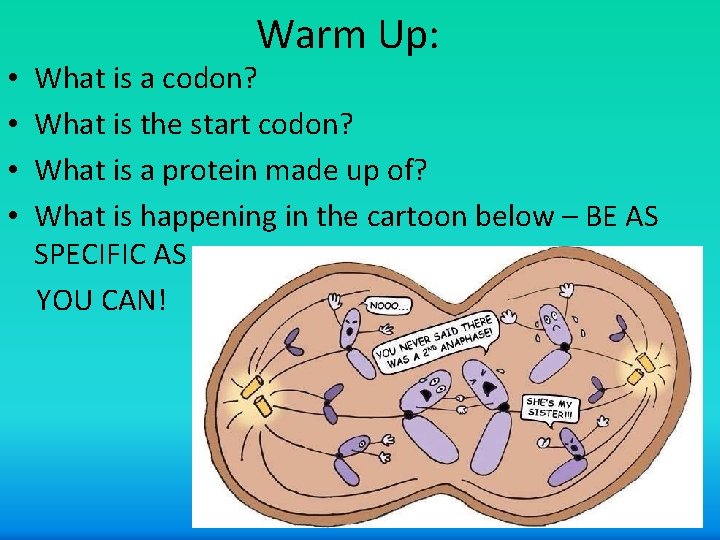
• • Warm Up: What is a codon? What is the start codon? What is a protein made up of? What is happening in the cartoon below – BE AS SPECIFIC AS YOU CAN!
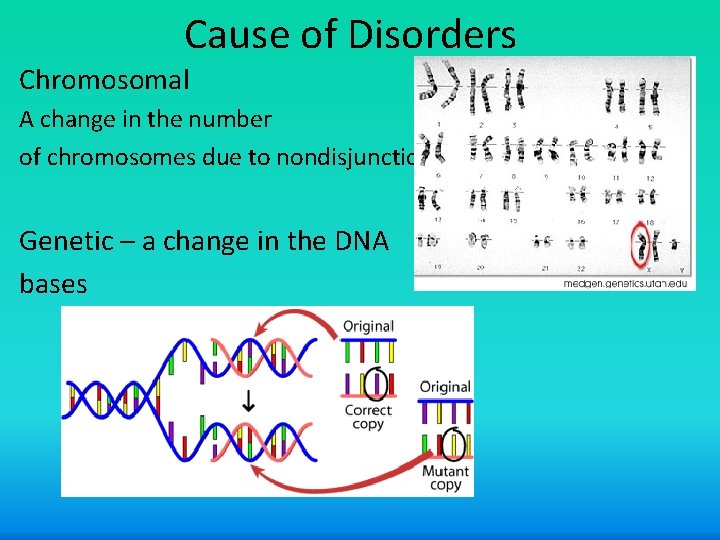
Cause of Disorders Chromosomal A change in the number of chromosomes due to nondisjunction Genetic – a change in the DNA bases
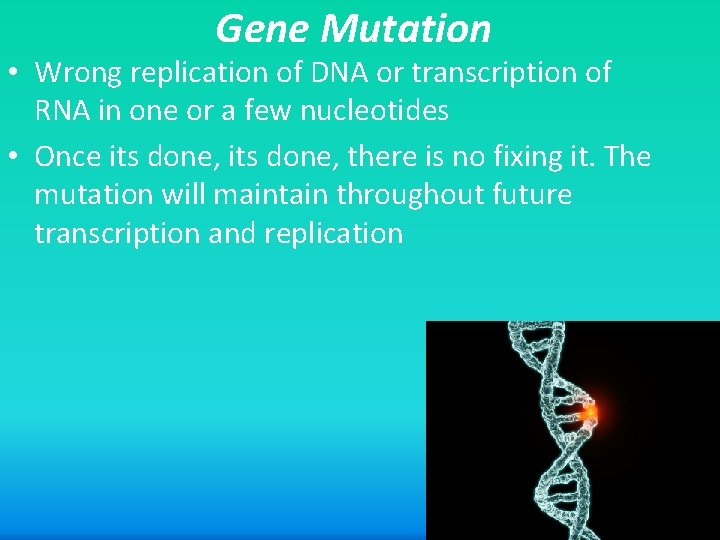
Gene Mutation • Wrong replication of DNA or transcription of RNA in one or a few nucleotides • Once its done, there is no fixing it. The mutation will maintain throughout future transcription and replication
GENETIC MUTATIONS Change in the DNA sequence Can be: – Helpful – Harmful – Neutral
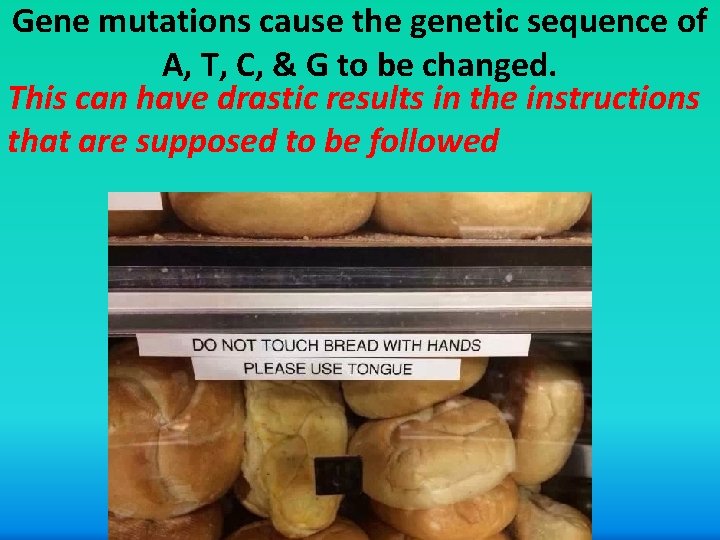
Gene mutations cause the genetic sequence of A, T, C, & G to be changed. This can have drastic results in the instructions that are supposed to be followed
Three types of gene mutations Substitution (point-mutation – happens in one location only) Duplication (frameshift) Addition (frameshift) Deletion (frameshift)
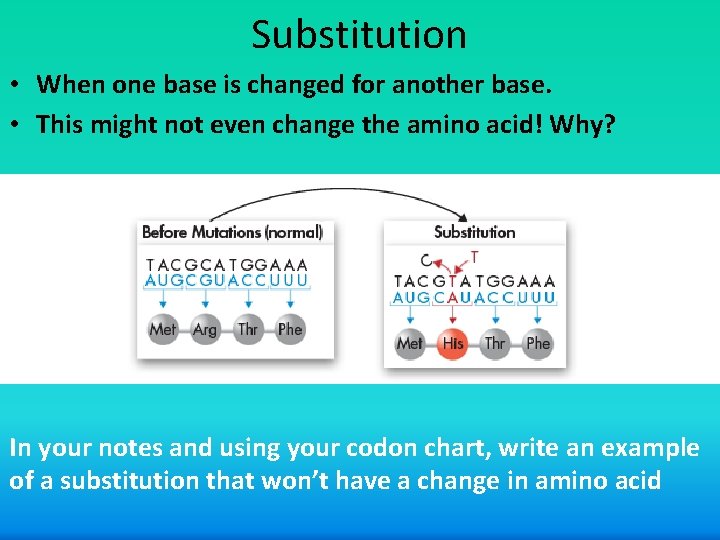
Substitution • When one base is changed for another base. • This might not even change the amino acid! Why? In your notes and using your codon chart, write an example of a substitution that won’t have a change in amino acid
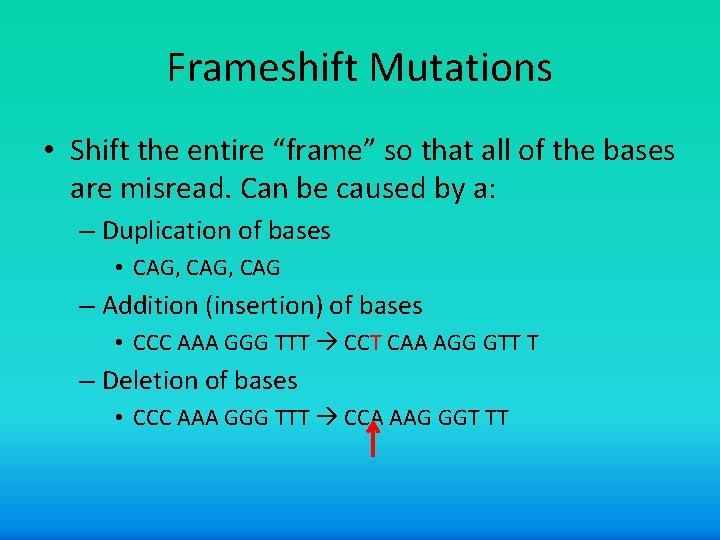
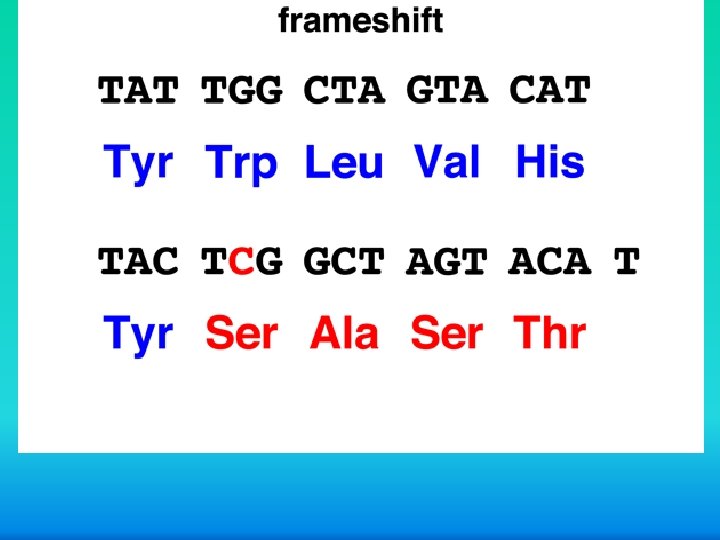
Frameshift Mutations • Shift the entire “frame” so that all of the bases are misread. Can be caused by a: – Duplication of bases • CAG, CAG – Addition (insertion) of bases • CCC AAA GGG TTT CCT CAA AGG GTT T – Deletion of bases • CCC AAA GGG TTT CCA AAG GGT TT
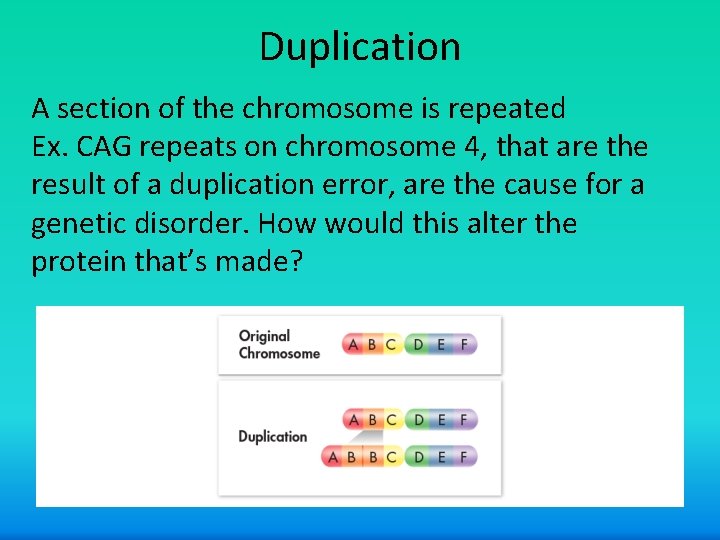
Duplication A section of the chromosome is repeated Ex. CAG repeats on chromosome 4, that are the result of a duplication error, are the cause for a genetic disorder. How would this alter the protein that’s made?
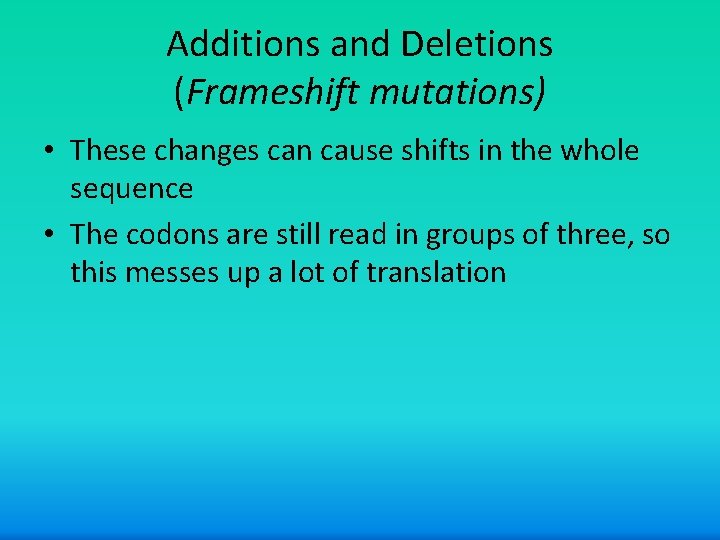
Additions and Deletions (Frameshift mutations) • These changes can cause shifts in the whole sequence • The codons are still read in groups of three, so this messes up a lot of translation
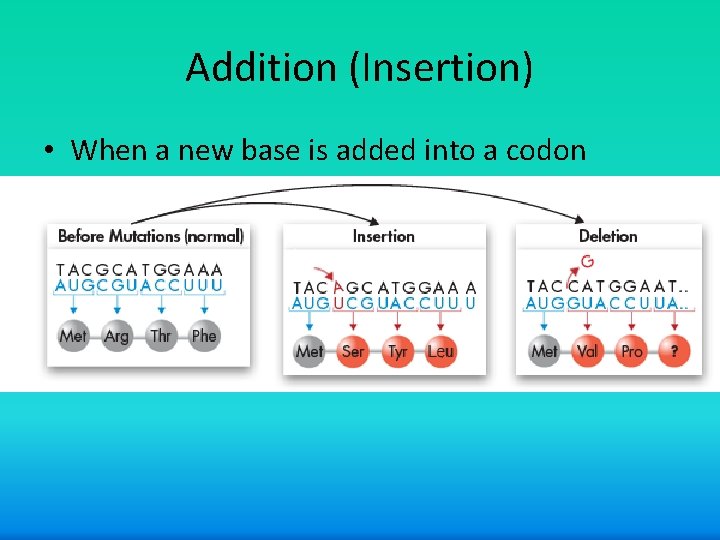
Addition (Insertion) • When a new base is added into a codon
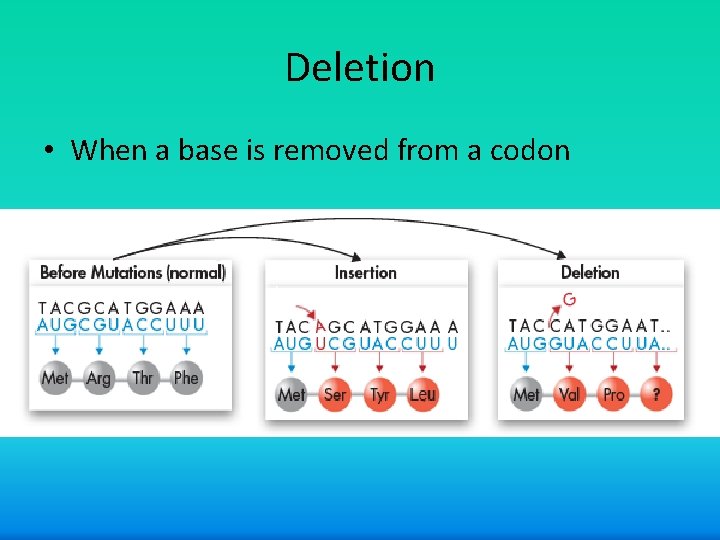
Deletion • When a base is removed from a codon
Day 1 & 2 Suggestions Research, research! Prior to beginning your presentation, you should completely understand your topic. Keep in mind the following while beginning research: – Focus on the science • nondisjunction? • Mutation? – Point mutation/substitution? Frameshift? How does the mutation impact the formation of the protein? • How does malformation of the protein and/or the addition or deletion of a chromosome manifest in symptoms? – Inheritance: Random, age-related? Auto. Dom/Rec? Sexlinked? – Detection: • DNA test? • Amnio/CVS? Karyotype?
Day 3 Suggestions Research, research! Prior to beginning your presentation, you should completely understand your topic. Keep in mind the following while beginning research: – Focus on the science • nondisjunction? • Mutation? – Point mutation/substitution? How does the mutation impact the formation of the protein? • How does malformation of the protein and/or the addition or deletion of a chromosome manifest in symptoms? – Inheritance: Random, age-related? Auto. Dom/Rec? Sex-linked? • Are you prepared to demonstrate Punnetts and pedigrees for your disorder? – Detection: • DNA test? • Amnio/CVS? Karyotype?
Day 4 - Continue research! – Focus on the science • nondisjunction? • Mutation? – Point mutation/substitution? How does the mutation impact the formation of the protein? • How does malformation of the protein and/or the addition or deletion of a chromosome manifest in symptoms? – Inheritance: Random, age-related? Auto. Dom/Rec? Sex-linked? – Detection: • DNA test? • Amnio/CVS? Karyotype? – Look into local groups, individuals that can add a personal aspect to your presentation.
Day 5 Suggestions • Begin to piece your information together. How does all of this information tie together? • What is the best way to organize your presentation? • What type of presentation do you want to give? • Have you synthesized all of the relevant info from semester 2 into your presentation and represented it accurately? • Have you addressed all of the requirements of the rubric? • Look into local groups and people who can add a personalized, community aspect to your report.
Quiz Topics Quizzes will range from 12 – 17 points. • • Each quiz will have at least 1 diagram (Punnett, pedigree, meiosis, karyotype) • Main questions: – Primary symptoms/characteristics – Mode of inheritance (auto dom/rec. , sex-linked, nondisjunction) – Chromosome number (ex. 11), gene(s) impacted, protein formation error – Onset and lifespan – Demographic most affected – Diagnosis – Treatment This is written in 20 font. The title is too light. This part is too lengthy and in paragraph form, which isn’t the best way to present. You want to have bullet points that you can speak about. Do not read from the slide. We can all read. You do not have to read for us. Based on what is written above, you may want to consider making a practice quiz or a few questions at the end to review. Don’t forget to add lots of pictures to make the presentation engaging and to illustrate information you are discussing, but do not let them obscure the writing. Also, keep in mind that you need to account for wait time for students to take notes. Finally, do no write in paragraph form or use colors that blend into the background and don’t use 20 font!
Day 6/7 • If you have completed the suggestions given on day 5, begin/continue creating your presentation. • Continue to research/contact supplemental information – News articles – Local groups/organizations/upcoming fundraisers – families and individuals

Day 7 and beyond • Put the final touches on your presentation • Confirm any speakers • Prepare handouts and give to your teacher to photocopy if needed. • Make your presentation engaging and visually acceptable for all seats in the classroom.
- Slides: 43