
GENES GENETIC MATERIAL AND CHROMOSOMES INTRODUCTION Each individual
- Slides: 36
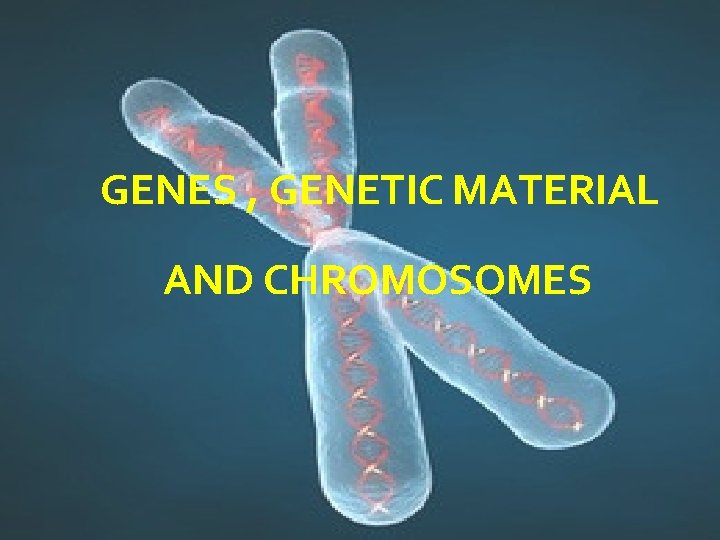
GENES , GENETIC MATERIAL AND CHROMOSOMES
INTRODUCTION • Each individual of a species possess a number of genes or basic of unit heredity which was earlier known as traits. • These genes are contained in the chromosomes which form the fundamental basis for the development of anatomical, physiological and behavioral traits. • A complete gene set of an organism is called its genotype whereas the actual observable physical, physiological and behavioral traits form its phenotype. • The gene pool of a species is the total collection of genes in a reproductive individual. • At a given locus alternative forms of gene called alleles may be present. • The phenotype- structure , physiology, appearance and behavior of all organisms is determined by the interaction of environment (nature) and genotype (nurture). • All behavioral patterns are either learned or genetic.
CONCEPT OF HEREDITY • Heredity refers to passing of traits or characters through genes from one generation to other generation. • This heredity is very evidently seen in sexual reproduction. • In sexual reproduction process, variation occurs due to some error in DNA copying. • Variation- contributes to evolution and forms the basis of heredity. • Causes for variation: positive gene mutations, interaction of genes with the environment and various combinations of genetic material. • In asexual reproduction variations are not very noticeable.
GENETICS AND BEHAVIOR • GENETICS – Study of heredity. It is the fundamental basis for the study of behavior. • BEHAVIOR – response of an individual or a group to an environment, action , person or stimulus. • Many behavioral studies are made on the survival and reproduction of the individual. • The survival and reproduction of a particular species is based on the favorable characters having a genetic basis. • The unfavorable characters are eliminated from the population.
NATURAL SELECTION • The theory of natural selection by Darwin, explains the development of new species by selecting the best adapted species and eliminating the unfit individuals. • His idea was based on the following facts: ü Capability of a species to overproduce. ü The populations of the species must remain stable over time. ü Resource limitation leading to struggle for existence. ü Survival of fit individual.
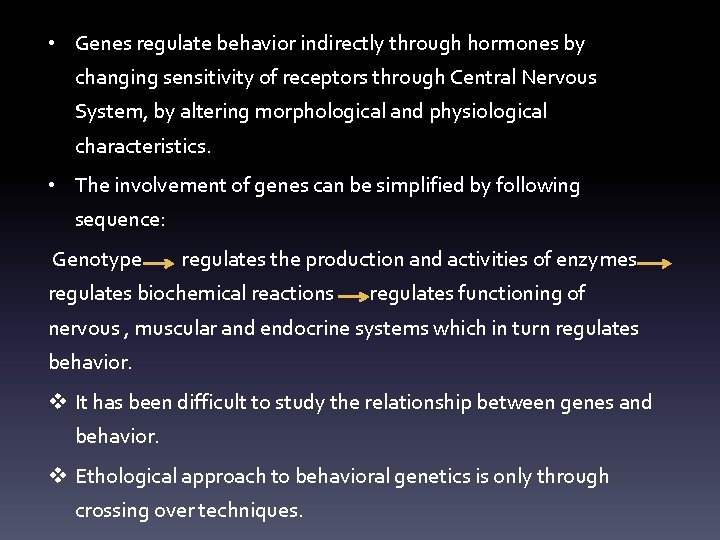
• Genes regulate behavior indirectly through hormones by changing sensitivity of receptors through Central Nervous System, by altering morphological and physiological characteristics. • The involvement of genes can be simplified by following sequence: Genotype regulates the production and activities of enzymes regulates biochemical reactions regulates functioning of nervous , muscular and endocrine systems which in turn regulates behavior. v It has been difficult to study the relationship between genes and behavior. v Ethological approach to behavioral genetics is only through crossing over techniques.
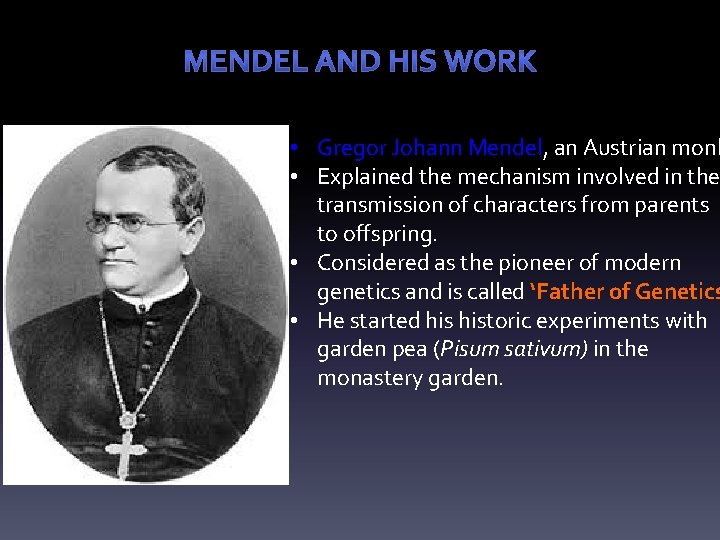
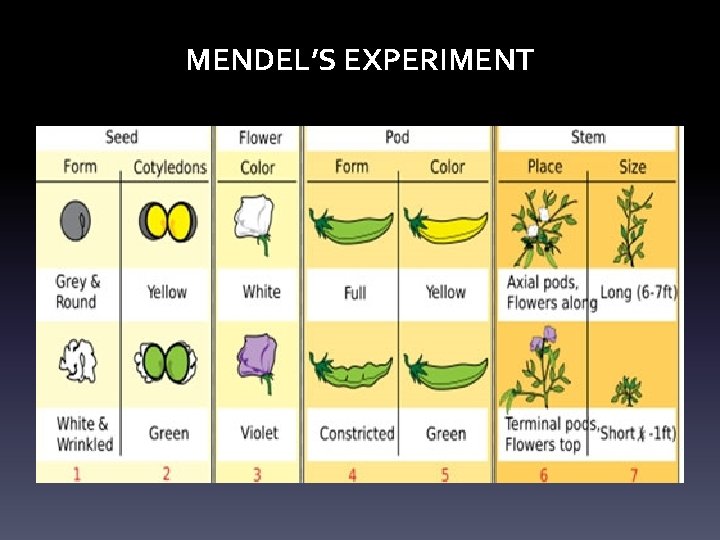
• Gregor Johann Mendel, an Austrian monk • Explained the mechanism involved in the transmission of characters from parents to offspring. • Considered as the pioneer of modern genetics and is called ‘Father of Genetics • He started historic experiments with garden pea (Pisum sativum) in the monastery garden.
The experiments continued for about nine years from 1856 to 1864. he selected garden pea as his experimental material not by chance but after long and careful thought because it had following advantages: ü Annual plant with short life cycle. ü Flowers were predominately self- pollinating. ü Easy to get pure lines because of self fertilization. ü Easy to cross because pollens from one plant can be introduced to the stigma of another plant by removing anthers.
MENDEL’S EXPERIMENT
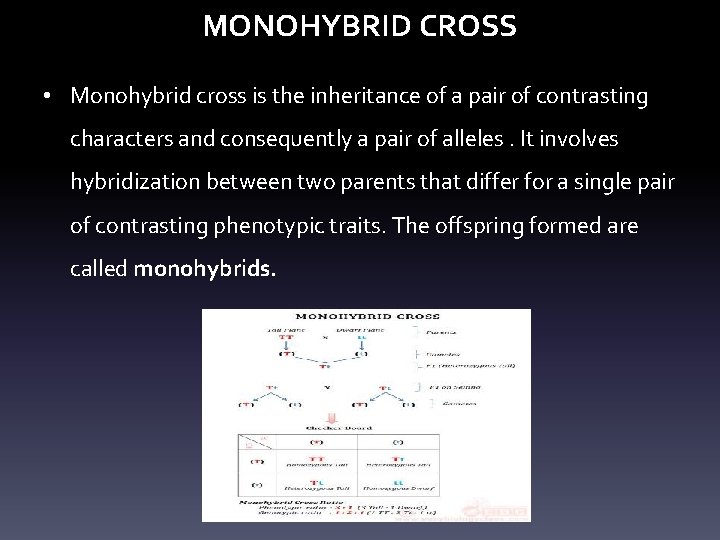
MONOHYBRID CROSS • Monohybrid cross is the inheritance of a pair of contrasting characters and consequently a pair of alleles. It involves hybridization between two parents that differ for a single pair of contrasting phenotypic traits. The offspring formed are called monohybrids.
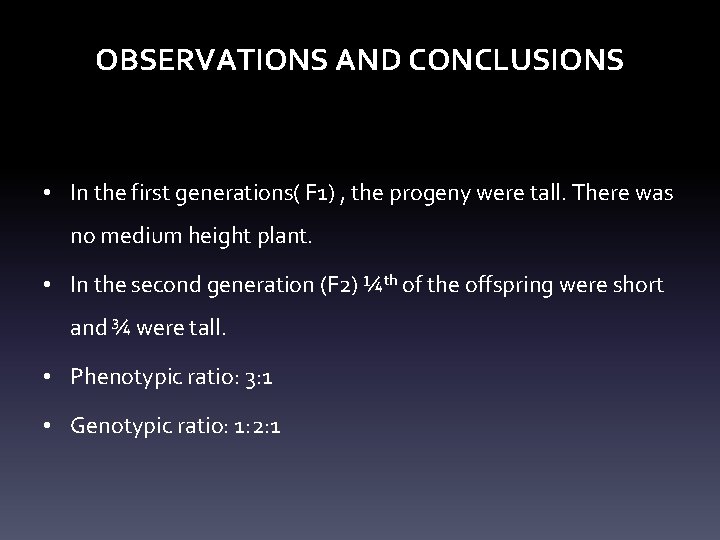
OBSERVATIONS AND CONCLUSIONS • In the first generations( F 1) , the progeny were tall. There was no medium height plant. • In the second generation (F 2) ¼th of the offspring were short and ¾ were tall. • Phenotypic ratio: 3: 1 • Genotypic ratio: 1: 2: 1
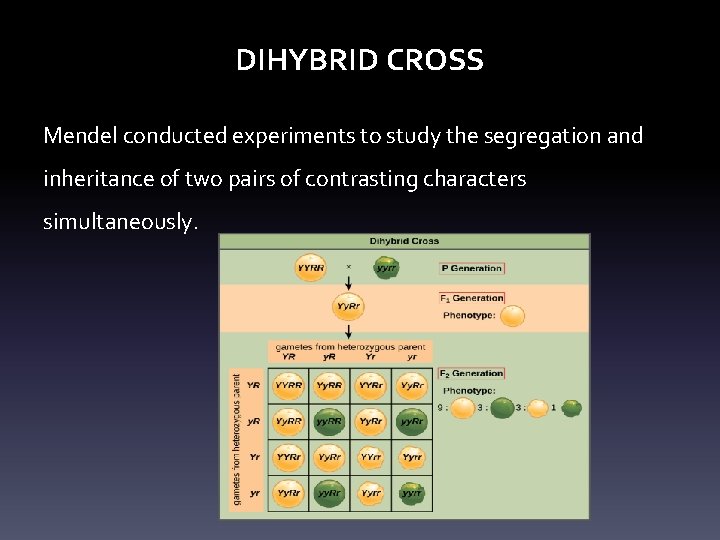
DIHYBRID CROSS Mendel conducted experiments to study the segregation and inheritance of two pairs of contrasting characters simultaneously.
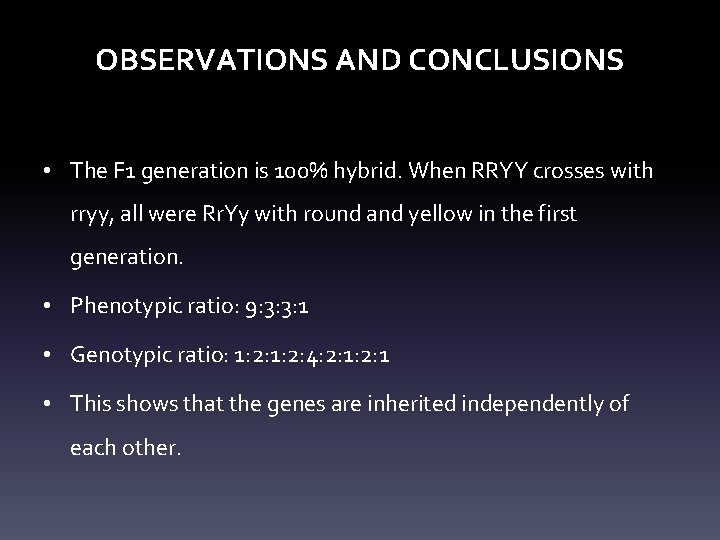
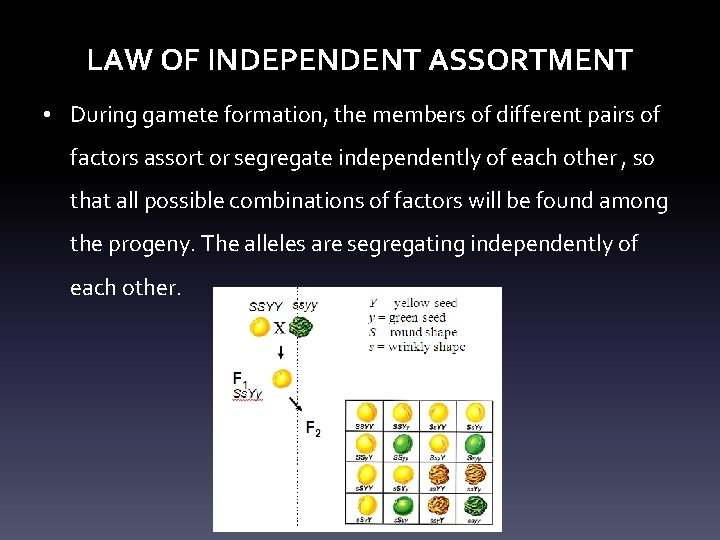
OBSERVATIONS AND CONCLUSIONS • The F 1 generation is 100% hybrid. When RRYY crosses with rryy, all were Rr. Yy with round and yellow in the first generation. • Phenotypic ratio: 9: 3: 3: 1 • Genotypic ratio: 1: 2: 4: 2: 1 • This shows that the genes are inherited independently of each other.
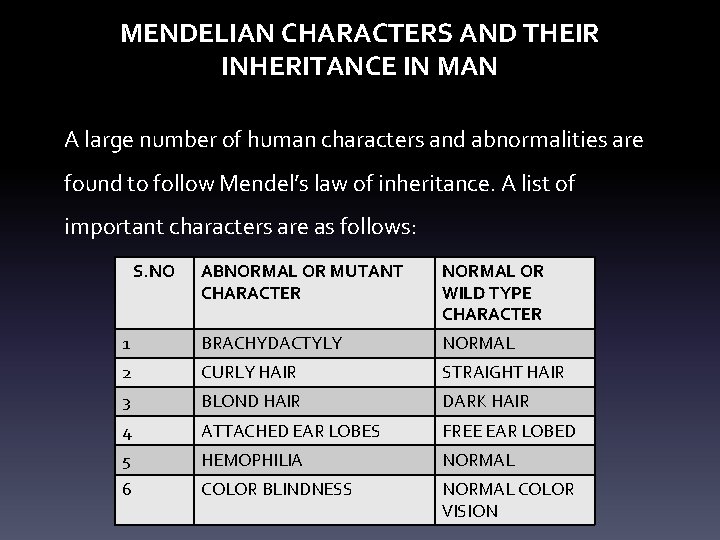
MENDELIAN CHARACTERS AND THEIR INHERITANCE IN MAN A large number of human characters and abnormalities are found to follow Mendel’s law of inheritance. A list of important characters are as follows: S. NO ABNORMAL OR MUTANT CHARACTER NORMAL OR WILD TYPE CHARACTER 1 BRACHYDACTYLY NORMAL 2 CURLY HAIR STRAIGHT HAIR 3 BLOND HAIR DARK HAIR 4 ATTACHED EAR LOBES FREE EAR LOBED 5 HEMOPHILIA NORMAL 6 COLOR BLINDNESS NORMAL COLOR VISION
MENDEL’S LAW OF INHERITANCE • Mendel proposed three laws: 1. Law of dominance 2. Law of segregation 3. Law of independent assortment
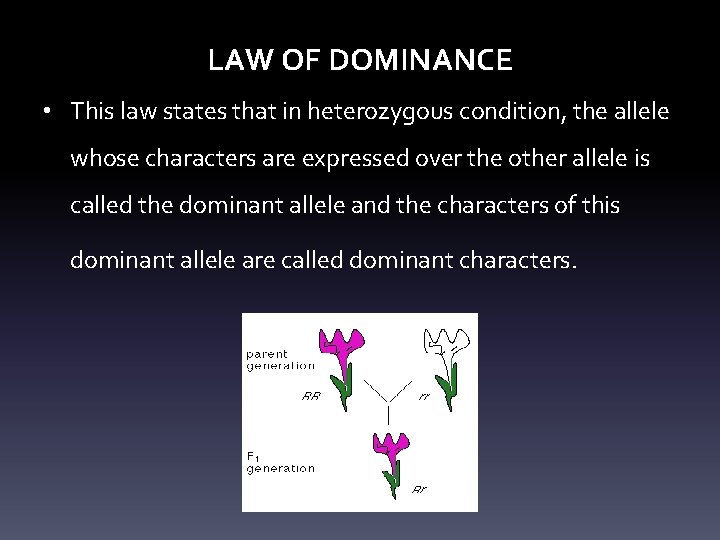
LAW OF DOMINANCE • This law states that in heterozygous condition, the allele whose characters are expressed over the other allele is called the dominant allele and the characters of this dominant allele are called dominant characters.
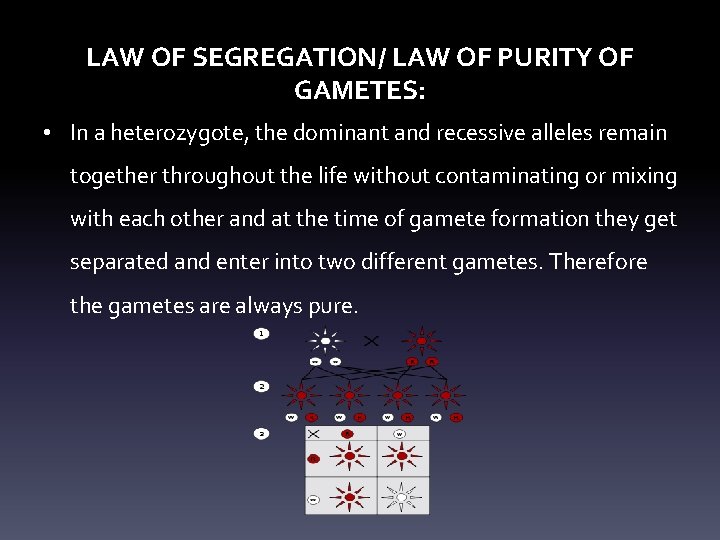
LAW OF SEGREGATION/ LAW OF PURITY OF GAMETES: • In a heterozygote, the dominant and recessive alleles remain together throughout the life without contaminating or mixing with each other and at the time of gamete formation they get separated and enter into two different gametes. Therefore the gametes are always pure.
LAW OF INDEPENDENT ASSORTMENT • During gamete formation, the members of different pairs of factors assort or segregate independently of each other , so that all possible combinations of factors will be found among the progeny. The alleles are segregating independently of each other.
• CHROMOSOMES Chromosomes contain genetic material that can determine a person’s characteristics. • Chromosomes contain genes, most of which made up of DNA and RNA. • The chromosomes are capable of self-reproduction and maintaining morphological and physiological properties through successive generations and thus capable of transmitting the contained hereditary material to the next generation. • Hence, these are popularly known as, ‘hereditary vehicles’. • The number of chromosomes is constant in all the somatic cells of all the individuals of a species. Chromosome number is used in the identification of species and in tracing the relationship within the species. In humans, there are 23 pairs of chromosomes
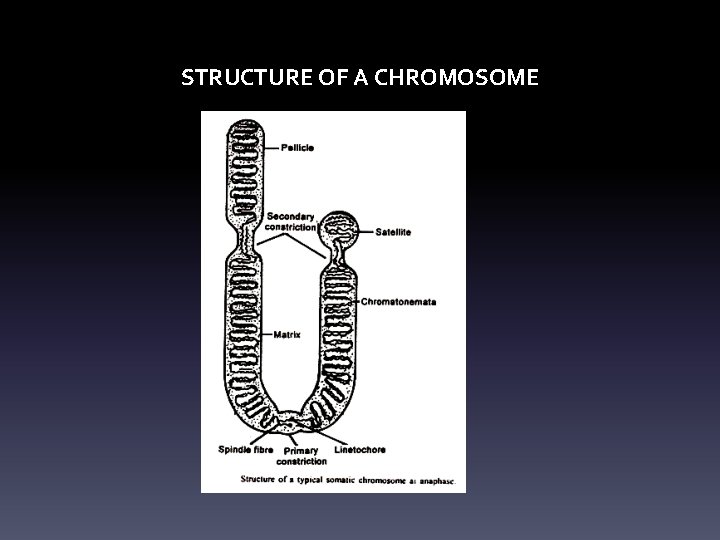
STRUCTURE OF A CHROMOSOME
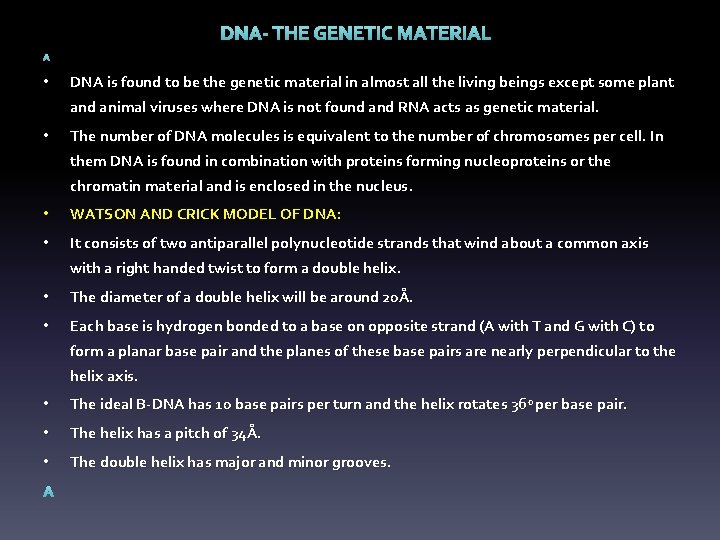
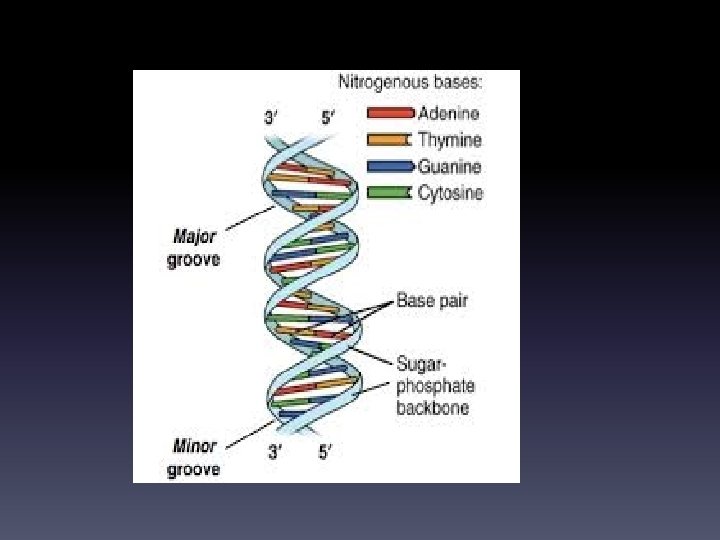
DNA- THE GENETIC MATERIAL • DNA is found to be the genetic material in almost all the living beings except some plant and animal viruses where DNA is not found and RNA acts as genetic material. • The number of DNA molecules is equivalent to the number of chromosomes per cell. In them DNA is found in combination with proteins forming nucleoproteins or the chromatin material and is enclosed in the nucleus. • WATSON AND CRICK MODEL OF DNA: • It consists of two antiparallel polynucleotide strands that wind about a common axis with a right handed twist to form a double helix. • The diameter of a double helix will be around 20Å. • Each base is hydrogen bonded to a base on opposite strand (A with T and G with C) to form a planar base pair and the planes of these base pairs are nearly perpendicular to the helix axis. • The ideal B-DNA has 10 base pairs per turn and the helix rotates 36 0 per base pair. • The helix has a pitch of 34Å. • The double helix has major and minor grooves.
GENES: • Gene is a unit of heredity; a segment of DNA transmitted from one generation to the next, carrying genetic information such as the sequence of amino acids for a protein. • Genes determine the physical as well as physiological characteristics. These are transmitted from parents to the offspring generation after generation. • Genes are situated in chromosomes. Genes in the chromosomes are arranged in a single linear order like the arrangement of beads on a string. • The gene may undergo sudden change in expression due to change in its composition. The changes gene is known as mutant gene and the phenomenon is known as mutation.
SINGLE OR MULTIPLE GENE EFFECT: • PLEIOTROPHY: A single gene that has an effect on the expression of two or more phenotypic traits, it is said to have a pleiotropic effects on the traits. For example, testosterone controls the development of secondary sexual characters, but testosterone also relates to behavioral traits like aggression. • It is striking that single gene can so severely disturb the development of normal behavior. • In humans there about 150 metabolic disorders caused by single gene defect. • In humans, it is usually metabolic disturbance which leads to mental retardation.
POLYGENIC: • If two or more genes are responsible for a single trait, the phenotypic trait is said to be governed by polygenic factors. • For example, growth rate is undoubtedly caused by a number of genes that act in a complex cascade. • Body size is also poly genetically determined which involves a number of genes. • It is important to note that there is no single gene for intelligence, personality traits, behavior or even height. • Such complex characteristics are influenced by multiple genes. • If alleles occur in just a dominant – recessive gene relationship , only two phenotypes are possible(single gene effect). Other genetic relationships such as multiple alleles produce wider range of phenotype(multiple gene effect). • Environment determines phenotype.
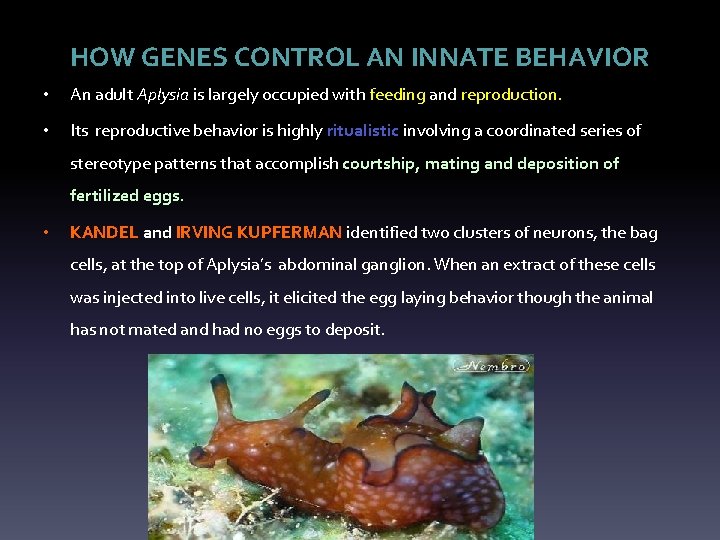
HOW GENES CONTROL AN INNATE BEHAVIOR • An adult Aplysia is largely occupied with feeding and reproduction. • Its reproductive behavior is highly ritualistic involving a coordinated series of stereotype patterns that accomplish courtship, mating and deposition of fertilized eggs. • KANDEL and IRVING KUPFERMAN identified two clusters of neurons, the bag cells, at the top of Aplysia’s abdominal ganglion. When an extract of these cells was injected into live cells, it elicited the egg laying behavior though the animal has not mated and had no eggs to deposit.
• ARCH and STRUMWASSER isolated one of the active bag cell factors and identified it as a peptide consisting of 36 amino acids. • When this peptide was administered into a snail, it elicited some but not all of the egg laying behavior suggesting that it was one of the factors controlling egg laying behavior. This peptide was designated as EGG LAYING HORMONE (ELH). • Later a group of scientists concluded that there is a single gene which encodes a long protein chain, brings about different actions in egg laying.
ROTHEN BUHLER carried out a cross between two strains of bees. It is an example for polygenic control over behavior. • Unhygienic strain: Dominant genes U= do not uncap the cell ; R= do not remove the dead from the cell. • Hygienic strain: Reccesive genes u= uncap the cell ; r= remove dead from the cell • In nature, these strains do not breed but in experimental conditions they breed giving following progeny: • UURR × uurr (parents) • Uu. Rr (offspring: phenotypically unhygienic and genotypically carrier) • If a test cross is done then following results were obtained: UURR × uurr • Gametes UR Ur u. R ur Uu. Rr(1) Uurr(2) uu. Rr(3) uurr(4) • (1) – Unhygienic • (2) – will not uncap the cell but if experimenter uncaps the cell the bees remove dead larvae. • (3)- uncap the cell but do not remove the dead larvae. • (4)- hygienic.
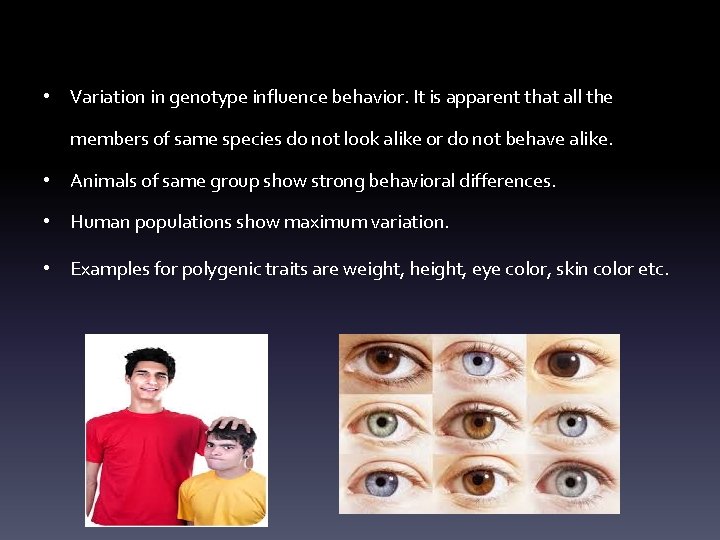
• Variation in genotype influence behavior. It is apparent that all the members of same species do not look alike or do not behave alike. • Animals of same group show strong behavioral differences. • Human populations show maximum variation. • Examples for polygenic traits are weight, height, eye color, skin color etc.
BEHAVIOR IS INFLUENCED BY NATURE OR NUTURE ? • The two basic influences on social behavior are genes and environment. • It is seen that most complicated behaviors are not controlled by a single gene. One gene may influence many different personality characters. • In addition, many genes work in concert to influence most behaviors, meaning the genetic aspects of a particular trait are result of small effects over hundreds of individual genes. • Even if all the genes influencing behavior were discovered, behavior still could not be explained or predicted. • Factors such as parenting, schooling , prenatal environment play a critical roles in the development of social behavior.
• Even the most heritable traits such as height are influenced by environmental factors, where malnourished children that are short despite having tall parents. Here the nutritional intake have actually altered the way in which genetically influenced characteristics are expressed. • Therefore, although these two forms are often presented in an either or fashion , as in the commonly used phrase ‘ nature versus nurture’ evidence suggests that behavior and other characteristics do not have one clearly identifiable cause. • It is observed that both the factors are at work and for the cause of any gene trait.
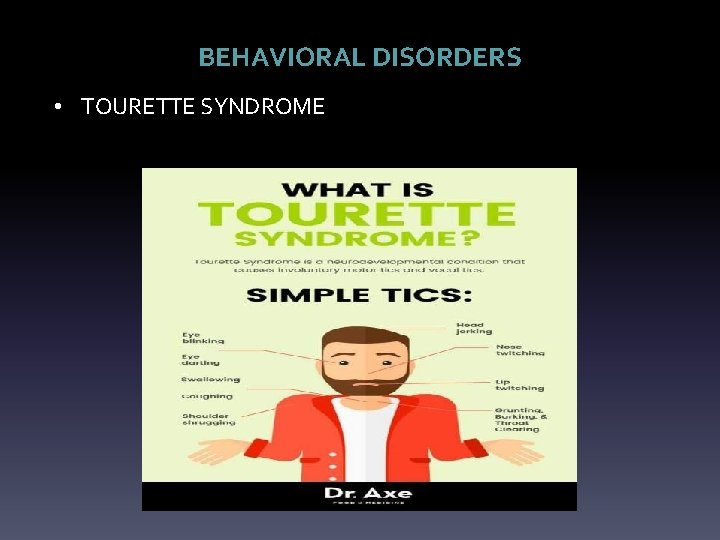
BEHAVIORAL DISORDERS • TOURETTE SYNDROME
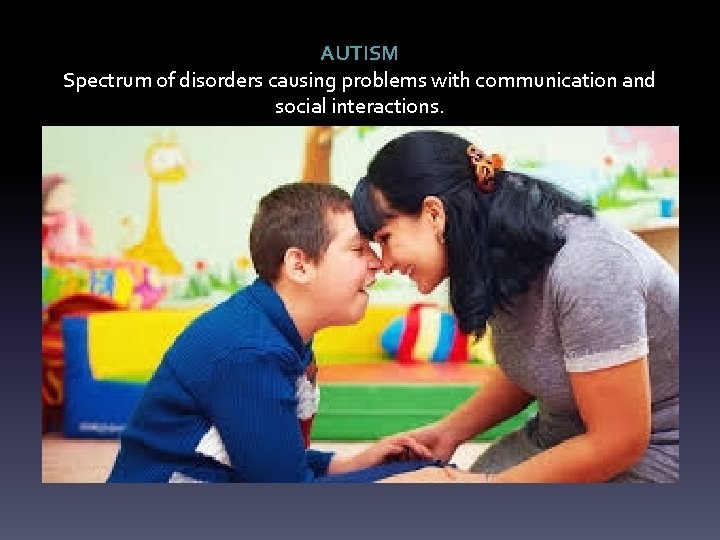
AUTISM Spectrum of disorders causing problems with communication and social interactions.
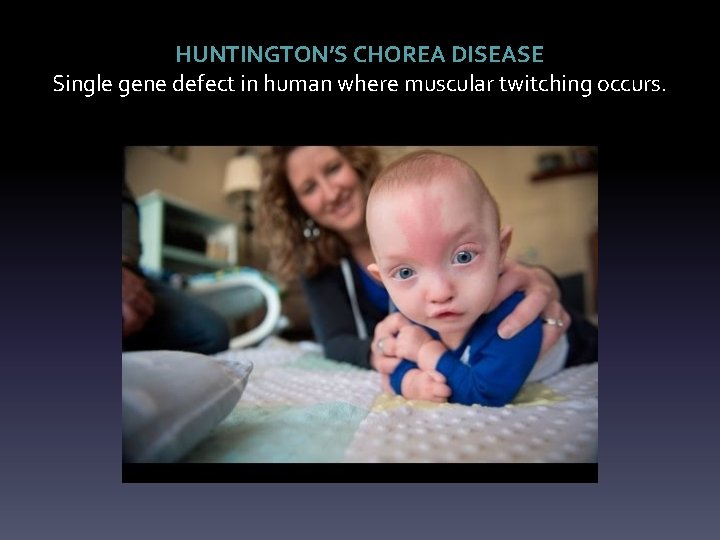
HUNTINGTON’S CHOREA DISEASE Single gene defect in human where muscular twitching occurs.
CONCLUSION • Evolution has acted so that genes and environment act to complement each other in yielding behavioral solutions to the survival challenges faced by animals. • Understanding the relative roles of genes and environment continues to create controversy. • Behavior has been seen as the result of evolutionary processes that s 0 metimes create, through genetic coding, behavioral instructions for animals and at other times create flexible behavioral instructions for animals to solve problems specific to their environment.
BIBLIOGRAPHY AND REFERENCE: • A Textbook of Animal Behavior – Hoshang S. Gundevia • Animal behavior – Reena Mathur • Genetics – Veer Bala Rastogi • https: //www. nature. com • https: //psychology. iresearchnet. com • https: //courses. lumenlearning. com • https: //genetics. emory. edu