
Genes and Variation 16 1 Grab a book

Genes and Variation 16 -1 Grab a book, we’ll be referring to it
Standard 8 c, d § 8 c: Students know the effects of genetic drift on the diversity of organisms in a population § 8 d: Students know reproductive or geographic isolation affects speciation
Recall Natural Selection § Darwin believed in Evolution through _______ Natural Selection _____ § So, what does that mean? § Organisms with characteristics or adaptations that are well suited to their environment survive and reproduce. Those who are not die! Survival § Another term for this is _____ of the Fittest ______ § Remember what fitness means!
Darwin and Mendel § Even though Darwin’s theory was well thought out, there were certain things he couldn’t explain… 1. The source of variation 2. How inheritable traits were passed from one generation to the next § Where were the answers he was looking for? § GENETICS! (i. e. : heredity)
Genetics and Variation § What is variation? § What are the causes of variation? § Mutations § Changes in the DNA code § Gene Shuffling § a. k. a. sexual reproduction § So we could say that GENES control variation
Genes and Natural Selection § Genes control variation § Natural Selection acts on physical variations that help an organism survive and reproduce in its environment. § So, Natural Selection does NOT act on Phenotype the genotype, but on the ______
Quick Quiz § In lizards, there are two traits for tail length: Long (L) and Short (l). The predators of these lizards sneak up behind them and grab onto their tails, so lizards with short tails are better able to escape predators. § Which trait will Natural Selection favor? Why? § There are three individuals, one LL, one Ll, and one ll. § What are the phenotypes of each individual? § Which lizard(s) are more likely to survive and reproduce? Why? § Which lizard(s) are less likely to survive and reproduce? Why?
Evolution through Genetic Change § What is a population? § A group of individuals of the same species that interbreed. § Since members of a population interbreed, they share a common group of genes called a Gene Pool
Gene Pools § So then, what is a Gene Pool? § All the genes, including all the different alleles that are present in a population § Lets think about Darwin’s Finches…
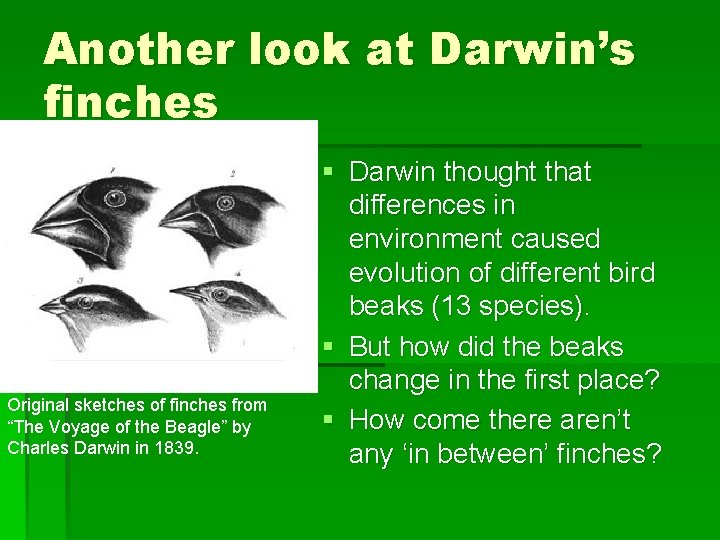
Another look at Darwin’s finches Original sketches of finches from “The Voyage of the Beagle” by Charles Darwin in 1839. § Darwin thought that differences in environment caused evolution of different bird beaks (13 species). § But how did the beaks change in the first place? § How come there aren’t any ‘in between’ finches?
Relative Frequency § The number of times an allele occurs in a gene pool, compared with the number of times other alleles for the same gene occur. (%) § Lets look at the mice… (p. 394)
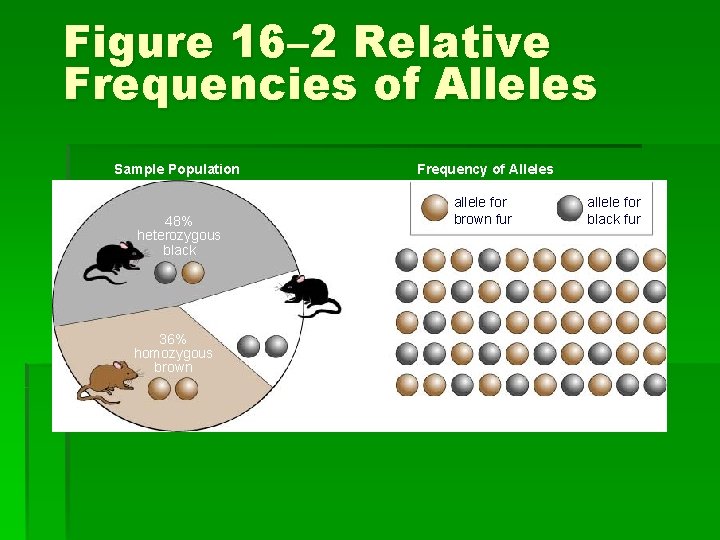
Figure 16– 2 Relative Frequencies of Alleles Sample Population 48% heterozygous black 16% homozygous black 36% homozygous brown Frequency of Alleles allele for brown fur allele for black fur
Evolution through Genetic Change § IN GENETIC TERMS: EVOLUTION IS ANY CHANGE IN THE RELATIVE FREQUENCY OF ALLELES IN A POPULATION
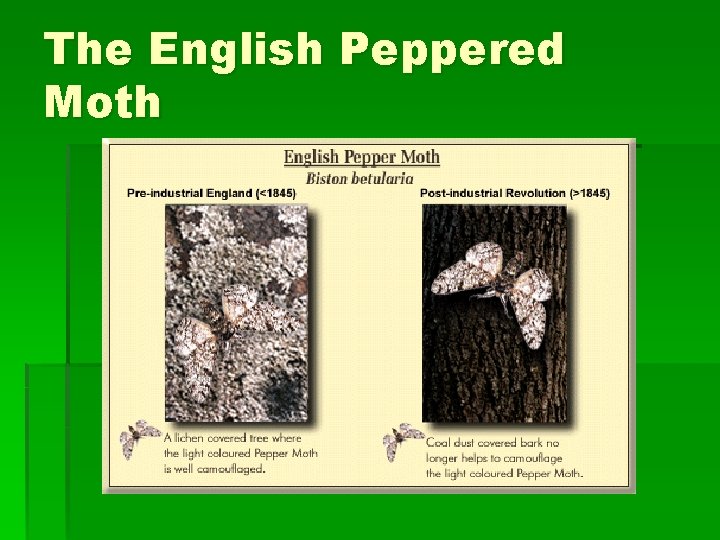
The English Peppered Moth
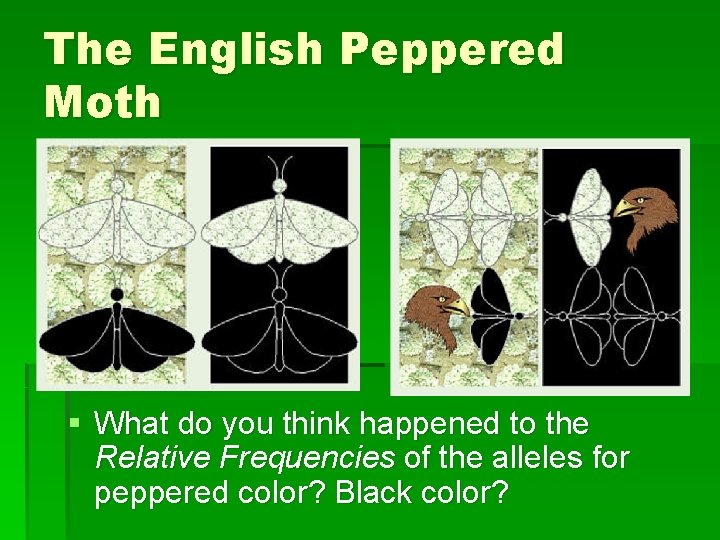
The English Peppered Moth § What do you think happened to the Relative Frequencies of the alleles for peppered color? Black color?
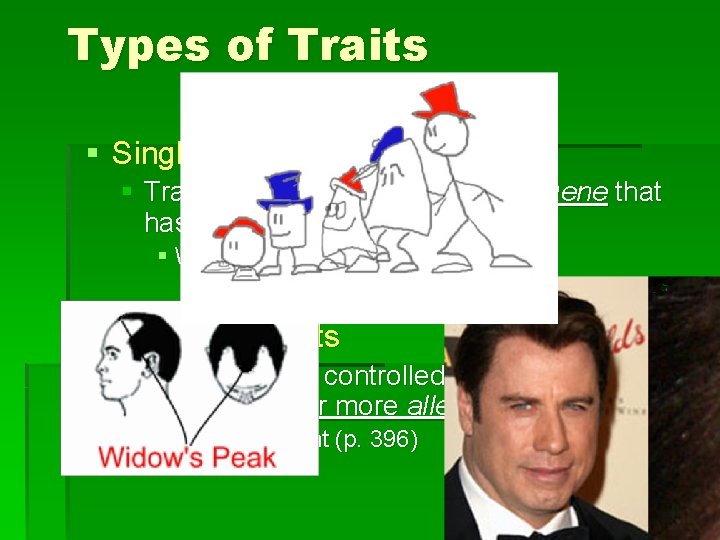
Types of Traits § Single-Gene Traits § Traits that are controlled by one gene that has two alleles § Widow’s Peak in Humans (p. 395) § Polygenic Traits § Traits that are controlled by multiple genes and has two or more alleles § Human Height (p. 396)
Quick Quiz § In humans, ear lobe shape is either attached or unattached. Is this a single gene trait or a polygenic trait? How do you know? § In humans, skin color varies in shades from very light to very dark. Is this a single gene trait or a polygenic trait? How do you know?
So, Lets Review § Genes control variation § Sources of genetic variation are § § Mutations Gene shuffling (sexual reproduction) § Natural Selection acts on the § PHENOTYPE § A Gene Pool is § the total of all genes and alleles in a population § Relative Frequency is § How often an allele occurs in a gene pool in comparison to other alleles.
So, Let’s Review § A Single-Gene Trait is § A trait that is controlled by one gene and has two alleles § A Polygenic Trait is § A trait that is controlled by multiple genes and has multiple alleles
- Slides: 19