
Genes and Their Evolution Population Genetics Chapter 4
- Slides: 44
Genes and Their Evolution: Population Genetics Chapter 4
Population v A population is a group of individuals of the same species who share a geographic area and usually mate within the group v The total genetic variation of that population is the gene pool v The number of times different genes or alleles occur is the frequency v And evolution is change in allele frequency over generations
Species h v We only look at reproductive populations of organisms. This is important because to be called a species, organisms must be able to mate and have fertile offspring v Are these different species? v Lion and tiger v Horse and donkey v Dog and wolf
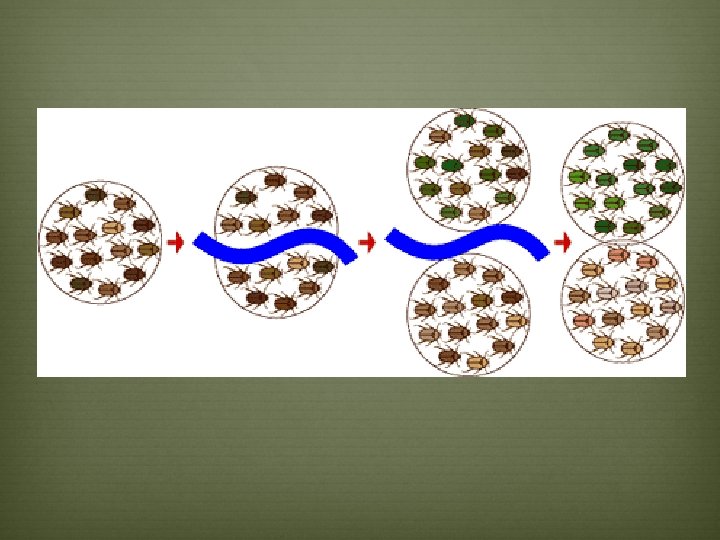
Species v When reproductive isolation occurs, this means that two populations are kept from mating h v If enough time passes, these two groups will become two different species v This is allopatric speciation v Example: two groups of beetles get separated by a river. Over time, enough differences arise that they become different species and would not be able to mate again
Population Genetics v This is the study of changes in genetic material v More specifically, the change in allele frequency v allele= different versions of genes v Frequency= how often they occur v Microevolution: small-scale; happens in a short period of time v Macroevolution: large-scale; occurs over many generations; speciation
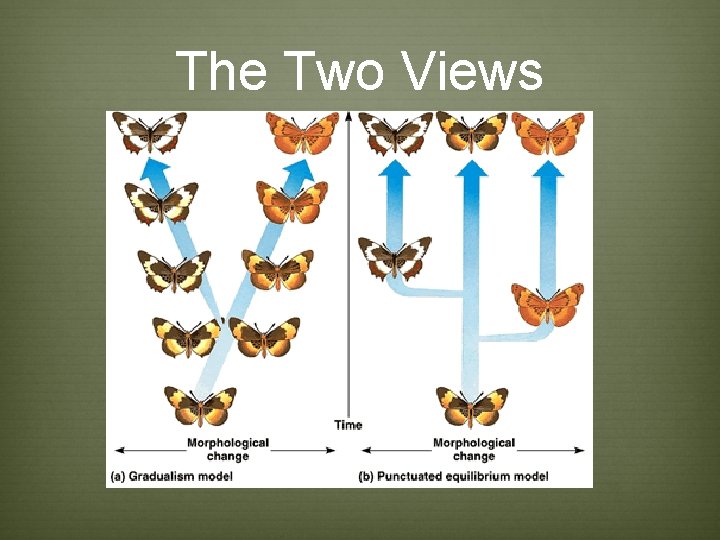
Different Views of Evolution v Darwin thought evolution was small changes accumulating over long periods of time v This is phyletic gradualism v Gould and Eldredge said evolution could have long periods of no or minor change, interrupted by sudden change, such as speciation or extinction v This is punctuated equilibrium h
The Two Views
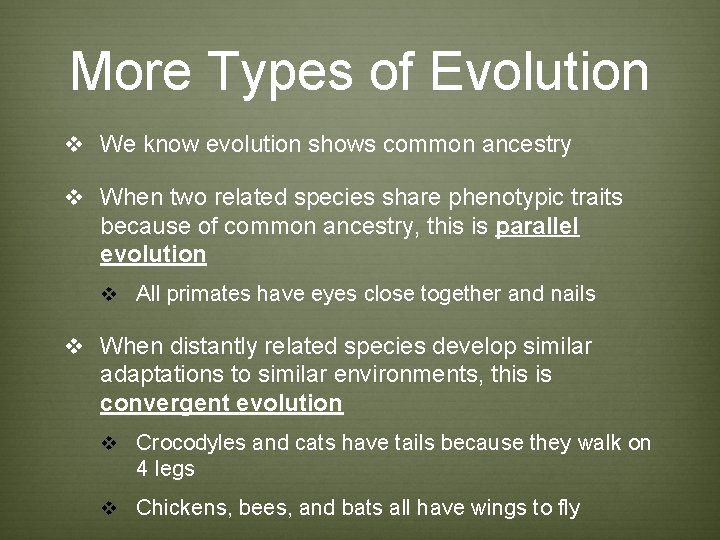
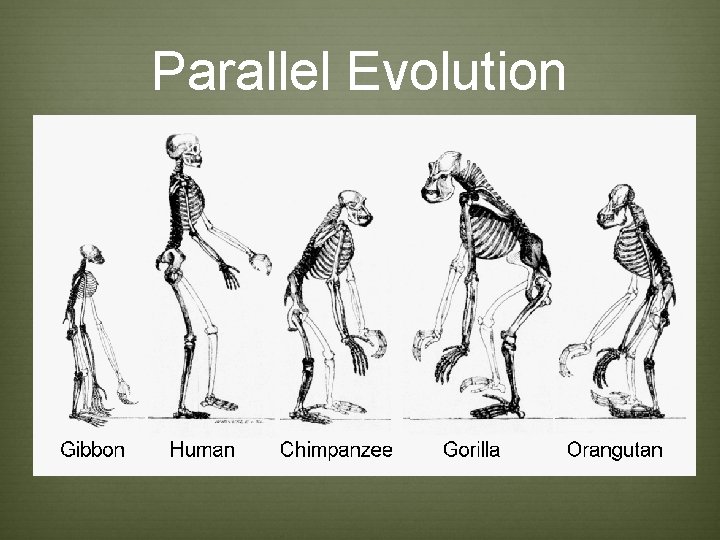
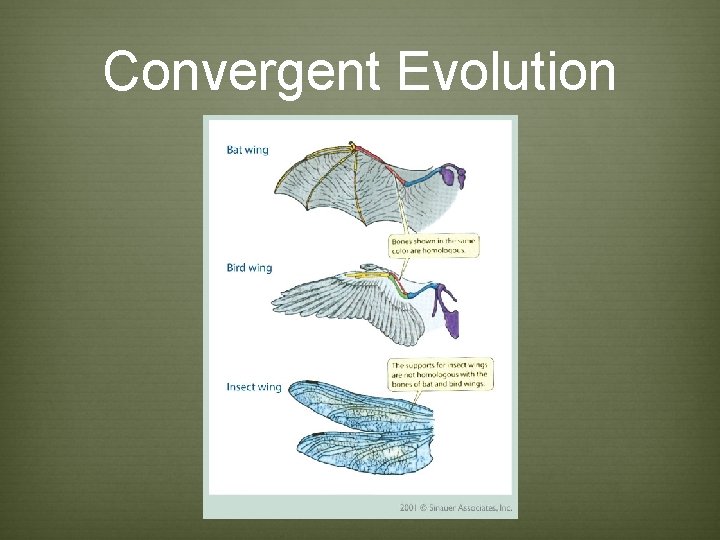
More Types of Evolution v We know evolution shows common ancestry v When two related species share phenotypic traits because of common ancestry, this is parallel evolution v All primates have eyes close together and nails v When distantly related species develop similar adaptations to similar environments, this is convergent evolution v Crocodyles and cats have tails because they walk on 4 legs v Chickens, bees, and bats all have wings to fly
Parallel Evolution
Convergent Evolution
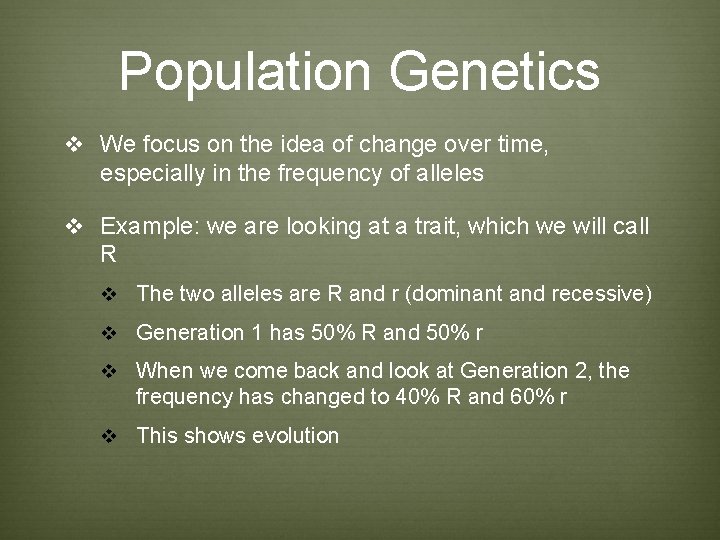
Population Genetics v We focus on the idea of change over time, especially in the frequency of alleles v Example: we are looking at a trait, which we will call R v The two alleles are R and r (dominant and recessive) v Generation 1 has 50% R and 50% r v When we come back and look at Generation 2, the frequency has changed to 40% R and 60% r v This shows evolution
Population Genetics v We need evidence that evolution is occurring, and we do this by looking at the frequencies of alleles in populations v If they do not change, there is no evolution v If they do change, there is evolution
Intro to Hardy-Weinberg h v If the frequency never changed, the population would be in equilibrium v So, there is an equation to test for equilibrium v If the numbers don’t change = equilibrium = no evolution v If they do change = no equilibrium = evolution
Hardy-Weinberg h v Godfrey Hardy and Wilhelm Weinberg developed a way to test for equilibrium in allele frequency v In order for equilibrium to exist, you must have: v No mutations v No natural selection v Completely random mating v An infinitely large population v Each organism having the exact same number of offspring v Would this ever occur in nature?
Hardy-Weinberg v Don’t let the equation intimidate you! v Focus on what each part stands for and follow the steps v There will only be a couple of questions of this on the midterm
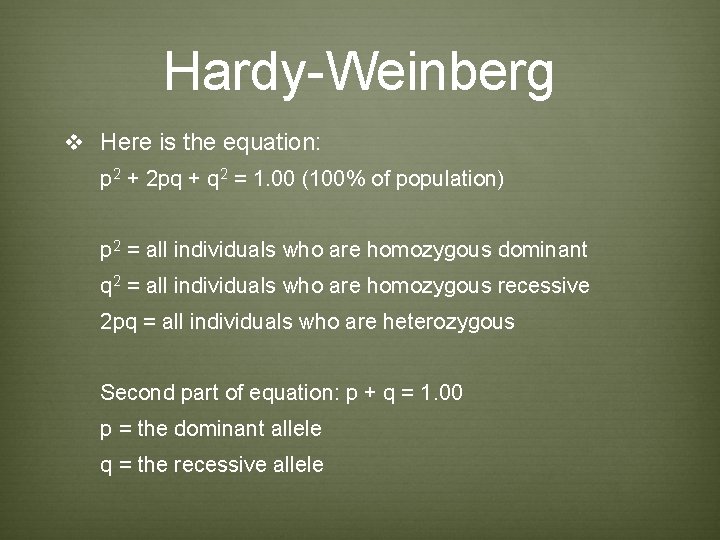
Hardy-Weinberg v Here is the equation: p 2 + 2 pq + q 2 = 1. 00 (100% of population) p 2 = all individuals who are homozygous dominant q 2 = all individuals who are homozygous recessive 2 pq = all individuals who are heterozygous Second part of equation: p + q = 1. 00 p = the dominant allele q = the recessive allele
Hardy-Weinberg v Please use the document titled “HW Explanation” on Canvas to see details and how to solve a problem
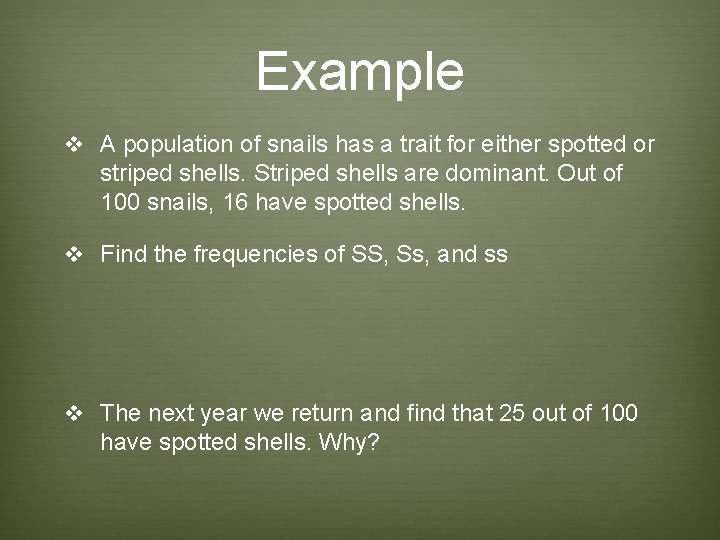
Example v A population of snails has a trait for either spotted or striped shells. Striped shells are dominant. Out of 100 snails, 16 have spotted shells. v Find the frequencies of SS, Ss, and ss v The next year we return and find that 25 out of 100 have spotted shells. Why?
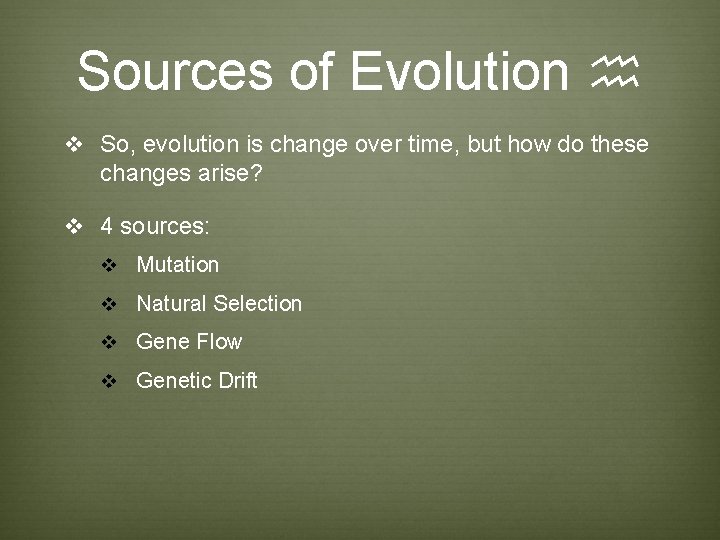
Sources of Evolution h v So, evolution is change over time, but how do these changes arise? v 4 sources: v Mutation v Natural Selection v Gene Flow v Genetic Drift
Mutation h v Small errors in DNA, especially during replication v Most go unnoticed. Some can be harmful and some beneficial v They occur at random v They are the only source of new genetic variation in a population
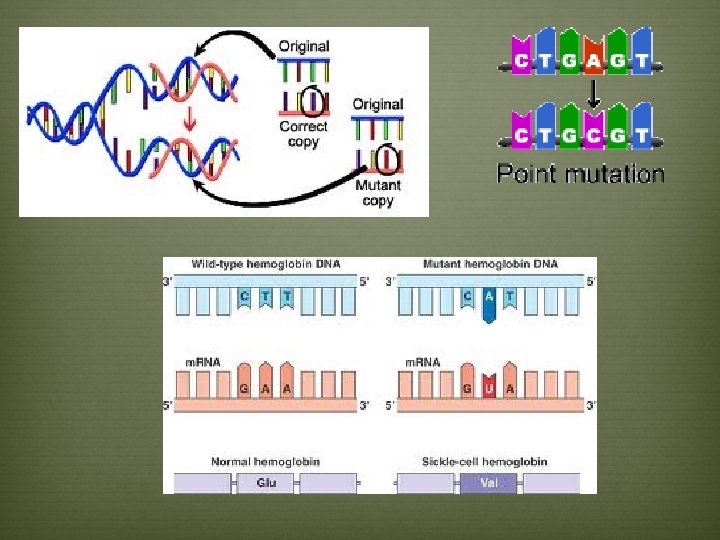
Mutations v Point mutation: a single base is changed h v ATCGGTC ATCGGTA v Frameshift mutation: caused by a deletion or insertion of genetic information; causes codons to be read incorrectly v Parts of chromosomes can be mutated, or entire chromosomes can be mutated v Kleinfelter’s Syndrome: males have extra sex chromosome: XXY v Trisomy 21: person has extra 21 st chromosome. AKA Down Syndrome h
Mutation Example v A point mutation changes the hemoglobin blood cell in some people v This causes sickle-cell anemia. Their blood cells are deformed and cannot carry enough oxygen v It is often fatal v Why do so many sub-Saharan Africans have this mutation?
Mutation Example v A point mutation changes the hemoglobin blood cell in some people v This causes sickle-cell anemia. Their blood cells are deformed and cannot carry enough oxygen v It is often fatal v Why do so many sub-Saharan Africans have this mutation? v Because it protects against malaria, the #1 killer in Africa v If a person is heterozygous for the sickle-cell trait, he/she will have enough normal blood to carry oxygen and enough affected blood to kill malaria parasites that enter body h v Watch: http: //www. youtube. com/watch? v=1 f. N 7 r. Ow. Dy. MQ
Malaria and Sickle-Cell h v The malaria/sickle-cell relationship is a balanced polymorphism h v Two seemingly negative things cancel each other out and are positive for a person’s health v The heterozygous trait balances one negative trait with another, giving the person a better chance of surviving v This is selected for, and is also an example of natural selection
Natural Selection h v Survival of those best adapted to current environmental pressures v Based on the idea of fitness: number of offspring produced in a lifetime v Has nothing to do with strength, speed, or intelligence v Is just how good are you at surviving and making babies
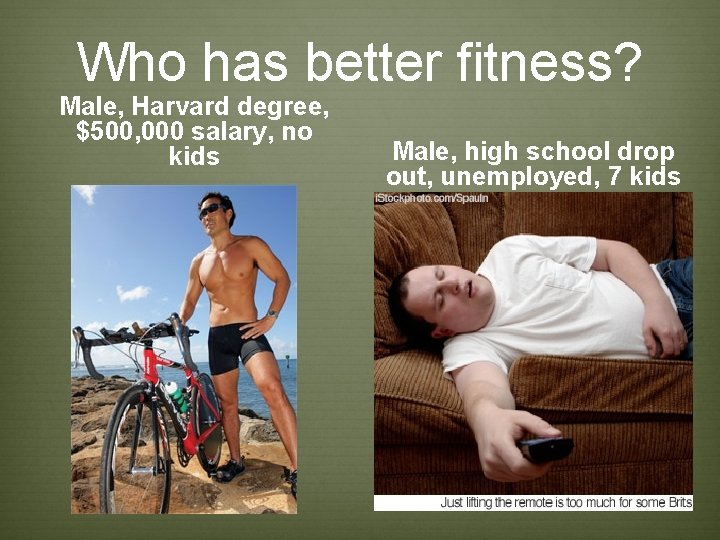
Who has better fitness? Male, Harvard degree, $500, 000 salary, no kids Male, high school drop out, unemployed, 7 kids
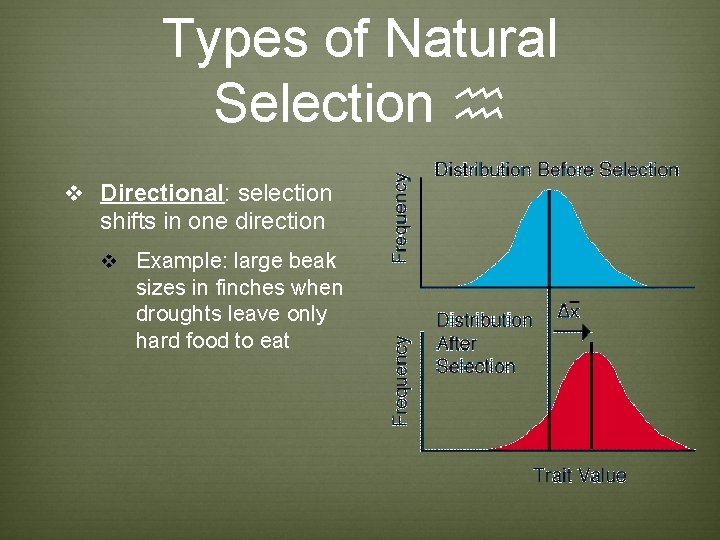
Types of Natural Selection h v Directional: selection shifts in one direction v Example: large beak sizes in finches when droughts leave only hard food to eat
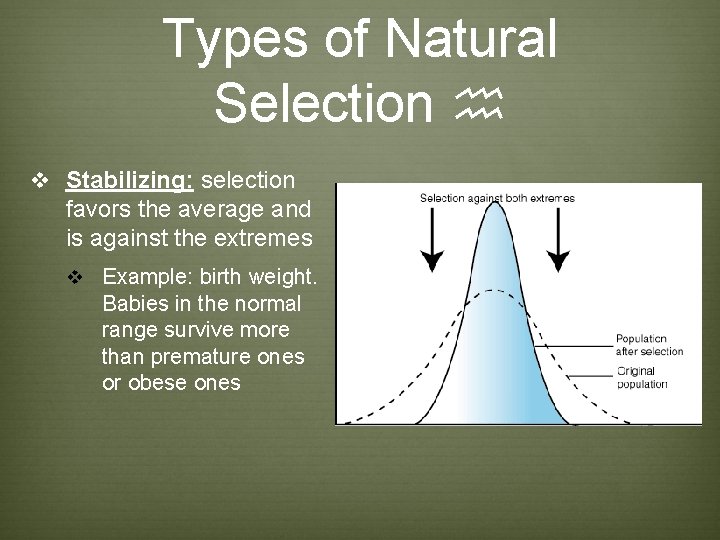
Types of Natural Selection h v Stabilizing: selection favors the average and is against the extremes v Example: birth weight. Babies in the normal range survive more than premature ones or obese ones
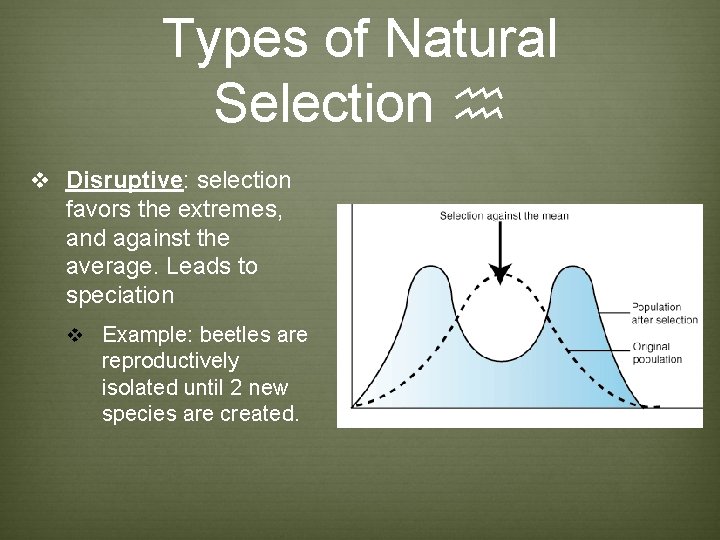
Types of Natural Selection h v Disruptive: selection favors the extremes, and against the average. Leads to speciation v Example: beetles are reproductively isolated until 2 new species are created.
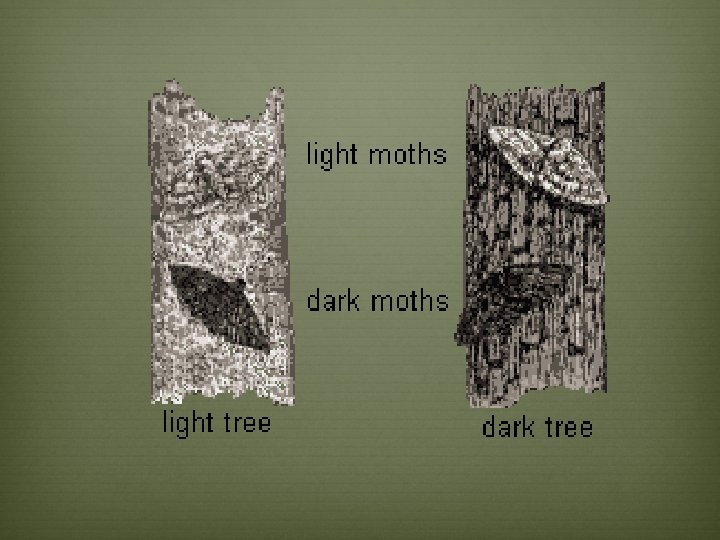
Example of Natural Selection v In Great Britain, most moths were light colored to blend in to the environment v With the Industrial Revolution in the 1800 s, the smog and soot produced changed the environment to be darker v Did the light moths have the advantage still? v No, they were eaten and darker moths survived. This changed allele frequencies
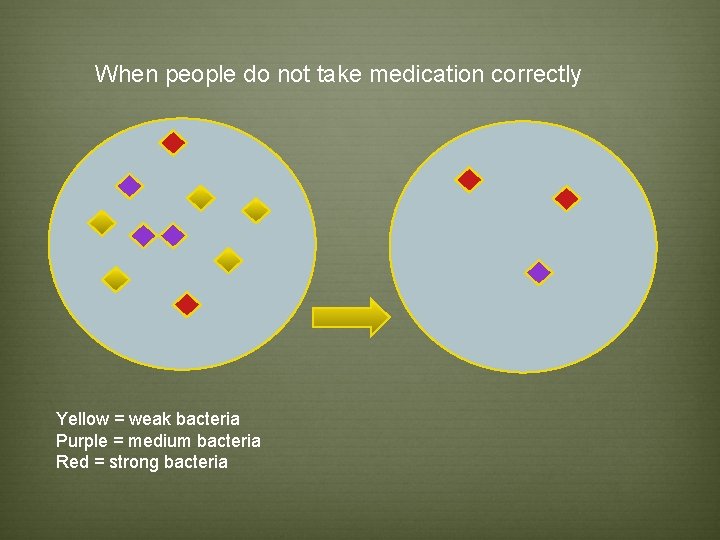
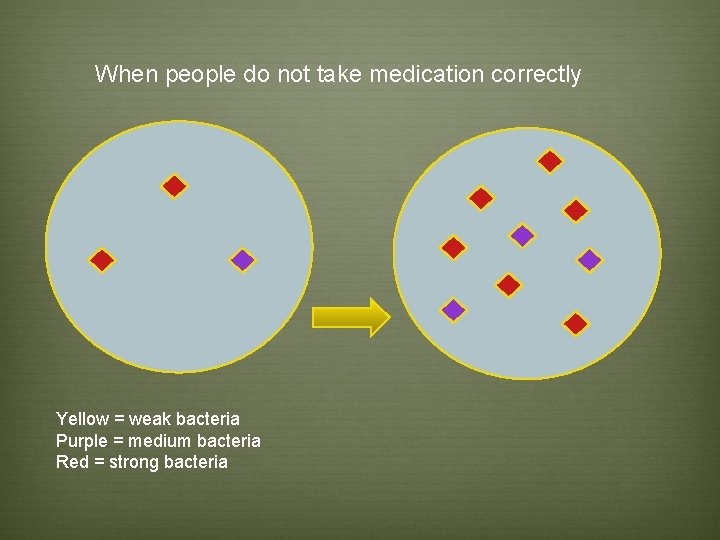
Practical Example #2 (from lecture 2) v Can you see viruses or bacteria? v They are alive and, like everything else, they evolve v Can evolve in a matter of hours v This is why not taking antibiotics/medication correctly leads to drug resistance
When people do not take medication correctly Yellow = weak bacteria Purple = medium bacteria Red = strong bacteria
When people do not take medication correctly Yellow = weak bacteria Purple = medium bacteria Red = strong bacteria
Genetic Drift v This is an over-representation or an under- representation of traits because of a small sample size h v Example: In a class of 25 people, I find that 20 have Type B blood, 3 have Type O and 2 have Type AB v Does this accurately reflect the frequency of blood types in the entire human population? v What about Type A?
Genetic Drift v This shows why large populations are healthier…there is more variation v Endogamous groups only breed within their population v Exogamous groups breed with members outside their population v Which is better for variation and health?
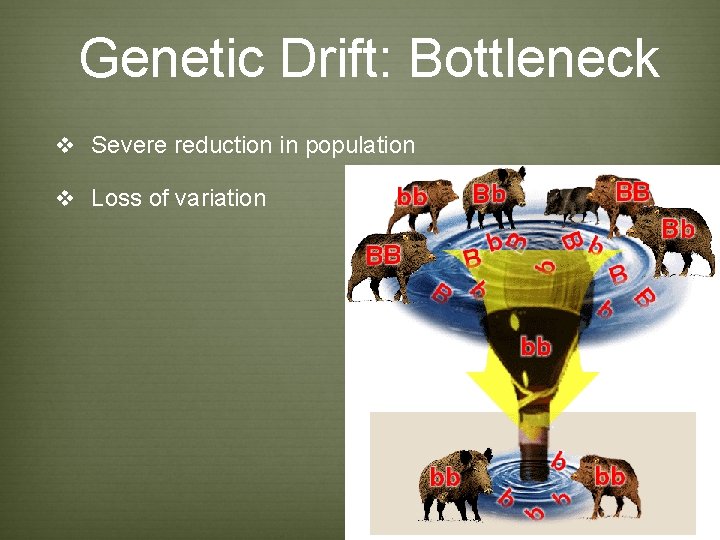
2 Types of Genetic Drift h v 1. Founder Effect: a small group breaks off from the original population and forms its own group v Will that small group accurately reflect all the variation of the original population? v Huntington’s Chorea and Tay Sachs: genetic defects that are exaggerated due to founder effect and genetic drift v 2. Population Bottleneck: when a population is reduced drastically, there is not enough variation to keep it going v Can cause extinction v This is what happens to endangered species
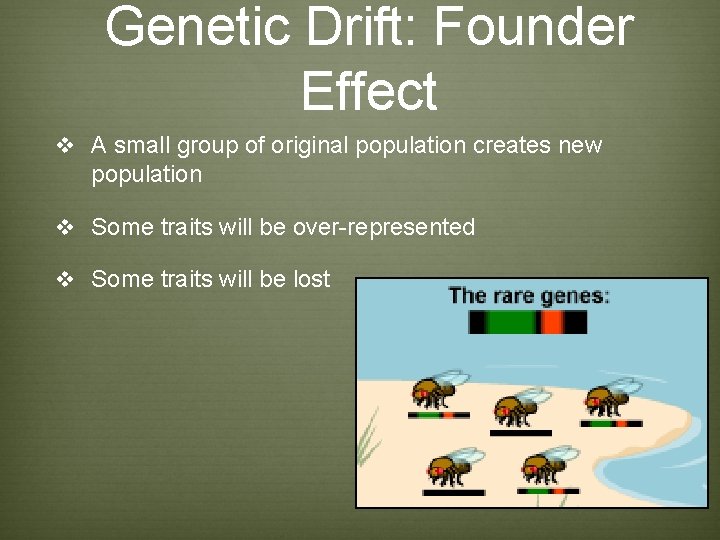
Genetic Drift: Founder Effect v A small group of original population creates new population v Some traits will be over-represented v Some traits will be lost
Genetic Drift: Bottleneck v Severe reduction in population v Loss of variation
Gene Flow v Movement of genes and mixture of them through breeding h v Not only migration: have to mate as well, in order to add variation v So it is migration and nonrandom mating v If there is no gene flow between 2 populations, they could evolve into 2 different species v With global travel and more open-mindedness in cultural ideals, our human gene pool has had a large increase in gene flow and variation
Gene Flow v Variation is the key to success! v Why is inbreeding so bad? v It limits variation in the gene pool and can increase harmful mutations
Review Questions v What is the difference between microevolution and macroevolution? v How does the Hardy-Weinberg equation show that evolution occurs? v What are the sources of evolution? What are some examples?