
GENERICS AND THE JAVA COLLECTIONS FRAMEWORK Lecture 16
- Slides: 26
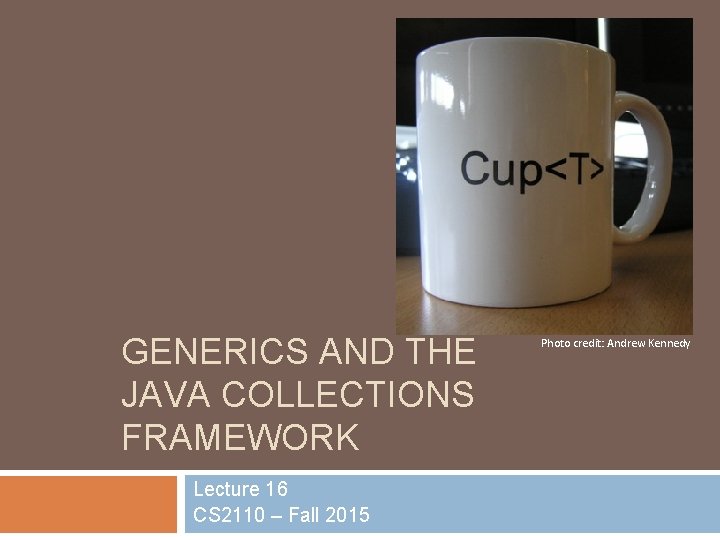
GENERICS AND THE JAVA COLLECTIONS FRAMEWORK Lecture 16 CS 2110 – Fall 2015 Photo credit: Andrew Kennedy
Textbook and Homework 2 Generics: Appendix B Generic types we discussed: Chapters 1 -3, 15 Useful tutorial: docs. oracle. com/javase/tutorial/extra/generics/index. html
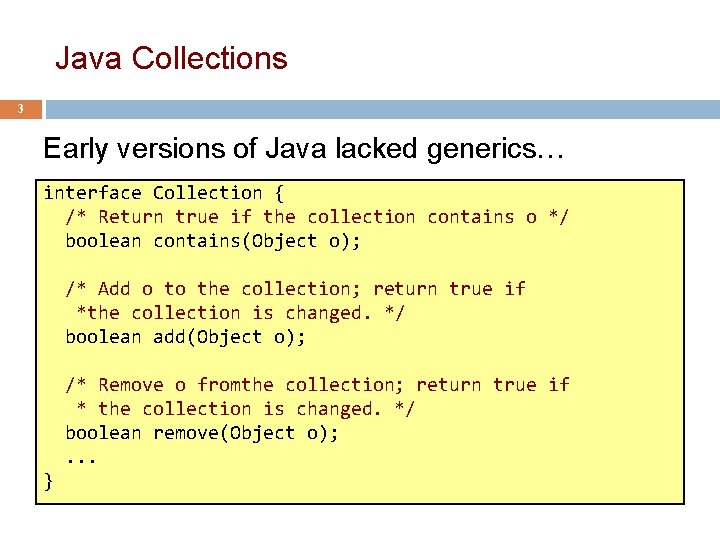
Java Collections 3 Early versions of Java lacked generics… interface Collection { /* Return true if the collection contains o */ boolean contains(Object o); /* Add o to the collection; return true if *the collection is changed. */ boolean add(Object o); /* Remove o fromthe collection; return true if * the collection is changed. */ boolean remove(Object o); . . . }
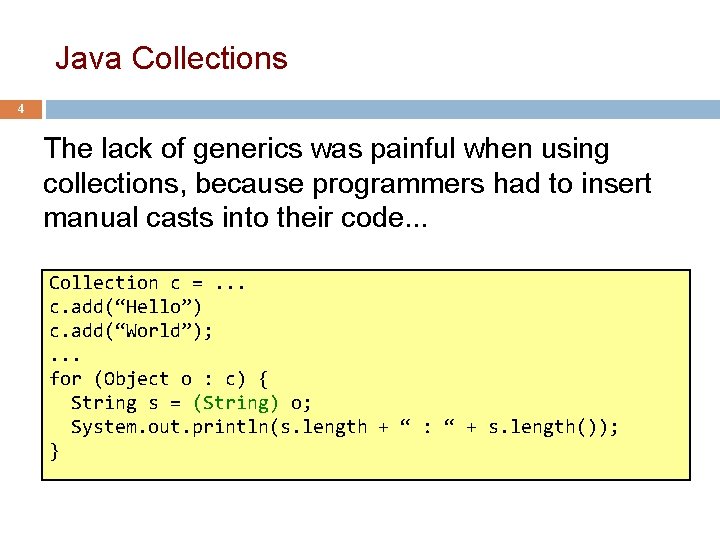
Java Collections 4 The lack of generics was painful when using collections, because programmers had to insert manual casts into their code. . . Collection c =. . . c. add(“Hello”) c. add(“World”); . . . for (Object o : c) { String s = (String) o; System. out. println(s. length + “ : “ + s. length()); }
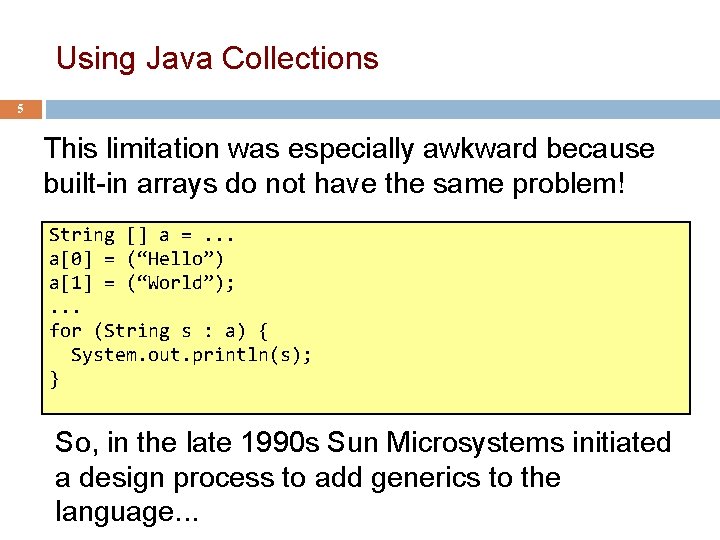
Using Java Collections 5 This limitation was especially awkward because built-in arrays do not have the same problem! String [] a =. . . a[0] = (“Hello”) a[1] = (“World”); . . . for (String s : a) { System. out. println(s); } So, in the late 1990 s Sun Microsystems initiated a design process to add generics to the language. . .
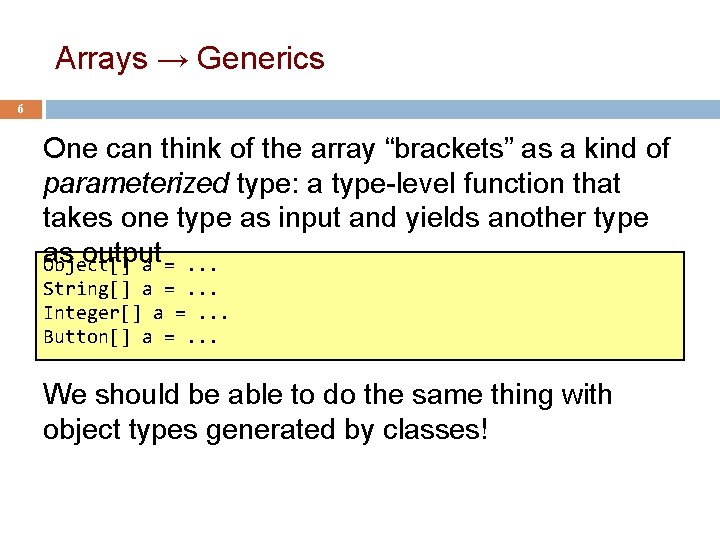
Arrays → Generics 6 One can think of the array “brackets” as a kind of parameterized type: a type-level function that takes one type as input and yields another type as output Object[] a =. . . String[] a =. . . Integer[] a =. . . Button[] a =. . . We should be able to do the same thing with object types generated by classes!
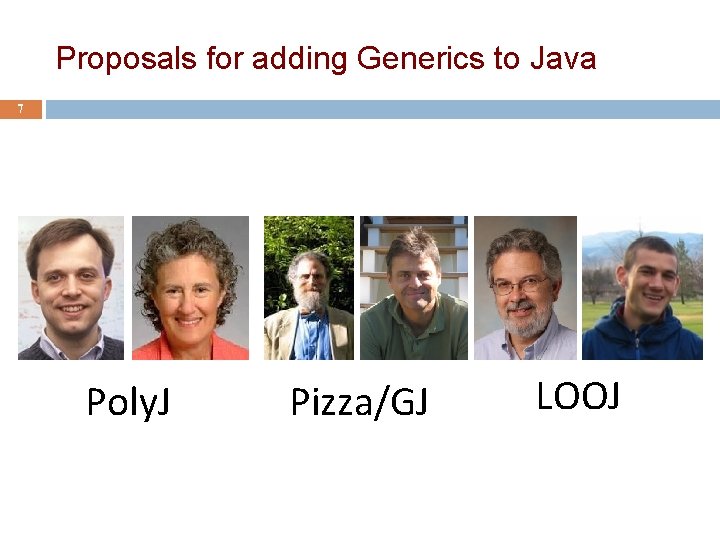
Proposals for adding Generics to Java 7 Poly. J Pizza/GJ LOOJ
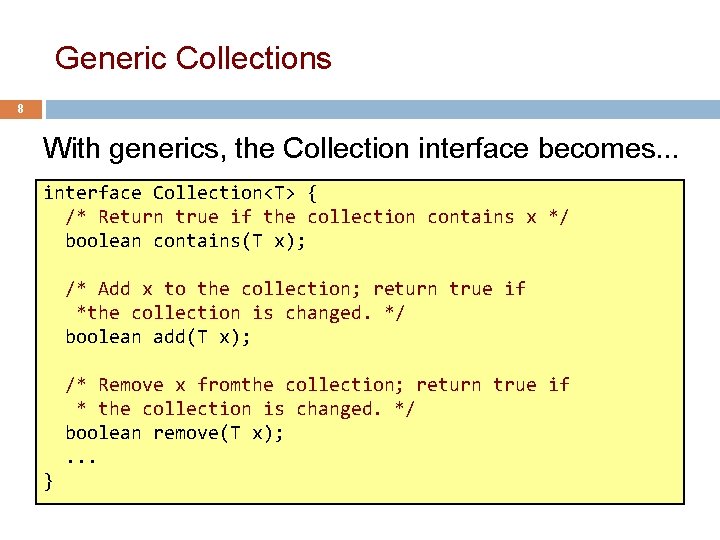
Generic Collections 8 With generics, the Collection interface becomes. . . interface Collection<T> { /* Return true if the collection contains x */ boolean contains(T x); /* Add x to the collection; return true if *the collection is changed. */ boolean add(T x); /* Remove x fromthe collection; return true if * the collection is changed. */ boolean remove(T x); . . . }
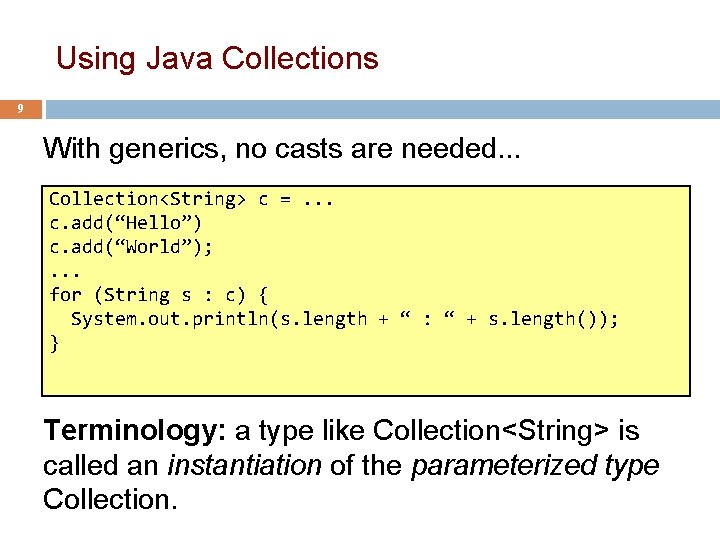
Using Java Collections 9 With generics, no casts are needed. . . Collection<String> c =. . . c. add(“Hello”) c. add(“World”); . . . for (String s : c) { System. out. println(s. length + “ : “ + s. length()); } Terminology: a type like Collection<String> is called an instantiation of the parameterized type Collection.
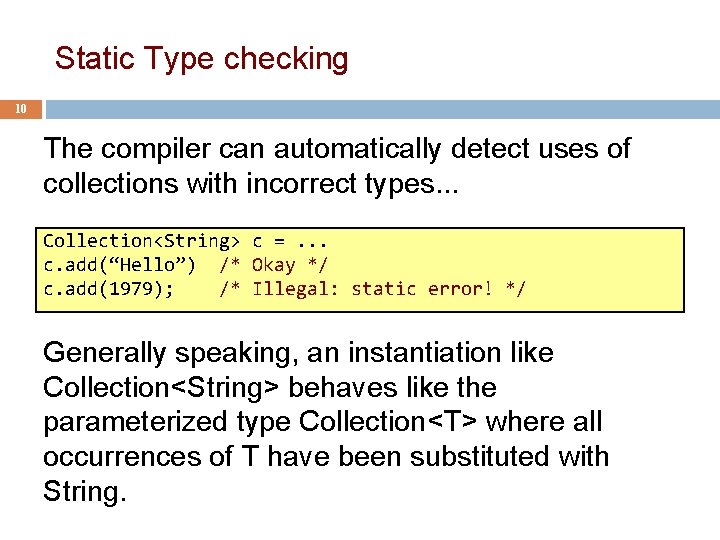
Static Type checking 10 The compiler can automatically detect uses of collections with incorrect types. . . Collection<String> c =. . . c. add(“Hello”) /* Okay */ c. add(1979); /* Illegal: static error! */ Generally speaking, an instantiation like Collection<String> behaves like the parameterized type Collection<T> where all occurrences of T have been substituted with String.
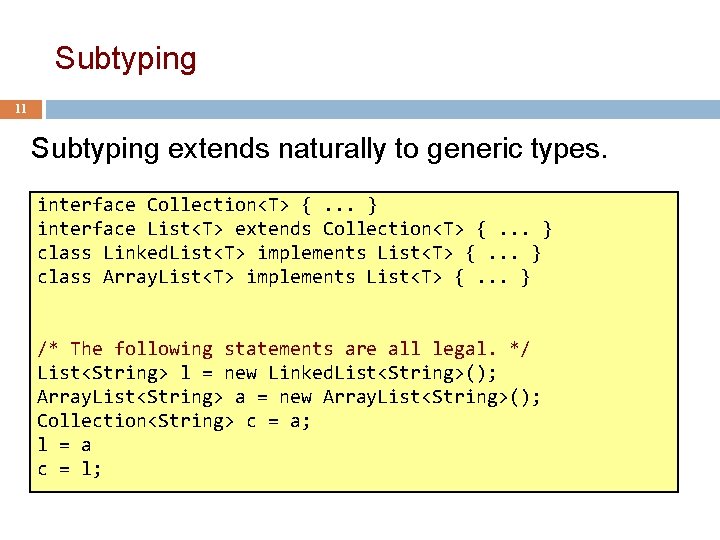
Subtyping 11 Subtyping extends naturally to generic types. interface Collection<T> {. . . } interface List<T> extends Collection<T> {. . . } class Linked. List<T> implements List<T> {. . . } class Array. List<T> implements List<T> {. . . } /* The following statements are all legal. */ List<String> l = new Linked. List<String>(); Array. List<String> a = new Array. List<String>(); Collection<String> c = a; l = a c = l;
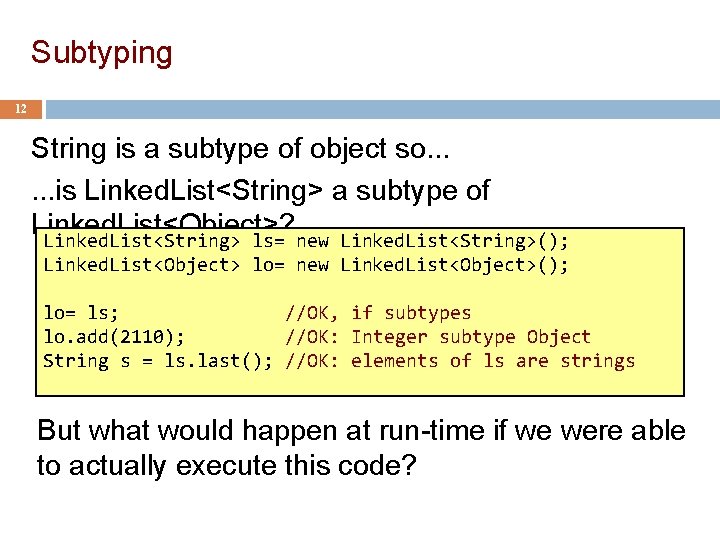
Subtyping 12 String is a subtype of object so. . . is Linked. List<String> a subtype of Linked. List<Object>? Linked. List<String> ls= new Linked. List<String>(); Linked. List<Object> lo= new Linked. List<Object>(); lo= ls; //OK, if subtypes lo. add(2110); //OK: Integer subtype Object String s = ls. last(); //OK: elements of ls are strings But what would happen at run-time if we were able to actually execute this code?
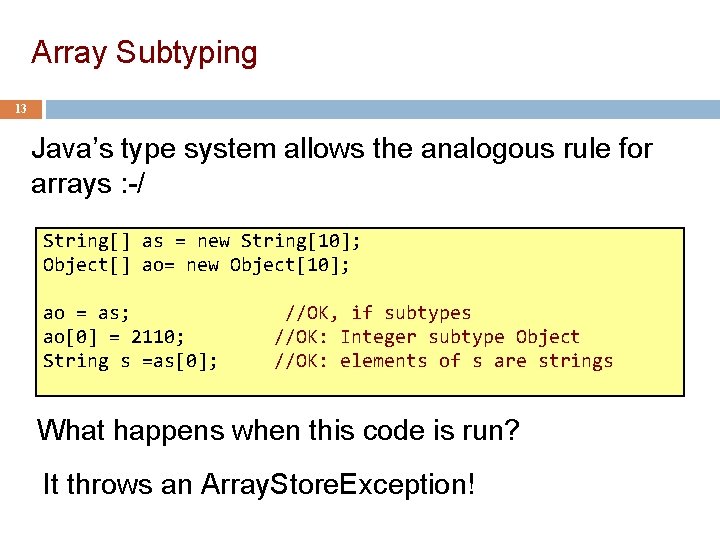
Array Subtyping 13 Java’s type system allows the analogous rule for arrays : -/ String[] as = new String[10]; Object[] ao= new Object[10]; ao = as; ao[0] = 2110; String s =as[0]; //OK, if subtypes //OK: Integer subtype Object //OK: elements of s are strings What happens when this code is run? It throws an Array. Store. Exception!
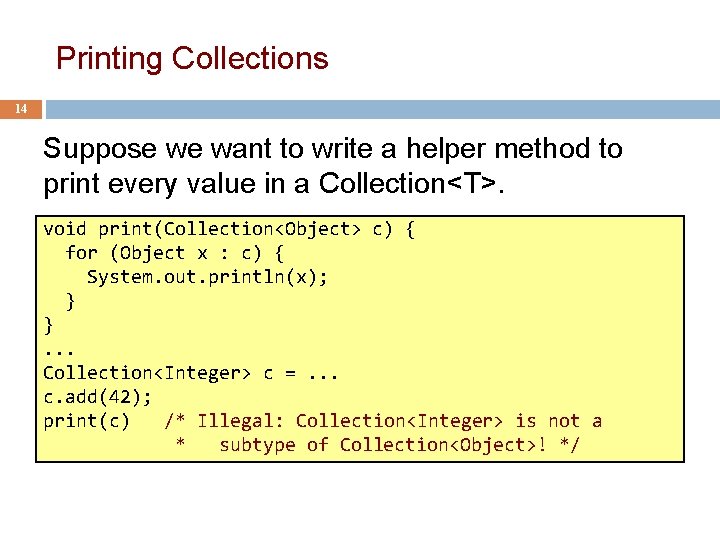
Printing Collections 14 Suppose we want to write a helper method to print every value in a Collection<T>. void print(Collection<Object> c) { for (Object x : c) { System. out. println(x); } }. . . Collection<Integer> c =. . . c. add(42); print(c) /* Illegal: Collection<Integer> is not a * subtype of Collection<Object>! */
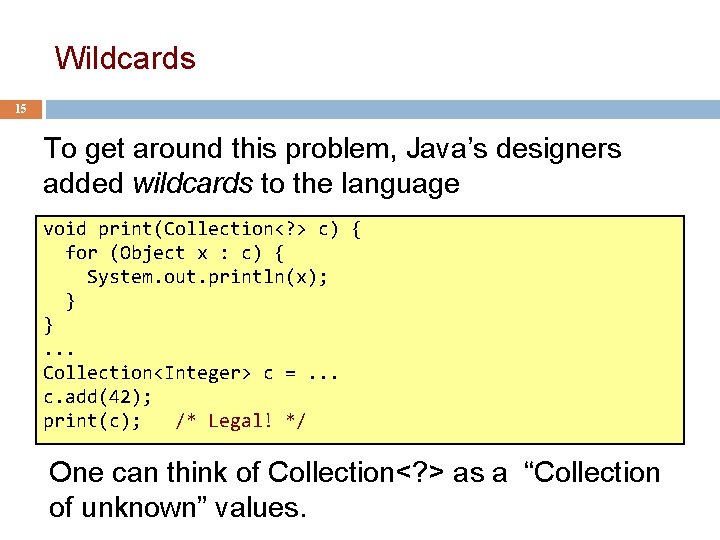
Wildcards 15 To get around this problem, Java’s designers added wildcards to the language void print(Collection<? > c) { for (Object x : c) { System. out. println(x); } }. . . Collection<Integer> c =. . . c. add(42); print(c); /* Legal! */ One can think of Collection<? > as a “Collection of unknown” values.
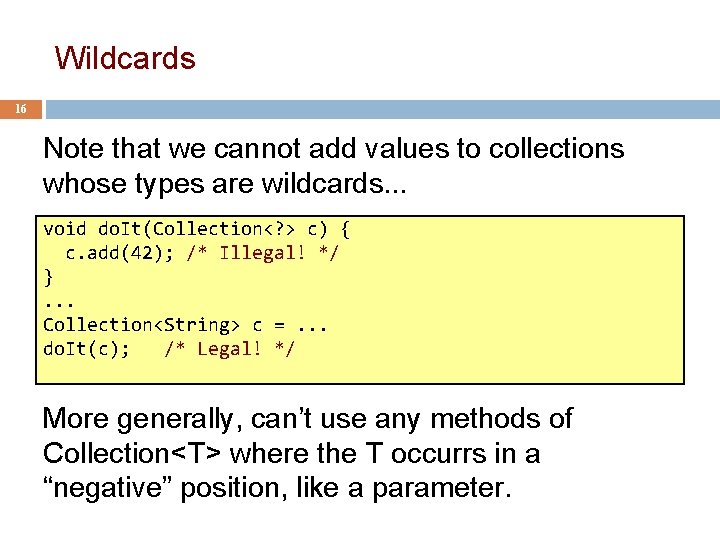
Wildcards 16 Note that we cannot add values to collections whose types are wildcards. . . void do. It(Collection<? > c) { c. add(42); /* Illegal! */ }. . . Collection<String> c =. . . do. It(c); /* Legal! */ More generally, can’t use any methods of Collection<T> where the T occurrs in a “negative” position, like a parameter.
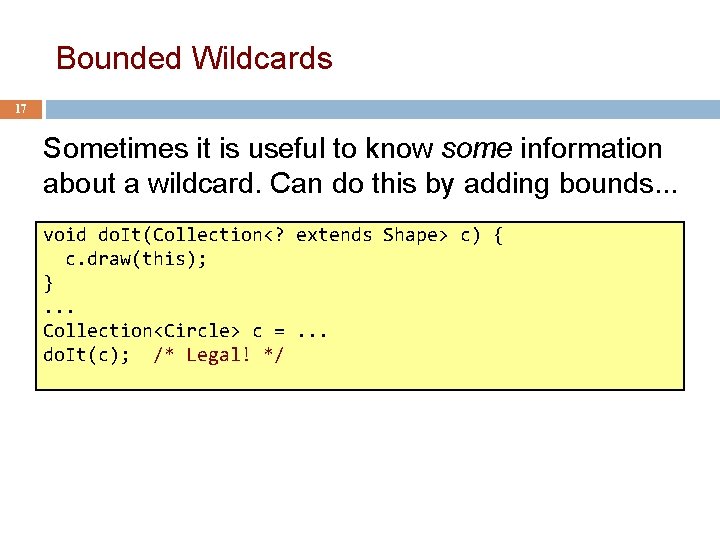
Bounded Wildcards 17 Sometimes it is useful to know some information about a wildcard. Can do this by adding bounds. . . void do. It(Collection<? extends Shape> c) { c. draw(this); }. . . Collection<Circle> c =. . . do. It(c); /* Legal! */
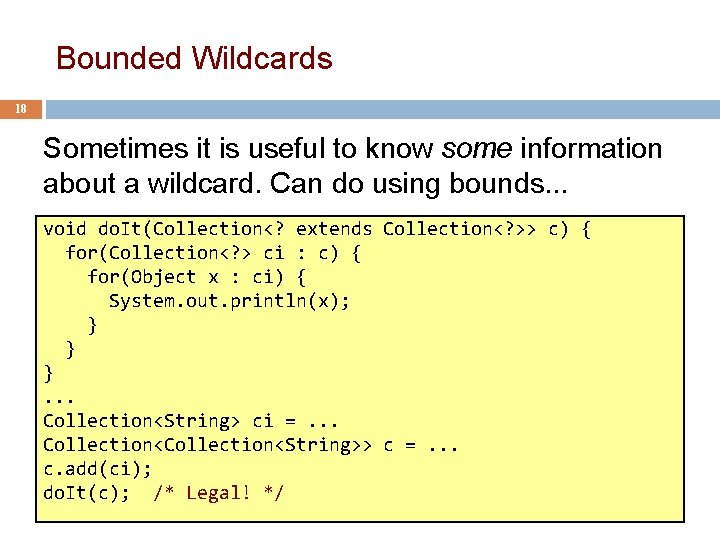
Bounded Wildcards 18 Sometimes it is useful to know some information about a wildcard. Can do using bounds. . . void do. It(Collection<? extends Collection<? >> c) { for(Collection<? > ci : c) { for(Object x : ci) { System. out. println(x); } } }. . . Collection<String> ci =. . . Collection<String>> c =. . . c. add(ci); do. It(c); /* Legal! */
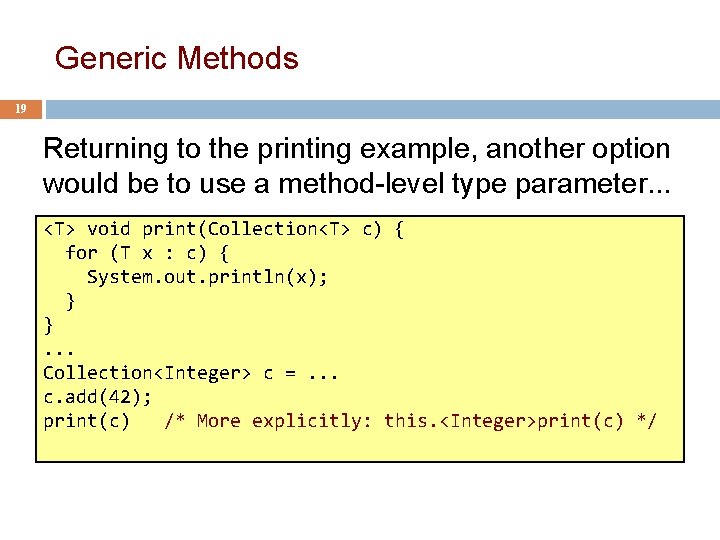
Generic Methods 19 Returning to the printing example, another option would be to use a method-level type parameter. . . <T> void print(Collection<T> c) { for (T x : c) { System. out. println(x); } }. . . Collection<Integer> c =. . . c. add(42); print(c) /* More explicitly: this. <Integer>print(c) */
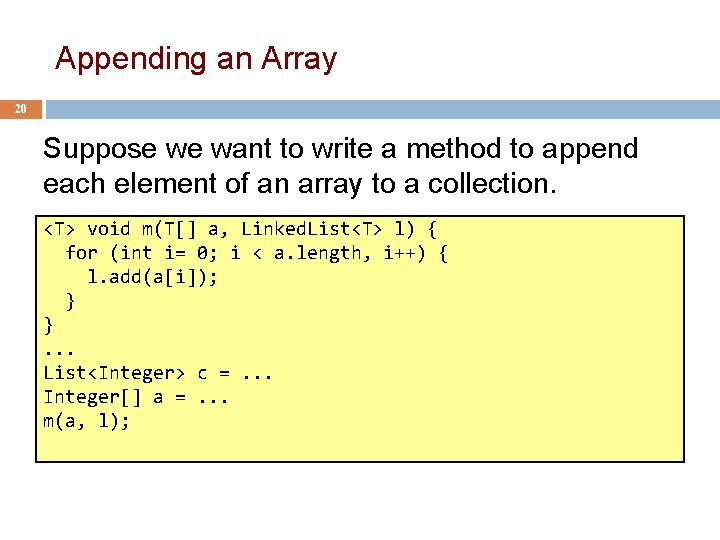
Appending an Array 20 Suppose we want to write a method to append each element of an array to a collection. <T> void m(T[] a, Linked. List<T> l) { for (int i= 0; i < a. length, i++) { l. add(a[i]); } }. . . List<Integer> c =. . . Integer[] a =. . . m(a, l);
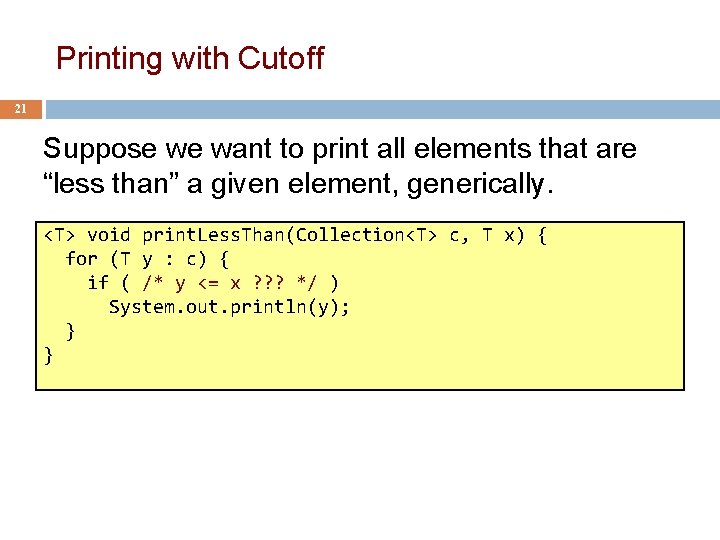
Printing with Cutoff 21 Suppose we want to print all elements that are “less than” a given element, generically. <T> void print. Less. Than(Collection<T> c, T x) { for (T y : c) { if ( /* y <= x ? ? ? */ ) System. out. println(y); } }
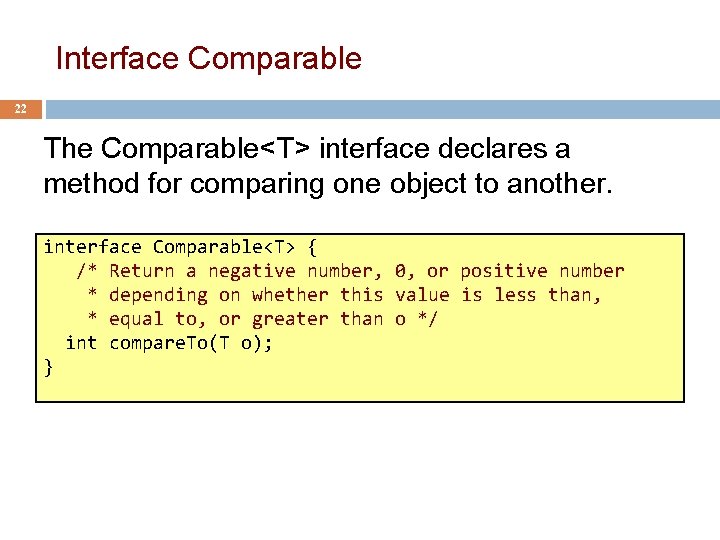
Interface Comparable 22 The Comparable<T> interface declares a method for comparing one object to another. interface Comparable<T> { /* Return a negative number, 0, or positive number * depending on whether this value is less than, * equal to, or greater than o */ int compare. To(T o); }
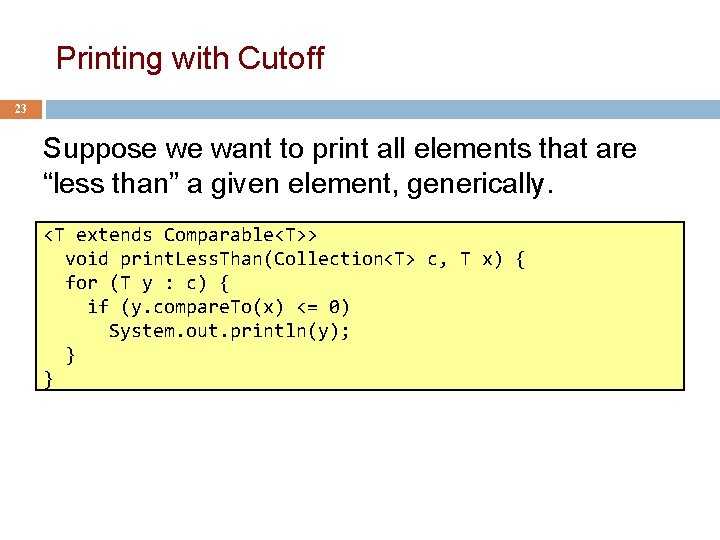
Printing with Cutoff 23 Suppose we want to print all elements that are “less than” a given element, generically. <T extends Comparable<T>> void print. Less. Than(Collection<T> c, T x) { for (T y : c) { if (y. compare. To(x) <= 0) System. out. println(y); } }
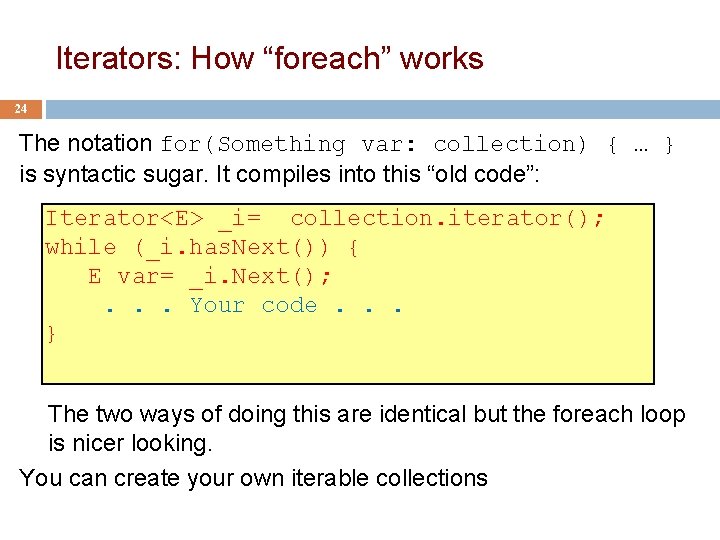
Iterators: How “foreach” works 24 The notation for(Something var: collection) { … } is syntactic sugar. It compiles into this “old code”: Iterator<E> _i= collection. iterator(); while (_i. has. Next()) { E var= _i. Next(); . . . Your code. . . } The two ways of doing this are identical but the foreach loop is nicer looking. You can create your own iterable collections
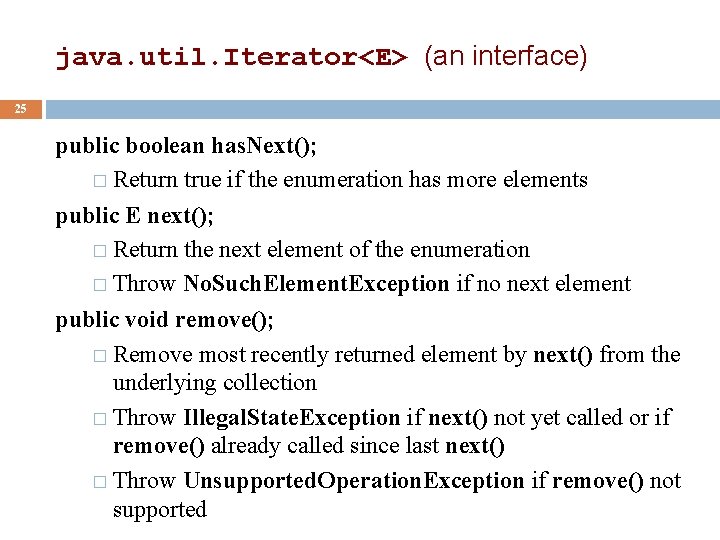
java. util. Iterator<E> (an interface) 25 public boolean has. Next(); � Return true if the enumeration has more elements public E next(); � Return the next element of the enumeration � Throw No. Such. Element. Exception if no next element public void remove(); � Remove most recently returned element by next() from the underlying collection � Throw Illegal. State. Exception if next() not yet called or if remove() already called since last next() � Throw Unsupported. Operation. Exception if remove() not supported
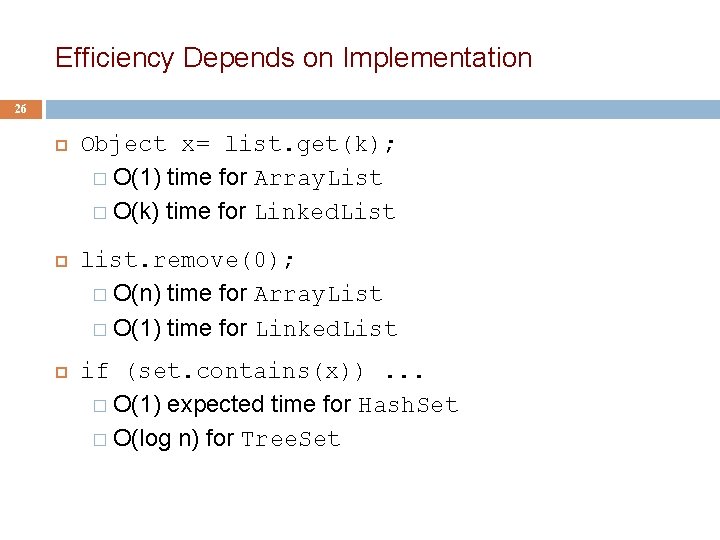
Efficiency Depends on Implementation 26 Object x= list. get(k); � O(1) time for Array. List � O(k) time for Linked. List list. remove(0); � O(n) time for Array. List � O(1) time for Linked. List if (set. contains(x)). . . � O(1) expected time for Hash. Set � O(log n) for Tree. Set