
Generic Tasks In the 80s KB engineering used
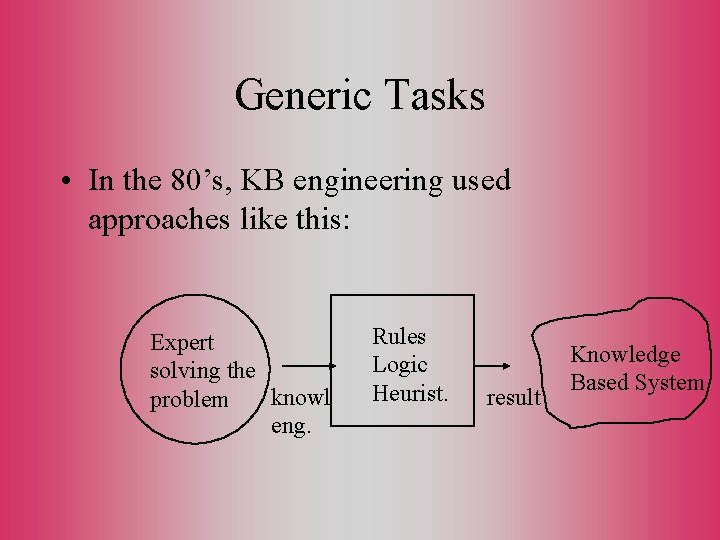
Generic Tasks • In the 80’s, KB engineering used approaches like this: Expert solving the knowl problem eng. Rules Logic Heurist. result Knowledge Based System
The Problem • What if the expert’s approach did not fit the rules, logic or heuristic paradigm? • Knowledge Engineers forced the knowledge into one of these forms, appropriately or not • OR, Starting from scracth, the KE would build their system out of Lisp or Prolog and construct the system in a free-form way • The expert’s approach and knowledge may be more suitable for another approach • What approach?
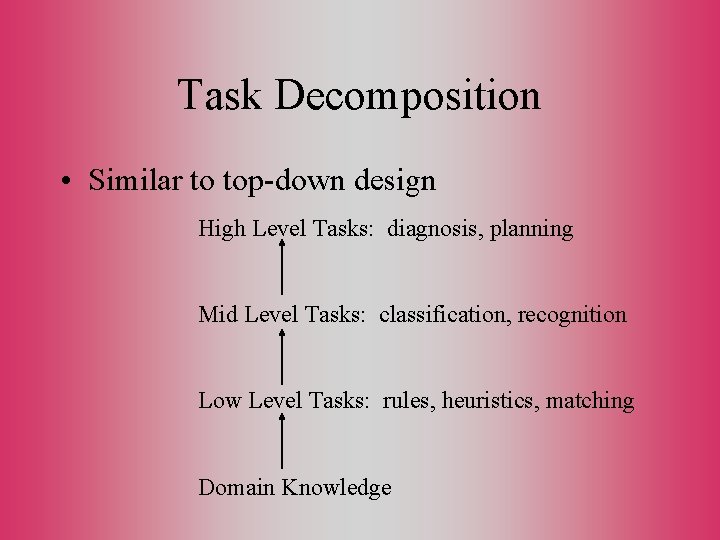
Task Decomposition • Similar to top-down design High Level Tasks: diagnosis, planning Mid Level Tasks: classification, recognition Low Level Tasks: rules, heuristics, matching Domain Knowledge

What Level is Appropriate? • Low levels are very primitive, offer flexibility but no structure (e. g. compare assembly language to Pascal) • High levels offer structure but no flexibility (e. g. write a merge sort using Quattro Pro) • Middle levels are a nice compromise which offer some structure and some flexibility
Similarities in problem solving • All diagnostic problems have similar procedural approaches whether medical, mechanical, electrical or debugging • Many planning problems have similar procedural approaches whether linear, nonlinear, hierarchical, routine, or reactive • Many interpretation problems are like diagnostic problems - recognition tasks
Generic Tasks • Information Processing Strategies • Functionally Defined - tells us how this task might fit in with other tasks – What is the input? – What is the output? • Implied Method(s) – Tells us what knowledge is needed to solve the problem for knowledge acquisition – Helps for automated explanations
Example: Diagnosis • • Malfunction hierarchy Rule-out knowledge Associational knowledge Differential knowledge Evaluation knowledge Test-ordering knowledge Refinement knowledge
Example: Design/Planning • • Device/Component interactions Design plans Preferences Adjustment/Failure-handling knowledge
Generic Tasks • Hierarchical Classification (HC) • Routine Recognition/Hypothesis Matching (RR) • State Abstraction (FR) • Plan Selection/Refinement (RD) • Data Inferencing (DI) • Abductive Assembly (AA)
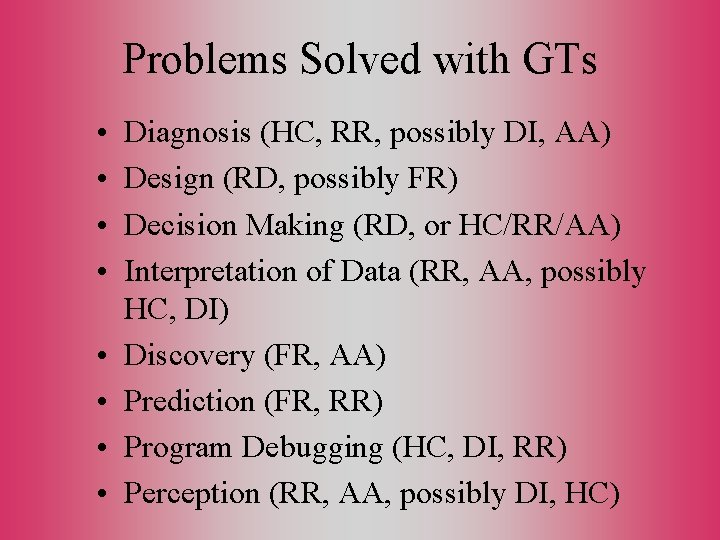
Problems Solved with GTs • • Diagnosis (HC, RR, possibly DI, AA) Design (RD, possibly FR) Decision Making (RD, or HC/RR/AA) Interpretation of Data (RR, AA, possibly HC, DI) Discovery (FR, AA) Prediction (FR, RR) Program Debugging (HC, DI, RR) Perception (RR, AA, possibly DI, HC)
Problems with GTs • • • Control issues Learning with GTs Need for Deep knowledge Need for Common Sense knowledge How to perform explanations What about problems not listed on the previous slide? Can any problem be solved in this way?
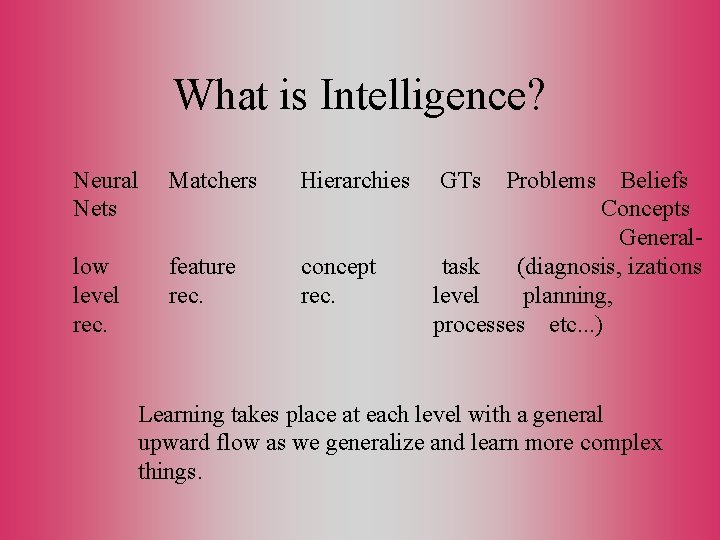
What is Intelligence? Neural Nets Matchers Hierarchies low level rec. feature rec. concept rec. GTs Problems Beliefs Concepts Generaltask (diagnosis, izations level planning, processes etc. . . ) Learning takes place at each level with a general upward flow as we generalize and learn more complex things.
- Slides: 12