
Generic Overlay OAM and Datapath Failure Detection Kanwar



- Slides: 10
Generic Overlay OAM and Datapath Failure Detection Kanwar Singh (Nuage Networks) Pradeep Jain, Florin Balus Wim Henderickx Anil Lohiya, Ravi Shekhar Vinay Bannai Nuage Networks Alcatel-Lucent, Inc Juniper Networks, Inc Paypal, Inc
Motivation of Generic Overlay OAM Application • • • Existing IP/Ping Trace does not work well for Overlays. Consistency of Control and Data Plane Programming. Continuity Check. Fault Verification. Fault Isolation. Performance. – Packet Delay Statistics. – Packet Loss Measurements.
Requirements for Overlay OAM Framework • Originating Overlay End Point should send the OAM Frame (Echo Request) following the same Data-Path as that of End-System’s traffic. • Terminating Overlay End Point should be able to differentiate the OAM Frames from the End System Data, and send it to OAM Application for Reply. • Should be able to achieve OAM for applications using L 2 and L 3 Overlays. • Should give capability to Trace the Path taken in the Underlay for a given Overlay Segment. • Should work for Overlay Technologies as Vx. LAN, NVGRE, MPLSo. UDP.
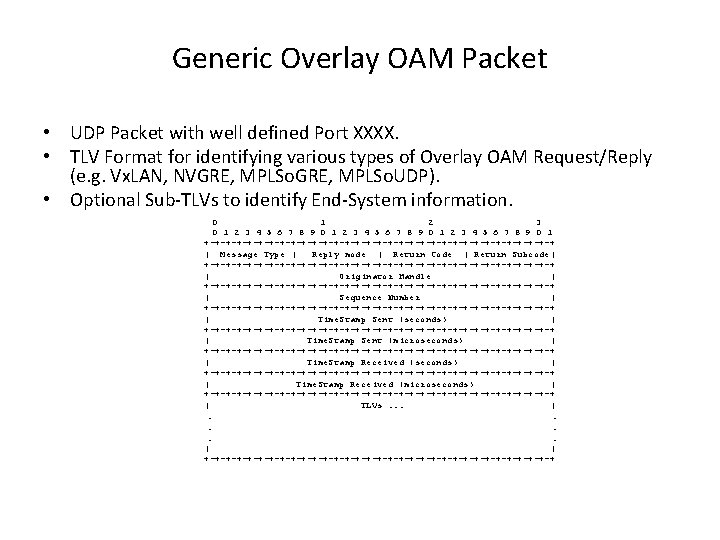
Generic Overlay OAM Packet • UDP Packet with well defined Port XXXX. • TLV Format for identifying various types of Overlay OAM Request/Reply (e. g. Vx. LAN, NVGRE, MPLSo. UDP). • Optional Sub-TLVs to identify End-System information. 0 1 2 3 4 5 6 7 8 9 0 1 +-+-+-+-+-+-+-+-+-+-+-+-+-+-+-+-+ | Message Type | Reply mode | Return Code | Return Subcode| +-+-+-+-+-+-+-+-+-+-+-+-+-+-+-+-+ | Originator Handle | +-+-+-+-+-+-+-+-+-+-+-+-+-+-+-+-+ | Sequence Number | +-+-+-+-+-+-+-+-+-+-+-+-+-+-+-+-+ | Time. Stamp Sent (seconds) | +-+-+-+-+-+-+-+-+-+-+-+-+-+-+-+-+ | Time. Stamp Sent (microseconds) | +-+-+-+-+-+-+-+-+-+-+-+-+-+-+-+-+-+-+-+-+-+-+-+-+-+-+-+-+-+-+-+-+ | Time. Stamp Received (microseconds) | +-+-+-+-+-+-+-+-+-+-+-+-+-+-+-+-+ | TLVs. . . | | +-+-+-+-+-+-+-+-+-+-+-+-+-+-+-+-+
Overlay Ping - Originating Overlay End Point Procedures • Outer Header Should follow Encapsulation similar to Overlay Segment – Vx. LAN / NVGRE : Set Router Alert Bit (draft-singh-nvo 3 -vxlan-router-alert / draft-singhnvo 3 -nvgre-router-alert) – indicating Control Packet – MPLSo. GRE/MPLSo. UDP : Add Router Alert Label following Overlay Segment Label. • Inner Header Encapsulation – L 2 Overlay • Echo Request should have inner Ethernet Header, followed by IP and UDP Header • Inner DMAC: 00 -00 -5 E-90 -XX-XX (to be assigned by IANA) • Inner DST-IP: In Range of 127/8 (for IPv 4) or In Range 0: 0: 0: FFFF: 127/104 (for IPv 6) • Inner DST-UDP Port: XXXX (assigned by IANA for Overlay OAM). • Generic OAM Frame – L 3 Overlay • Echo Request’s Encapsulation is same as above, except Inner Ethernet Header.
Overlay Ping - Terminating Overlay End Point Procedures • Identify Packet as Control Packet from Outer Header – Vx. LAN / NVGRE : Router Alert Bit (draft-singh-nvo 3 -vxlan-router-alert / draft-singh-nvo 3 -nvgre-router-alert) – MPLSo. GRE/MPLSo. UDP : Router Alert Label. • Identify Packet as Overlay OAM Packet and sent it to OAM Application using Inner Header Encapsulation – L 2 Overlay • Inner DMAC: 00 -00 -5 E-90 -XX-XX (to be assigned by IANA) • Inner DST-IP: In Range of 127/8 (for IPv 4) or In Range 0: 0: 0: FFFF: 127/104 (for IPv 6) • Inner DST-UDP Port: XXXX (assigned by IANA for Overlay OAM). – L 3 Overlay • Inner DST-IP: In Range of 127/8 (for IPv 4) or In Range 0: 0: 0: FFFF: 127/104 (for IPv 6) • Inner DST-UDP Port: XXXX (assigned by IANA for Overlay OAM). • Validate Control/Data Plane and Send Echo Reply with Return Code
Overlay Ping Construct • Two Type of Packets – Echo Request – Echo Reply • Reply Modes – Do not reply – Reply via IPv 4 UDP Packet – Reply via Overlay Segment • Return Codes – – – No return code Malformed Echo Request Received Overlay Segment Not Present Overlay Segment Not Operational Return-Code-OK
Path Trace Procedures • Echo Request is prepared via same Encapsulation as that of Overlay Tunnel. • Echo Request packets are sent with Incremental TTL values 1, 2. . n of Outer Header to probe the Path taken by the Overlay. • TTL Expiry creates an Exception, packet is sent to OAM Application based on inner UDP Port. • Each Transit Node as well as Overlay End Point receiving such an exception should send Echo Reply.
Procedures End-System Ping • Originating Overlay End Point – Echo Request similar to Overlay Ping along with : • TLV Identifying Overlay Segment. • Sub-TLV identifying Type of End-System Ping (e. g MAC, IP or MAC/IP of End-System). – Echo Request follows same Data Path as that of End-System Data. • Terminating Overlay End Point – Terminating Overlay End Point validates End-System(s) information and send Echo Reply with proper Return Code for each End-System. • Return Code – End-System Present – End-System Not Present
Next Step • Looking forward to Comment/Feedback. • Request the document to be accepted as WG document