
Generator Design Patterns The Factory Patterns 2007 Pearson

- Slides: 22
Generator Design Patterns: The Factory Patterns © 2007 Pearson Education, Inc. Publishing as Pearson Addison-Wesley
Objectives § To present the structure, behavior, and characteristics of generator patterns § To discuss the uses of factory methods § To present the Factory Method and Abstract Factory design patterns © 2007 Pearson Education, Inc. Publishing as Pearson Addison-Wesley
Topics § Instance creation § Generator patterns § Factory methods § The Factory Method pattern § The Abstract Factory pattern © 2007 Pearson Education, Inc. Publishing as Pearson Addison-Wesley
Instance Creation § There are two ways to create objects: • Instantiating a class using one of its constructors • Cloning an existing object § Clients may use another class to create an instance on their behalf; this is the essence of the generator pattern category. § Analogy: a tailor © 2007 Pearson Education, Inc. Publishing as Pearson Addison-Wesley
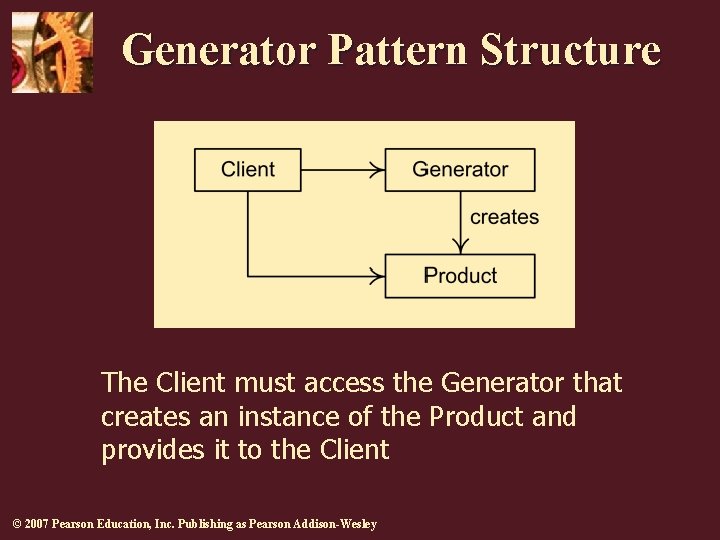
Generator Pattern Structure The Client must access the Generator that creates an instance of the Product and provides it to the Client © 2007 Pearson Education, Inc. Publishing as Pearson Addison-Wesley
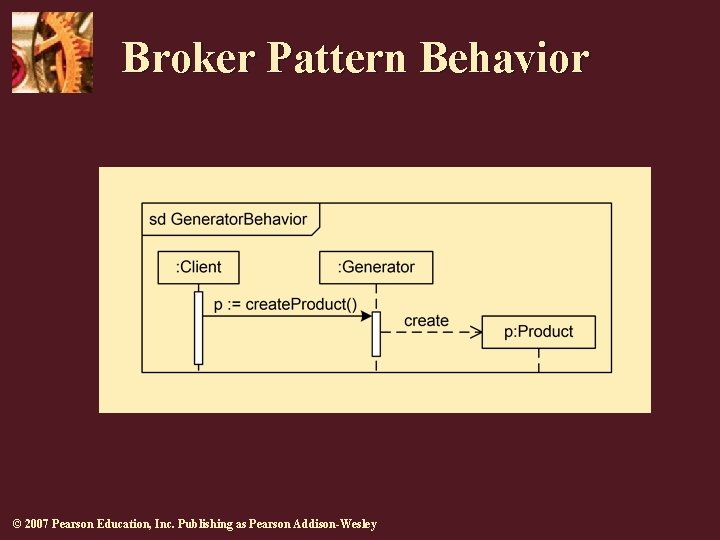
Broker Pattern Behavior © 2007 Pearson Education, Inc. Publishing as Pearson Addison-Wesley
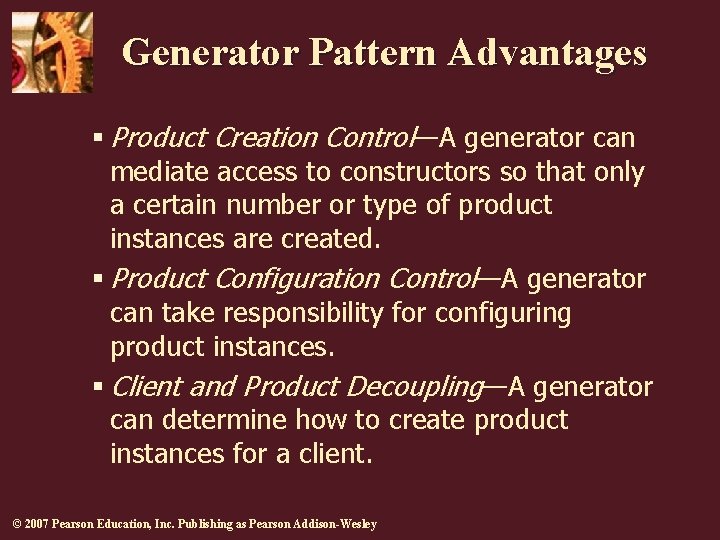
Generator Pattern Advantages § Product Creation Control—A generator can mediate access to constructors so that only a certain number or type of product instances are created. § Product Configuration Control—A generator can take responsibility for configuring product instances. § Client and Product Decoupling—A generator can determine how to create product instances for a client. © 2007 Pearson Education, Inc. Publishing as Pearson Addison-Wesley
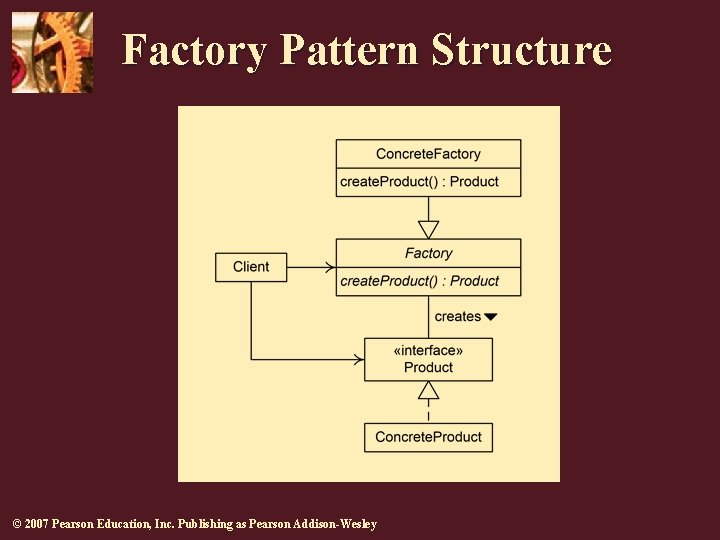
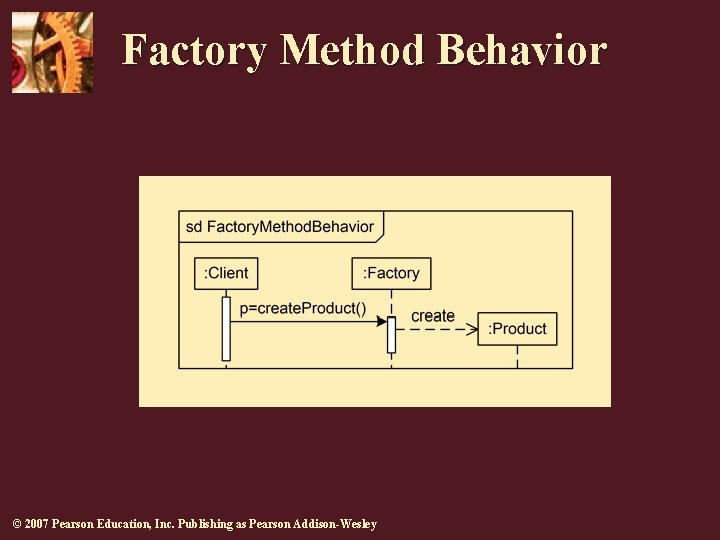
Factory Methods A Generator must have an operation that creates and returns Product instances. A factory method is a nonconstructor operation that creates and returns class instances. © 2007 Pearson Education, Inc. Publishing as Pearson Addison-Wesley
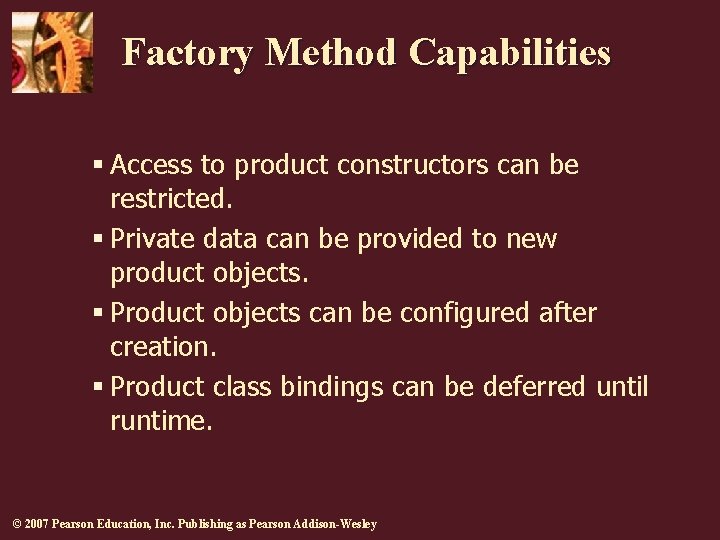
Factory Method Capabilities § Access to product constructors can be restricted. § Private data can be provided to new product objects. § Product objects can be configured after creation. § Product class bindings can be deferred until runtime. © 2007 Pearson Education, Inc. Publishing as Pearson Addison-Wesley
The Factory Patterns § All generator patterns have factory methods. § Factory patterns configure participating classes in certain ways to decouple the client from the product. § Interfaces are used to • Change the generator • Change the product instances § Analogy: automobile factories © 2007 Pearson Education, Inc. Publishing as Pearson Addison-Wesley
The Factory Patterns § Factory Method—Uses interfaces and abstract classes to decouple the client from the generator class and the resulting products. § Abstract Factory—Has a generator that is a container for several factory methods, along with interfaces decoupling the client from the generator and the products. © 2007 Pearson Education, Inc. Publishing as Pearson Addison-Wesley
The Factory Method Pattern § The generator usually contains both factory methods and other methods. § Analogy: different auto factories producing the same kind of automobile (SUVs for example). © 2007 Pearson Education, Inc. Publishing as Pearson Addison-Wesley
Factory Pattern Structure © 2007 Pearson Education, Inc. Publishing as Pearson Addison-Wesley
Factory Method Behavior © 2007 Pearson Education, Inc. Publishing as Pearson Addison-Wesley
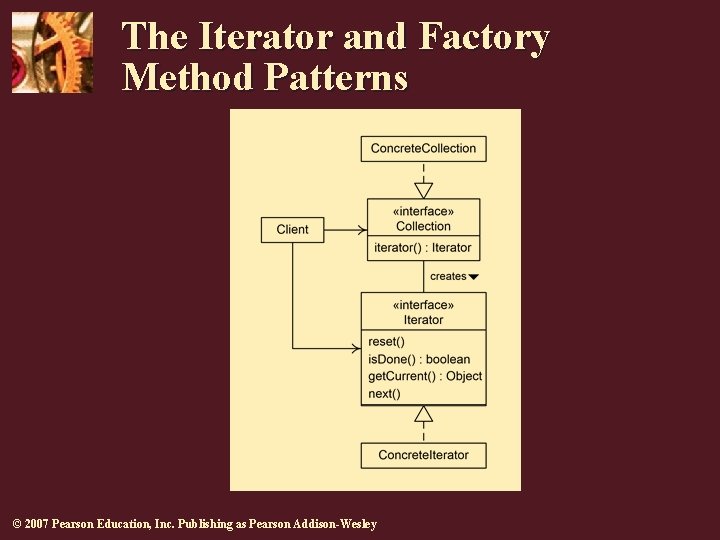
The Iterator and Factory Method Patterns © 2007 Pearson Education, Inc. Publishing as Pearson Addison-Wesley
When to Use the Factory Method Pattern § Use the Factory Method pattern when there is a need to decouple a client from a particular product that it uses. § Use the Factory Method to relieve a client of responsibility for creating and configuring instances of a product. © 2007 Pearson Education, Inc. Publishing as Pearson Addison-Wesley
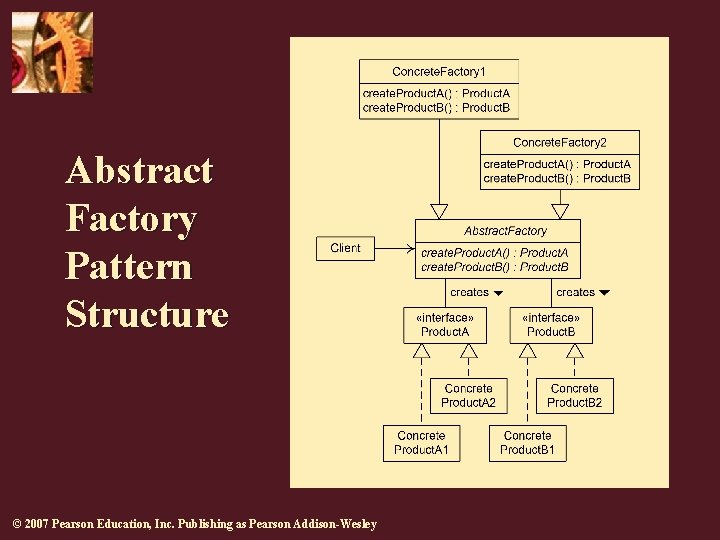
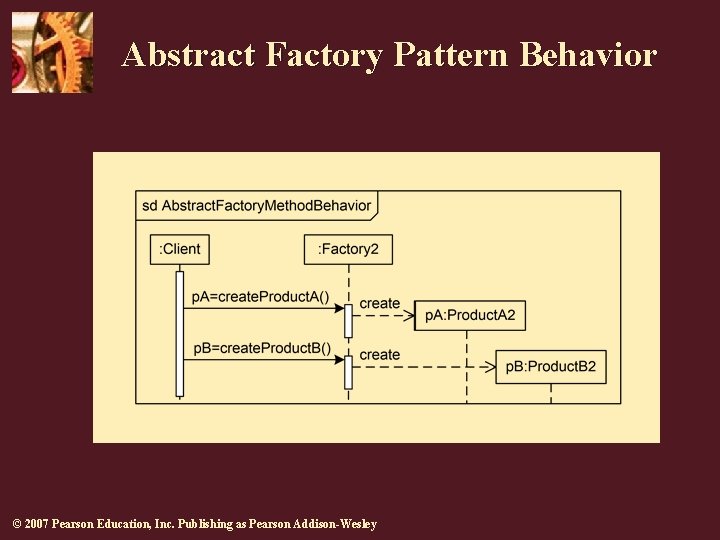
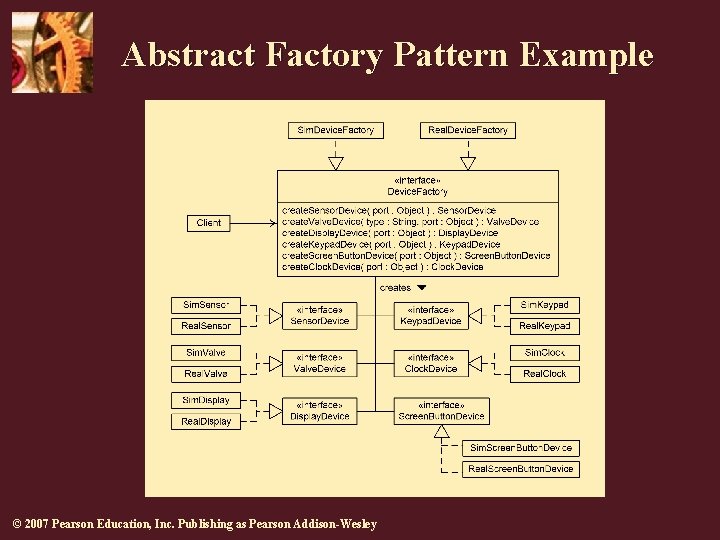
The Abstract Factory Pattern § A factory class is one that contains only factory methods for different (though usually related) products. § The Abstract Factory generator class is a factory class. • Restricts the Factory Method pattern because the generator holds only factory methods • Generalizes the Factory Method pattern because the generator creates several different kinds of product § Analogy: auto factory with assembly lines for different kinds of vehicles © 2007 Pearson Education, Inc. Publishing as Pearson Addison-Wesley
Abstract Factory Pattern Structure © 2007 Pearson Education, Inc. Publishing as Pearson Addison-Wesley
Abstract Factory Pattern Behavior © 2007 Pearson Education, Inc. Publishing as Pearson Addison-Wesley
Abstract Factory Pattern Example © 2007 Pearson Education, Inc. Publishing as Pearson Addison-Wesley
When to Use the Abstract Factory Pattern § Use the Abstract Factory pattern when clients must be decoupled from product classes. • Especially useful for program configuration and modification § The Abstract Factory pattern can also enforce constraints about which classes must be used with others. § It may be a lot of work to make new concrete factories. © 2007 Pearson Education, Inc. Publishing as Pearson Addison-Wesley
Summary § Generator patterns use a Generator class to produce and configure instances of a Product class for a Client. § The Factory Method pattern uses interfaces and abstract classes to decouple clients from generators and products. § The Abstract Factory pattern has a factory class whose factory methods create instances of different but related products. © 2007 Pearson Education, Inc. Publishing as Pearson Addison-Wesley