
Generator Design Patterns Singleton and Prototype 2007 Pearson

- Slides: 19
Generator Design Patterns: Singleton and Prototype © 2007 Pearson Education, Inc. Publishing as Pearson Addison-Wesley
Objectives § To introduce singletons and the Singleton pattern § To introduce cloning and discuss problems about shallow and deep copies of cloned objects § To introduce the Prototype pattern © 2007 Pearson Education, Inc. Publishing as Pearson Addison-Wesley
Topics § Singletons § The Singleton pattern § Cloning § Shallow and deep copies § The Prototype pattern © 2007 Pearson Education, Inc. Publishing as Pearson Addison-Wesley
Singletons Often there is a need to guarantee that a class has only a single (or a few) instances. • Servers • Controllers • Managers A singleton is a class that can have only one instance. © 2007 Pearson Education, Inc. Publishing as Pearson Addison-Wesley
The Singleton Pattern § Guarantees that a class is a singleton • Can be modified to provide any set number of instances § Provides wide (often global) access to the single instance • Can be modified to provide more restricted access § Analogy: gods of the Greek, Roman, or Norse pantheons © 2007 Pearson Education, Inc. Publishing as Pearson Addison-Wesley
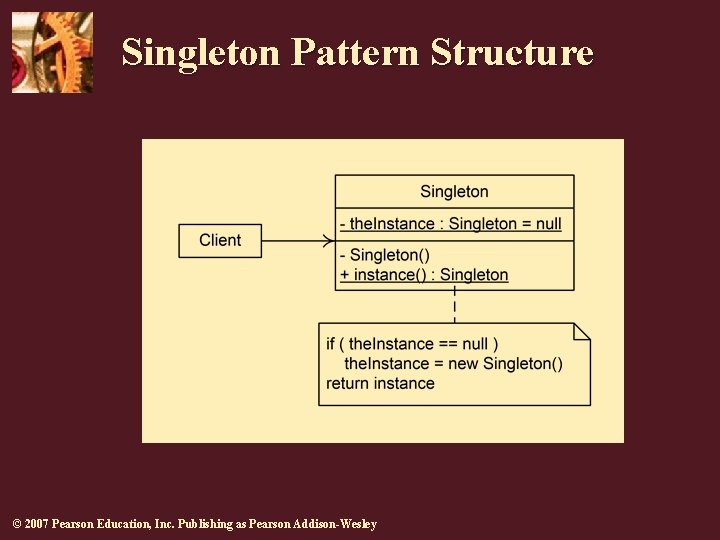
Singleton Pattern Structure © 2007 Pearson Education, Inc. Publishing as Pearson Addison-Wesley
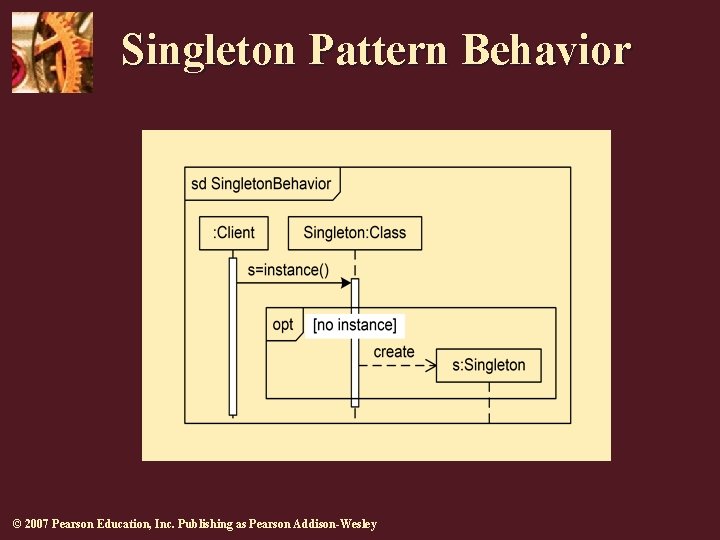
Singleton Pattern Behavior © 2007 Pearson Education, Inc. Publishing as Pearson Addison-Wesley
Singleton Examples of the need for global unique entities in a program abound: • • Subsystems (or their façade objects) Communication streams Major containers or aggregates OS or windowing system proxies © 2007 Pearson Education, Inc. Publishing as Pearson Addison-Wesley
When to Use Singletons § Use the Singleton pattern to guarantee that there is only one or a small number of instances of some class. § Sometimes an abstract class with static attributes and operations can be used instead, but • Often languages can’t store or pass around references to classes; • Polymorphism doesn’t work with classes; • This only works for singletons, not couples, etc. © 2007 Pearson Education, Inc. Publishing as Pearson Addison-Wesley
Cloning An alternative to class instantiation is making a copy of an object. A clone is a copy of an object. A clone has the state of its source at the moment of creation. © 2007 Pearson Education, Inc. Publishing as Pearson Addison-Wesley
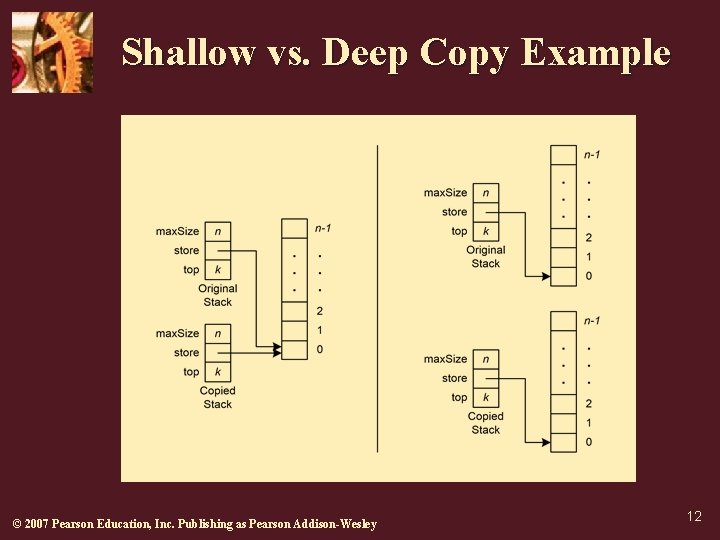
Shallow and Deep Copies § Copying objects that hold references to other entities raises the question “Should the references or the referenced entities be copied? ” • Shallow copy: Copy references when an entity is copied. • Deep copy: Copy referenced entities (and any entities they reference as well) when an entity is copied. § Sometimes a shallow copy is the right thing to do, and sometimes a deep copy is. © 2007 Pearson Education, Inc. Publishing as Pearson Addison-Wesley
Shallow vs. Deep Copy Example © 2007 Pearson Education, Inc. Publishing as Pearson Addison-Wesley 12
Shallow or Deep Copy in Cloning? Should a clone be made using a shallow or a deep copy? • It does not matter if no attributes hold references. • There is not accepted practice. • What ought to be done depends on the particular case at hand. © 2007 Pearson Education, Inc. Publishing as Pearson Addison-Wesley
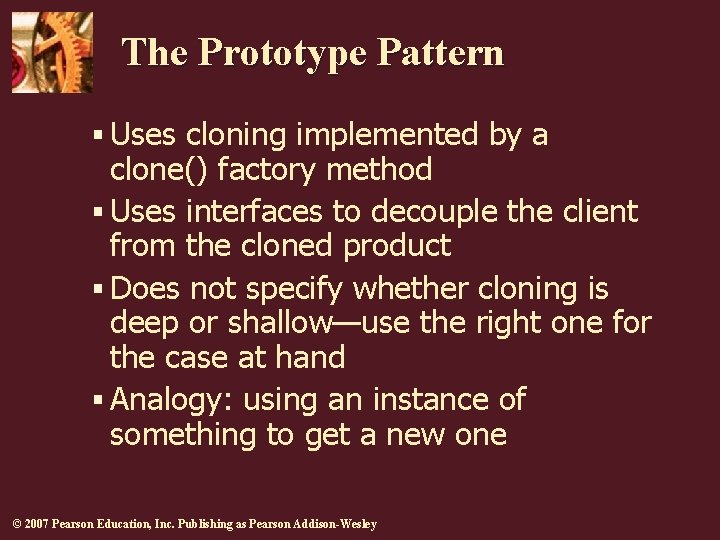
The Prototype Pattern § Uses cloning implemented by a clone() factory method § Uses interfaces to decouple the client from the cloned product § Does not specify whether cloning is deep or shallow—use the right one for the case at hand § Analogy: using an instance of something to get a new one © 2007 Pearson Education, Inc. Publishing as Pearson Addison-Wesley
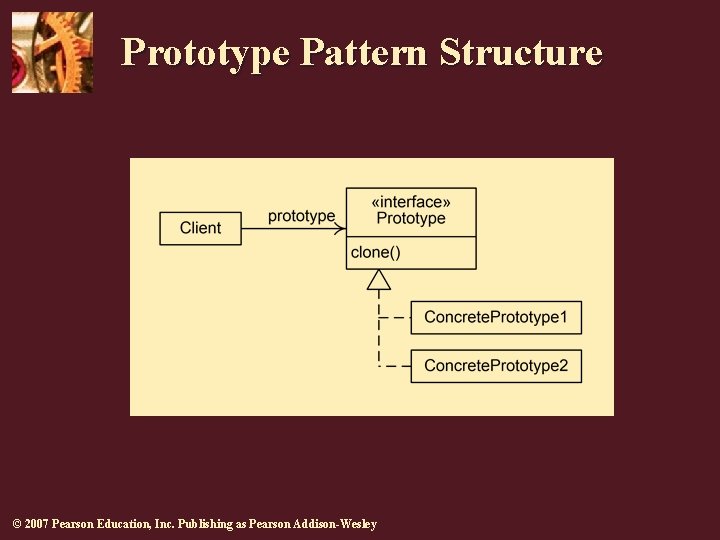
Prototype Pattern Structure © 2007 Pearson Education, Inc. Publishing as Pearson Addison-Wesley
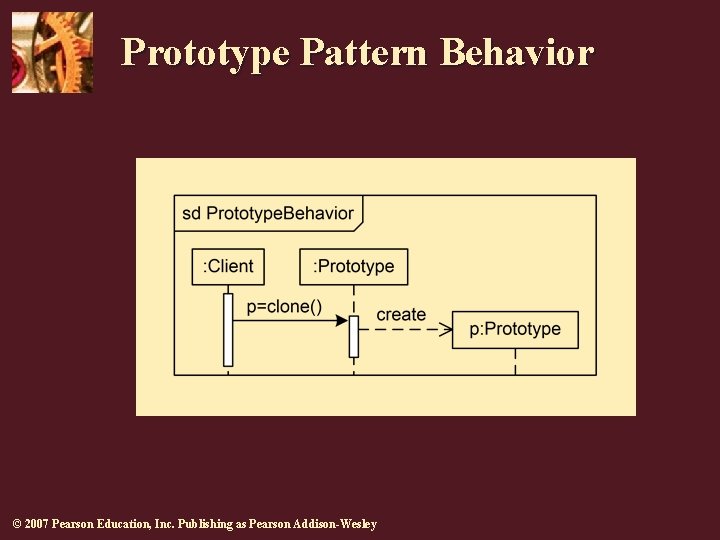
Prototype Pattern Behavior © 2007 Pearson Education, Inc. Publishing as Pearson Addison-Wesley
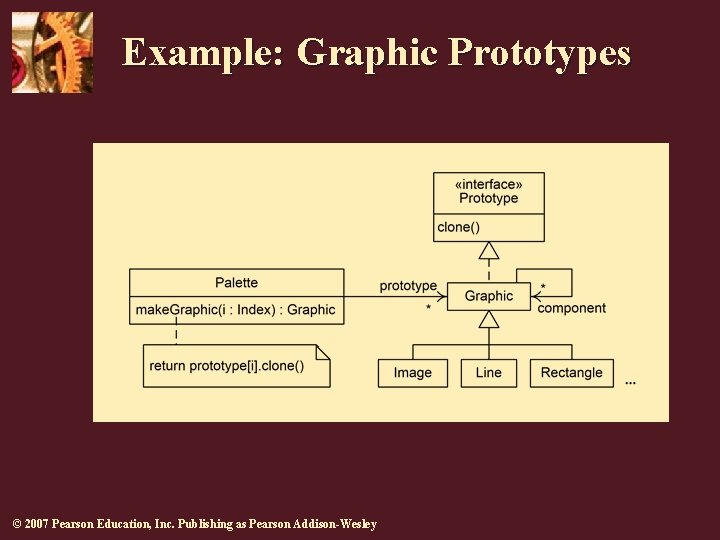
Example: Graphic Prototypes © 2007 Pearson Education, Inc. Publishing as Pearson Addison-Wesley
When to Use the Prototype Pattern § Use the Prototype pattern when clients need to be decoupled from products, and the products need to be set at runtime. § The main problem with the prototype pattern is that it relies on cloning, which presents problems about shallow and deep copies. © 2007 Pearson Education, Inc. Publishing as Pearson Addison-Wesley
Summary § The Singleton pattern is used to guarantee that only one or a set number of instances of some class exist. § The Prototype pattern is used to create instances of classes (really copies of objects) determined at run time. © 2007 Pearson Education, Inc. Publishing as Pearson Addison-Wesley