
GENERATOR 103 WHAT YOU WILL LEARN 2 Describe
GENERATOR 103
WHAT YOU WILL LEARN • • • 2 Describe what traditional sizing programs do well Describe the limitations of traditional sizing programs Describe the basis for sizing new construction Explain the methodology used when sizing existing facilities Describe the affects of leading power factor on generators Explain alternator starting k. VA requirements for across the line motor starts Explain the factors involved in determining inrush current Describe IEC and NEMA starting differences Describe rules of thumb for upsizing alternators for improved motor starting Explain how electro-mechanical reduced voltage starting operates • Describe generator performance specifications according to NFPA 110. • Explain generator performance requirements relative to fire pumps.
WHAT YOU WILL LEARN • • Explain the affects of harmonics on generator voltage Describe how non-linear loads affect generators Explain various techniques used to reduce harmonic levels Explain the use of IGBT rectifiers Describe the function of an electronic soft starter Explain sizing requirements for use with variable frequency drives Explain regeneration as it applies to certain applications of variable frequency drives • Explain the factors involved in sizing for UPS’s • Describe three main UPS classifications • Describe typical methods used to solve UPS problems 3
Sizing Plan
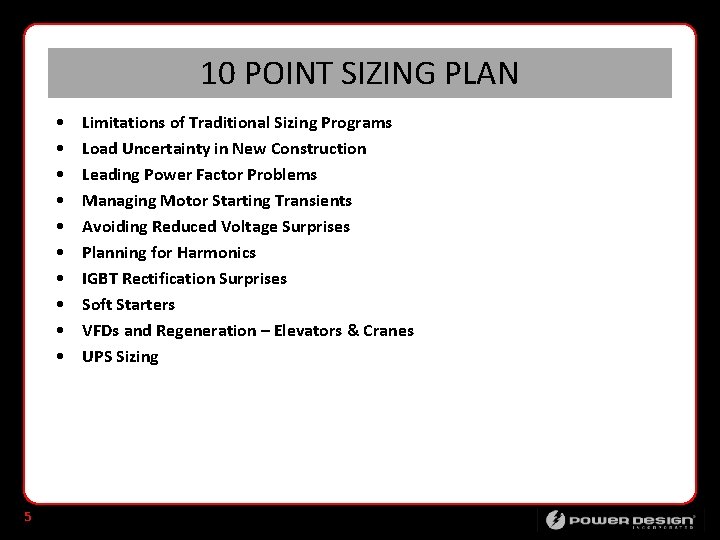
10 POINT SIZING PLAN • • • 5 Limitations of Traditional Sizing Programs Load Uncertainty in New Construction Leading Power Factor Problems Managing Motor Starting Transients Avoiding Reduced Voltage Surprises Planning for Harmonics IGBT Rectification Surprises Soft Starters VFDs and Regeneration – Elevators & Cranes UPS Sizing
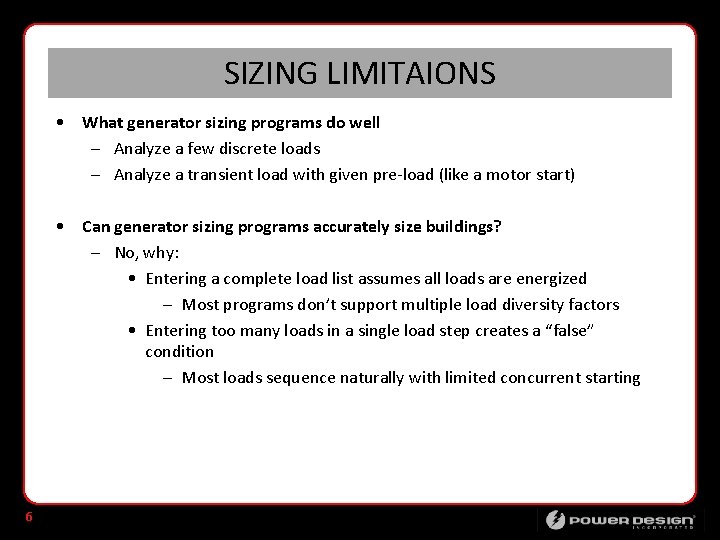
SIZING LIMITAIONS • What generator sizing programs do well – Analyze a few discrete loads – Analyze a transient load with given pre-load (like a motor start) • Can generator sizing programs accurately size buildings? – No, why: • Entering a complete load list assumes all loads are energized – Most programs don’t support multiple load diversity factors • Entering too many loads in a single load step creates a “false” condition – Most loads sequence naturally with limited concurrent starting 6
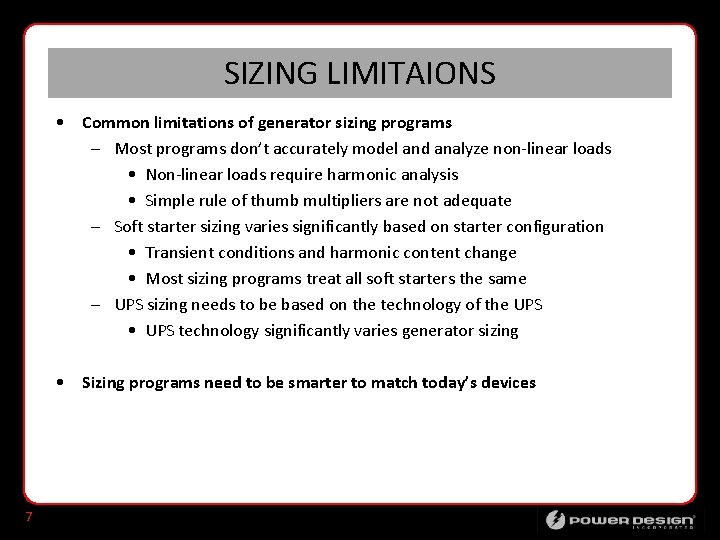
SIZING LIMITAIONS • Common limitations of generator sizing programs – Most programs don’t accurately model and analyze non-linear loads • Non-linear loads require harmonic analysis • Simple rule of thumb multipliers are not adequate – Soft starter sizing varies significantly based on starter configuration • Transient conditions and harmonic content change • Most sizing programs treat all soft starters the same – UPS sizing needs to be based on the technology of the UPS • UPS technology significantly varies generator sizing • Sizing programs need to be smarter to match today’s devices 7
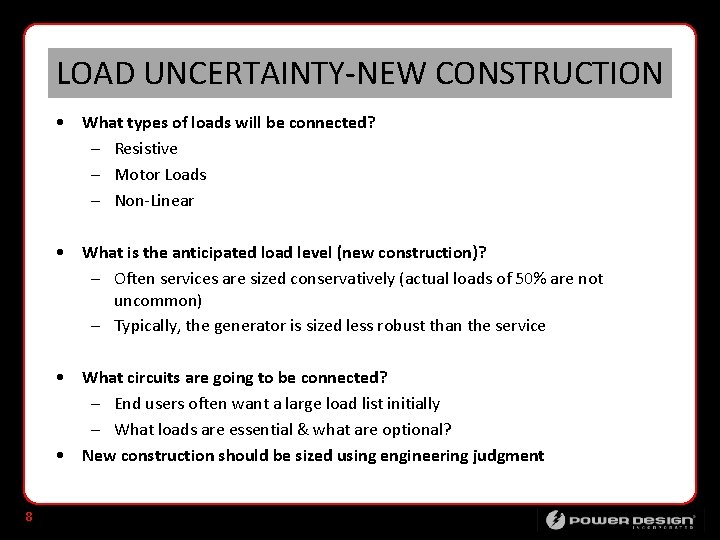
LOAD UNCERTAINTY-NEW CONSTRUCTION • What types of loads will be connected? – Resistive – Motor Loads – Non-Linear • What is the anticipated load level (new construction)? – Often services are sized conservatively (actual loads of 50% are not uncommon) – Typically, the generator is sized less robust than the service • What circuits are going to be connected? – End users often want a large load list initially – What loads are essential & what are optional? • New construction should be sized using engineering judgment 8
LOAD UNCERTAINTY-LOAD GROWTH • What is the expected load growth? – Does the end user have an aggressive growth plan? – How certain is the business model? – What is the value of different capital expenditures? • Would the end user benefit from an expandable solution? – Is paralleled generation an option? 9
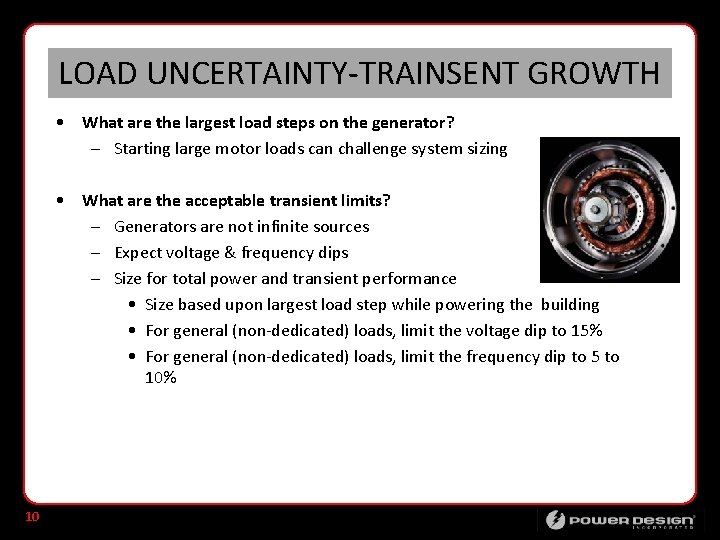
LOAD UNCERTAINTY-TRAINSENT GROWTH • What are the largest load steps on the generator? – Starting large motor loads can challenge system sizing • What are the acceptable transient limits? – Generators are not infinite sources – Expect voltage & frequency dips – Size for total power and transient performance • Size based upon largest load step while powering the building • For general (non-dedicated) loads, limit the voltage dip to 15% • For general (non-dedicated) loads, limit the frequency dip to 5 to 10% 10
LOAD UNCERTAINTY-EXISTING BLDGS • Billing History – Demand charges (capture peak k. W) • Captures seasonality & business cycles • Peak power over 15 minute average • Power Analyzer – Snapshot / short history (measures transient spikes) – Capture power quality • Harmonic content • Power factor • Existing facilities should utilize historical & measurement data 11
LEADING POWER FACTOR • Generators are rated for. 8 pf (lagging) to 1. 0 pf • Leading power factor can cause self excitation resulting in – Voltage instability – Over-voltage shutdowns • Sources of leading power factor – Power factor correction capacitors at the service – Lightly loaded (less than 30%) UPS’s with filtering • If power factor is leading – Remove the leading power factor elements – Add offsetting lagging power factor loads 12
KEY POINT SUMMARY • Recognize the limitations of the sizing program you utilize – Be cautious of entering too many loads into a single load step • When sizing a building – Matching the service size will often oversize the generator – Use billing history & actual data (when available) – Consider expandable, paralleled solutions if load growth is uncertain • Leading power factor can cause generator voltage issues 13
Motor Starting
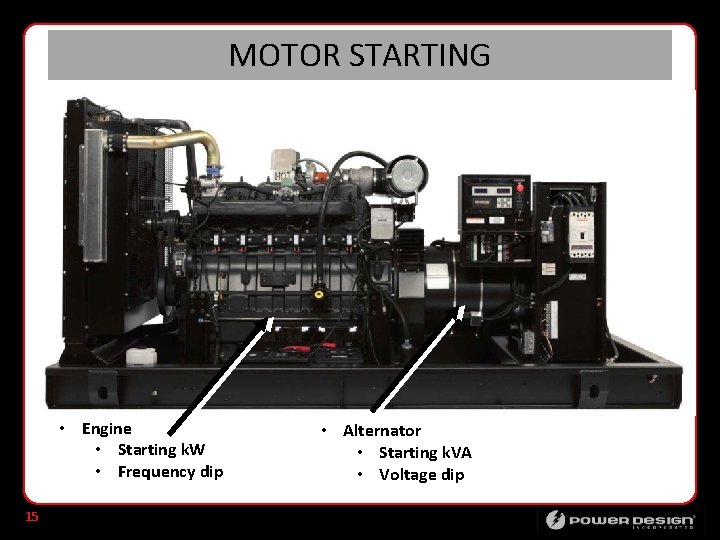
MOTOR STARTING • Engine • Starting k. W • Frequency dip 15 • Alternator • Starting k. VA • Voltage dip
MOTOR STARTING-kva 16
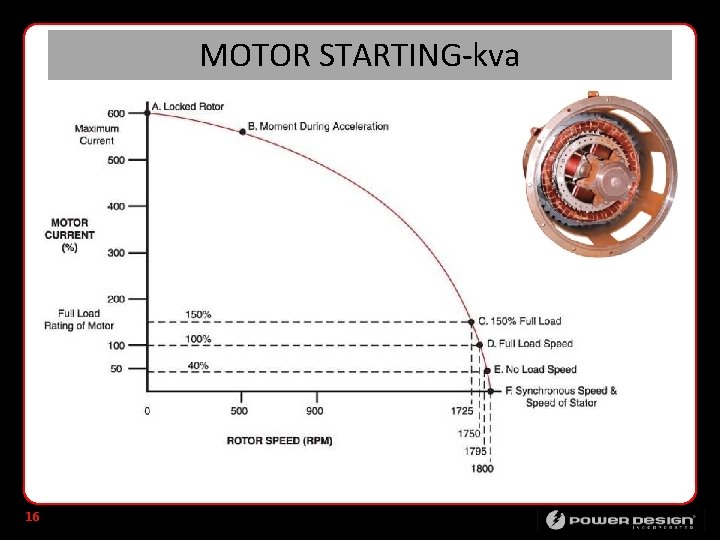
MOTOR STARTING-kva What happens when a contactor closes to start an electric motor? • Immediate inrush of current • Inrush is referenced as: Locked rotor current Inrush current Motor starting current Start k. VA Note: 17 “s” indicates the motors starting period “r” indicates the motors running period
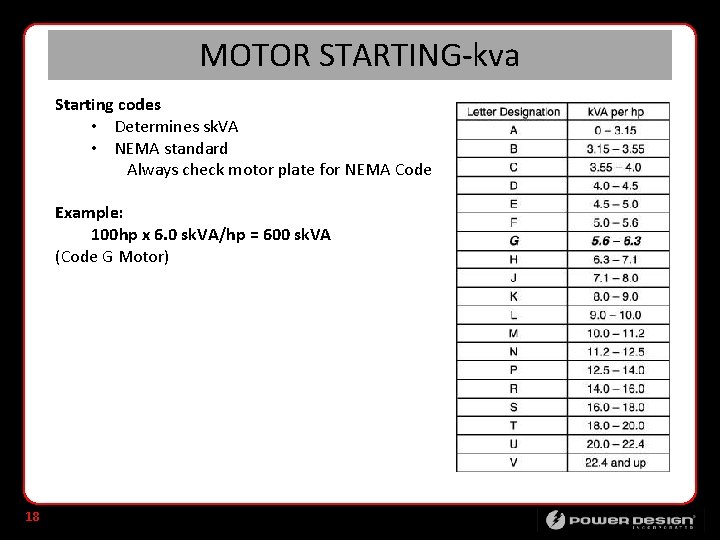
MOTOR STARTING-kva Starting codes • Determines sk. VA • NEMA standard Always check motor plate for NEMA Code Example: 100 hp x 6. 0 sk. VA/hp = 600 sk. VA (Code G Motor) 18
MOTOR STARTING-kva Starting codes • Three phase Typically have a NEMA starting code • Single phase May not have a NEMA starting code Starting k. VAs vary broadly • IEC vs. NEMA European motors (IEC) typically have higher starting currents • High efficiency motors have higher starting currents 19
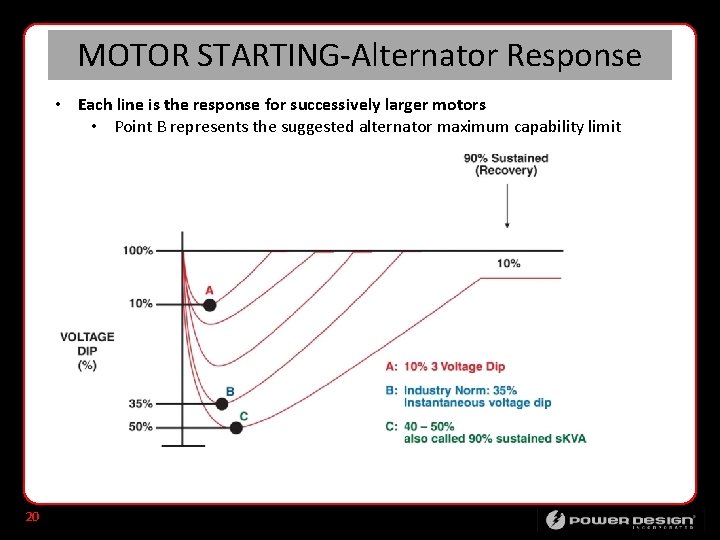
MOTOR STARTING-Alternator Response • Each line is the response for successively larger motors • Point B represents the suggested alternator maximum capability limit 20
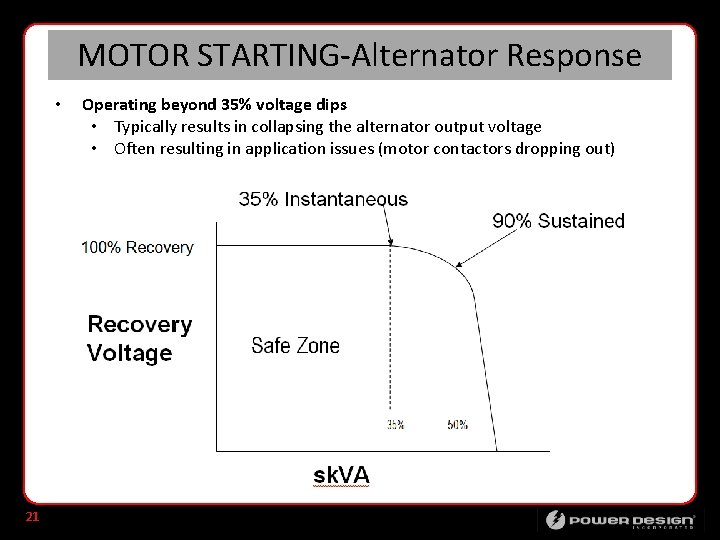
MOTOR STARTING-Alternator Response • 21 Operating beyond 35% voltage dips • Typically results in collapsing the alternator output voltage • Often resulting in application issues (motor contactors dropping out)
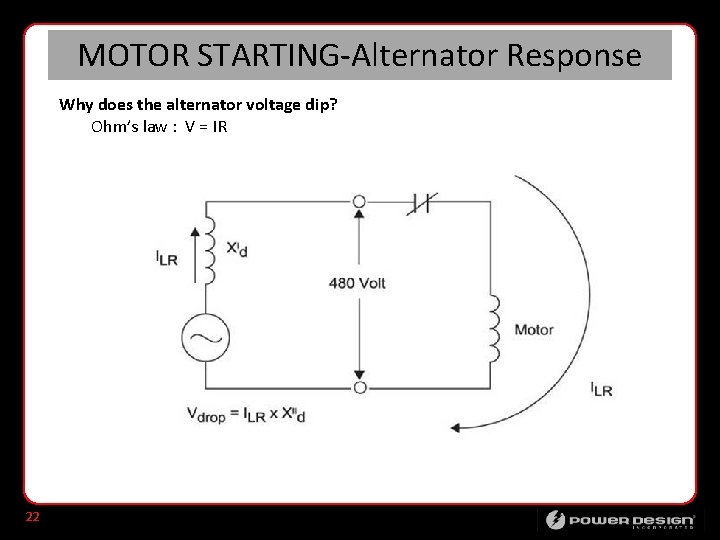
MOTOR STARTING-Alternator Response Why does the alternator voltage dip? Ohm’s law : V = IR How do we minimize the voltage dip? 22
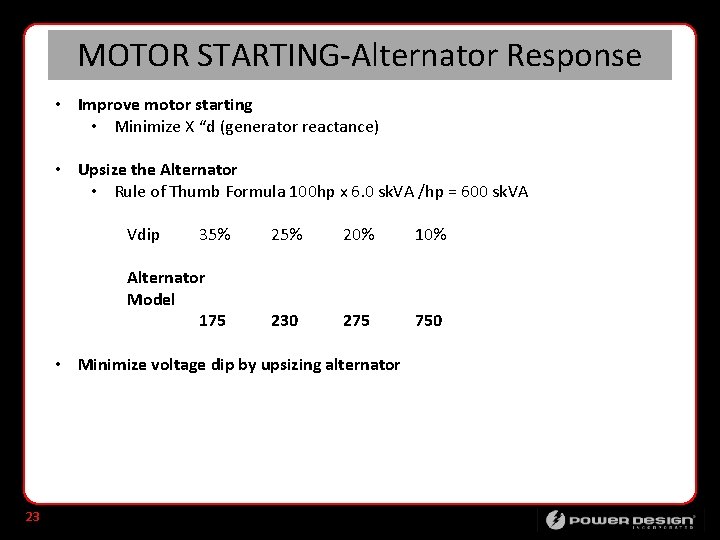
MOTOR STARTING-Alternator Response • Improve motor starting • Minimize X “d (generator reactance) • Upsize the Alternator • Rule of Thumb Formula 100 hp x 6. 0 sk. VA /hp = 600 sk. VA Vdip 35% 20% 10% Alternator Model 175 230 275 750 • Minimize voltage dip by upsizing alternator 23
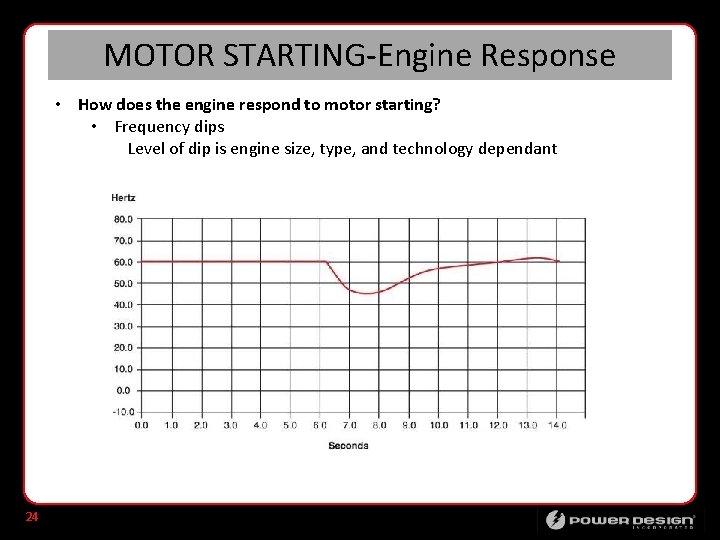
MOTOR STARTING-Engine Response • How does the engine respond to motor starting? • Frequency dips Level of dip is engine size, type, and technology dependant 24
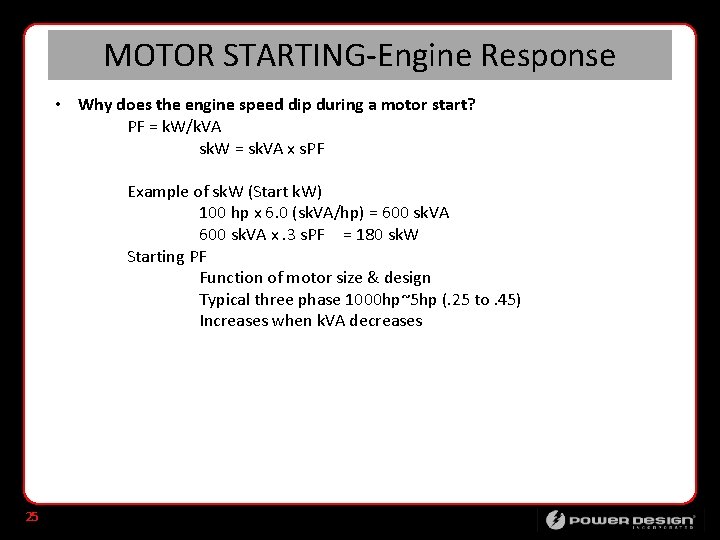
MOTOR STARTING-Engine Response • Why does the engine speed dip during a motor start? PF = k. W/k. VA sk. W = sk. VA x s. PF Example of sk. W (Start k. W) 100 hp x 6. 0 (sk. VA/hp) = 600 sk. VA x. 3 s. PF = 180 sk. W Starting PF Function of motor size & design Typical three phase 1000 hp~5 hp (. 25 to. 45) Increases when k. VA decreases 25
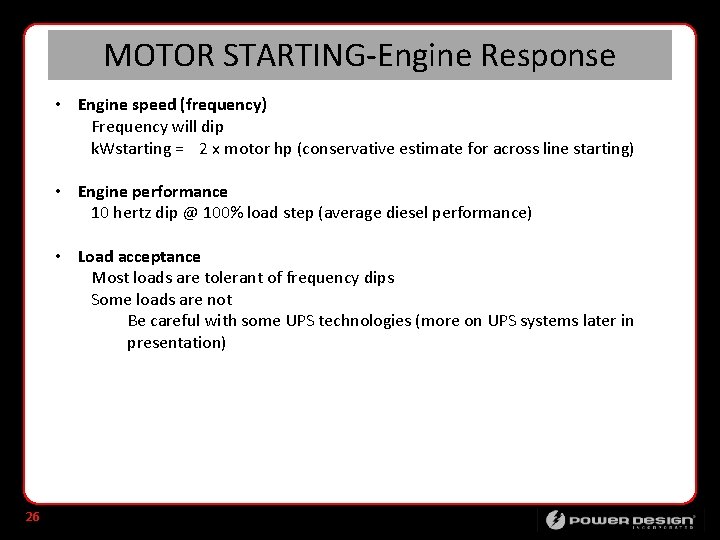
MOTOR STARTING-Engine Response • Engine speed (frequency) Frequency will dip k. Wstarting = 2 x motor hp (conservative estimate for across line starting) • Engine performance 10 hertz dip @ 100% load step (average diesel performance) • Load acceptance Most loads are tolerant of frequency dips Some loads are not Be careful with some UPS technologies (more on UPS systems later in presentation) 26
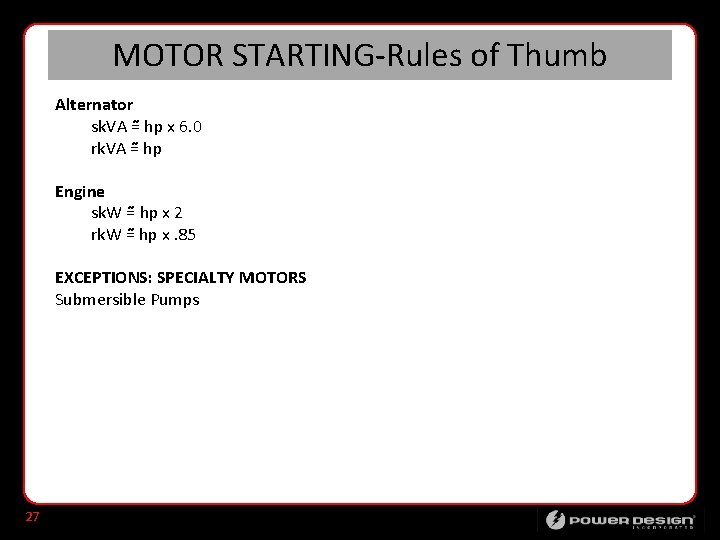
MOTOR STARTING-Rules of Thumb Alternator sk. VA = hp x 6. 0 rk. VA = hp Engine sk. W = hp x 2 rk. W = hp x. 85 EXCEPTIONS: SPECIALTY MOTORS Submersible Pumps 27
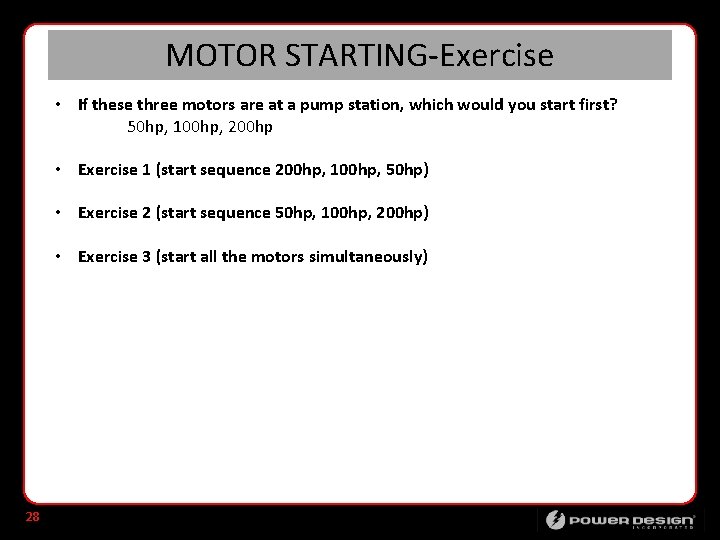
MOTOR STARTING-Exercise • If these three motors are at a pump station, which would you start first? 50 hp, 100 hp, 200 hp • Exercise 1 (start sequence 200 hp, 100 hp, 50 hp) • Exercise 2 (start sequence 50 hp, 100 hp, 200 hp) • Exercise 3 (start all the motors simultaneously) 28
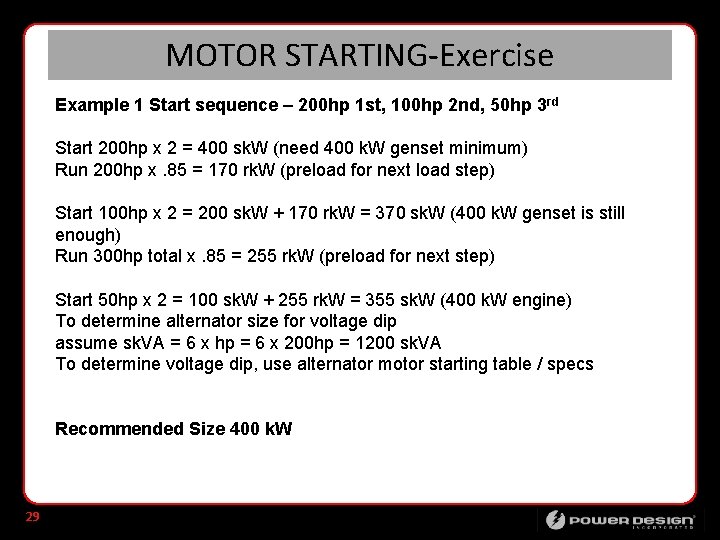
MOTOR STARTING-Exercise Example 1 Start sequence – 200 hp 1 st, 100 hp 2 nd, 50 hp 3 rd Start 200 hp x 2 = 400 sk. W (need 400 k. W genset minimum) Run 200 hp x. 85 = 170 rk. W (preload for next load step) Start 100 hp x 2 = 200 sk. W + 170 rk. W = 370 sk. W (400 k. W genset is still enough) Run 300 hp total x. 85 = 255 rk. W (preload for next step) Start 50 hp x 2 = 100 sk. W + 255 rk. W = 355 sk. W (400 k. W engine) To determine alternator size for voltage dip assume sk. VA = 6 x hp = 6 x 200 hp = 1200 sk. VA To determine voltage dip, use alternator motor starting table / specs Recommended Size 400 k. W 29
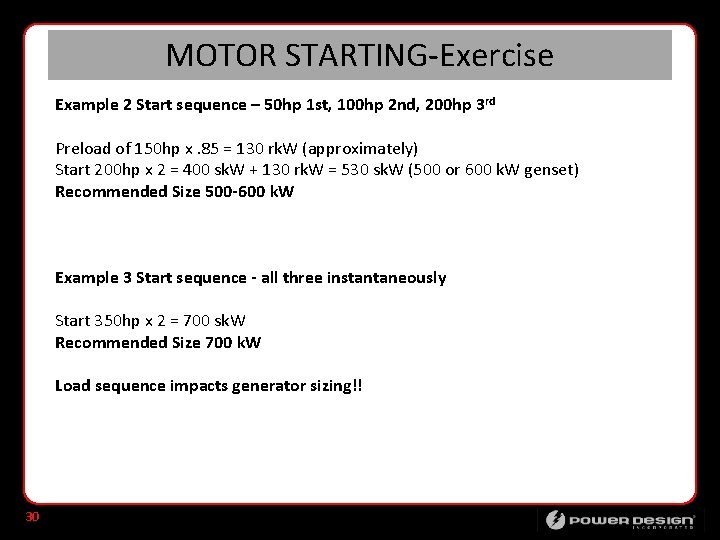
MOTOR STARTING-Exercise Example 2 Start sequence – 50 hp 1 st, 100 hp 2 nd, 200 hp 3 rd Preload of 150 hp x. 85 = 130 rk. W (approximately) Start 200 hp x 2 = 400 sk. W + 130 rk. W = 530 sk. W (500 or 600 k. W genset) Recommended Size 500 -600 k. W Example 3 Start sequence - all three instantaneously Start 350 hp x 2 = 700 sk. W Recommended Size 700 k. W Load sequence impacts generator sizing!! 30
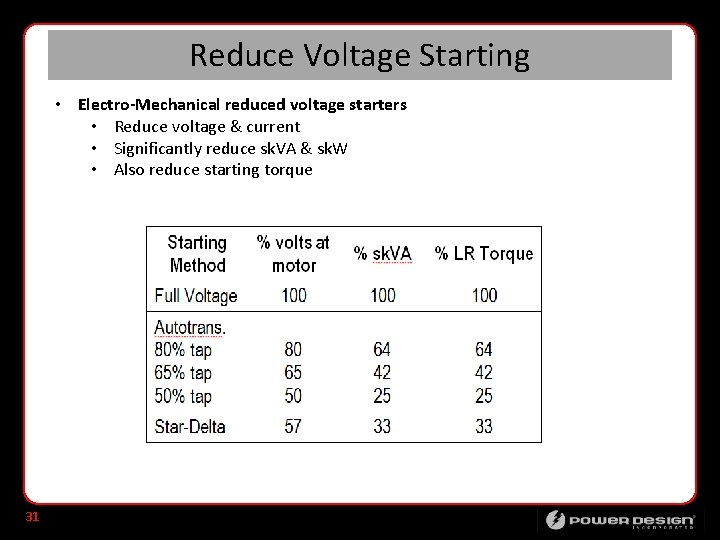
Reduce Voltage Starting • Electro-Mechanical reduced voltage starters • Reduce voltage & current • Significantly reduce sk. VA & sk. W • Also reduce starting torque 31
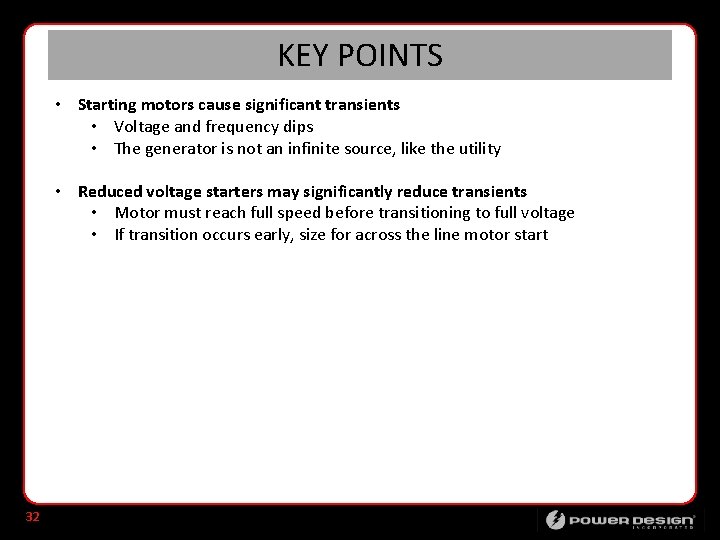
KEY POINTS • Starting motors cause significant transients • Voltage and frequency dips • The generator is not an infinite source, like the utility • Reduced voltage starters may significantly reduce transients • Motor must reach full speed before transitioning to full voltage • If transition occurs early, size for across the line motor start 32
Harmonics
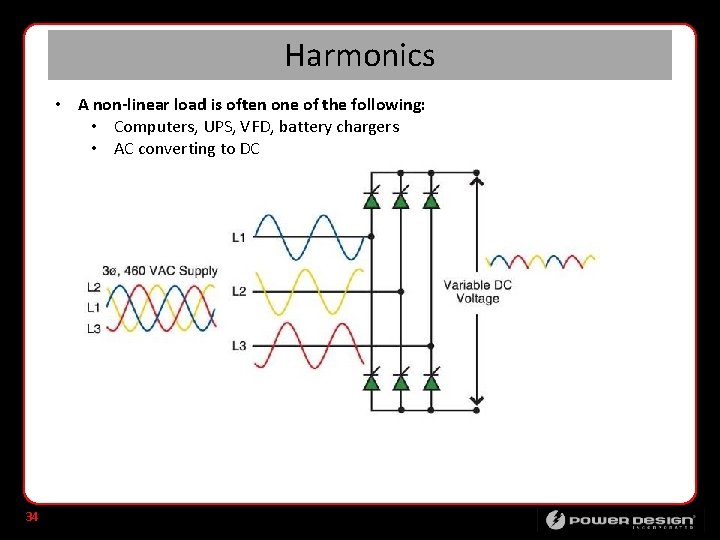
Harmonics • A non-linear load is often one of the following: • Computers, UPS, VFD, battery chargers • AC converting to DC 34
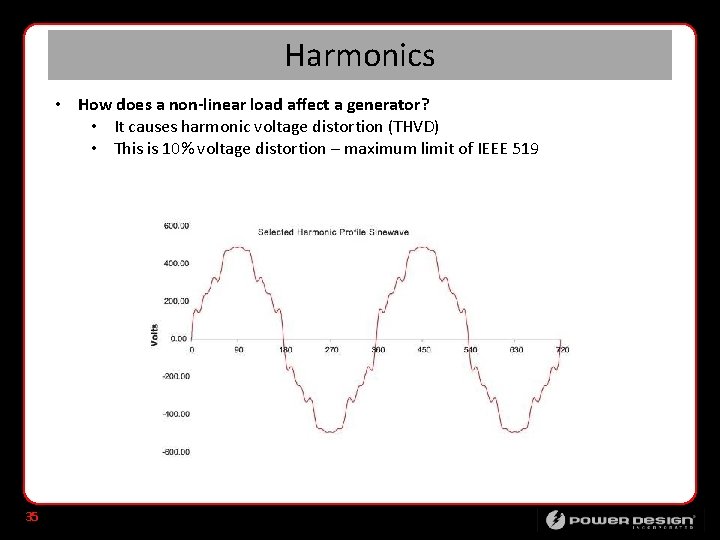
Harmonics • How does a non-linear load affect a generator? • It causes harmonic voltage distortion (THVD) • This is 10% voltage distortion – maximum limit of IEEE 519 35
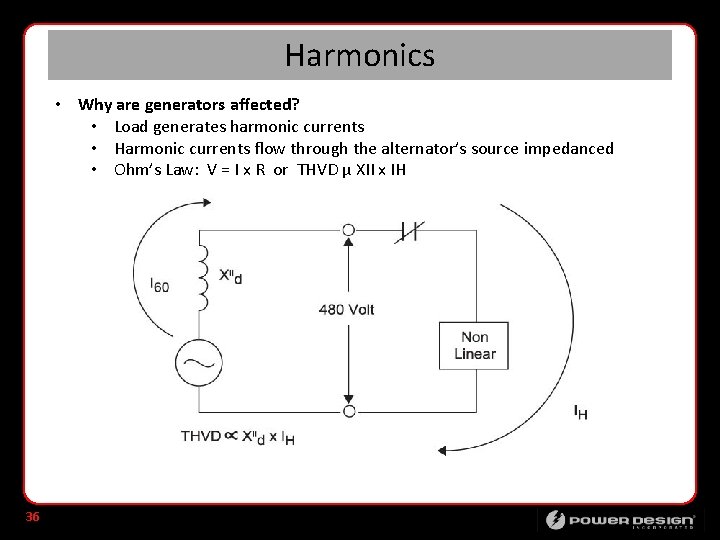
Harmonics • Why are generators affected? • Load generates harmonic currents • Harmonic currents flow through the alternator’s source impedanced • Ohm’s Law: V = I x R or THVD µ XII x IH 36
Harmonics • How to minimize harmonics to acceptable levels? Active or passive filtering Upsizing the alternator (minimize the source impedance – x”d) Rules of thumb for typical 6 pulse, unfiltered loads (35% THID) Upsize the alternator (2 to 2. 5 x non-linear load @ 480 V) Upsize the alternator (3 to 3. 5 x non-linear load @ 208 V) Upsize the alternator (5 x for small single phase units) Rules of thumb for typical 6 pulse, filtered loads (10% THID) No upsized alternator required Rules of thumb vary significantly based on: The device’s harmonic current level Size & voltage of the alternator Don’t rely heavily on “Rules of Thumb” for harmonic loads Rely on harmonic analysis Inputs are harmonic current spectrum and alternator reactance Output is an estimated voltage distortion 37
KEY POINTS • Generators must be sized based on harmonic content • Sizing impacted by alternator size & voltage • Sizing impacted by the characteristics of non-linear load • Harmonic analysis approach is better than rules of thumb 38

Soft Starts & VFD’s
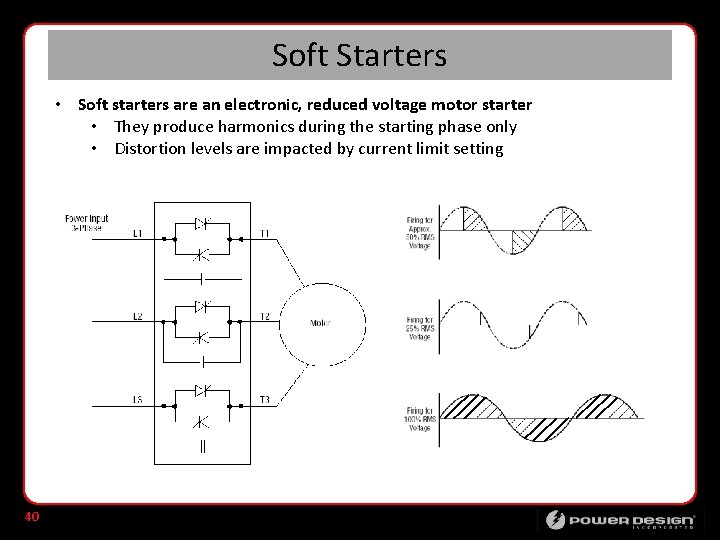
Soft Starters • Soft starters are an electronic, reduced voltage motor starter • They produce harmonics during the starting phase only • Distortion levels are impacted by current limit setting 40
Soft Starters • Harmonics(alternator sizing) • At 300% current limit, estimated distortion is 30 % THID • The minimum alternator size is 2 to 3 times the largest motor being started • Higher current limit settings will require a larger alternator • Harmonic analysis is preferred to using “rules of thumb” • Sequence start when possible • Harmonics are only present during the starting phase 41
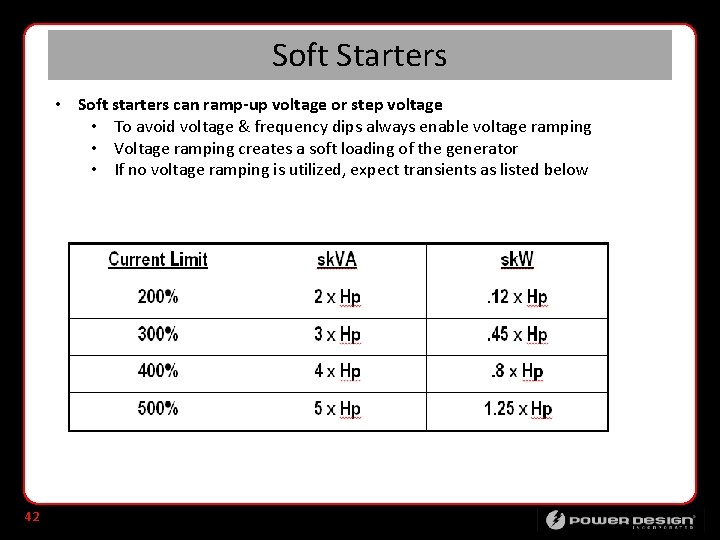
Soft Starters • Soft starters can ramp-up voltage or step voltage • To avoid voltage & frequency dips always enable voltage ramping • Voltage ramping creates a soft loading of the generator • If no voltage ramping is utilized, expect transients as listed below 42
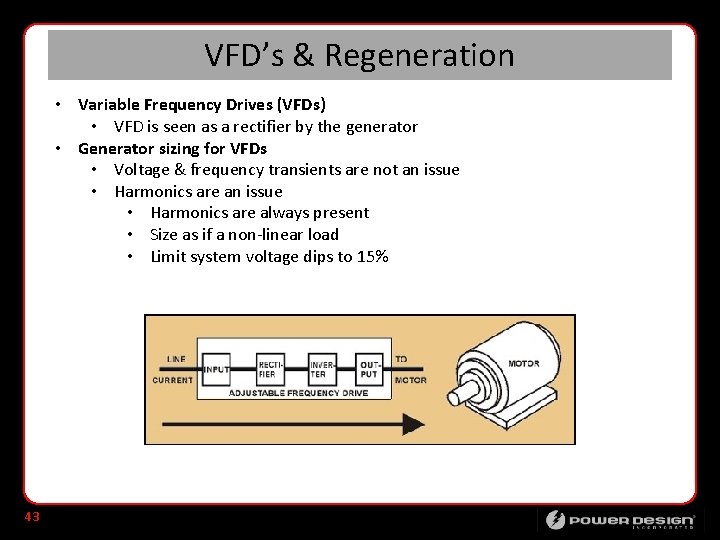
VFD’s & Regeneration • Variable Frequency Drives (VFDs) • VFD is seen as a rectifier by the generator • Generator sizing for VFDs • Voltage & frequency transients are not an issue • Harmonics are always present • Size as if a non-linear load • Limit system voltage dips to 15% 43
VFD’s & Regeneration • Cable elevators and cranes regenerate • When the load is going down, the drive is a break • Regeneration k. W = hp x. 8 • How is the power dissipated? • Breaking Resistor • Put other loads on the generator • Unit mounted load bank • Don’t rely on the generator as a brake 44
KEY POINTS • Soft Starters • Sequence start to minimize harmonic content • Limit harmonics by limiting current limit setting • Limit transients by using voltage ramp feature • VFDs • Size as non-linear load • Plan for regeneration with cable elevators and cranes 45
- Slides: 45