
Generative Pattern Language By Michal Telem and Karen
Generative Pattern Language By Michal Telem and Karen Fingas and Michal Telem 2018
Agenda: 1. What is Generative Pattern Language? 2. Background: Christopher Alexander 3. Main Concepts and Qualities 4. Examples for implementations 5. Recommended Processes 6. Pros and Cons Karen Fingas and Michal 2 Telem 2018
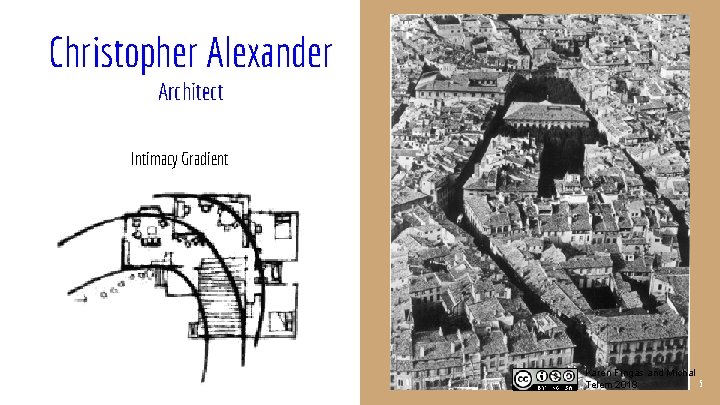
Christopher Alexander Architect Intimacy Gradient - Karen Fingas and Michal 3 Telem 2018
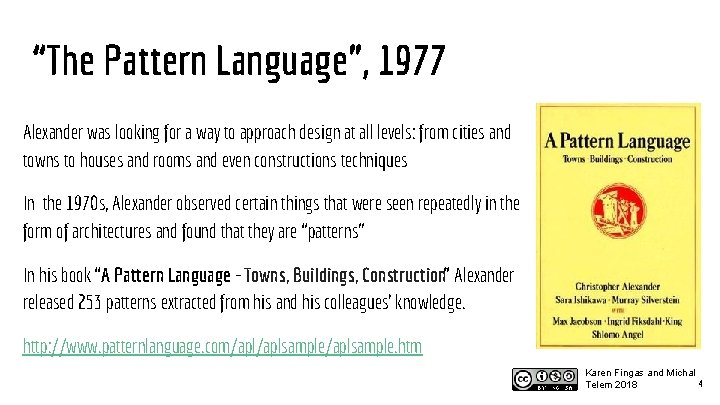
“The Pattern Language”, 1977 Alexander was looking for a way to approach design at all levels: from cities and towns to houses and rooms and even constructions techniques In the 1970 s, Alexander observed certain things that were seen repeatedly in the form of architectures and found that they are “patterns” In his book “A Pattern Language - Towns, Buildings, Construction” Alexander released 253 patterns extracted from his and his colleagues’ knowledge. http: //www. patternlanguage. com/aplsample/aplsample. htm Karen Fingas and Michal 4 Telem 2018

Main Concepts At first: Context - Problem - Solution Whenever a certain CONTEXT exists, a certain PROBLEM will arise; the stated PATTERN will solve the PROBLEM and there should be provided in the CONTEXT. Karen Fingas and Michal 5 Telem 2018
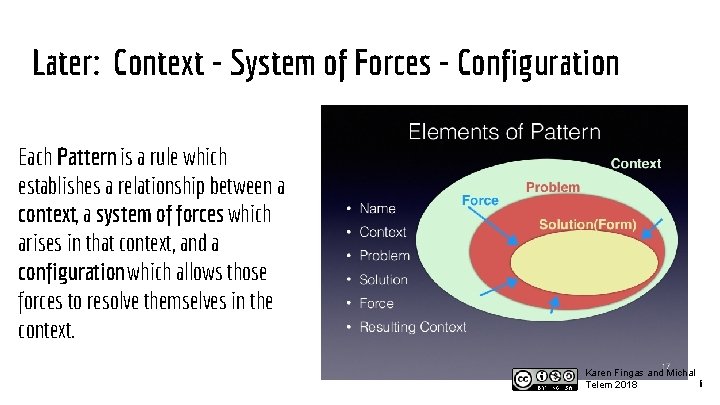
Later: Context - System of Forces - Configuration Each Pattern is a rule which establishes a relationship between a context, a system of forces which arises in that context, and a configuration which allows those forces to resolve themselves in the context. Karen Fingas and Michal 6 Telem 2018
Currently: Process oriented towards service systems (i) voices on issues (who + what) (ii) affording value(s) (how + why), and (iii) spatio-temporal frames (where + when) David Ing “Pattern Manual for Service Systems Karen Fingas and Michal Thinking”. Telem 2018 7
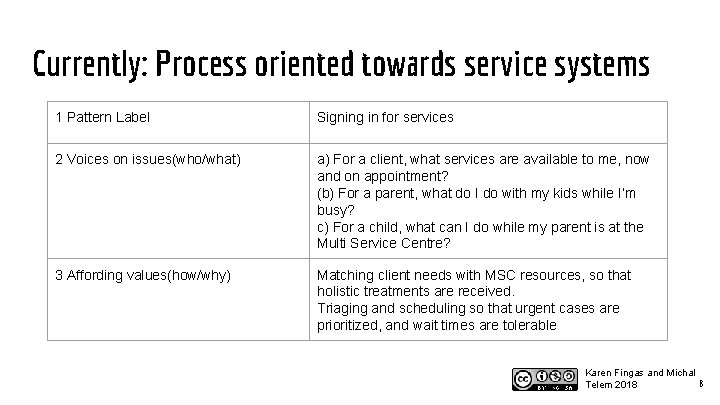
Currently: Process oriented towards service systems 1 Pattern Label Signing in for services 2 Voices on issues(who/what) a) For a client, what services are available to me, now and on appointment? (b) For a parent, what do I do with my kids while I‘m busy? c) For a child, what can I do while my parent is at the Multi Service Centre? 3 Affording values(how/why) Matching client needs with MSC resources, so that holistic treatments are received. Triaging and scheduling so that urgent cases are prioritized, and wait times are tolerable Karen Fingas and Michal 8 Telem 2018
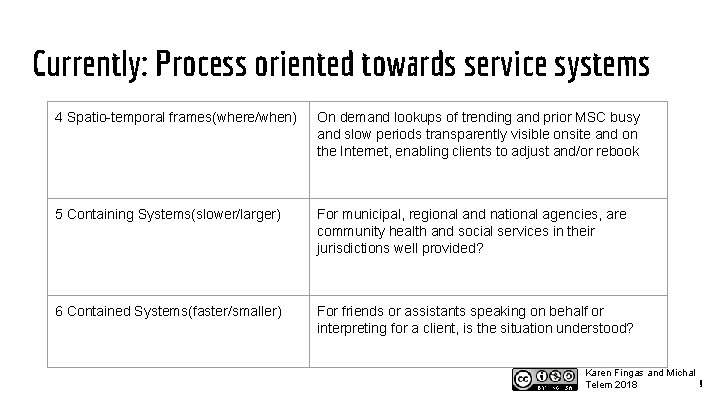
Currently: Process oriented towards service systems 4 Spatio-temporal frames(where/when) On demand lookups of trending and prior MSC busy and slow periods transparently visible onsite and on the Internet, enabling clients to adjust and/or rebook 5 Containing Systems(slower/larger) For municipal, regional and national agencies, are community health and social services in their jurisdictions well provided? 6 Contained Systems(faster/smaller) For friends or assistants speaking on behalf or interpreting for a client, is the situation understood? Karen Fingas and Michal 9 Telem 2018
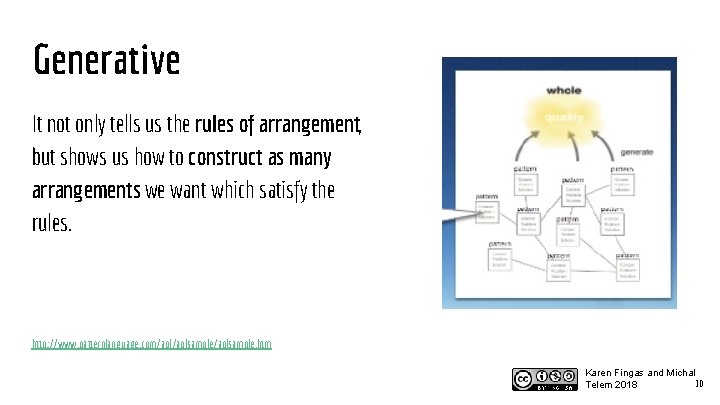
Generative It not only tells us the rules of arrangement, but shows us how to construct as many arrangements we want which satisfy the rules. http: //www. patternlanguage. com/aplsample/aplsample. htm Karen Fingas and Michal 10 Telem 2018
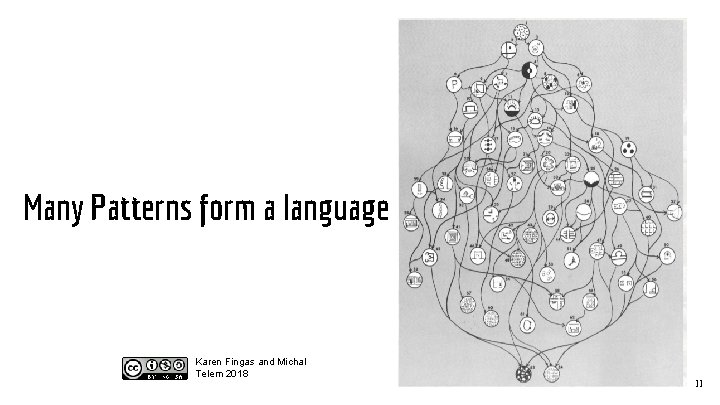
Many Patterns form a language Karen Fingas and Michal Telem 2018 11
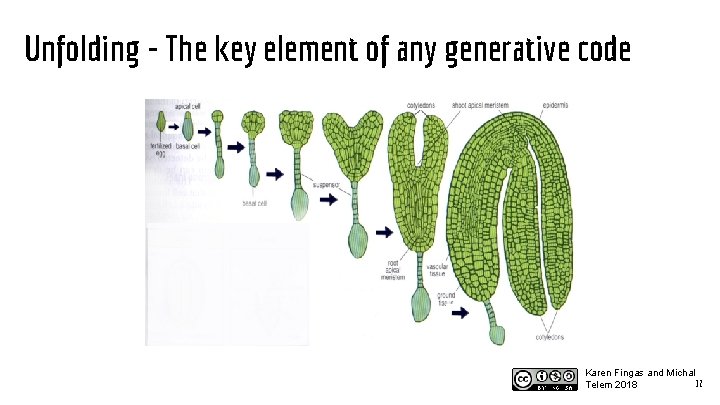
Unfolding - The key element of any generative code Karen Fingas and Michal 12 Telem 2018
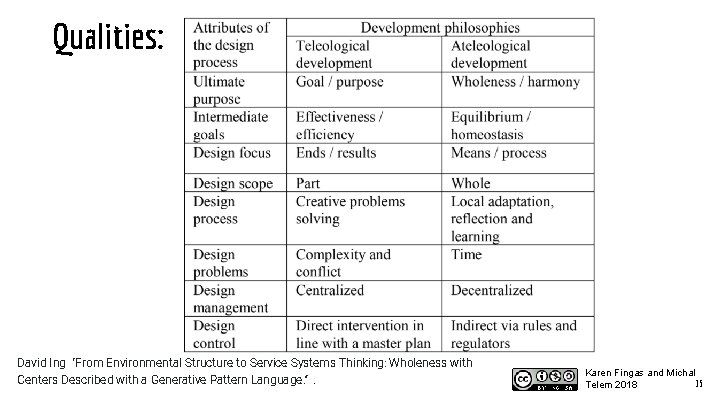
Qualities: David Ing “From Environmental Structure to Service Systems Thinking: Wholeness with Centers Described with a Generative Pattern Language. ”. Karen Fingas and Michal 13 Telem 2018
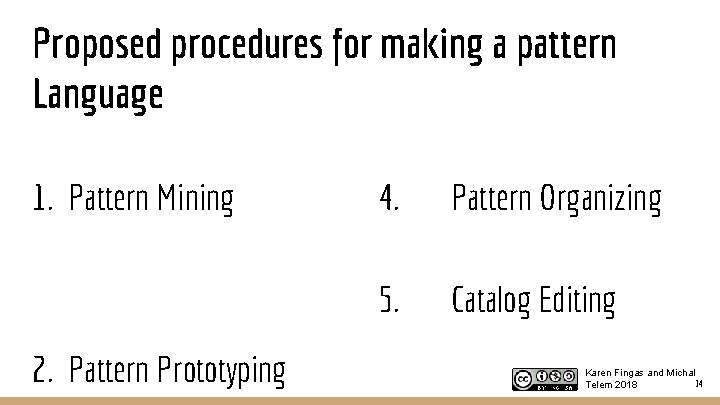
Proposed procedures for making a pattern Language 1. Pattern Mining 2. Pattern Prototyping 4. Pattern Organizing 5. Catalog Editing Karen Fingas and Michal 14 Telem 2018
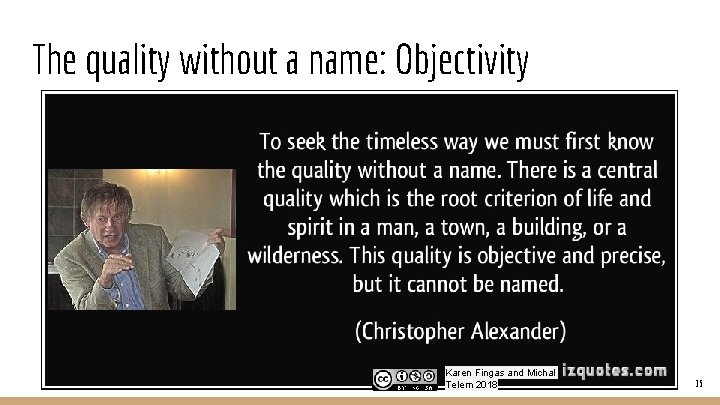
The quality without a name: Objectivity Karen Fingas and Michal Telem 2018 15
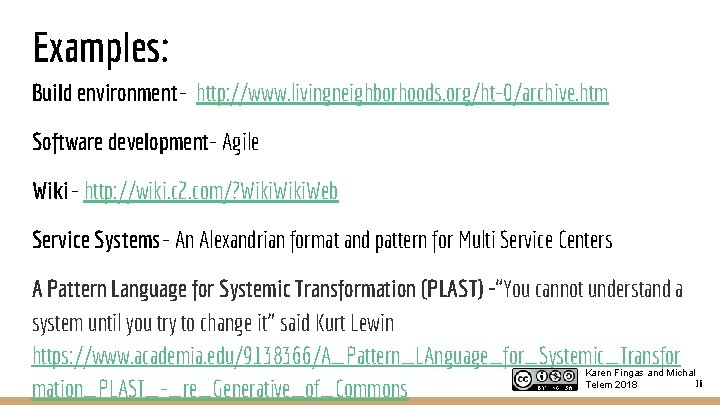
Examples: Build environment - http: //www. livingneighborhoods. org/ht-0/archive. htm Software development- Agile Wiki - http: //wiki. c 2. com/? Wiki. Web Service Systems - An Alexandrian format and pattern for Multi Service Centers A Pattern Language for Systemic Transformation (PLAST) -“You cannot understand a system until you try to change it” said Kurt Lewin https: //www. academia. edu/9138366/A_Pattern_LAnguage_for_Systemic_Transfor Karen Fingas and Michal 16 Telem 2018 mation_PLAST_-_re_Generative_of_Commons
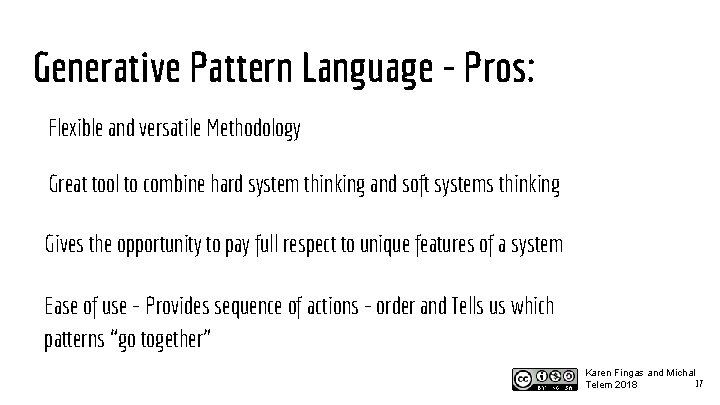
Generative Pattern Language - Pros: Flexible and versatile Methodology Great tool to combine hard system thinking and soft systems thinking Gives the opportunity to pay full respect to unique features of a system Ease of use - Provides sequence of actions - order and Tells us which patterns “go together” Karen Fingas and Michal 17 Telem 2018
Generative Pattern Language - Cons Relies on collaboration - not everyone can/will participate Patterns take labour and time to develop Need experts Karen Fingas and Michal 18 Telem 2018
“A generative code is a system of unfolding steps that enable people in a community to create. . . ” - Christopher Alexander Karen Fingas and Michal 19 Telem 2018
References Karen Fingas and Michal Telem 2018 Alexander, Christopher. “Generative Codes. ” Living Neighbourhoods. Accessed February 1, 2018. http: //www. livingneighborhoods. org/ht-0/generative. htm. Ing, David. “Pattern Manual For Service Systems Thinking, ” October 28, 2016. http: //coevolving. com/pubs/20161028_PUARL_Ing_Pattern. Manual. For. Service. Systems. Thinking_v 1020 a. pdf. Ing, David. . An Introduction to Service Systems Thinking (Part 2 of 2) 2015/10/02. Accessed January 27, 2018. https: //www. youtube. com/watch? v=j 3 a 4 j 9 x. N 61 I. Iba, Takashi, Mami Sakamoto, and Toko Miyake. “How to Write Tacit Knowledge as a Pattern Language: Media Design for Spontaneous and Collaborative Communities. ” Procedia - Social and Behavioral Sciences, The 2 nd Collaborative Innovation Networks Conference - COINs 2010, 26 (January 1, 2011): 46– 54. https: //doi. org/10. 1016/j. sbspro. 2011. 10. 561. Gabriel, Richard P. 1996. “The Quality Without a Name. ” In Patterns of Software, 33– 44. New York: Oxford University Press. http: //dreamsongs. net/Files/Patterns. Of. Software. pdf. Iba, Takashi, “Peer Learning via Dialogue with a Pattern Language”, in the 7 th International Conference on Collaborative Innovation Networks (COINs 17), Detroit, USA, Sep. , 2017. https: //www. slideshare. net/takashiiba/peer-learning-via-dialogue-with-a-pattern-language Chihyang Li, “A brief introduction about design patterns in Swift language”, 2017. https: //www. slideshare. net/Chihyang. Li/design-patterns-in-swift-ch 0 -introduction https: //blog. p 2 pfoundation. net/what-is-an-unfolding/2015/04/12 https: //www. slideshare. net/Chihyang. Li? utm_campaign=profiletracking&utm_medium=sssite&utm_source=ssslideview 20
- Slides: 20