
Generational Differences Communicating with College Students as a






- Slides: 46
Generational Differences Communicating with College Students as a Healthcare Provider Pamela Golub, BSN, APRN, WHNP-BC Texas A&M University
Disclaimer There is no actual or potential conflict of interest in relation to this educational activity or presentation
Learning Objectives 1. Define a safe and non-judgmental environment in care. 2. Discuss ways to listen and understand student needs. 3. Identify ways to communicate and instruct students at a level for safe care and intervention.
Communication With College Students Communication Defined: 2 a : information communicated : information transmitted or conveyed b : a verbal or written message 3 a : a process by which information is exchanged between individuals through a common system of symbols, signs; exchange of information
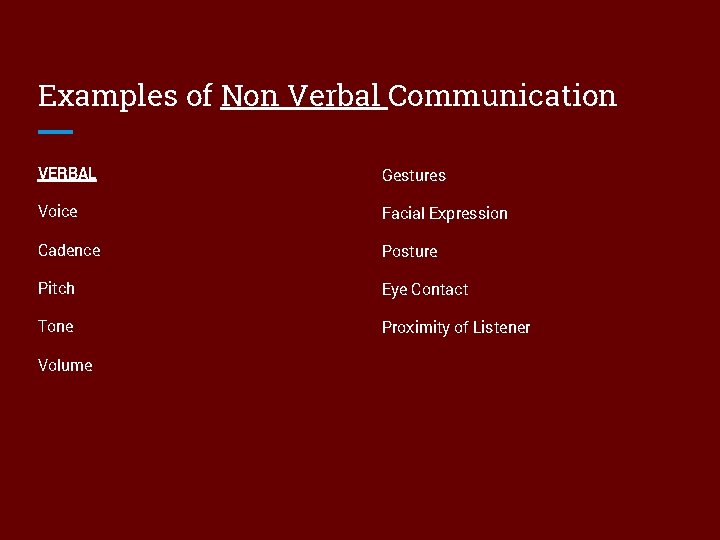
Examples of Non Verbal Communication VERBAL Gestures Voice Facial Expression Cadence Posture Pitch Eye Contact Tone Proximity of Listener Volume
When does communication start in providing care? BEFORE the student comes into the clinic
Why is Communication in Health Care Important? Improving communication with students increases understanding and decreases callbacks and return visits
Importance of Communication ❖Miscommunication can lead to further serious illness and dangerous consequences. ❖One study showed that patient only recalled 40% of the information they were given, and almost half of what they thought they remembered was incorrect.
What is a safe environment? Where the risk of harm is minimised and students feel secure
National Standards for Culturally and Linguistically Appropriate Services (CLAS) in Health and Health Care Provide effective, equitable, understandable, and respectful quality care and services that are responsive to diverse cultural health beliefs and practices, preferred languages, health literacy, and other communication needs
RESPECT Model Respect Empathy Support Partnership Explanations Cultural Competence Trust
Rapport ❖Connect on a social level. ❖See the patient’s point of view. ❖Consciously attempt to suspend judgment. ❖Recognize and avoid making assumptions.
Empathy ❖Remember that the patient has come to you for help. ❖Seek out and understand the patient’s rationale for their behaviors or illness. ❖Verbally acknowledge and legitimize the patient’s feelings.
Support ❖Ask about and try to understand barriers to care and compliance. ❖Help the patient overcome barriers. ❖Involve family members if appropriate. ❖Reassure the patient you are and will be available to help.
Partnership ❖Be flexible with regard to issues of control. ❖Negotiate roles when necessary. ❖Stress that you will be working together to address medical problems.
Explanations ❖Check often for understanding. ❖Use verbal clarification techniques
Cultural Competence ❖Respect the patient and their culture and beliefs. ❖Understand that the patient’s view of you may be defined by ethnic or cultural stereotypes. ❖Be aware of you own biases and preconceptions. ❖Know your limitations in addressing medical issues across cultures. ❖Understand your personal style and recognize when it may not be working with a given patient.
Trust ❖Self-disclosure may be an issue for some patients who are not accustomed to ❖Western medical approaches. ❖Take the necessary time and consciously work to establish trust.
What does a supportive environment mean? A supportive environment facilitates and enhances the social, academic, physical and emotional development of students
Why should there be some guidelines?
Customer Service Customer service is the provision of service to customers before, during and after a purchase **The perception of success in such interactions is dependent on employees “who can adjust themselves to the personality of the guest”
How can you communicate effectively with students?
5 Fundamentals of Patient Communication ❖Acknowledge ❖Introduce ❖Duration ❖Explanation ❖Thank you
Team approach TEAM Leader = student
Attitude
Listening
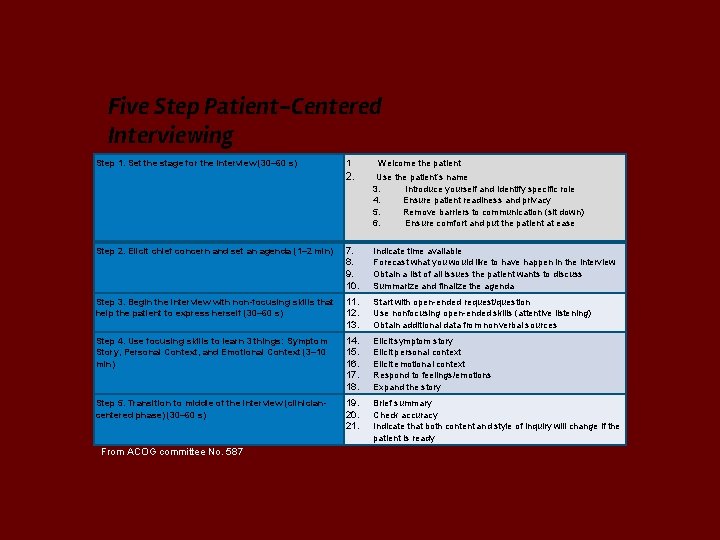
Five Step Patient-Centered Interviewing Step 1. Set the stage for the interview (30– 60 s) 1 Welcome the patient 2. Use the patient’s name 3. Introduce yourself and identify specific role 4. Ensure patient readiness and privacy 5. Remove barriers to communication (sit down) 6. Ensure comfort and put the patient at ease Step 2. Elicit chief concern and set an agenda (1– 2 min) 7. 8. 9. 10. Indicate time available Forecast what you would like to have happen in the interview Obtain a list of all issues the patient wants to discuss Summarize and finalize the agenda Step 3. Begin the interview with non-focusing skills that help the patient to express herself (30– 60 s) 11. 12. 13. Start with open-ended request/question Use nonfocusing open-ended skills (attentive listening) Obtain additional data from nonverbal sources Step 4. Use focusing skills to learn 3 things: Symptom Story, Personal Context, and Emotional Context (3– 10 min) 14. 15. 16. 17. 18. Elicit symptom story Elicit personal context Elicit emotional context Respond to feelings/emotions Expand the story Step 5. Transition to middle of the interview (cliniciancentered phase) (30– 60 s) 19. 20. 21. Brief summary Check accuracy Indicate that both content and style of inquiry will change if the patient is ready From ACOG committee No. 587
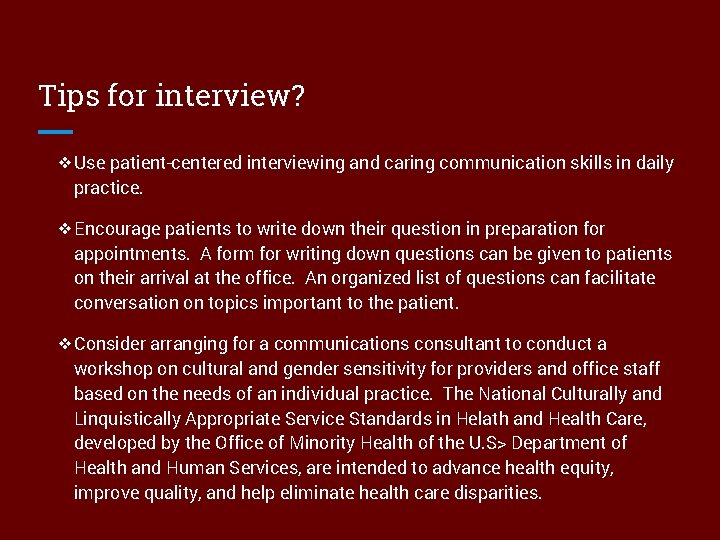
Tips for interview? ❖Use patient-centered interviewing and caring communication skills in daily practice. ❖Encourage patients to write down their question in preparation for appointments. A form for writing down questions can be given to patients on their arrival at the office. An organized list of questions can facilitate conversation on topics important to the patient. ❖Consider arranging for a communications consultant to conduct a workshop on cultural and gender sensitivity for providers and office staff based on the needs of an individual practice. The National Culturally and Linquistically Appropriate Service Standards in Helath and Health Care, developed by the Office of Minority Health of the U. S> Department of Health and Human Services, are intended to advance health equity, improve quality, and help eliminate health care disparities.
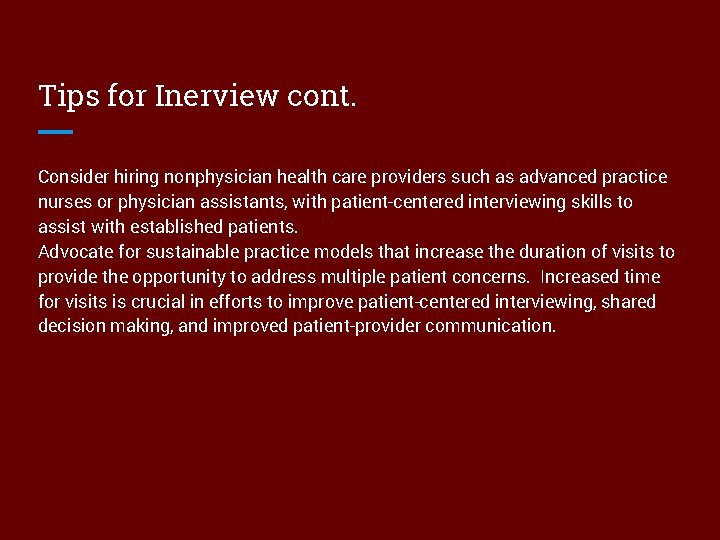
Tips for Inerview cont. Consider hiring nonphysician health care providers such as advanced practice nurses or physician assistants, with patient-centered interviewing skills to assist with established patients. Advocate for sustainable practice models that increase the duration of visits to provide the opportunity to address multiple patient concerns. Increased time for visits is crucial in efforts to improve patient-centered interviewing, shared decision making, and improved patient-provider communication.
Body language
Alleviate fear Not a catastrophe
Instruction
Verbal overuse of jargon
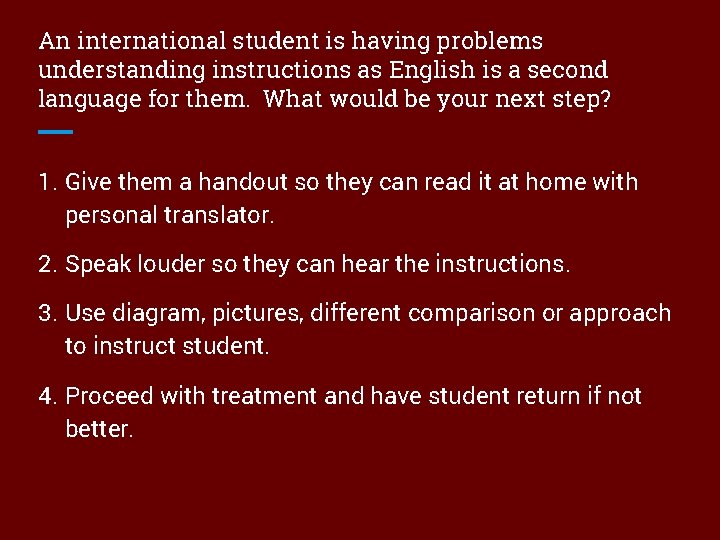
An international student is having problems understanding instructions as English is a second language for them. What would be your next step? 1. Give them a handout so they can read it at home with personal translator. 2. Speak louder so they can hear the instructions. 3. Use diagram, pictures, different comparison or approach to instruct student. 4. Proceed with treatment and have student return if not better.
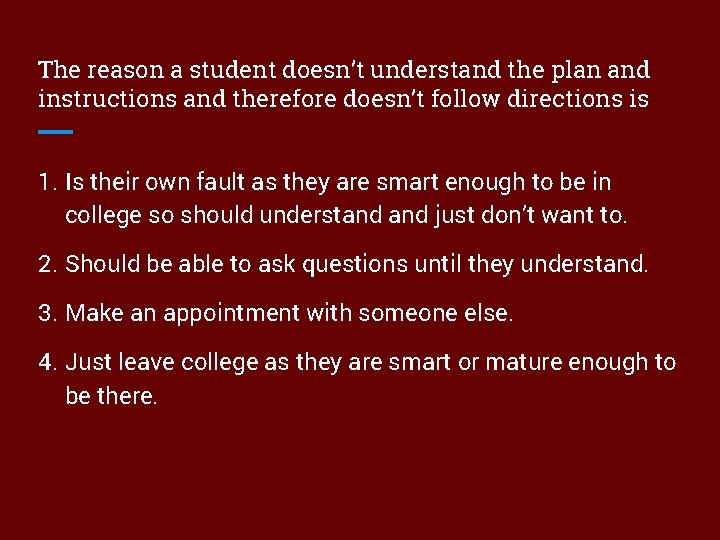
The reason a student doesn’t understand the plan and instructions and therefore doesn’t follow directions is 1. Is their own fault as they are smart enough to be in college so should understand just don’t want to. 2. Should be able to ask questions until they understand. 3. Make an appointment with someone else. 4. Just leave college as they are smart or mature enough to be there.
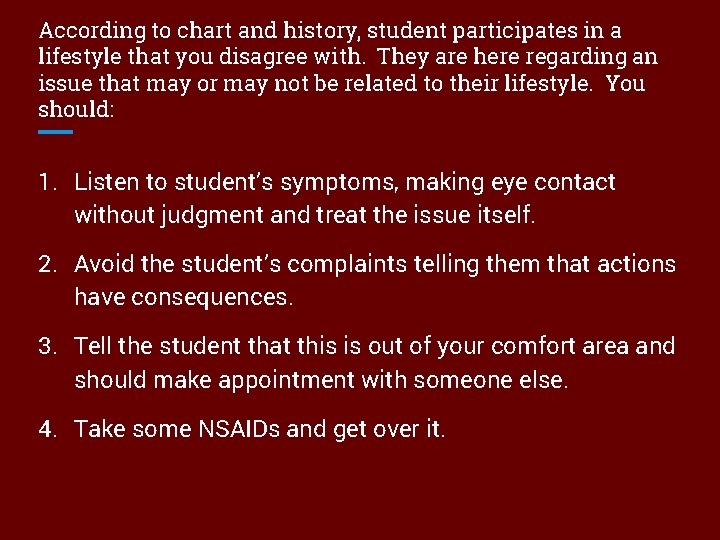
According to chart and history, student participates in a lifestyle that you disagree with. They are here regarding an issue that may or may not be related to their lifestyle. You should: 1. Listen to student’s symptoms, making eye contact without judgment and treat the issue itself. 2. Avoid the student’s complaints telling them that actions have consequences. 3. Tell the student that this is out of your comfort area and should make appointment with someone else. 4. Take some NSAIDs and get over it.
Letting personal feelings get in the way of how a provider communicates and effective in care of the student is easy to avoid. True or False
Statements and instructions from a provider should be accepted and followed due to being older and more educated than the student. True or False
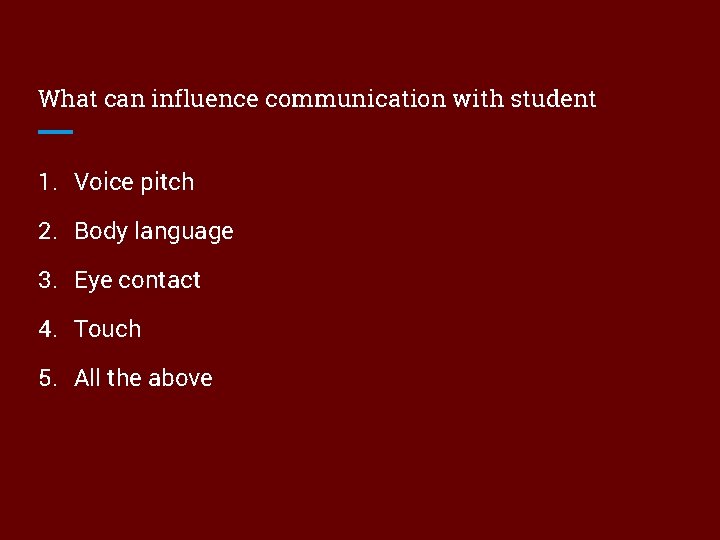
What can influence communication with student 1. Voice pitch 2. Body language 3. Eye contact 4. Touch 5. All the above
Examples
Positive statements ❖ “Cared about me. I mattered. ” ❖ “Of all the people she sees all day she remembered me and asked how I felt. ” ❖ “I will be sad when I graduate and no longer have access to this clinic and the lovely ladies who work in it. ” ❖ “Took time to explain to me. Answered my questions. ” ❖ “Dr. ____ was great to deal with. ” ❖ “Very nice staff” ❖ “NP ____is great as well as the nurse. ”
Negative statements ❖ “The doctor was horribly rude to me. (He/She) treated me very poorly. ❖ “(He/She) treated me with a rude tone, snide remarks, and an overall tone of being “bothered by me. ” ❖ “I was appalled by (his/her)treatment and am strongly considering never using the student clinic again. ” ❖ “Overall, this was the ABSOLUTE WORST experience I have ever had at any doctor’s office. ”
Conclusion
References http: //www. hhs. gov/civil-rights/for-individuals/special-topics/hospitalseffective-communication/index. html Content created by Office for Civil Rights (OCR) HTTP: //hhs. gov/civi-rights for-providers http: //www. acog. org/Resources-And-Publications/Committee. Opinions/Committee-on-Health-Care-for-Underserved-Women/Effective. Patient-Physician-Communication Feb 2014 http: //www. ahrq. gov/cahps/quality-improvement/improvement-guide/6 -strategies-for-improving/communication/strategy 6 htools. html http: //www. jhsph. edu/news-releases/2012/dycommunication. html http: //medicalreview. columbia. edu/article/communication-healthcare/
References