
Generating Redundant Features with Unsupervised MultiTree Genetic Programming





- Slides: 27
Generating Redundant Features with Unsupervised Multi-Tree Genetic Programming Andrew Lensen, Dr. Bing Xue, and Prof. Mengjie Zhang Victoria University of Wellington, New Zealand Euro. GP ‘ 18
Feature Selection • Many datasets have a large number of attributes (features). • Feature Selection (FS) is often used to select only a few features: • Reduce the search space for data mining. • Improve interpretability of evolved models (less complex). • What features should be removed? Two main types: • Irrelevant/noisy: add little value to the dataset, or even mislead. • Redundant: Share high amount of information with other features. 04/04/2018 Andrew. Lensen@ecs. vuw. ac. nz 2
Evaluating FS Algorithms • How do we know how good a FS algorithm is at identifying each type of “bad” feature? • Identify noisy/redundant features in an existing dataset, then see how well our algorithm detects these. • But doing so is equivalent to performing FS NP-hard… • Or, add some generated “bad” features to an existing dataset. • How? 04/04/2018 Andrew. Lensen@ecs. vuw. ac. nz 3
Generating “Bad” Features • Generating noisy features is relatively straightforward: • Use a Gaussian/uniform/… feature generator. • Can vary the level of noise. • Ways of generating redundant features (rfs) are much less apparent. • Naïve approach: duplicate or scale existing features (+noise). • But makes easy-to-detect features: e. g. pearson’s correlation! • Also not representative of real-world redundancies. 04/04/2018 Andrew. Lensen@ecs. vuw. ac. nz 4
How to generate redundant features then? • Very little (if any? ) work proposed to do so. • Two redundant features must have some mapping, i. e. a function that defines their redundancy relationship. • Genetic Programming (GP) is very good for evolving functions that map an input(s) to an output(s). Can we use GP to evolve redundant features? 04/04/2018 Andrew. Lensen@ecs. vuw. ac. nz 5
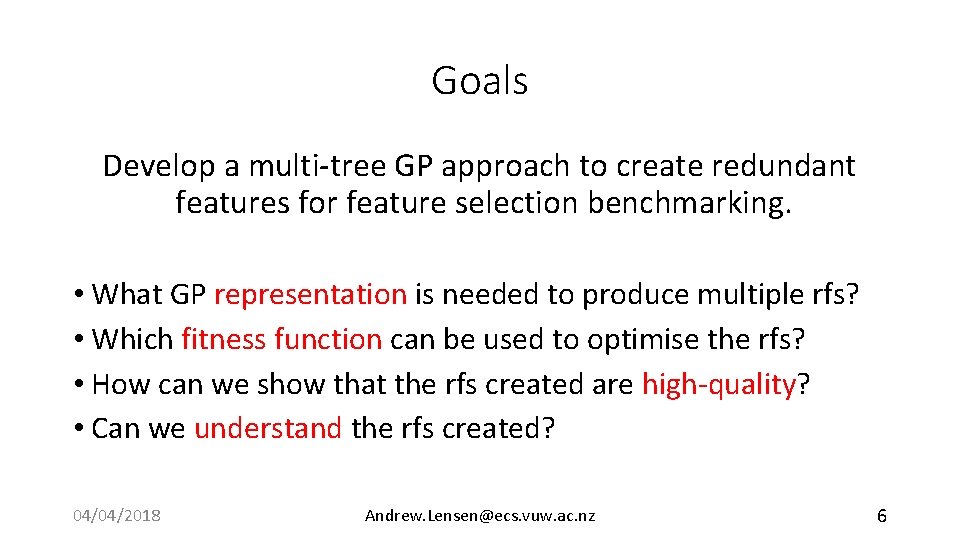
Goals Develop a multi-tree GP approach to create redundant features for feature selection benchmarking. • What GP representation is needed to produce multiple rfs? • Which fitness function can be used to optimise the rfs? • How can we show that the rfs created are high-quality? • Can we understand the rfs created? 04/04/2018 Andrew. Lensen@ecs. vuw. ac. nz 6
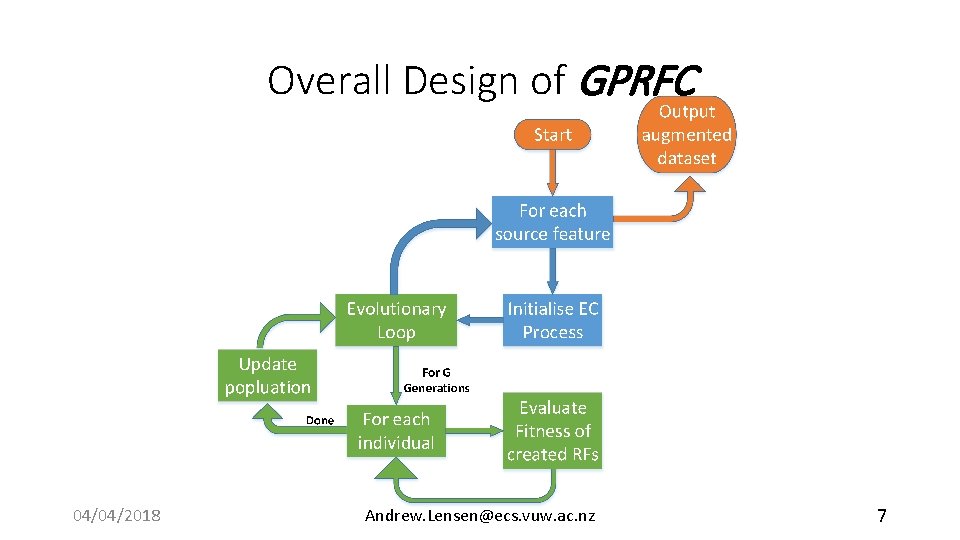
Overall Design of GPRFC 04/04/2018 Andrew. Lensen@ecs. vuw. ac. nz 7
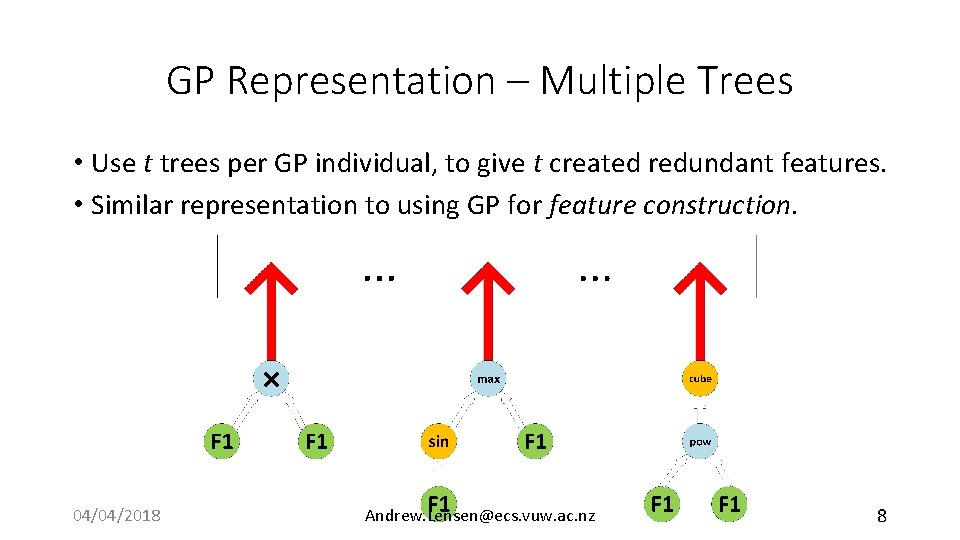
GP Representation – Multiple Trees • Use t trees per GP individual, to give t created redundant features. • Similar representation to using GP for feature construction. 04/04/2018 Andrew. Lensen@ecs. vuw. ac. nz 8
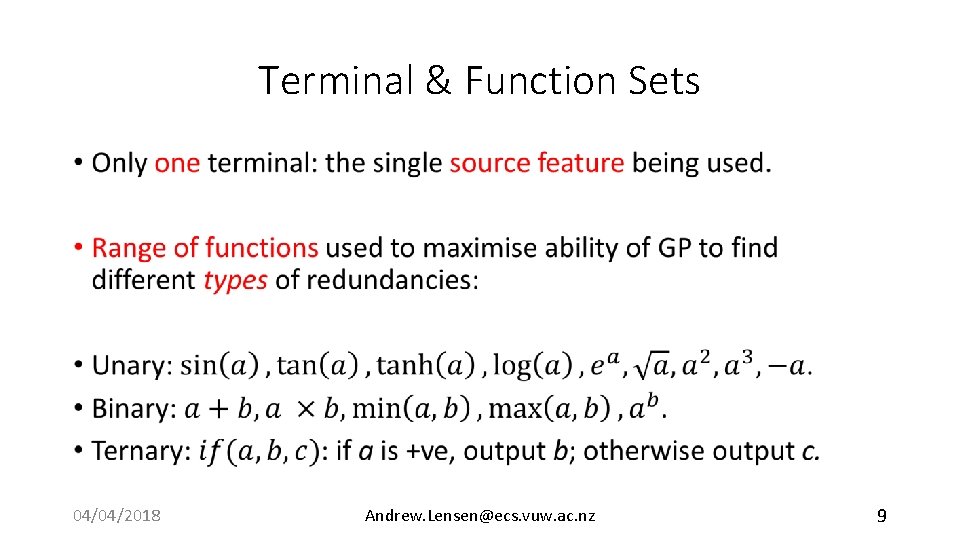
Terminal & Function Sets • 04/04/2018 Andrew. Lensen@ecs. vuw. ac. nz 9
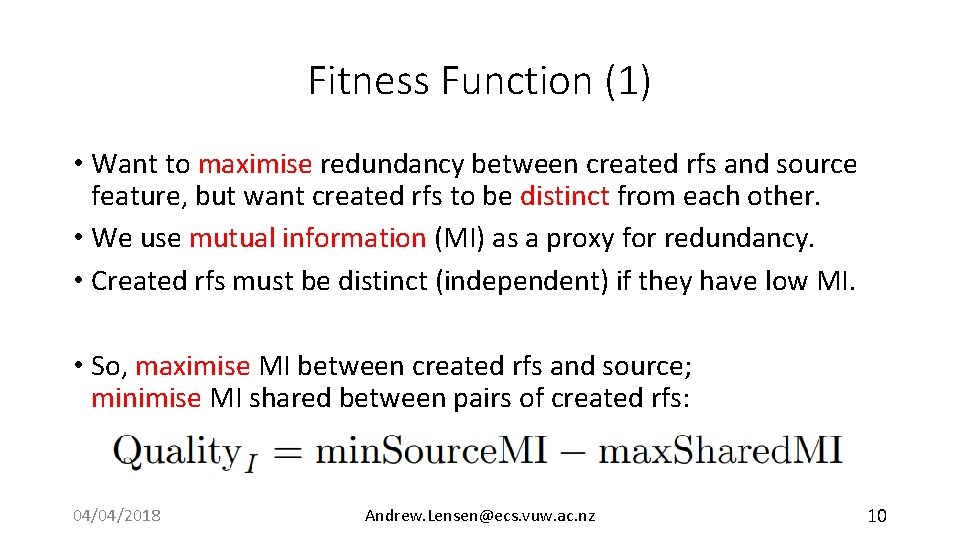
Fitness Function (1) • Want to maximise redundancy between created rfs and source feature, but want created rfs to be distinct from each other. • We use mutual information (MI) as a proxy for redundancy. • Created rfs must be distinct (independent) if they have low MI. • So, maximise MI between created rfs and source; minimise MI shared between pairs of created rfs: 04/04/2018 Andrew. Lensen@ecs. vuw. ac. nz 10
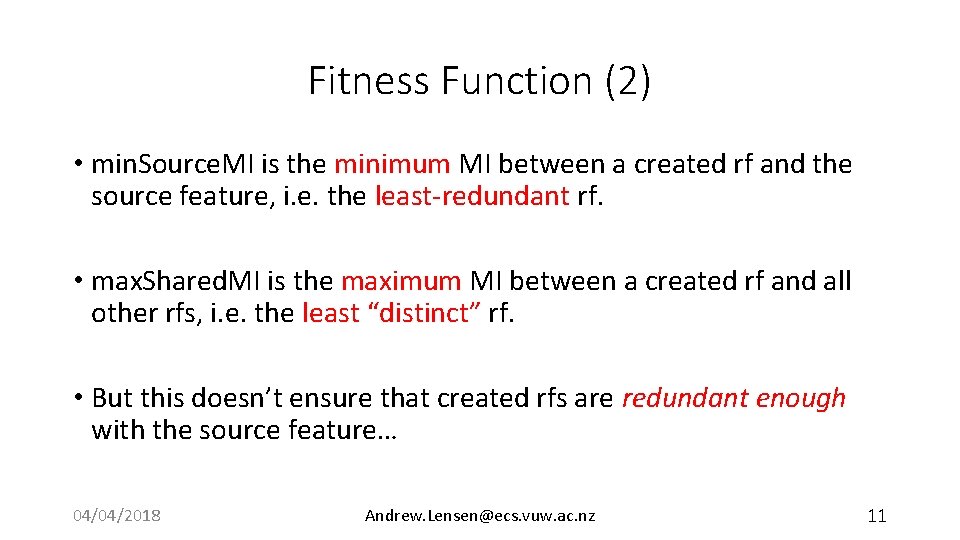
Fitness Function (2) • min. Source. MI is the minimum MI between a created rf and the source feature, i. e. the least-redundant rf. • max. Shared. MI is the maximum MI between a created rf and all other rfs, i. e. the least “distinct” rf. • But this doesn’t ensure that created rfs are redundant enough with the source feature… 04/04/2018 Andrew. Lensen@ecs. vuw. ac. nz 11
Fitness Function (3) • If min. Source. MI is below some threshold Θ, we consider the created rfs to be an infeasible solution. • In this case, should prioritise increasing all source MIs to encourage solution becoming feasible. 04/04/2018 Andrew. Lensen@ecs. vuw. ac. nz 12
Other Considerations… • Unfortunately, life isn’t that simple. Few tweaks needed: 1. All features are scaled [0, 1], but 0 s kill training speed. So add a small ε to all feature values. 2. Real-world data often has duplicate values, which make it hard to create granular rfs. Add small amount of noise to features. 3. Scale and round the created rfs for visualisation, performance, and storage purposes. 04/04/2018 Andrew. Lensen@ecs. vuw. ac. nz 13
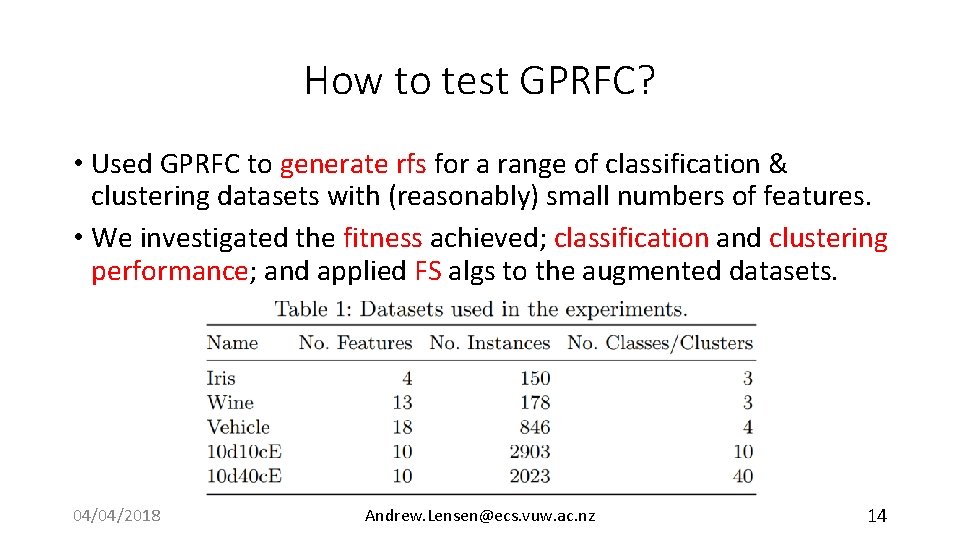
How to test GPRFC? • Used GPRFC to generate rfs for a range of classification & clustering datasets with (reasonably) small numbers of features. • We investigated the fitness achieved; classification and clustering performance; and applied FS algs to the augmented datasets. 04/04/2018 Andrew. Lensen@ecs. vuw. ac. nz 14
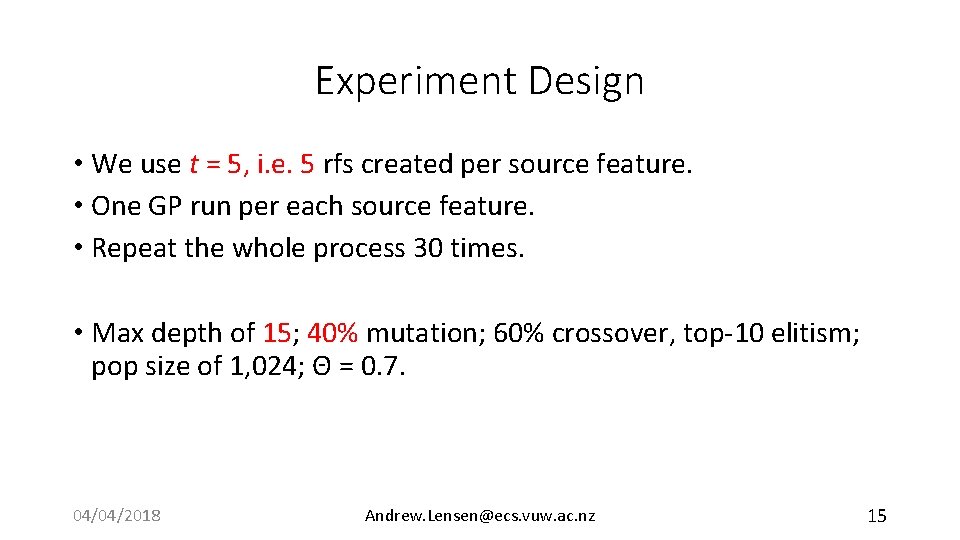
Experiment Design • We use t = 5, i. e. 5 rfs created per source feature. • One GP run per each source feature. • Repeat the whole process 30 times. • Max depth of 15; 40% mutation; 60% crossover, top-10 elitism; pop size of 1, 024; Θ = 0. 7. 04/04/2018 Andrew. Lensen@ecs. vuw. ac. nz 15
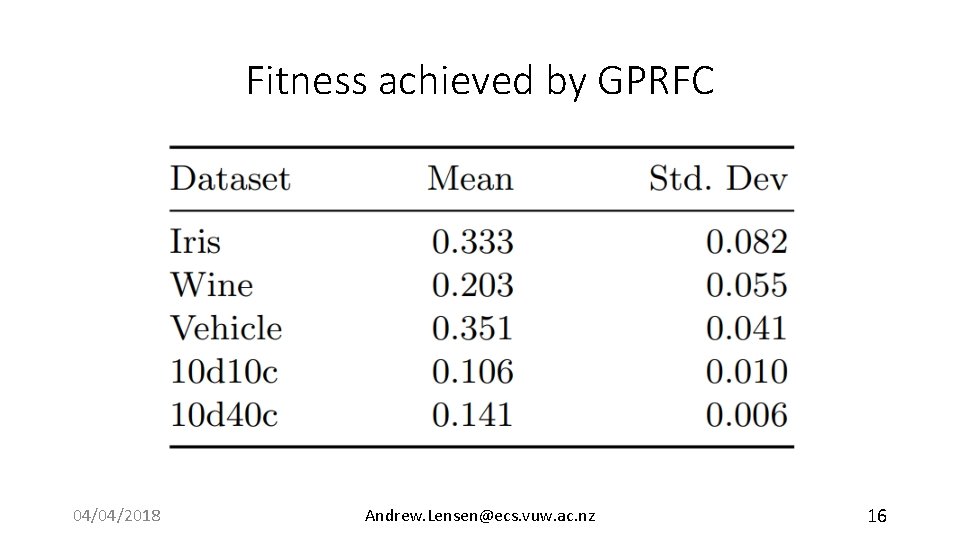
Fitness achieved by GPRFC 04/04/2018 Andrew. Lensen@ecs. vuw. ac. nz 16
Data Mining Performance How do the RFs affect classification and clustering algorithms? 04/04/2018 Andrew. Lensen@ecs. vuw. ac. nz 17
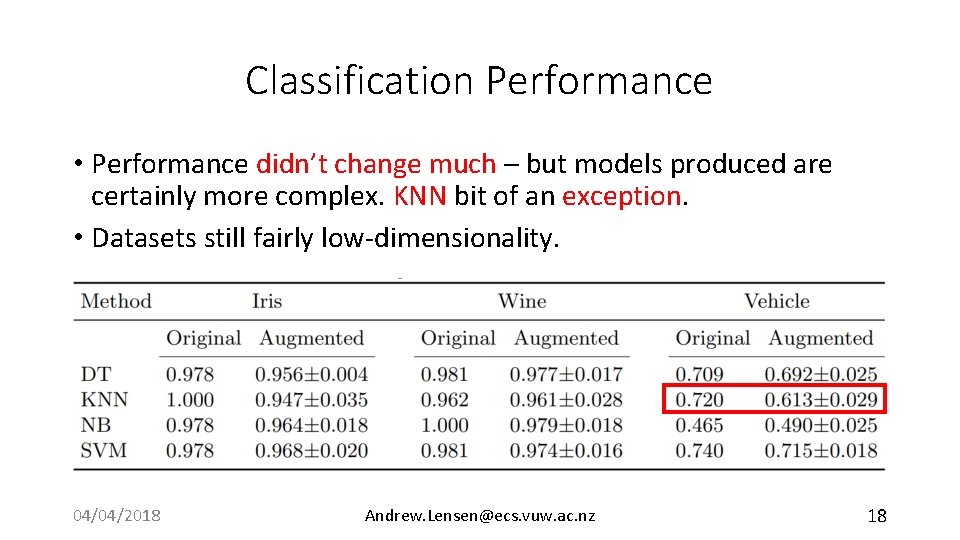
Classification Performance • Performance didn’t change much – but models produced are certainly more complex. KNN bit of an exception. • Datasets still fairly low-dimensionality. 04/04/2018 Andrew. Lensen@ecs. vuw. ac. nz 18
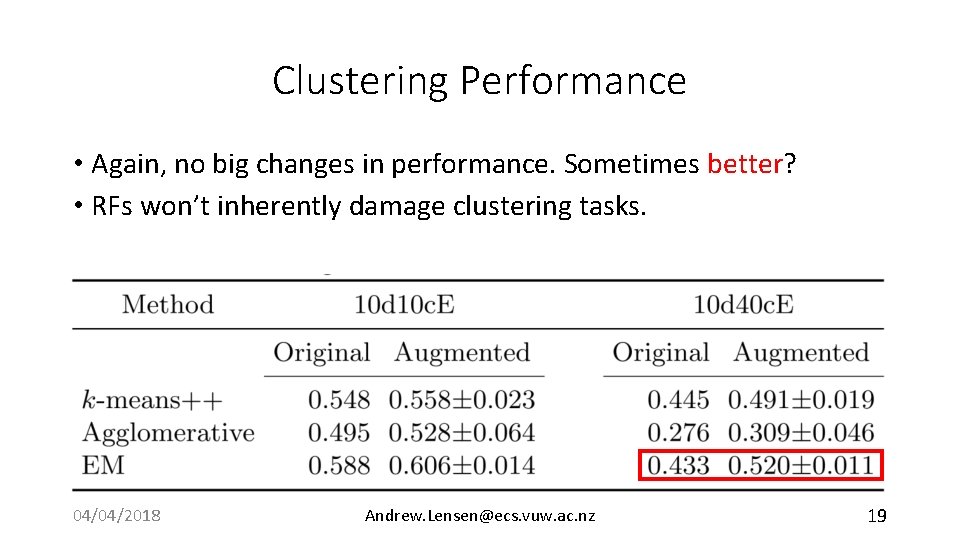
Clustering Performance • Again, no big changes in performance. Sometimes better? • RFs won’t inherently damage clustering tasks. 04/04/2018 Andrew. Lensen@ecs. vuw. ac. nz 19
Feature Selection How well can FS methods discover the redundant features? 04/04/2018 Andrew. Lensen@ecs. vuw. ac. nz 20
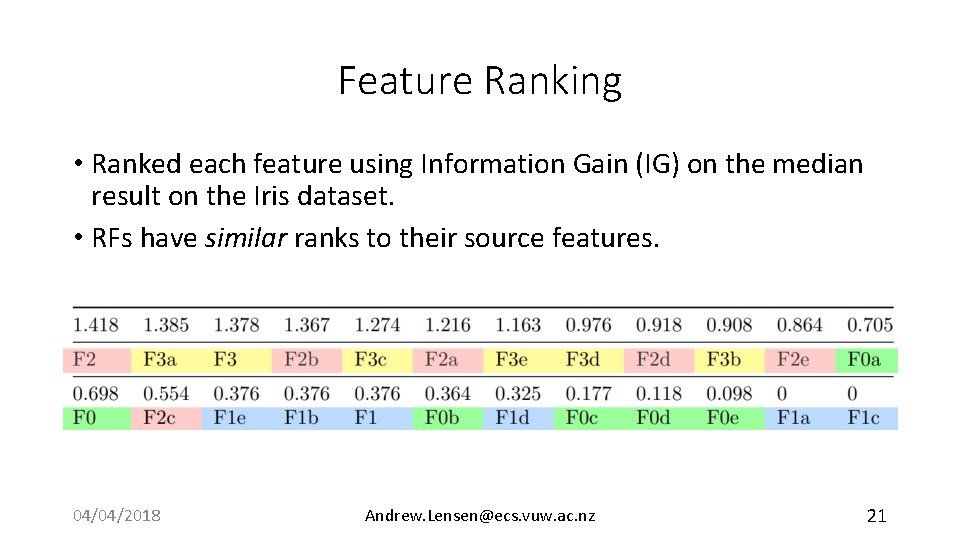
Feature Ranking • Ranked each feature using Information Gain (IG) on the median result on the Iris dataset. • RFs have similar ranks to their source features. 04/04/2018 Andrew. Lensen@ecs. vuw. ac. nz 21
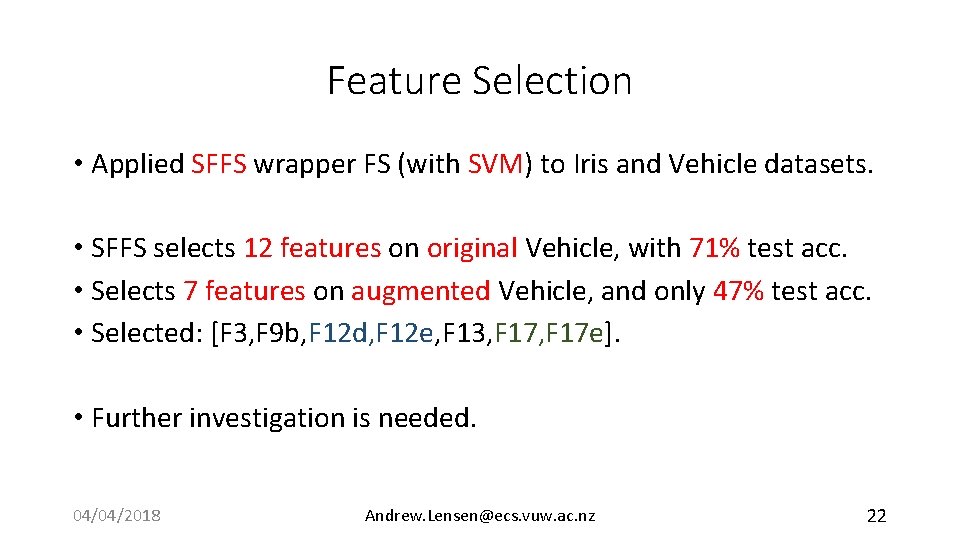
Feature Selection • Applied SFFS wrapper FS (with SVM) to Iris and Vehicle datasets. • SFFS selects 12 features on original Vehicle, with 71% test acc. • Selects 7 features on augmented Vehicle, and only 47% test acc. • Selected: [F 3, F 9 b, F 12 d, F 12 e, F 13, F 17 e]. • Further investigation is needed. 04/04/2018 Andrew. Lensen@ecs. vuw. ac. nz 22
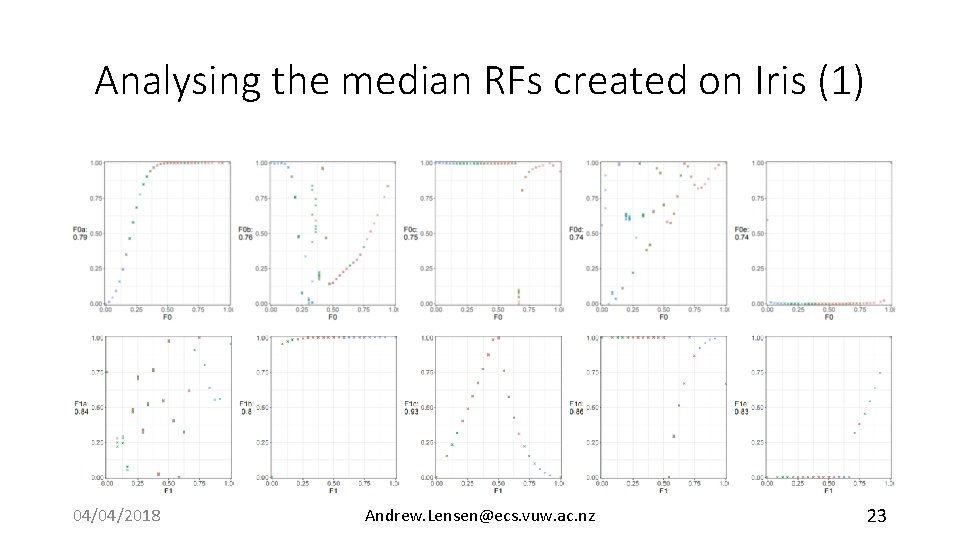
Analysing the median RFs created on Iris (1) 04/04/2018 Andrew. Lensen@ecs. vuw. ac. nz 23
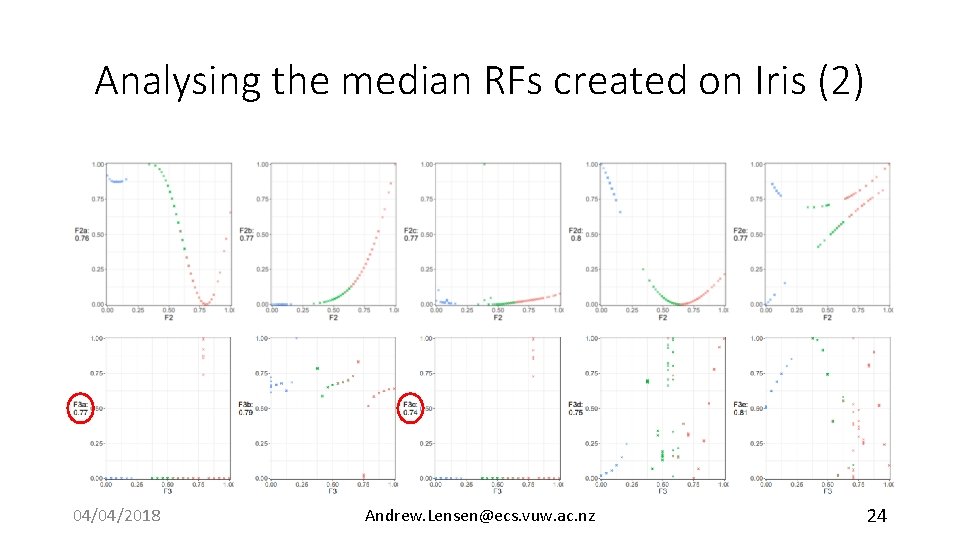
Analysing the median RFs created on Iris (2) 04/04/2018 Andrew. Lensen@ecs. vuw. ac. nz 24
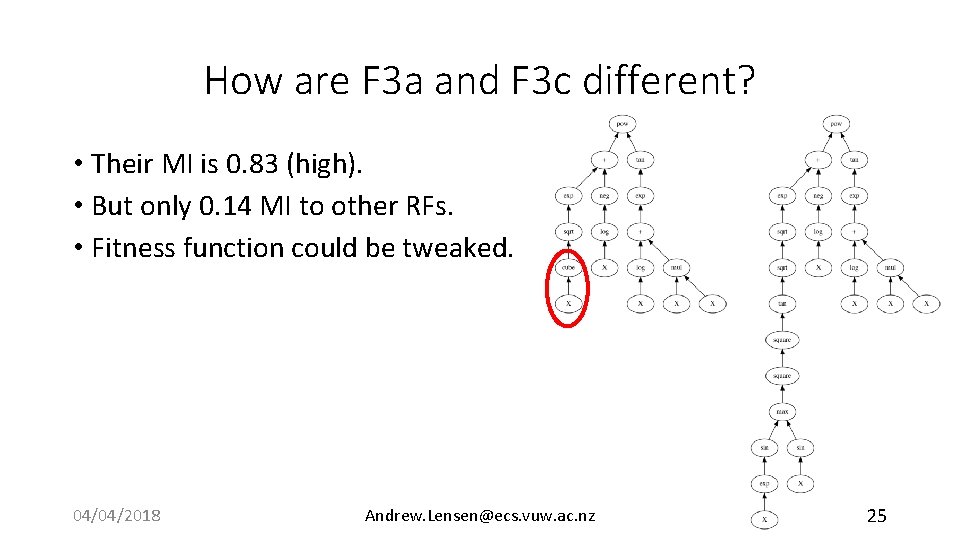
How are F 3 a and F 3 c different? • Their MI is 0. 83 (high). • But only 0. 14 MI to other RFs. • Fitness function could be tweaked. 04/04/2018 Andrew. Lensen@ecs. vuw. ac. nz 25
Final Remarks • We proposed the first approach to using GP to create non-trivial redundant features for benchmarking FS algorithms. • Promising initial results, with clear direction for future work: • Fitness function needs refinement. Better way to compare how “diverse” RFs are? • Currently one source feature used. Multivariate approach? • More refined terminal/function set? 04/04/2018 Andrew. Lensen@ecs. vuw. ac. nz 26
Thank you! <insert CEC 2019 plug here> 04/04/2018 Andrew. Lensen@ecs. vuw. ac. nz 27