
Generating impact from IP How scientists succeed or
- Slides: 46
Generating impact from IP: How scientists succeed… …or fail Ian Harvey March 12 th, 2018 © Ian Harvey v 6
A patent gives you the right to use your invention True or False? © Ian Harvey
Should a researcher undertake a patent search before starting research? Yes or no? © Ian Harvey
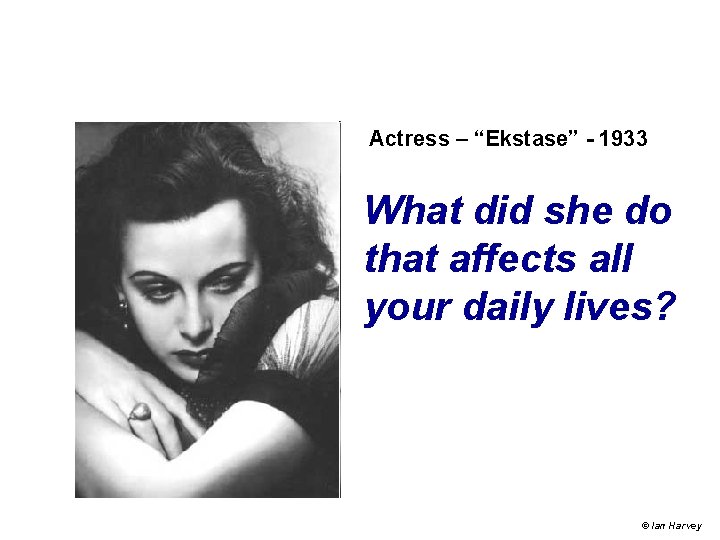
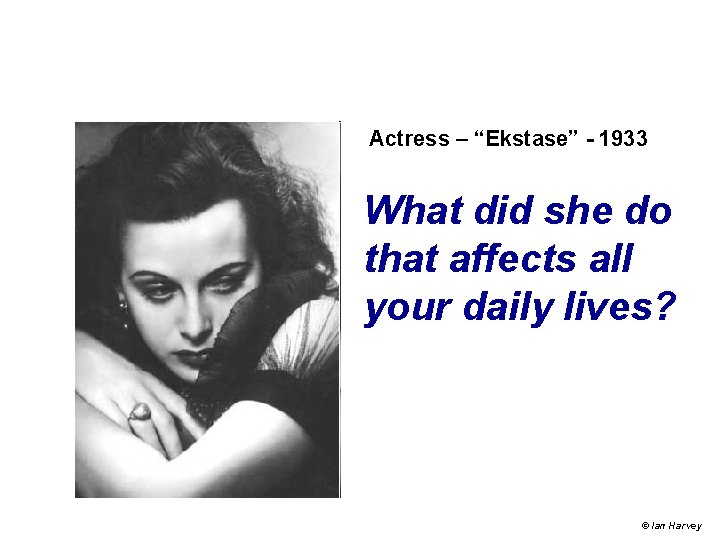
Actress – “Ekstase” - 1933 What did she do that affects all your daily lives? © Ian Harvey
“Future competition in the world is competition in IP …. ” Who said this – and why should we take note? © Ian Harvey
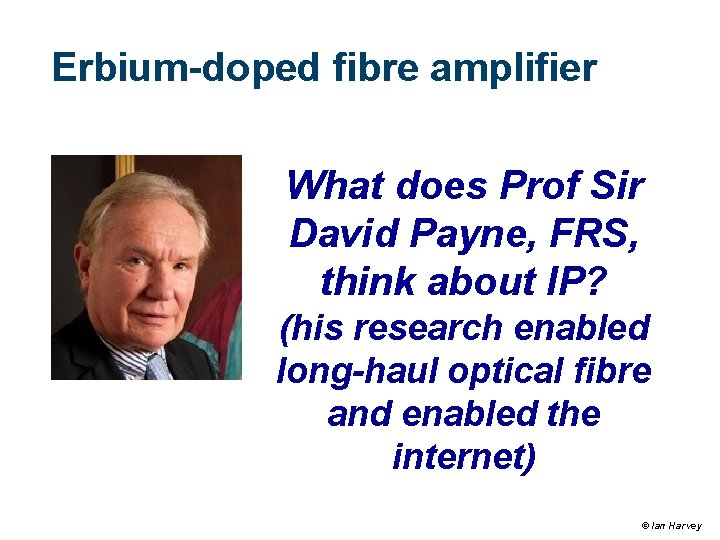
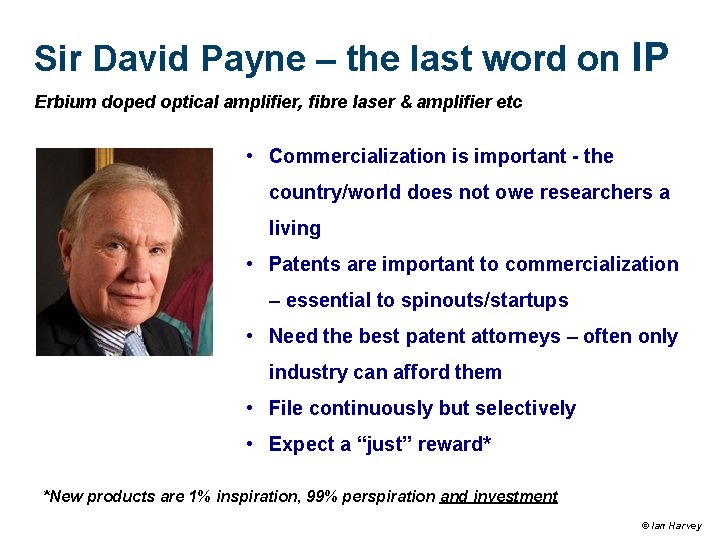
Erbium-doped fibre amplifier What does Prof Sir David Payne, FRS, think about IP? (his research enabled long-haul optical fibre and enabled the internet) © Ian Harvey
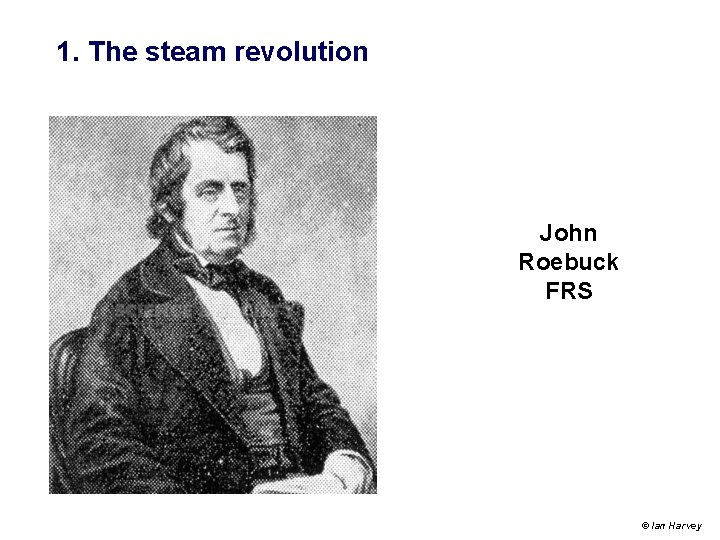
1. The steam revolution John Roebuck FRS © Ian Harvey
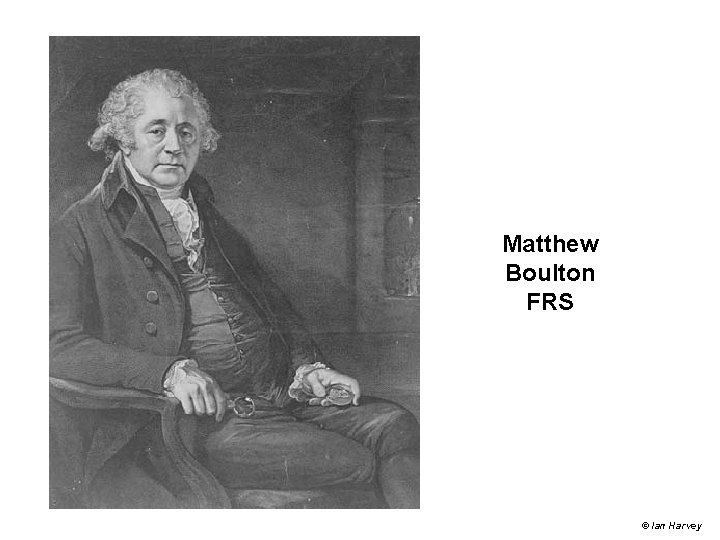
Matthew Boulton FRS © Ian Harvey
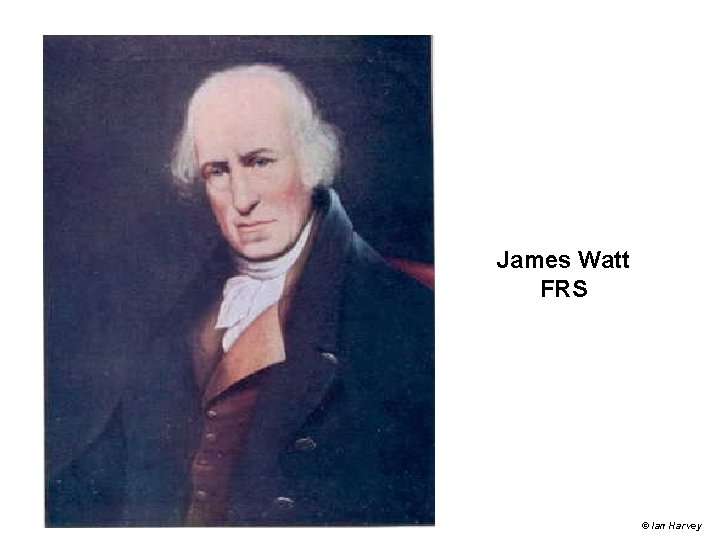
James Watt FRS © Ian Harvey
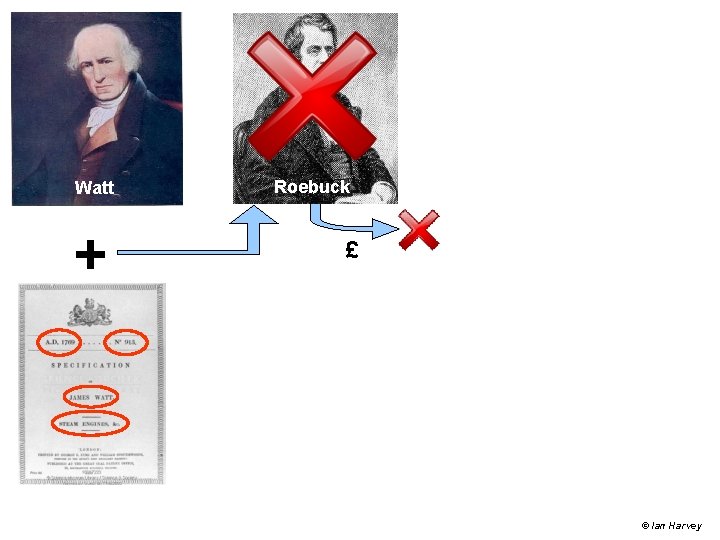
Watt + Roebuck £ © Ian Harvey
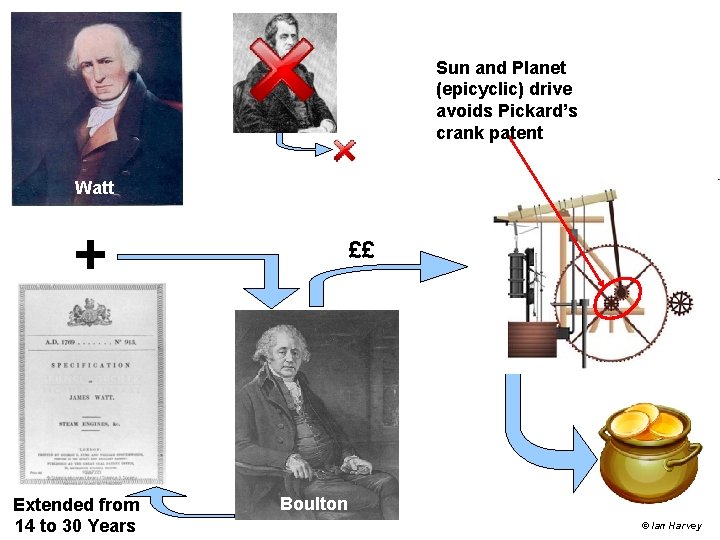
Sun and Planet (epicyclic) drive avoids Pickard’s crank patent Watt + Extended from 14 to 30 Years ££ Boulton © Ian Harvey
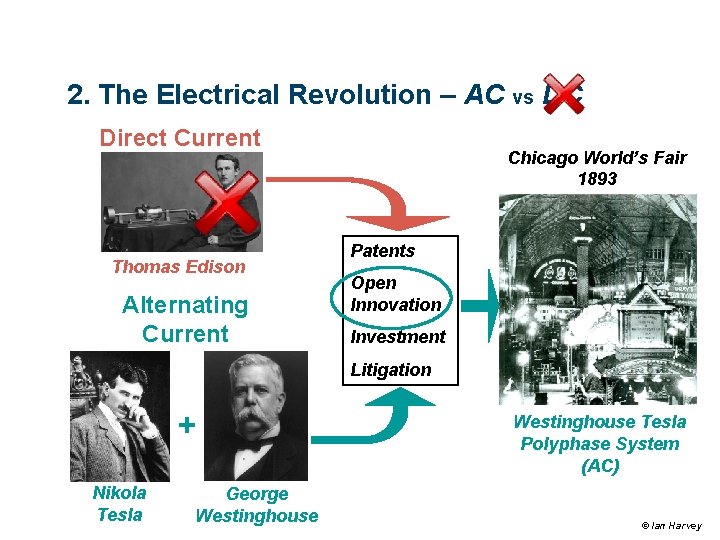
2. The Electrical Revolution – AC vs DC Direct Current Thomas Edison Alternating Current Chicago World’s Fair 1893 Patents Open Innovation Investment Litigation + Nikola Tesla Westinghouse Tesla Polyphase System (AC) George Westinghouse © Ian Harvey
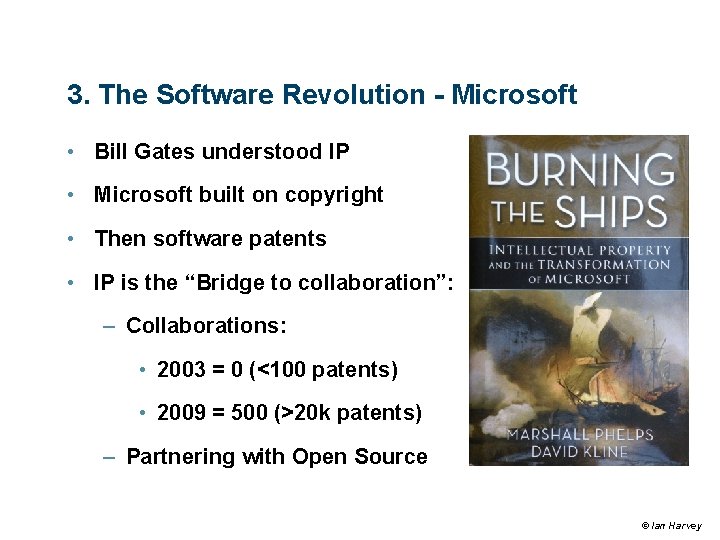
3. The Software Revolution - Microsoft • Bill Gates understood IP • Microsoft built on copyright • Then software patents • IP is the “Bridge to collaboration”: – Collaborations: • 2003 = 0 (<100 patents) • 2009 = 500 (>20 k patents) – Partnering with Open Source © Ian Harvey
Lessons from 250 years • The inventors and heads of these successful companies (Watt, Boulton, Tesla, Westinghouse, Gates) understood IP very well • IP was essential to raising finance for developing their ideas • Most researchers and heads of companies today do not understand IP well • You are more likely to succeed if you are IP-literate © Ian Harvey
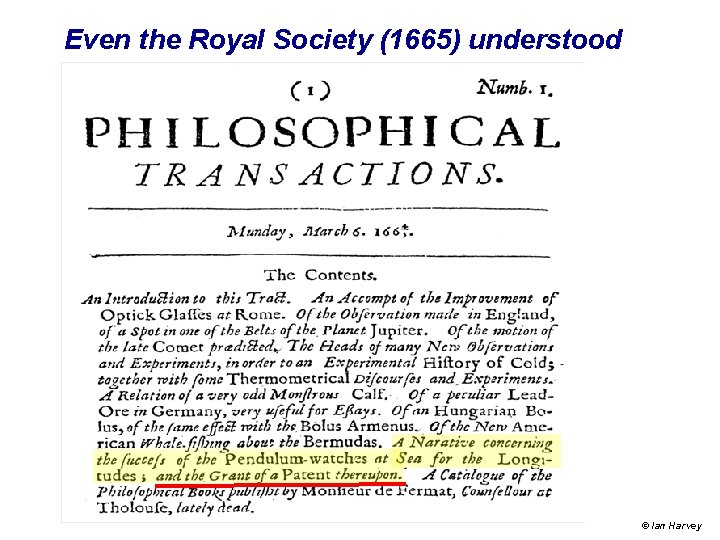
Even the Royal Society (1665) understood © Ian Harvey
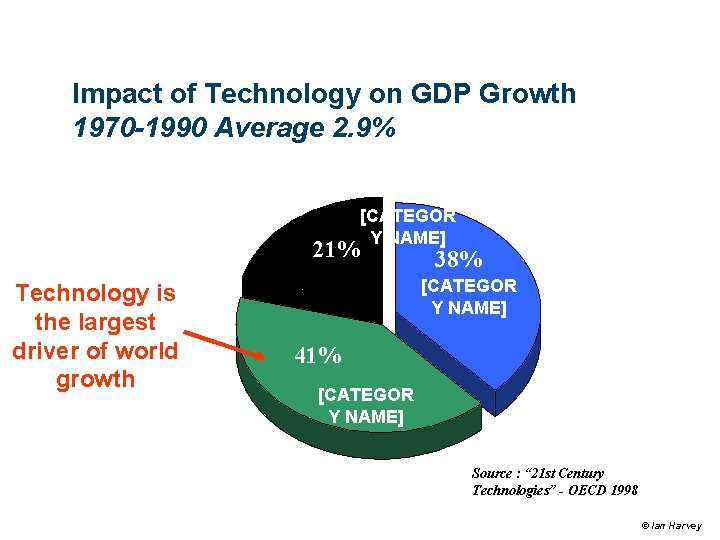
Impact of Technology on GDP Growth 1970 -1990 Average 2. 9% [CATEGOR Y NAME] 21% Technology is the largest driver of world growth 38% [CATEGOR Y NAME] 41% [CATEGOR Y NAME] Source : “ 21 st Century Technologies” - OECD 1998 © Ian Harvey
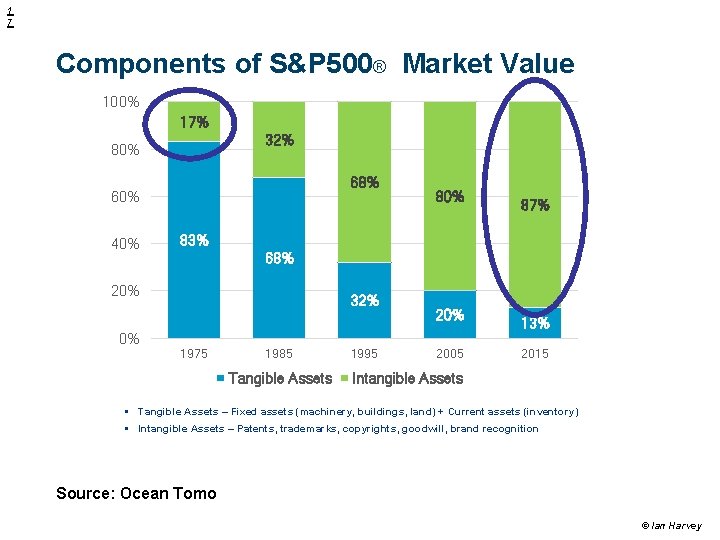
1 7 Components of S&P 500® Market Value 100% 17% 32% 80% 68% 60% 40% 87% 83% 68% 20% 0% 80% 32% 1975 1985 Tangible Assets 1995 20% 2005 13% 2015 Intangible Assets § Tangible Assets – Fixed assets (machinery, buildings, land) + Current assets (inventory) § Intangible Assets – Patents, trademarks, copyrights, goodwill, brand recognition Source: Ocean Tomo © Ian Harvey
IPRs provide: • The incentive to innovate and invest in risky new ideas • The legal clarity and certainty for technology transfer transactions – including creation of IP pools – they are enforceable in court • The choice to IPR owners how their IPRs will be used © Ian Harvey
Copyright • 70/95 years – simple & free • international right, simple, zero cost, certain, use is simple • managing artistic works, databases, software © Ian Harvey
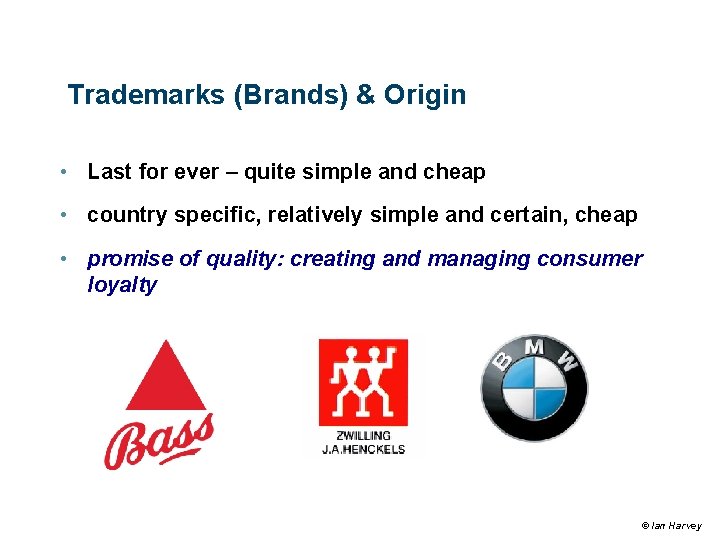
Trademarks (Brands) & Origin • Last for ever – quite simple and cheap • country specific, relatively simple and certain, cheap • promise of quality: creating and managing consumer loyalty © Ian Harvey
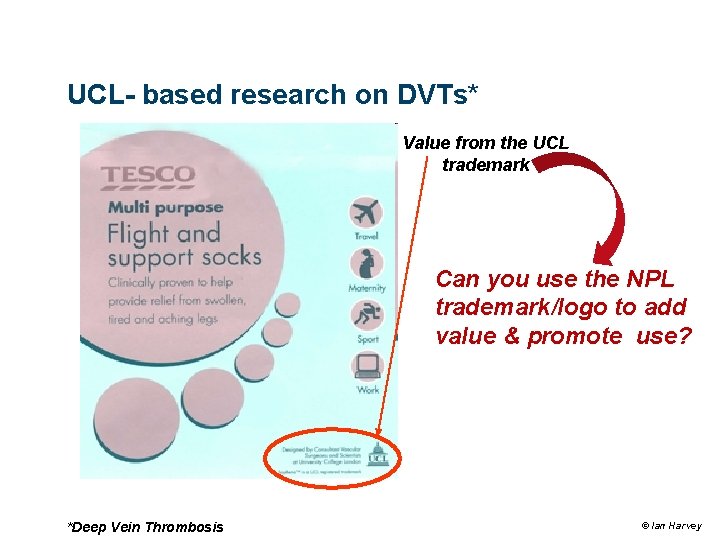
UCL- based research on DVTs* Value from the UCL trademark Can you use the NPL trademark/logo to add value & promote use? *Deep Vein Thrombosis © Ian Harvey
Ethiopia: Geographic Origin Coffee varietals: • Sidamo • Harar • Yirgacheffe © Ian Harvey
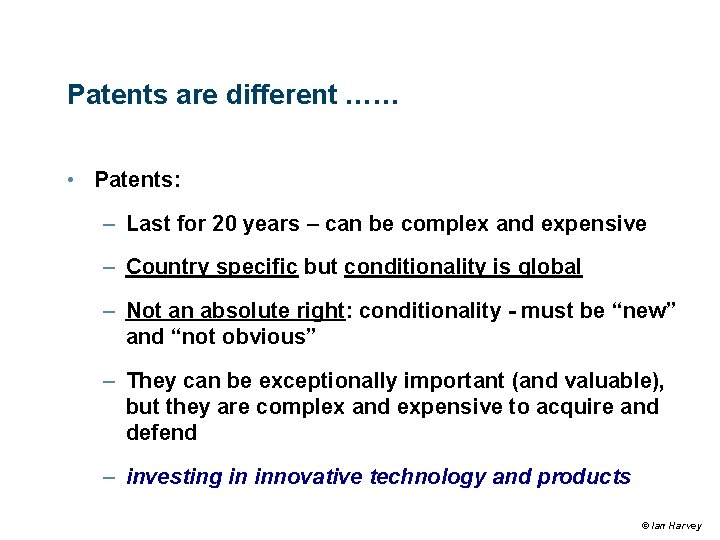
Patents are different …… • Patents: – Last for 20 years – can be complex and expensive – Country specific but conditionality is global – Not an absolute right: conditionality - must be “new” and “not obvious” – They can be exceptionally important (and valuable), but they are complex and expensive to acquire and defend – investing in innovative technology and products © Ian Harvey
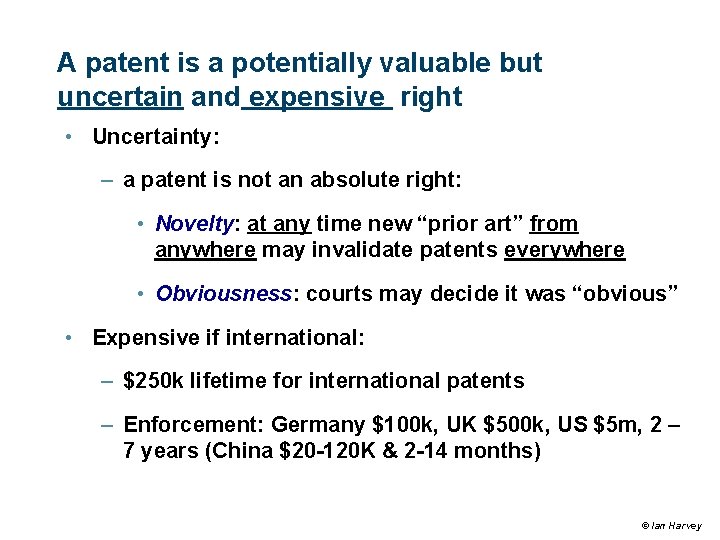
A patent is a potentially valuable but uncertain and expensive right • Uncertainty: – a patent is not an absolute right: • Novelty: at any time new “prior art” from anywhere may invalidate patents everywhere • Obviousness: courts may decide it was “obvious” • Expensive if international: – $250 k lifetime for international patents – Enforcement: Germany $100 k, UK $500 k, US $5 m, 2 – 7 years (China $20 -120 K & 2 -14 months) © Ian Harvey
What does a patent do for you? • It gives you the right to stop other people from making, selling or using your invention commercially • A patent does not give you the right to use your own invention! © Ian Harvey
Does a patent …… • confer ownership of the technology - the “ownership of life” issue? – No - patenting is a passive right - - a patent allows you to stop someone else using your invention, it does not confer ownership of the technology or the right to use it • keep things secret? – No - a patent puts the invention into the public domain • last for ever? – No - a patent ends 20 years after filing the application • constrain research into the patented area? – No - patenting does not prevent research except, possibly, in the US © Ian Harvey
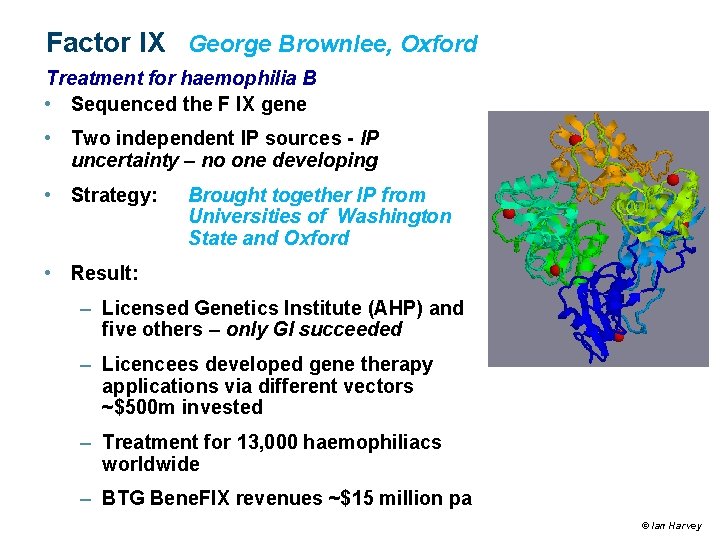
Factor IX George Brownlee, Oxford Treatment for haemophilia B • Sequenced the F IX gene • Two independent IP sources - IP uncertainty – no one developing • Strategy: Brought together IP from Universities of Washington State and Oxford • Result: – Licensed Genetics Institute (AHP) and five others – only GI succeeded – Licencees developed gene therapy applications via different vectors ~$500 m invested – Treatment for 13, 000 haemophiliacs worldwide – BTG Bene. FIX revenues ~$15 million pa © Ian Harvey
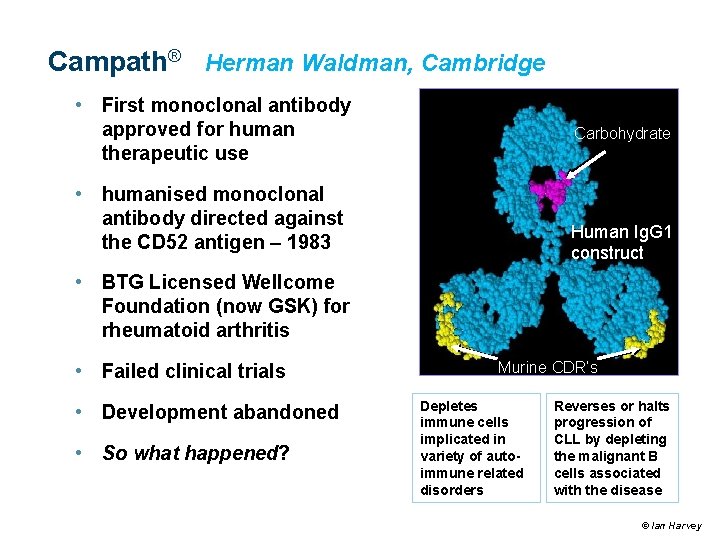
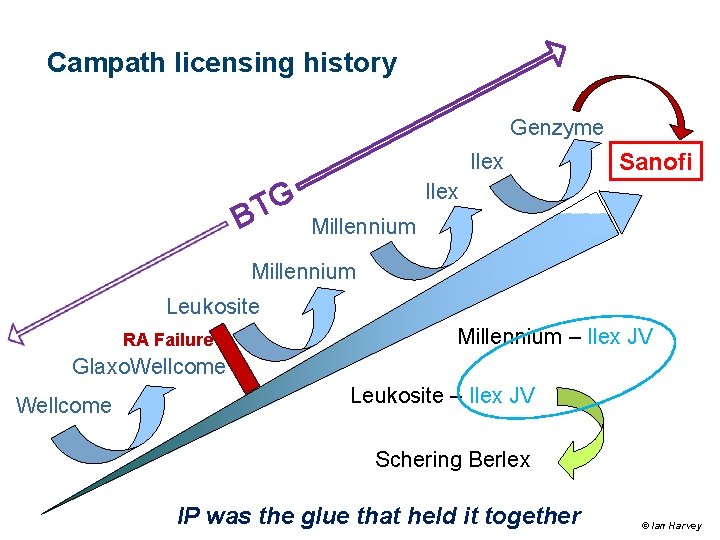
Campath® Herman Waldman, Cambridge • First monoclonal antibody approved for human therapeutic use Carbohydrate • humanised monoclonal antibody directed against the CD 52 antigen – 1983 Human Ig. G 1 construct • BTG Licensed Wellcome Foundation (now GSK) for rheumatoid arthritis • Failed clinical trials • Development abandoned • So what happened? Murine CDR’s Depletes immune cells implicated in variety of autoimmune related disorders Reverses or halts progression of CLL by depleting the malignant B cells associated with the disease © Ian Harvey
Campath licensing history Genzyme Ilex TG B Sanofi Ilex Millennium Leukosite RA Failure Millennium – Ilex JV Glaxo. Wellcome Leukosite – Ilex JV Schering Berlex IP was the glue that held it together © Ian Harvey
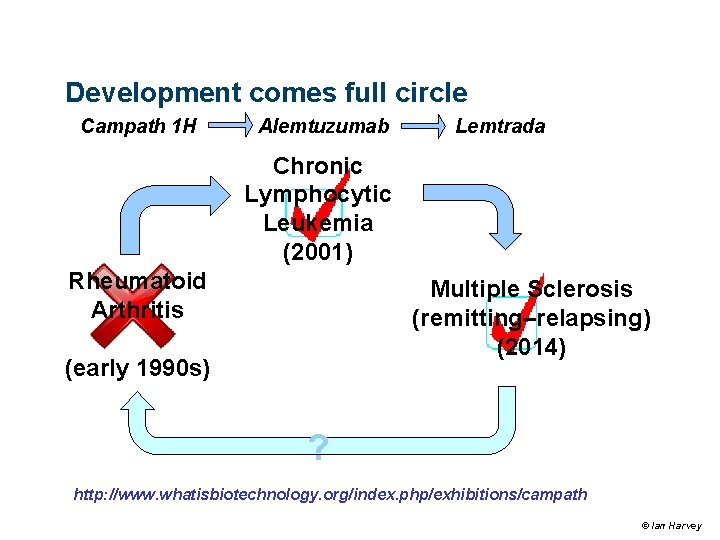
Development comes full circle Campath 1 H Alemtuzumab Lemtrada Chronic Lymphocytic Leukemia (2001) Rheumatoid Arthritis Multiple Sclerosis (remitting–relapsing) (2014) (early 1990 s) ? http: //www. whatisbiotechnology. org/index. php/exhibitions/campath © Ian Harvey
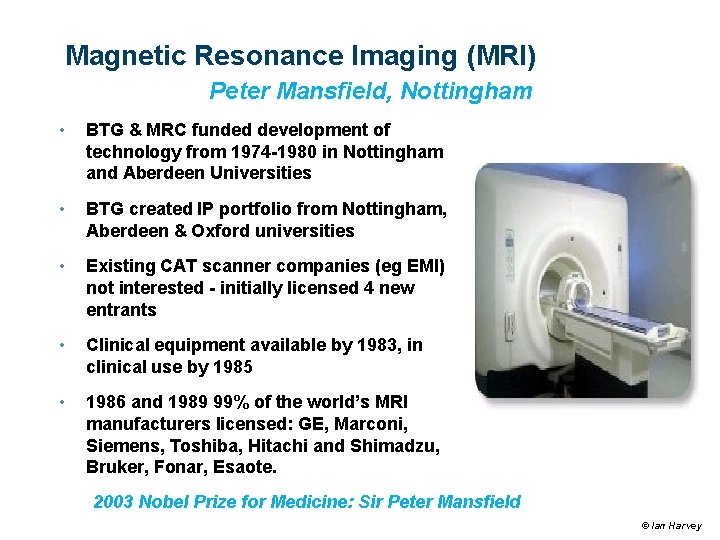
Magnetic Resonance Imaging (MRI) Peter Mansfield, Nottingham • BTG & MRC funded development of technology from 1974 -1980 in Nottingham and Aberdeen Universities • BTG created IP portfolio from Nottingham, Aberdeen & Oxford universities • Existing CAT scanner companies (eg EMI) not interested - initially licensed 4 new entrants • Clinical equipment available by 1983, in clinical use by 1985 • 1986 and 1989 99% of the world’s MRI manufacturers licensed: GE, Marconi, Siemens, Toshiba, Hitachi and Shimadzu, Bruker, Fonar, Esaote. 2003 Nobel Prize for Medicine: Sir Peter Mansfield © Ian Harvey
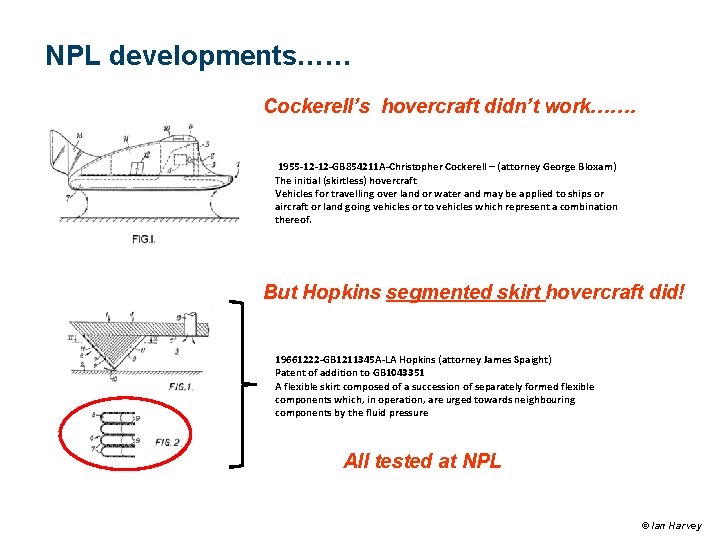
NPL developments…… Cockerell’s hovercraft didn’t work……. 1955 -12 -12 -GB 854211 A-Christopher Cockerell – (attorney George Bloxam) The initial (skirtless) hovercraft Vehicles for travelling over land or water and may be applied to ships or aircraft or land going vehicles or to vehicles which represent a combination thereof. But Hopkins segmented skirt hovercraft did! 19661222 -GB 1211345 A-LA Hopkins (attorney James Spaight) Patent of addition to GB 1043351 A flexible skirt composed of a succession of separately formed flexible components which, in operation, are urged towards neighbouring components by the fluid pressure All tested at NPL © Ian Harvey
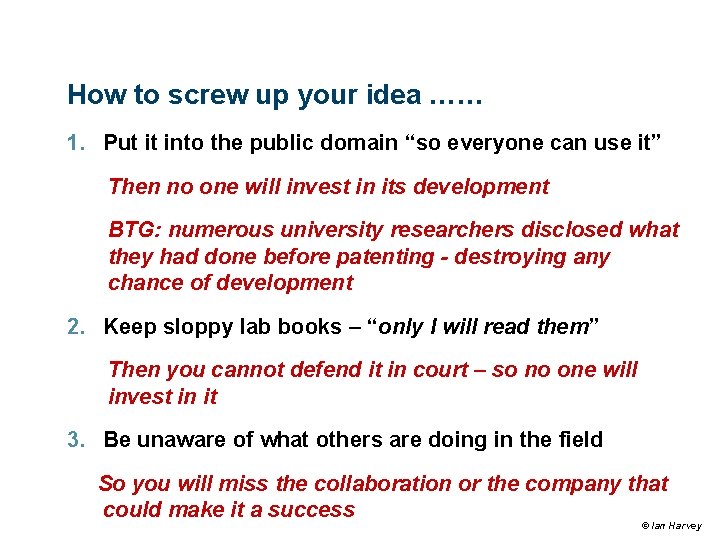
How to screw up your idea …… 1. Put it into the public domain “so everyone can use it” Then no one will invest in its development BTG: numerous university researchers disclosed what they had done before patenting - destroying any chance of development 2. Keep sloppy lab books – “only I will read them” Then you cannot defend it in court – so no one will invest in it 3. Be unaware of what others are doing in the field So you will miss the collaboration or the company that could make it a success © Ian Harvey
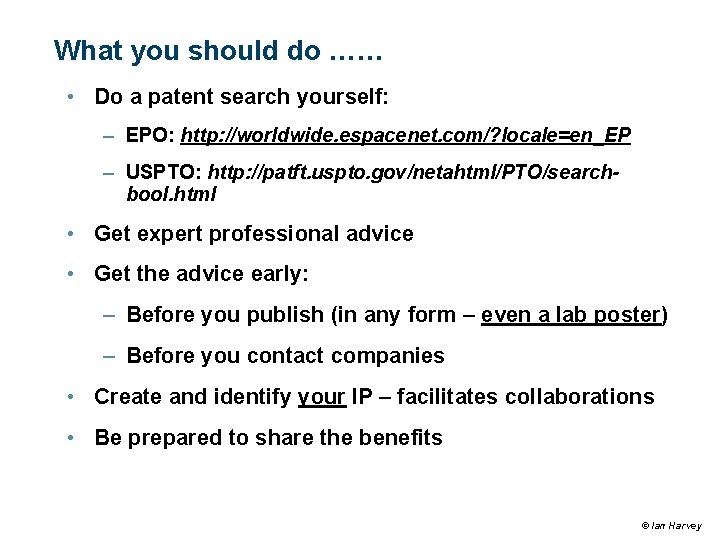
What you should do …… • Do a patent search yourself: – EPO: http: //worldwide. espacenet. com/? locale=en_EP – USPTO: http: //patft. uspto. gov/netahtml/PTO/searchbool. html • Get expert professional advice • Get the advice early: – Before you publish (in any form – even a lab poster) – Before you contact companies • Create and identify your IP – facilitates collaborations • Be prepared to share the benefits © Ian Harvey
A patent gives you the right to use your invention False © Ian Harvey
Should a researcher undertake a patent search before starting research? Yes – one of the best sources of who is doing what research © Ian Harvey
“future competition in the world is competition in IP …. ” Wen Jiabao - Chinese Prime Minister June 2004 et seq © Ian Harvey
Tianjin (China) IP Education • Every primary and secondary school has an IP teacher • Every child is taught about IP • Why? – “Because stealing IP is like stealing your intellect” – “Because a modern economy depends on IP” © Ian Harvey
Actress – “Ekstase” - 1933 What did she do that affects all your daily lives? © Ian Harvey
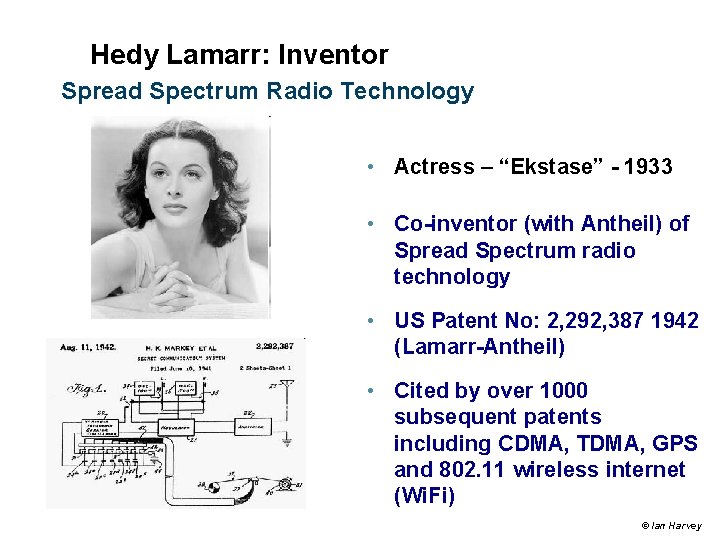
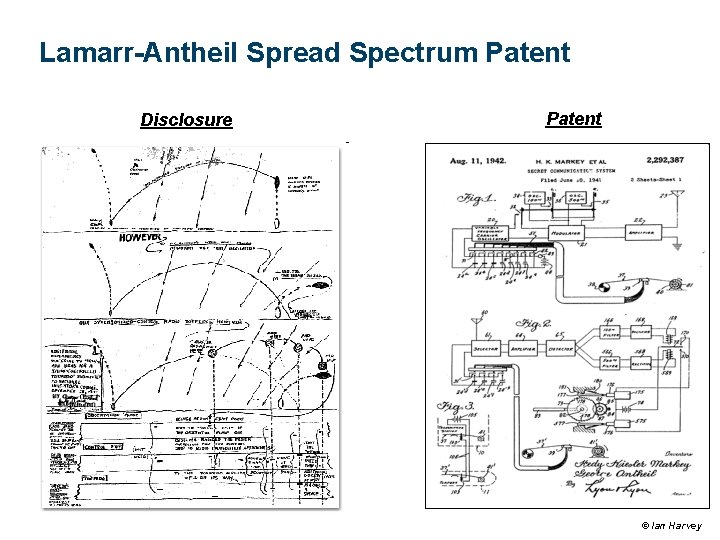
Hedy Lamarr: Inventor Spread Spectrum Radio Technology • Actress – “Ekstase” - 1933 • Co-inventor (with Antheil) of Spread Spectrum radio technology • US Patent No: 2, 292, 387 1942 (Lamarr-Antheil) • Cited by over 1000 subsequent patents including CDMA, TDMA, GPS and 802. 11 wireless internet (Wi. Fi) © Ian Harvey
Lamarr-Antheil Spread Spectrum Patent Disclosure Patent © Ian Harvey
Sir David Payne – the last word on IP Erbium doped optical amplifier, fibre laser & amplifier etc • Commercialization is important - the country/world does not owe researchers a living • Patents are important to commercialization – essential to spinouts/startups • Need the best patent attorneys – often only industry can afford them • File continuously but selectively • Expect a “just” reward* *New products are 1% inspiration, 99% perspiration and investment © Ian Harvey
Generating impact from IP: How scientists succeed… Ian Harvey …or fail “…. talk to the IP Team: Darian or Deborah!” March 12 th, 2018 © Ian Harvey
Further reading © Ian Harvey
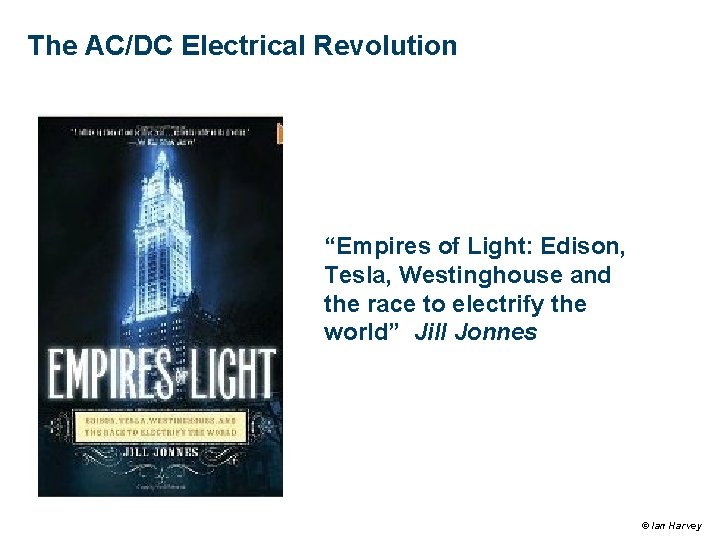
The AC/DC Electrical Revolution “Empires of Light: Edison, Tesla, Westinghouse and the race to electrify the world” Jill Jonnes © Ian Harvey
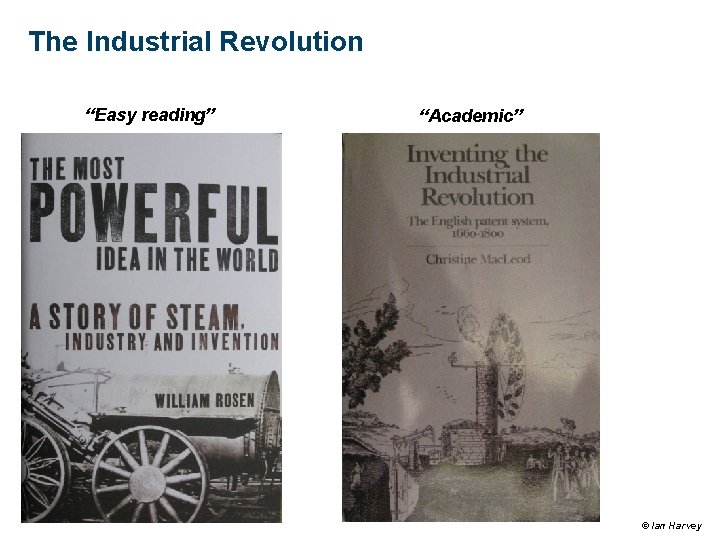
The Industrial Revolution “Easy reading” “Academic” © Ian Harvey