
Generalized Software Defined Network Platform for Radio Access



- Slides: 17
Generalized Software Defined Network Platform for Radio Access Networks Author: Aravinthan Gopalasingham, Laurent Roullet, Nessrine Trabelsi, Chung Shue Chen, Abdelkrim Hebbar, Erick Bizouarn Presenter: Xiao-Min Zheng Date: Department of Computer Science and Information Engineering National Cheng Kung University, Taiwan R. O. C.
Introduction l l It is predicted that there will be tremendous increase in delivering data, so we need a significant network to adapt this network. LTE Het. Net is the well known solution for this increasing network which by deploying small cells(SC) mixed with macro cells(MC). Now it is expected that 5 G will be deployed as heterogeneous network, consisting of various radio access technologies. Currently none of the mainstream SDN controllers provides support for 4 G RAN. National Cheng Kung University CSIE Computer & Internet Architecture Lab 2
Introduction l l We design a wireless SDN controller based on Open. Day. Light(ODL) controller and migrate Radio Access Network(RAN) to software defined wireless networks. This design is highly flexible and can be leveraged for future wireless networks such as C-RAN and 5 G. National Cheng Kung University CSIE Computer & Internet Architecture Lab 3
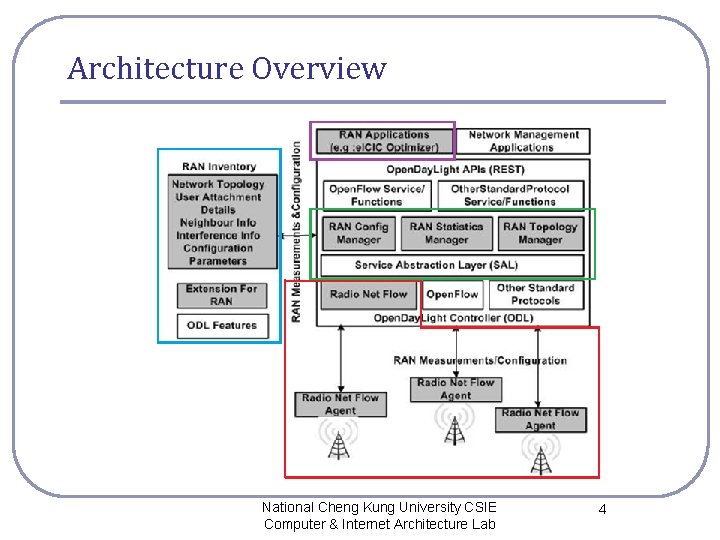
Architecture Overview. National Cheng Kung University CSIE Computer & Internet Architecture Lab 4
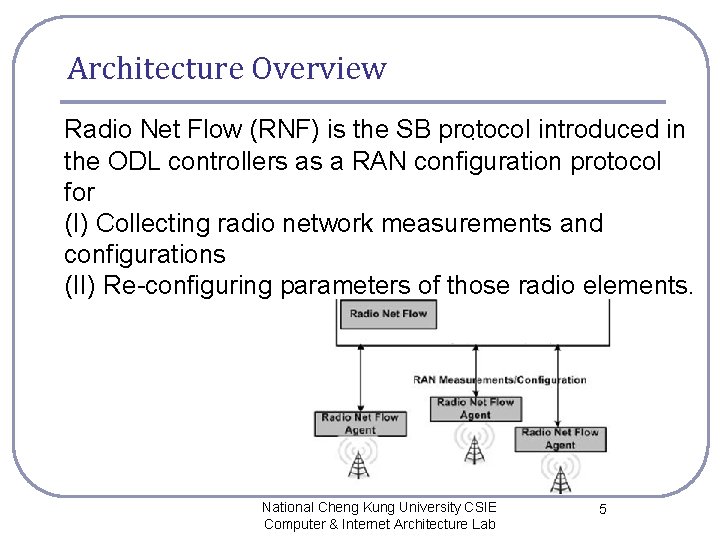
Architecture Overview Radio Net Flow (RNF) is the SB protocol introduced in. the ODL controllers as a RAN configuration protocol for (I) Collecting radio network measurements and configurations (II) Re-configuring parameters of those radio elements. National Cheng Kung University CSIE Computer & Internet Architecture Lab 5
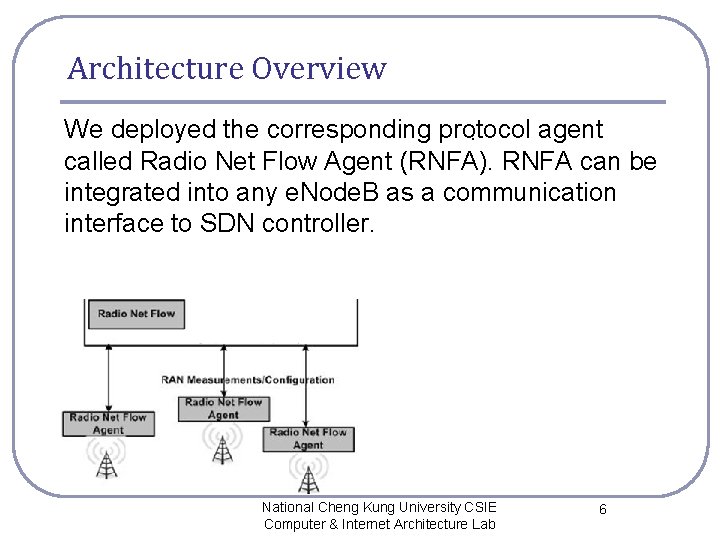
Architecture Overview We deployed the corresponding protocol agent. called Radio Net Flow Agent (RNFA). RNFA can be integrated into any e. Node. B as a communication interface to SDN controller. National Cheng Kung University CSIE Computer & Internet Architecture Lab 6
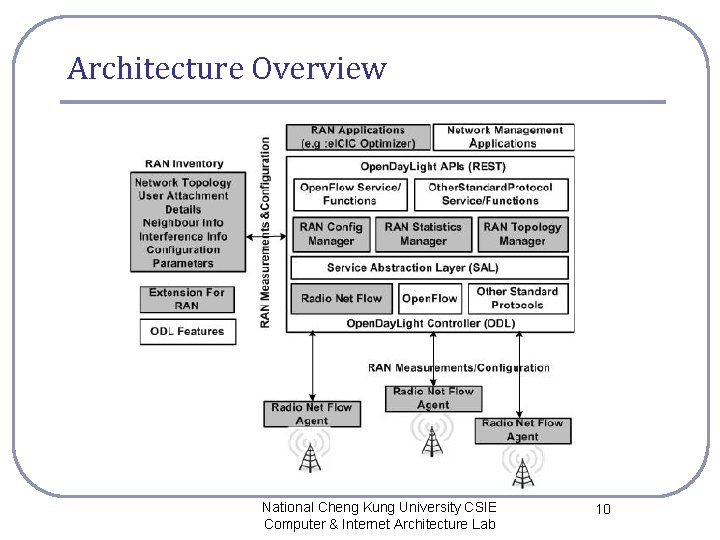
Architecture Overview Three service modules in the Service Abstraction Layer (SAL) of ODL: 1) RAN Configuration Manager: This manager sends optimized parameters periodically to the base stations. 2) RAN Statistics Manager: This manager is responsible for populating user attachment and interference information in the RAN Inventory. 3) RAN Topology Manager: A complete record of network topology. National Cheng Kung University CSIE Computer & Internet Architecture Lab 7
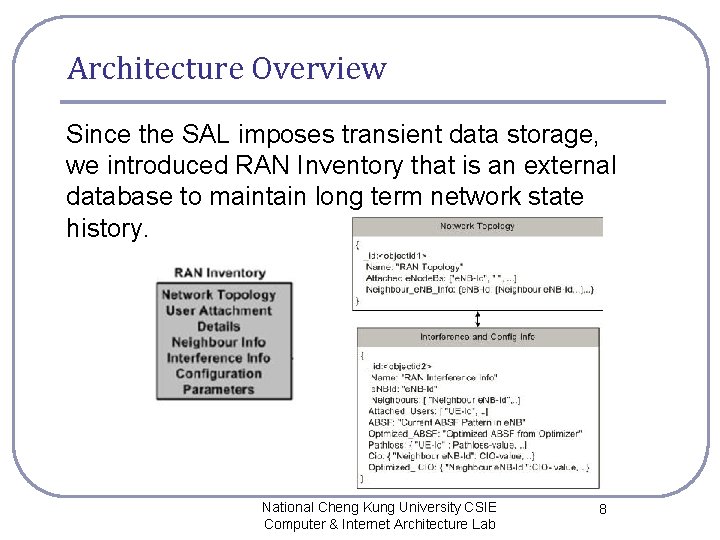
Architecture Overview Since the SAL imposes transient data storage, we introduced RAN Inventory that is an external database to maintain long term network state history. National Cheng Kung University CSIE Computer & Internet Architecture Lab 8
Architecture Overview. controller’s NB The RAN Applications would use the APIs to: • Discover existing network elements and topology; • Retrieve RAN measurements and configuration parameters; • Re-configure RAN using optimal parameters. National Cheng Kung University CSIE Computer & Internet Architecture Lab 9
Architecture Overview. National Cheng Kung University CSIE Computer & Internet Architecture Lab 10
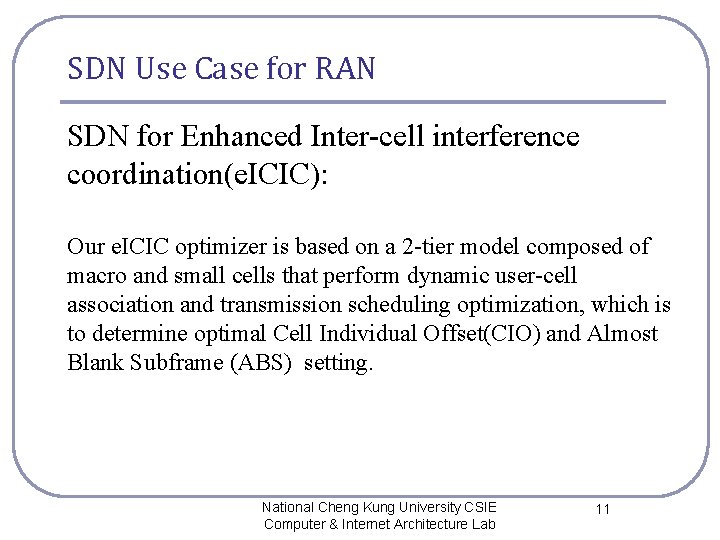
SDN Use Case for RAN SDN for Enhanced Inter-cell interference coordination(e. ICIC): Our e. ICIC optimizer is based on a 2 -tier model composed of macro and small cells that perform dynamic user-cell association and transmission scheduling optimization, which is to determine optimal Cell Individual Offset(CIO) and Almost Blank Subframe (ABS) setting. National Cheng Kung University CSIE Computer & Internet Architecture Lab 11
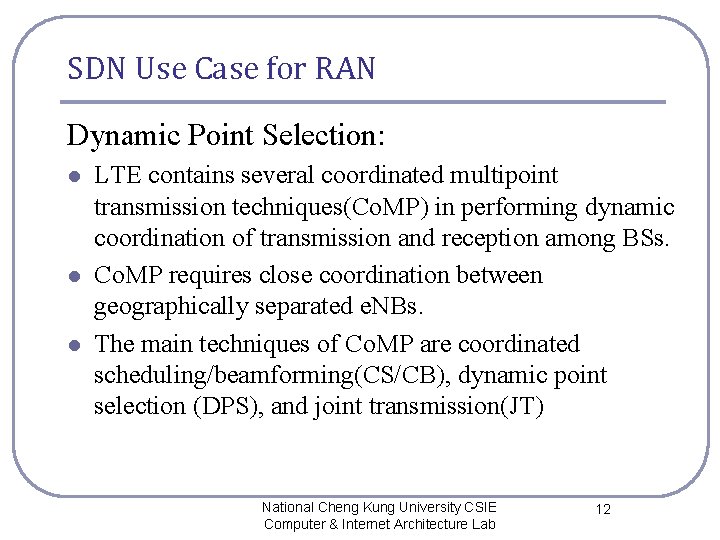
SDN Use Case for RAN Dynamic Point Selection: l l l LTE contains several coordinated multipoint transmission techniques(Co. MP) in performing dynamic coordination of transmission and reception among BSs. Co. MP requires close coordination between geographically separated e. NBs. The main techniques of Co. MP are coordinated scheduling/beamforming(CS/CB), dynamic point selection (DPS), and joint transmission(JT) National Cheng Kung University CSIE Computer & Internet Architecture Lab 12
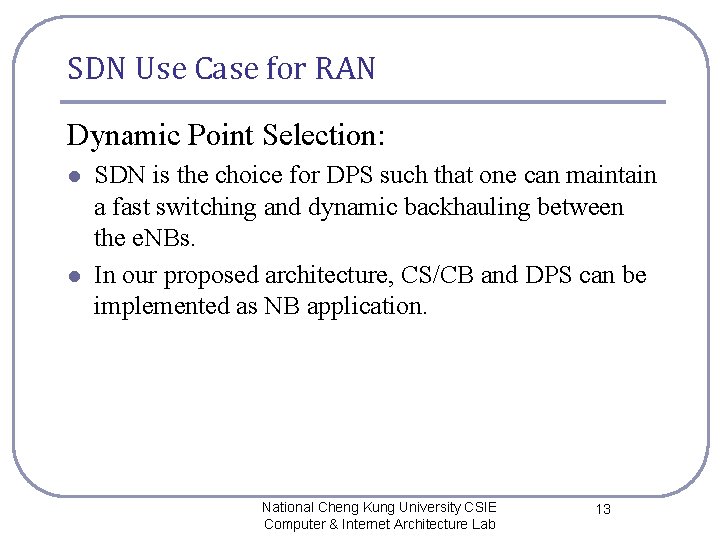
SDN Use Case for RAN Dynamic Point Selection: l l SDN is the choice for DPS such that one can maintain a fast switching and dynamic backhauling between the e. NBs. In our proposed architecture, CS/CB and DPS can be implemented as NB application. National Cheng Kung University CSIE Computer & Internet Architecture Lab 13
Validation of the framework. National Cheng Kung University CSIE Computer & Internet Architecture Lab 14
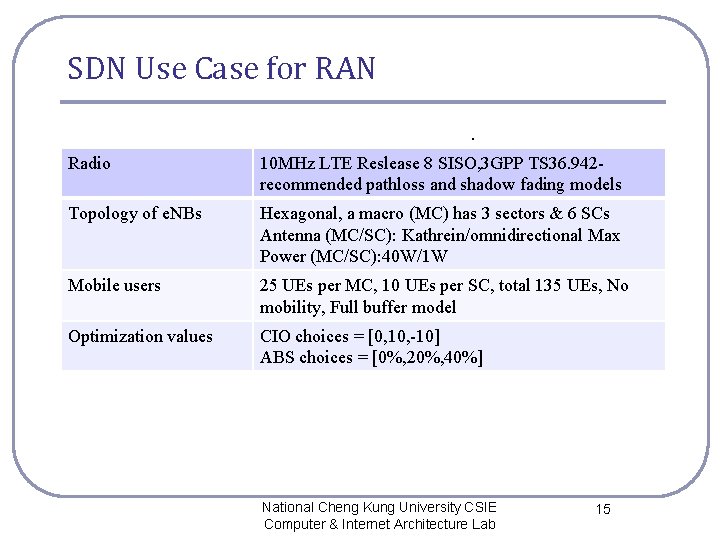
SDN Use Case for RAN. Radio 10 MHz LTE Reslease 8 SISO, 3 GPP TS 36. 942 recommended pathloss and shadow fading models Topology of e. NBs Hexagonal, a macro (MC) has 3 sectors & 6 SCs Antenna (MC/SC): Kathrein/omnidirectional Max Power (MC/SC): 40 W/1 W Mobile users 25 UEs per MC, 10 UEs per SC, total 135 UEs, No mobility, Full buffer model Optimization values CIO choices = [0, 10, -10] ABS choices = [0%, 20%, 40%] National Cheng Kung University CSIE Computer & Internet Architecture Lab 15
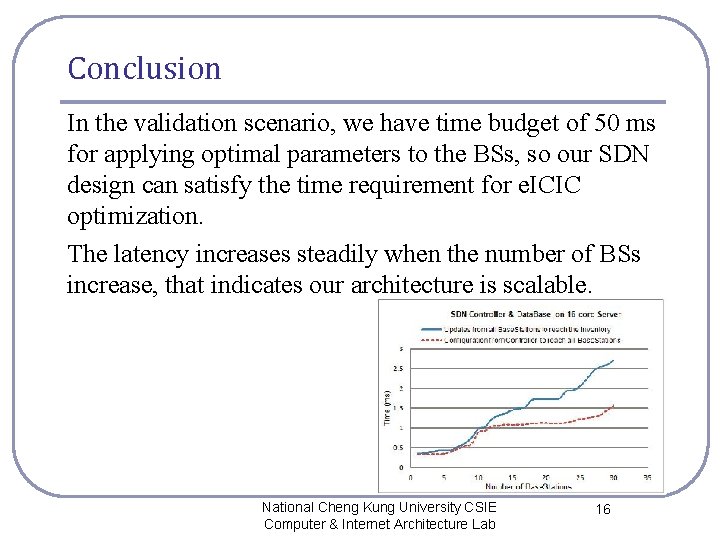
Conclusion In the validation scenario, we have time budget of 50 ms for applying optimal parameters to the BSs, so our SDN design can satisfy the time requirement for e. ICIC optimization. The latency increases steadily when the number of BSs increase, that indicates our architecture is scalable. National Cheng Kung University CSIE Computer & Internet Architecture Lab 16
Conclusion Though our SDN platform is primarily developed for supporting LTE SON methods, it can be future extended to support different use cases in Cloud RAN and future 5 G. National Cheng Kung University CSIE Computer & Internet Architecture Lab 17