
Generalized Principal Component Analysis Ren Vidal Center for
![Finding a basis for each subspace Polynomial Differentiation (GPCA-PDA) [CVPR’ 04] • To learn](https://slidetodoc.com/presentation_image_h2/c7dfa6c0aa8fbfecf907950f6415723d/image-15.jpg "Finding a basis for each subspace Polynomial Differentiation (GPCA-PDA) [CVPR’ 04] • To learn")

- Slides: 36
Generalized Principal Component Analysis René Vidal Center for Imaging Science Institute for Computational Medicine Johns Hopkins University
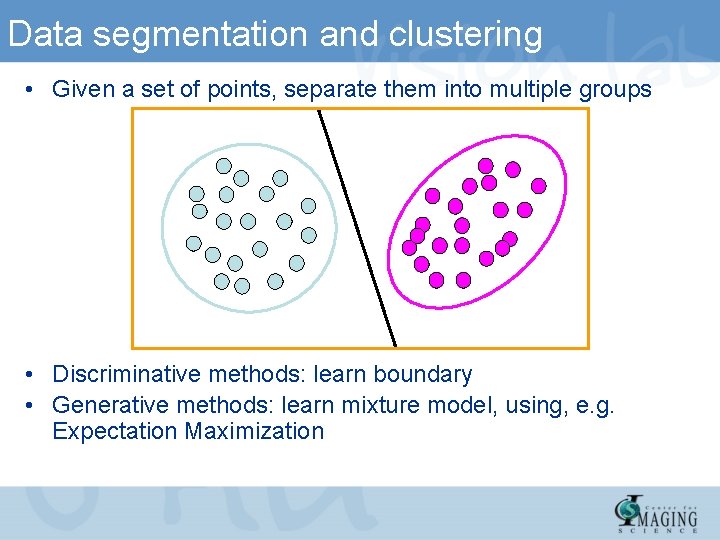
Data segmentation and clustering • Given a set of points, separate them into multiple groups • Discriminative methods: learn boundary • Generative methods: learn mixture model, using, e. g. Expectation Maximization
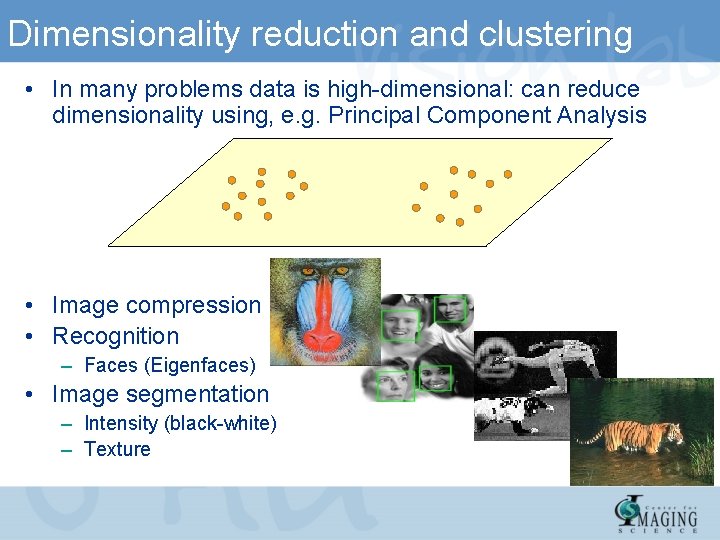
Dimensionality reduction and clustering • In many problems data is high-dimensional: can reduce dimensionality using, e. g. Principal Component Analysis • Image compression • Recognition – Faces (Eigenfaces) • Image segmentation – Intensity (black-white) – Texture
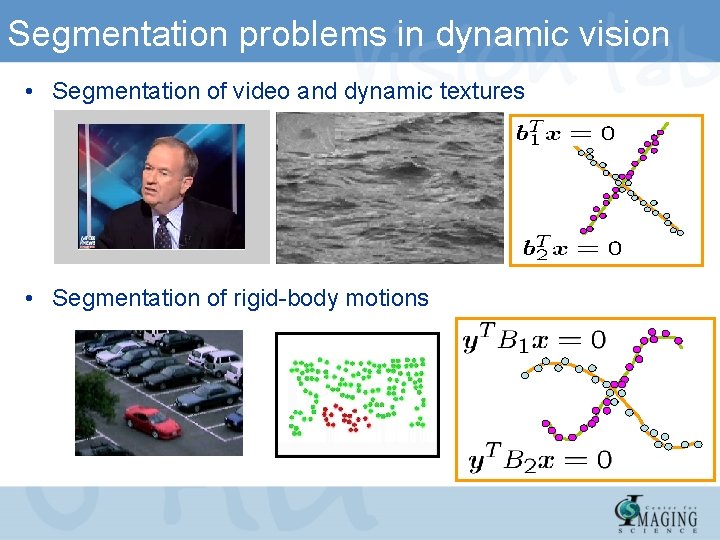
Segmentation problems in dynamic vision • Segmentation of video and dynamic textures • Segmentation of rigid-body motions
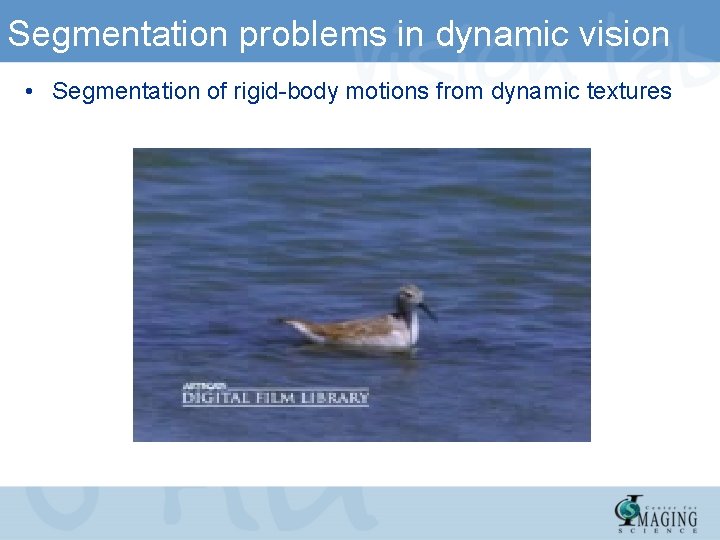
Segmentation problems in dynamic vision • Segmentation of rigid-body motions from dynamic textures
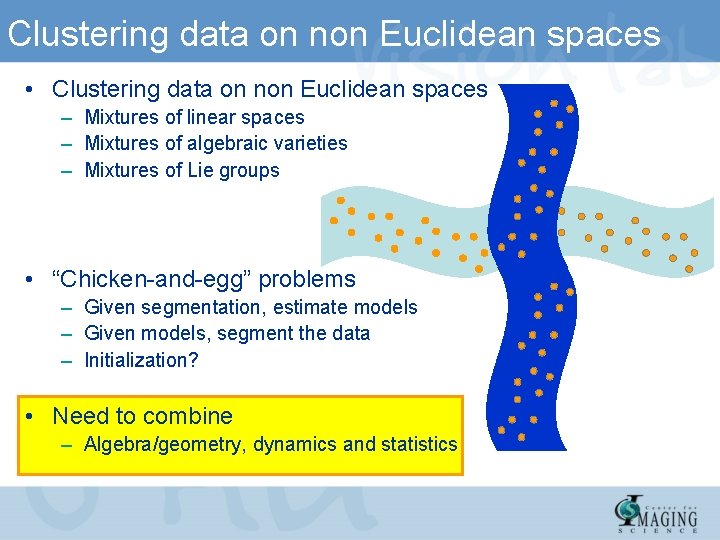
Clustering data on non Euclidean spaces • Clustering data on non Euclidean spaces – Mixtures of linear spaces – Mixtures of algebraic varieties – Mixtures of Lie groups • “Chicken-and-egg” problems – Given segmentation, estimate models – Given models, segment the data – Initialization? • Need to combine – Algebra/geometry, dynamics and statistics
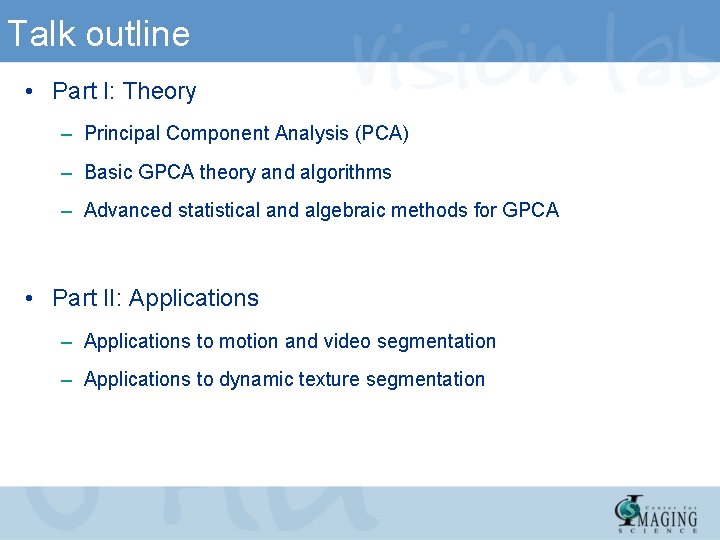
Talk outline • Part I: Theory – Principal Component Analysis (PCA) – Basic GPCA theory and algorithms – Advanced statistical and algebraic methods for GPCA • Part II: Applications – Applications to motion and video segmentation – Applications to dynamic texture segmentation
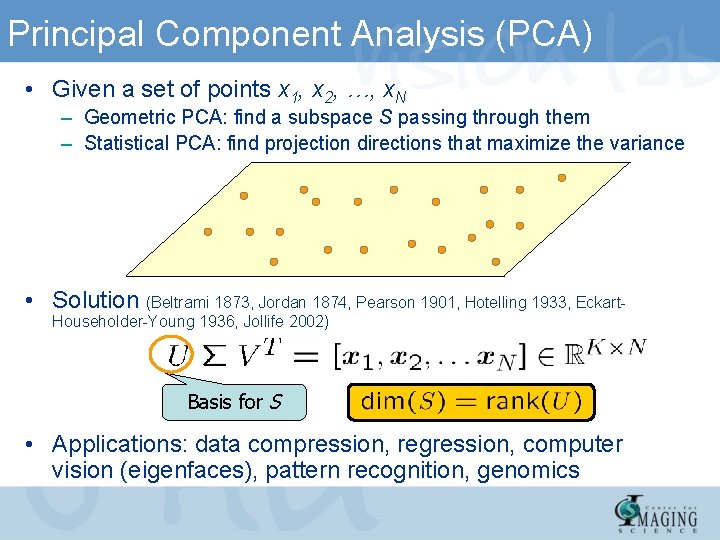
Principal Component Analysis (PCA) • Given a set of points x 1, x 2, …, x. N – Geometric PCA: find a subspace S passing through them – Statistical PCA: find projection directions that maximize the variance • Solution (Beltrami 1873, Jordan 1874, Pearson 1901, Hotelling 1933, Eckart. Householder-Young 1936, Jollife 2002) Basis for S • Applications: data compression, regression, computer vision (eigenfaces), pattern recognition, genomics
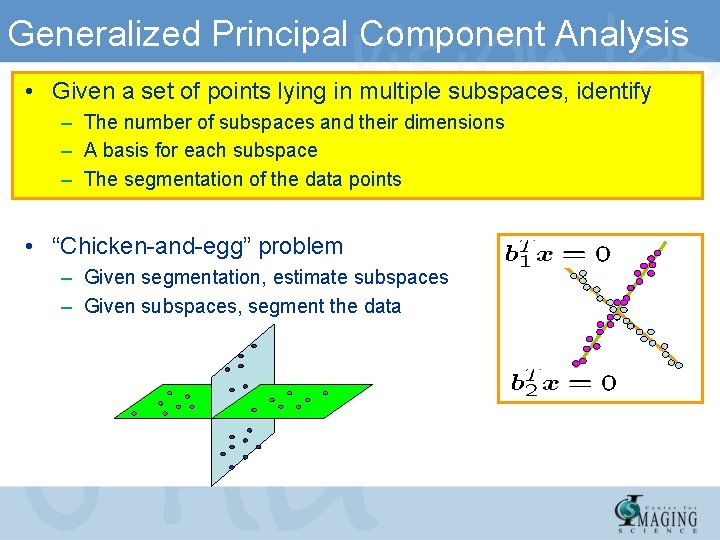
Generalized Principal Component Analysis • Given a set of points lying in multiple subspaces, identify – The number of subspaces and their dimensions – A basis for each subspace – The segmentation of the data points • “Chicken-and-egg” problem – Given segmentation, estimate subspaces – Given subspaces, segment the data
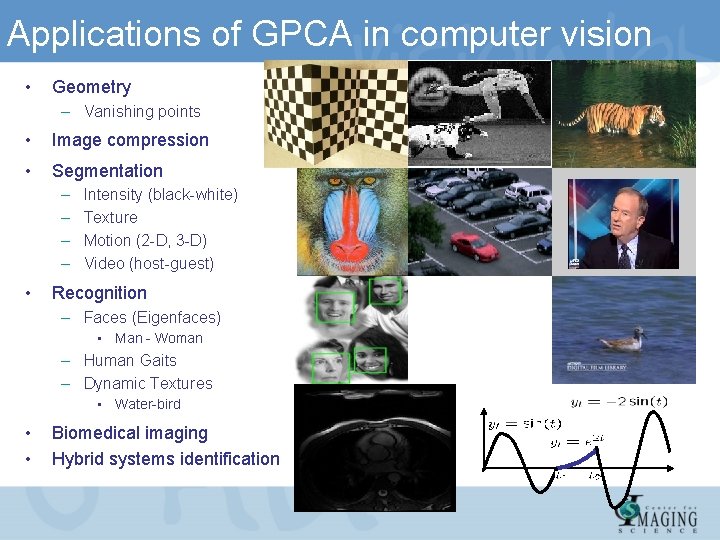
Applications of GPCA in computer vision • Geometry – Vanishing points • Image compression • Segmentation – – • Intensity (black-white) Texture Motion (2 -D, 3 -D) Video (host-guest) Recognition – Faces (Eigenfaces) • Man - Woman – Human Gaits – Dynamic Textures • Water-bird • • Biomedical imaging Hybrid systems identification
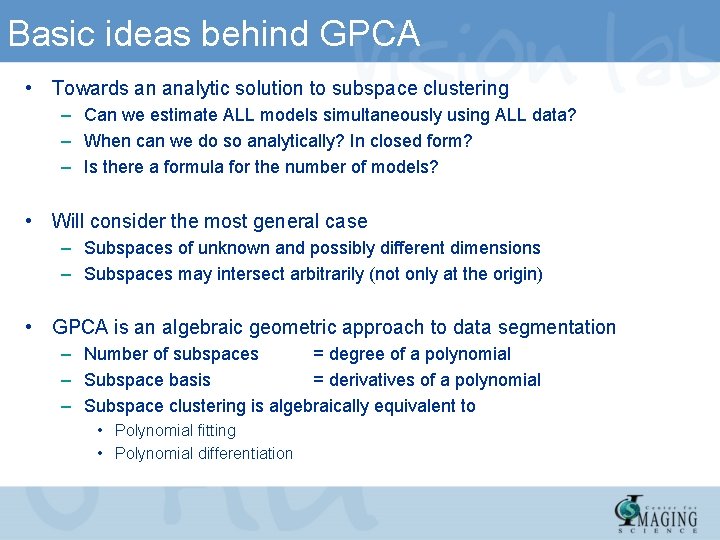
Basic ideas behind GPCA • Towards an analytic solution to subspace clustering – Can we estimate ALL models simultaneously using ALL data? – When can we do so analytically? In closed form? – Is there a formula for the number of models? • Will consider the most general case – Subspaces of unknown and possibly different dimensions – Subspaces may intersect arbitrarily (not only at the origin) • GPCA is an algebraic geometric approach to data segmentation – Number of subspaces = degree of a polynomial – Subspace basis = derivatives of a polynomial – Subspace clustering is algebraically equivalent to • Polynomial fitting • Polynomial differentiation
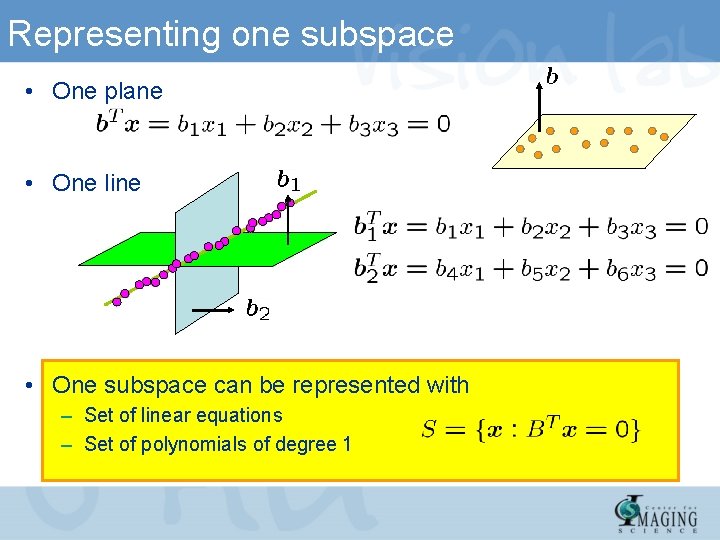
Representing one subspace • One plane • One line • One subspace can be represented with – Set of linear equations – Set of polynomials of degree 1
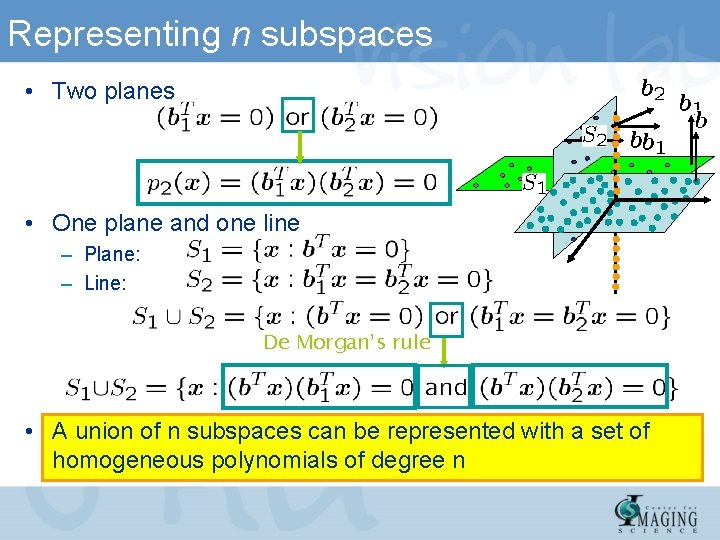
Representing n subspaces • Two planes • One plane and one line – Plane: – Line: De Morgan’s rule • A union of n subspaces can be represented with a set of homogeneous polynomials of degree n
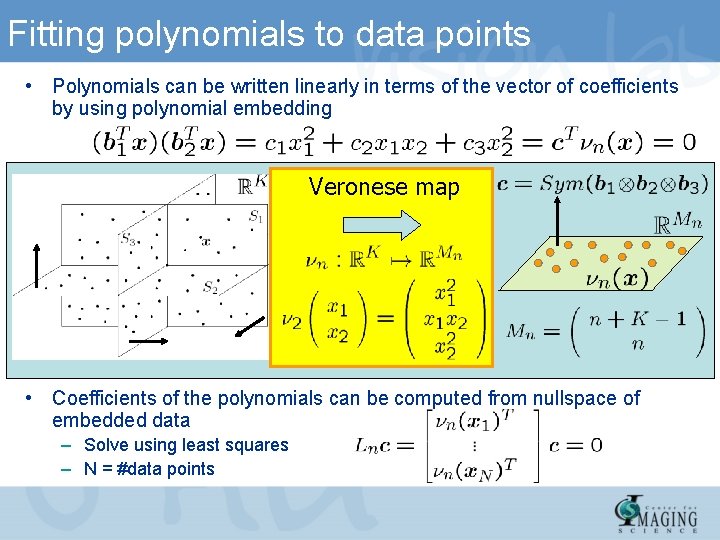
Fitting polynomials to data points • Polynomials can be written linearly in terms of the vector of coefficients by using polynomial embedding Veronese map • Coefficients of the polynomials can be computed from nullspace of embedded data – Solve using least squares – N = #data points
Finding a basis for each subspace Polynomial Differentiation (GPCA-PDA) [CVPR’ 04] • To learn a mixture of subspaces we just need one positive example per class
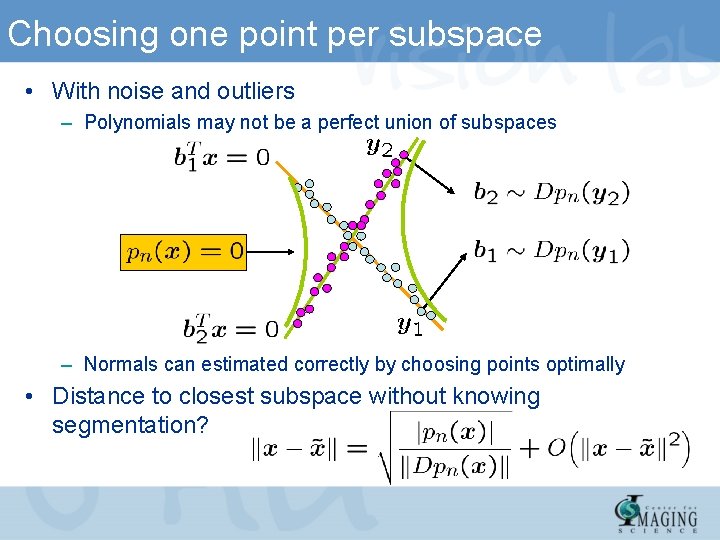
Choosing one point per subspace • With noise and outliers – Polynomials may not be a perfect union of subspaces – Normals can estimated correctly by choosing points optimally • Distance to closest subspace without knowing segmentation?
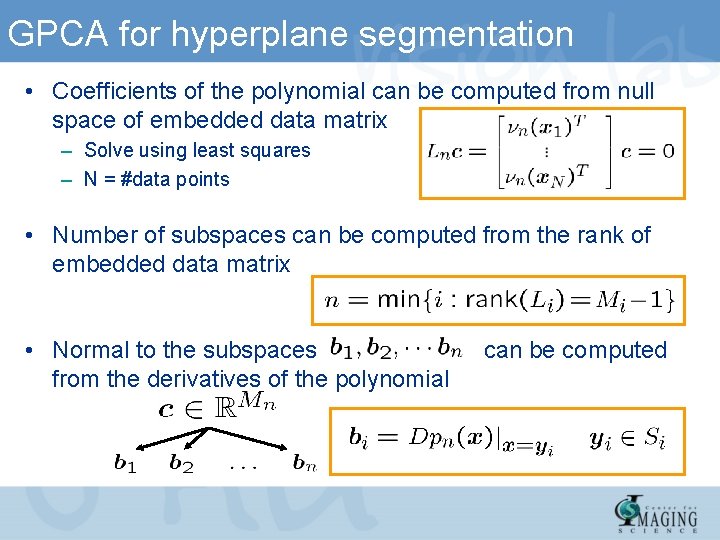
GPCA for hyperplane segmentation • Coefficients of the polynomial can be computed from null space of embedded data matrix – Solve using least squares – N = #data points • Number of subspaces can be computed from the rank of embedded data matrix • Normal to the subspaces from the derivatives of the polynomial can be computed
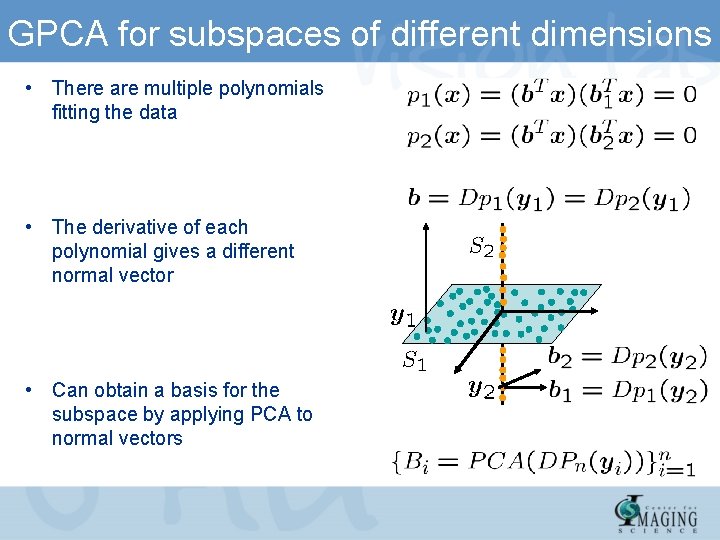
GPCA for subspaces of different dimensions • There are multiple polynomials fitting the data • The derivative of each polynomial gives a different normal vector • Can obtain a basis for the subspace by applying PCA to normal vectors
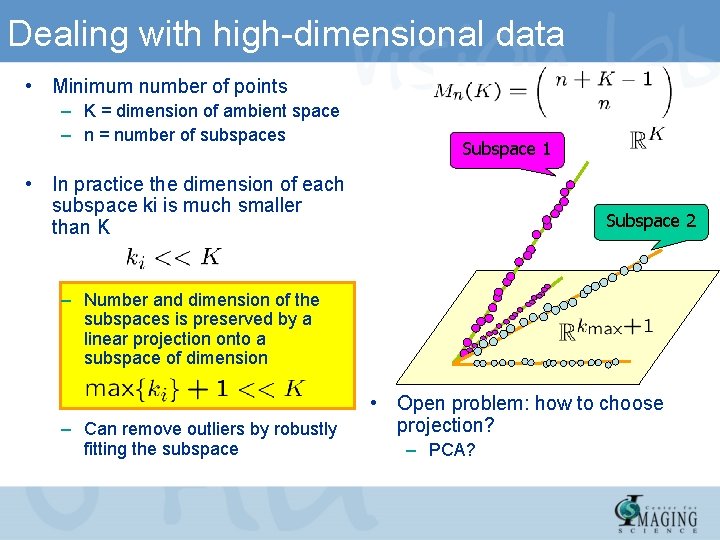
Dealing with high-dimensional data • Minimum number of points – K = dimension of ambient space – n = number of subspaces Subspace 1 • In practice the dimension of each subspace ki is much smaller than K Subspace 2 – Number and dimension of the subspaces is preserved by a linear projection onto a subspace of dimension – Can remove outliers by robustly fitting the subspace • Open problem: how to choose projection? – PCA?
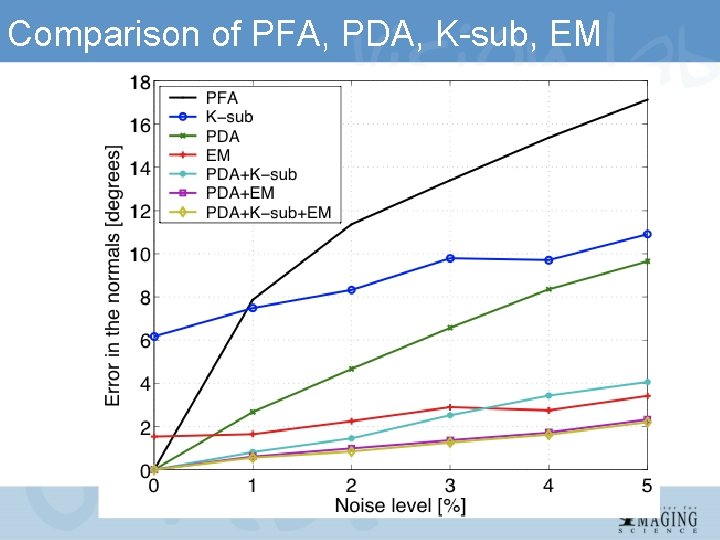
Comparison of PFA, PDA, K-sub, EM
Applications to motion and video segmentation René Vidal Center for Imaging Science Institute for Computational Medicine Johns Hopkins University
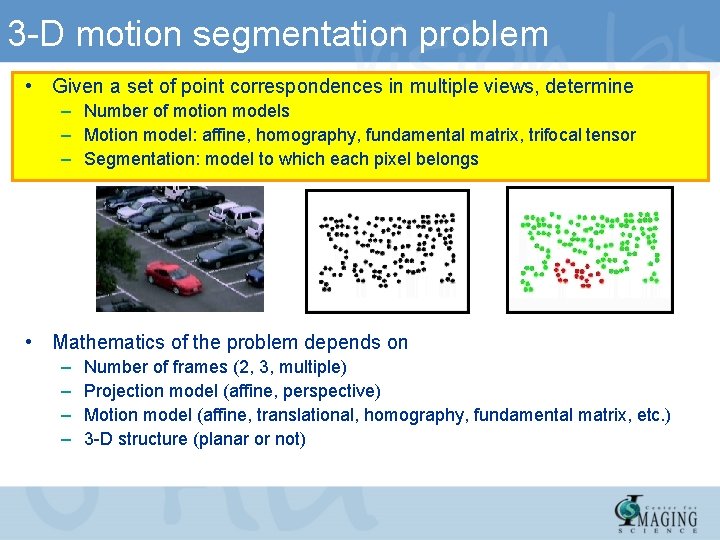
3 -D motion segmentation problem • Given a set of point correspondences in multiple views, determine – Number of motion models – Motion model: affine, homography, fundamental matrix, trifocal tensor – Segmentation: model to which each pixel belongs • Mathematics of the problem depends on – – Number of frames (2, 3, multiple) Projection model (affine, perspective) Motion model (affine, translational, homography, fundamental matrix, etc. ) 3 -D structure (planar or not)
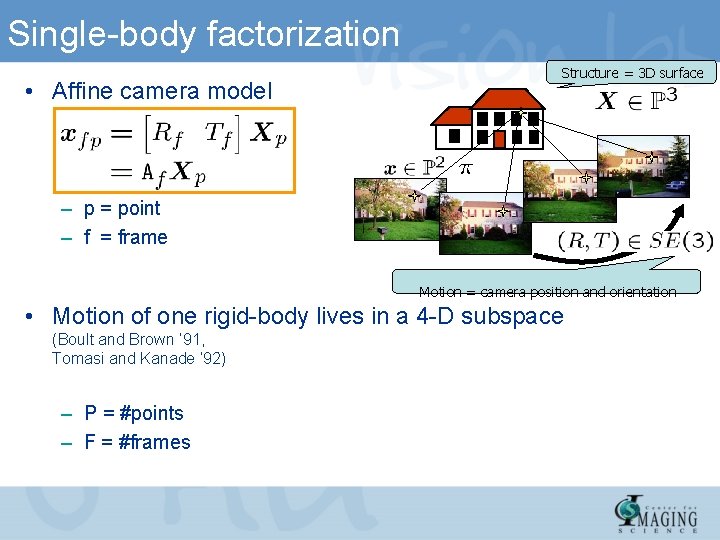
Single-body factorization • Affine camera model Structure = 3 D surface – p = point – f = frame Motion = camera position and orientation • Motion of one rigid-body lives in a 4 -D subspace (Boult and Brown ’ 91, Tomasi and Kanade ‘ 92) – P = #points – F = #frames
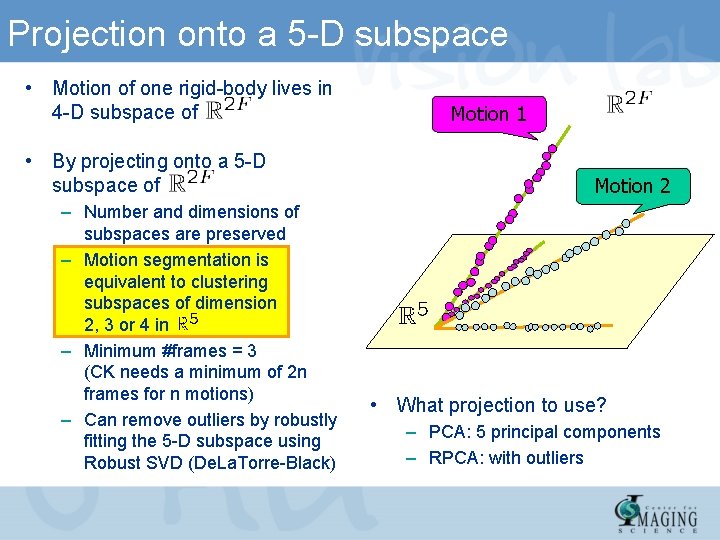
Projection onto a 5 -D subspace • Motion of one rigid-body lives in 4 -D subspace of • By projecting onto a 5 -D subspace of – Number and dimensions of subspaces are preserved – Motion segmentation is equivalent to clustering subspaces of dimension 2, 3 or 4 in – Minimum #frames = 3 (CK needs a minimum of 2 n frames for n motions) – Can remove outliers by robustly fitting the 5 -D subspace using Robust SVD (De. La. Torre-Black) Motion 1 Motion 2 • What projection to use? – PCA: 5 principal components – RPCA: with outliers
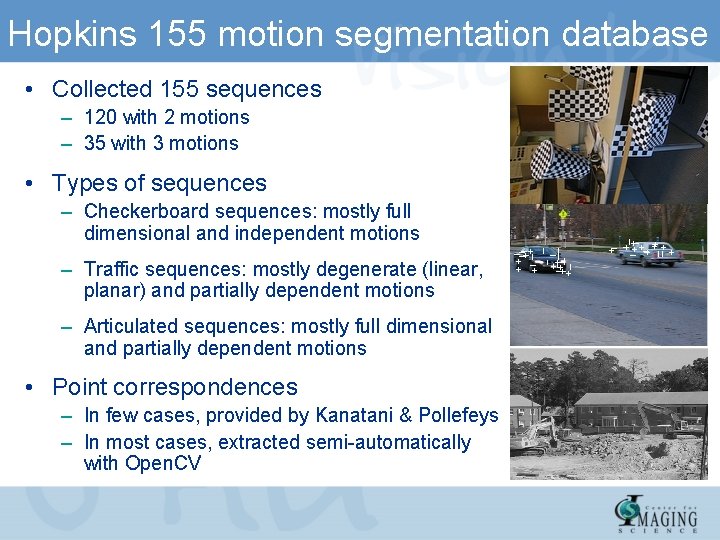
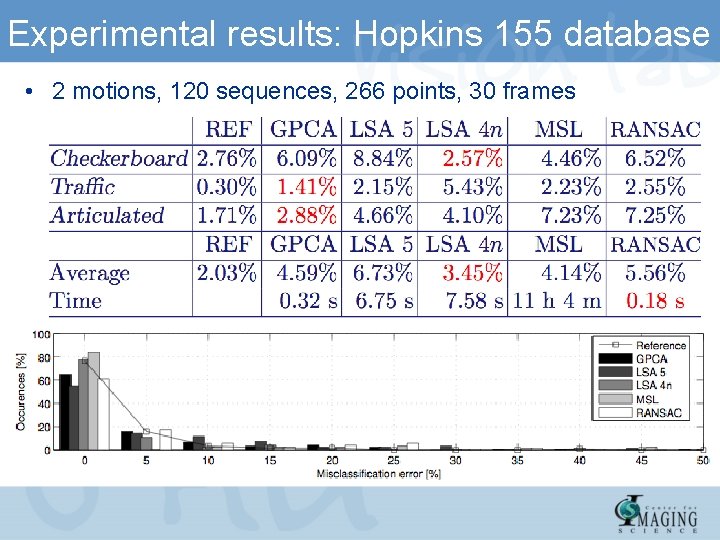
Hopkins 155 motion segmentation database • Collected 155 sequences – 120 with 2 motions – 35 with 3 motions • Types of sequences – Checkerboard sequences: mostly full dimensional and independent motions – Traffic sequences: mostly degenerate (linear, planar) and partially dependent motions – Articulated sequences: mostly full dimensional and partially dependent motions • Point correspondences – In few cases, provided by Kanatani & Pollefeys – In most cases, extracted semi-automatically with Open. CV
Experimental results: Hopkins 155 database • 2 motions, 120 sequences, 266 points, 30 frames
Segmentation of Dynamic Textures René Vidal Center for Imaging Science Institute for Computational Medicine Johns Hopkins University
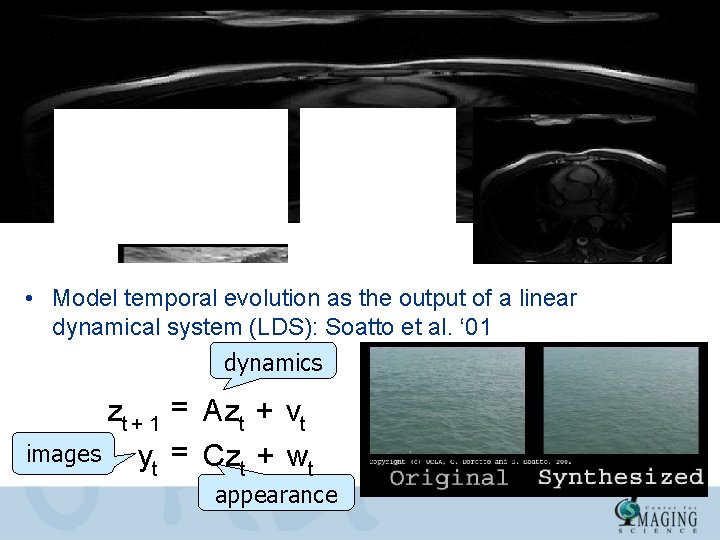
Modeling a dynamic texture: fixed boundary • Examples of dynamic textures: • Model temporal evolution as the output of a linear dynamical system (LDS): Soatto et al. ‘ 01 dynamics zt + 1 = Azt + vt images yt = Czt + wt appearance
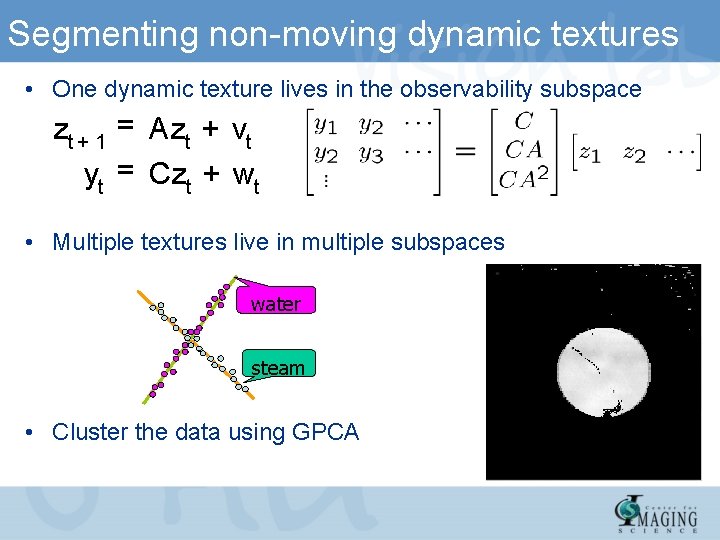
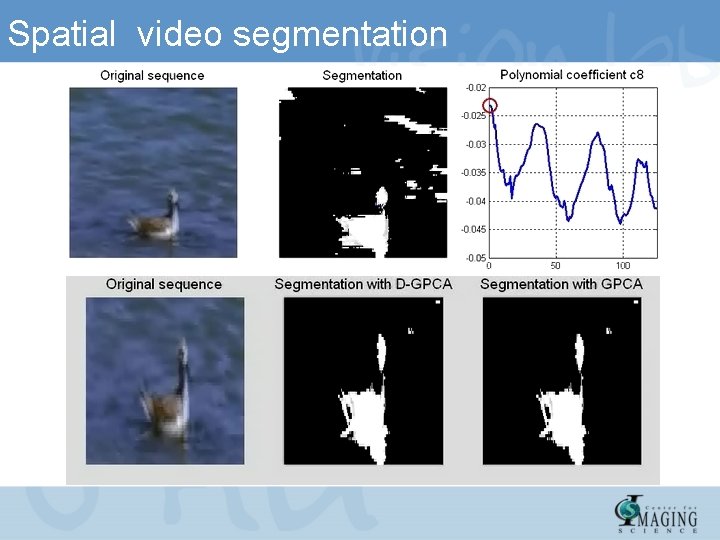
Segmenting non-moving dynamic textures • One dynamic texture lives in the observability subspace zt + 1 = Azt + vt yt = Czt + wt • Multiple textures live in multiple subspaces water steam • Cluster the data using GPCA
Spatial video segmentation
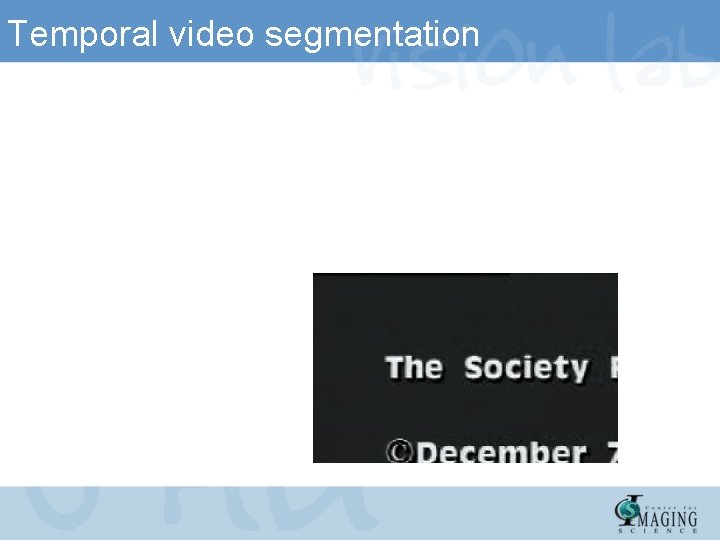
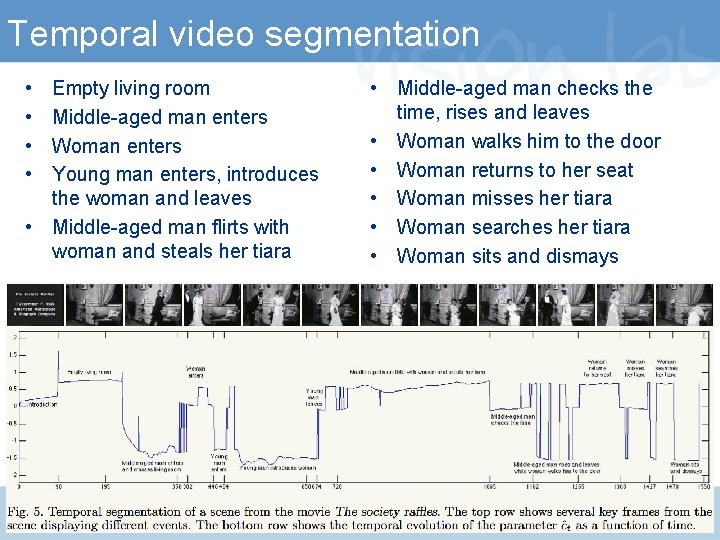
Temporal video segmentation
Temporal video segmentation • • Empty living room Middle-aged man enters Woman enters Young man enters, introduces the woman and leaves • Middle-aged man flirts with woman and steals her tiara • Middle-aged man checks the time, rises and leaves • Woman walks him to the door • Woman returns to her seat • Woman misses her tiara • Woman searches her tiara • Woman sits and dismays
Summary • GPCA: algorithm for clustering subspaces – Deals with unknown and possibly different dimensions – Deals with arbitrary intersections among the subspaces • Our approach is based on – Projecting data onto a low-dimensional subspace – Fitting polynomials to projected subspaces – Differentiating polynomials to obtain a basis • Many problems in computer vision can be posed as subspace clustering problems – – Temporal video segmentation 2 -D and 3 -D motion segmentation Dynamic texture segmentation Nonrigid motion segmentation
References: Springer-Verlag 2008
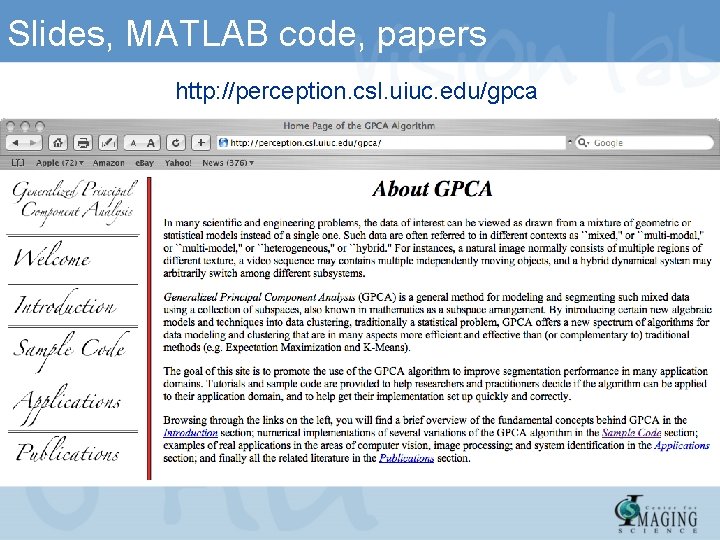
Slides, MATLAB code, papers http: //perception. csl. uiuc. edu/gpca
For more information, Vision, Dynamics and Learning Lab @ Johns Hopkins University Thank You!