
Generalized Buffering of PTL Logic Stages using Boolean
Generalized Buffering of PTL Logic Stages using Boolean Division and Don’t Cares Rajesh Garg Sunil P. Khatri Department of Electrical and Computer Engineering, Texas A&M University, College Station, TX 77843 1
Outline l Introduction l Objective l Previous Work l CODCs and ACODCs l Generalized Buffering With CODCs l Results l Conclusions 2
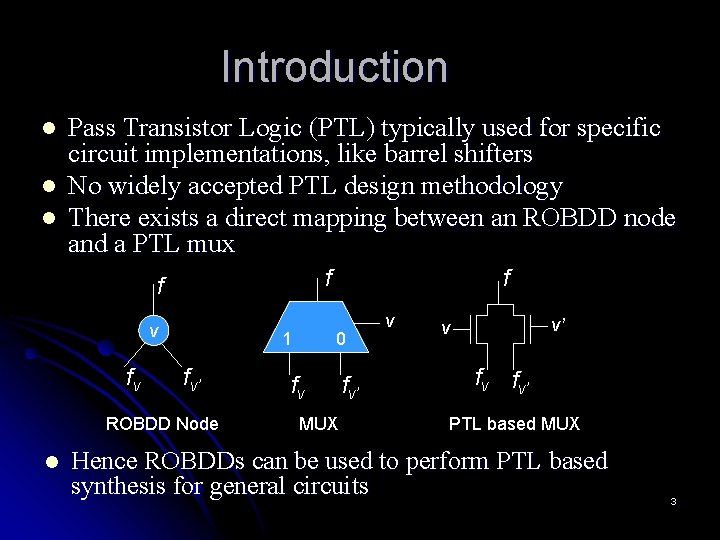
Introduction l l l Pass Transistor Logic (PTL) typically used for specific circuit implementations, like barrel shifters No widely accepted PTL design methodology There exists a direct mapping between an ROBDD node and a PTL mux f f v fv 1 fv’ ROBDD Node l f 0 fv MUX fv’ v fv fv’ PTL based MUX Hence ROBDDs can be used to perform PTL based synthesis for general circuits 3
Introduction (contd) l Problems with direct mapping l Body Effect l Cannot connect more than 4 -5 devices in series l Monolithic ROBDDs l Worst-case exponential size in number of the inputs (large) l Memory explosion can occur during ROBDD construction l Partitioned ROBDDs l l l Avoids memory explosion of monolithic ROBDDs Output of each PTL structure needs to be buffered Regenerate electrical drive capability after 4 or 5 levels using a pair of inverters (avoid body effect problems) 4
Objective l New PTL Synthesis Approach l Use partitioned ROBDDs l Avoid memory explosion l Guarantee no more than 4 -5 series devices l Use generalized buffering l Buffers can be complex logic gates in general (not simple inverters/ buffers) l Use ACODCs or CODCs to improve the extraction of generalized buffers l Simplifies the logic function of the PTL block l Boolean Division based formulation l Elegant, powerful formulation to extract generalized buffers l Augmented with CODC / ACODCs l Reduces total circuit delay and area 5

Previous Work l Buch et. al, “Logic synthesis for large pass transistor circuits”, in Proceedings, IEEE/ACM ICCAD, Nov 1997, pp 663 -670 l Lai et. al, “BDD decomposition for mixed CMOS/PTL logic circuit synthesis”, in Proceedings, IEEE ISCAS, May 2005, pp. 5649 -5652 l Yamashita et. al, “Pass-transistor/CMOS collaborated logic: The best of both worlds”, in Digest of Technical Papers, Symposium on VLSI Circuits, June 1997, pp. 31 -32. l Garg et. al, “Generalized buffering of PTL logic stages using Boolean division”, in Proceedings, IEEE ISCAS, May 2006. 6

CODCs l Observability Don’t Cares (ODCs) l l l ODCs used to minimize the logic function of a node Need to re-compute the ODCs of the other nodes after optimization Compatible Observability Don’t Cares l l Can simultaneously change the function of all nodes Subset of ODCs full_simplify is used to compute CODCs in SIS ROBDD based computation to compute CODCs 7
CODCs (contd. ) l l l Memory intensive Computation is possible only for small and medium sized circuits Approximate CODCs by Saluja et. al l l 30 X faster than full CODCs Requires 30 X less memory than full CODCs Literal count reduction is about 80% of that obtained by full CODCs Can compute ACODCs for arbitrarily large circuits 8
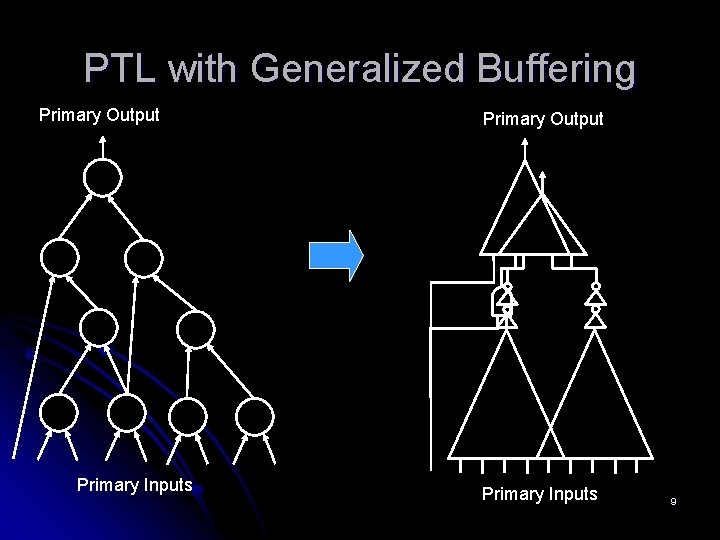
PTL with Generalized Buffering Primary Output Primary Inputs 9
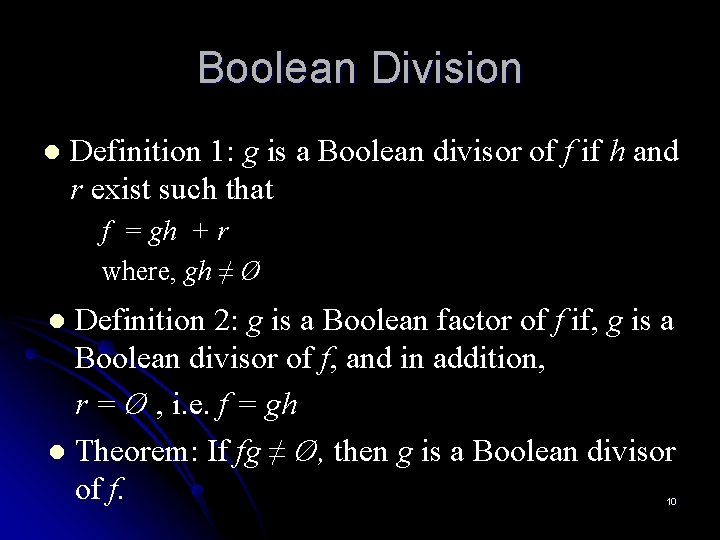
Boolean Division l Definition 1: g is a Boolean divisor of f if h and r exist such that f = gh + r where, gh ≠ Ø Definition 2: g is a Boolean factor of f if, g is a Boolean divisor of f, and in addition, r = Ø , i. e. f = gh l Theorem: If fg ≠ Ø, then g is a Boolean divisor of f. l 10
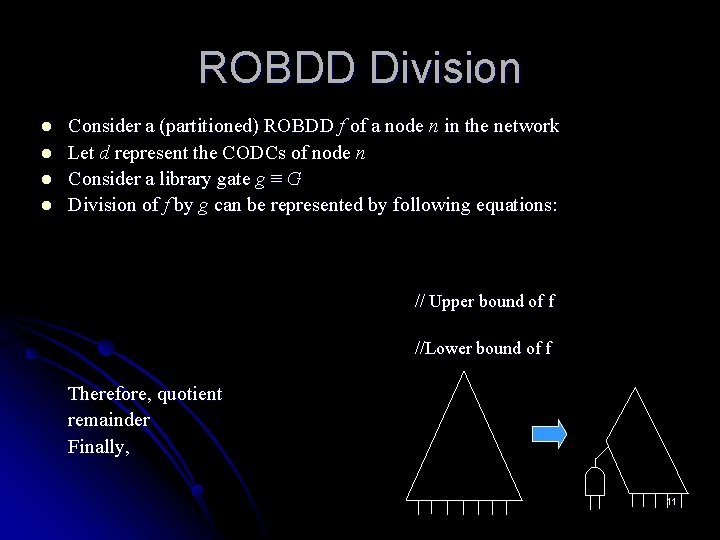
ROBDD Division l l Consider a (partitioned) ROBDD f of a node n in the network Let d represent the CODCs of node n Consider a library gate g ≡ G Division of f by g can be represented by following equations: // Upper bound of f //Lower bound of f Therefore, quotient remainder Finally, 11
Generalized Buffering with CODCs l Synthesize partitioned PTL blocks with l l l Maximum depth of 5 No more than 5 transistors in series Optimize and decompose network l l Using only 2 -input gates and inverters PTL structure will grow in predictable manner Initially any ROBBD can have maximum 8 variables If division fails, we can make one of the fanins a ROBDD variable -- back-track 12
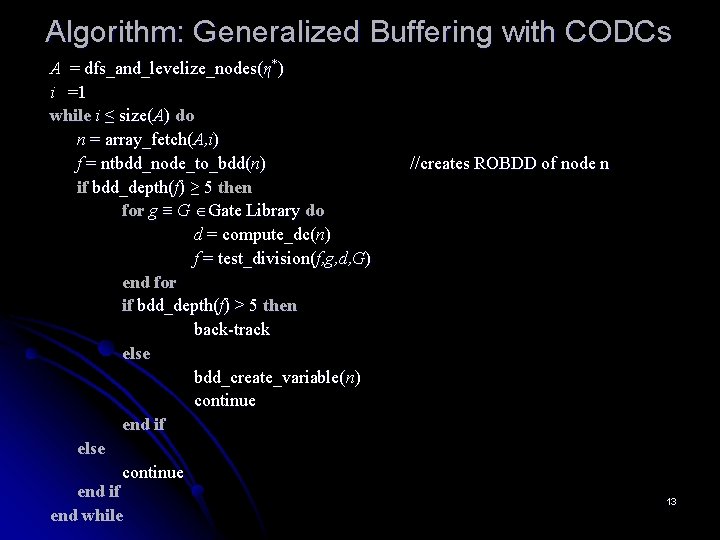
Algorithm: Generalized Buffering with CODCs A = dfs_and_levelize_nodes(η*) i =1 while i ≤ size(A) do n = array_fetch(A, i) f = ntbdd_node_to_bdd(n) if bdd_depth(f) ≥ 5 then for g ≡ G Gate Library do d = compute_dc(n) f = test_division(f, g, d, G) end for if bdd_depth(f) > 5 then back-track else bdd_create_variable(n) continue end if else continue end if end while //creates ROBDD of node n 13
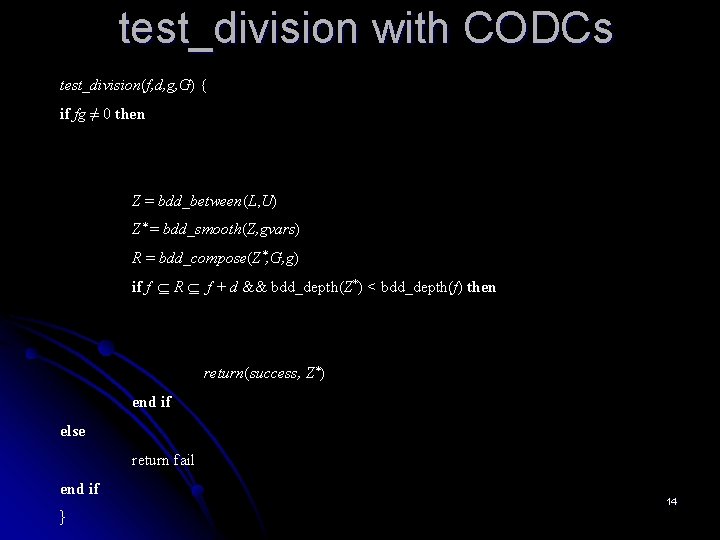
test_division with CODCs test_division(f, d, g, G) { if fg ≠ 0 then Z = bdd_between(L, U) Z* = bdd_smooth(Z, gvars) R = bdd_compose(Z*, G, g) if f R f + d && bdd_depth(Z*) < bdd_depth(f) then return(success, Z*) end if else return fail end if } 14
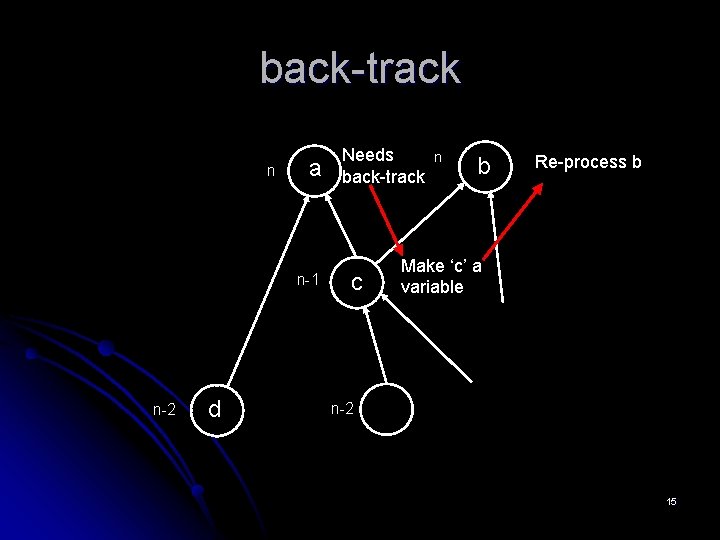
back-track n a n-1 n-2 d Needs back-track c n b Re-process b Make ‘c’ a variable n-2 15
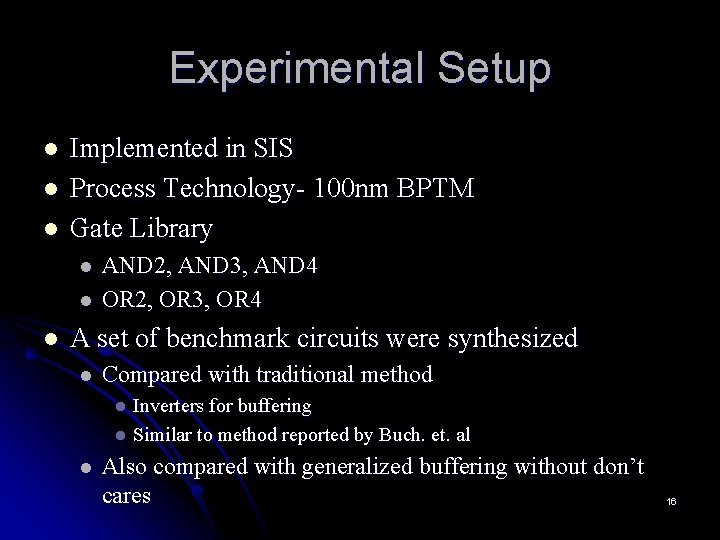
Experimental Setup l l l Implemented in SIS Process Technology- 100 nm BPTM Gate Library l l l AND 2, AND 3, AND 4 OR 2, OR 3, OR 4 A set of benchmark circuits were synthesized l Compared with traditional method Inverters for buffering l Similar to method reported by Buch. et. al l l Also compared with generalized buffering without don’t cares 16
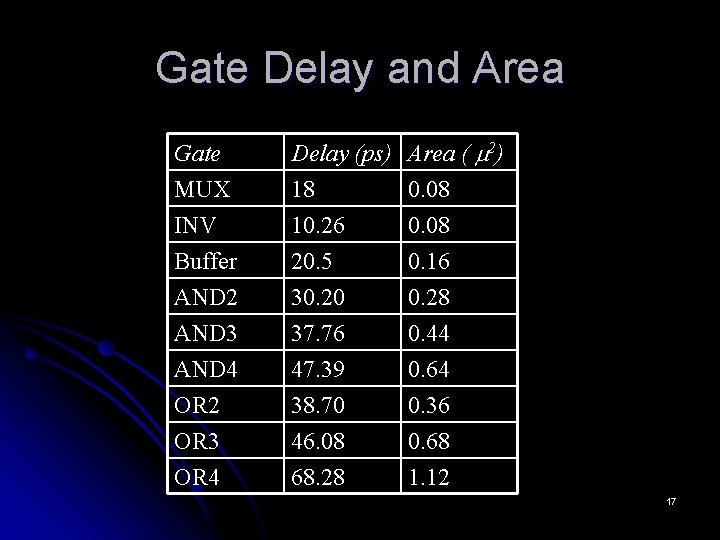
Gate Delay and Area Gate MUX INV Buffer Delay (ps) 18 10. 26 20. 5 Area ( 2) 0. 08 0. 16 AND 2 AND 3 AND 4 OR 2 OR 3 OR 4 30. 20 37. 76 47. 39 38. 70 46. 08 68. 28 0. 44 0. 64 0. 36 0. 68 1. 12 17
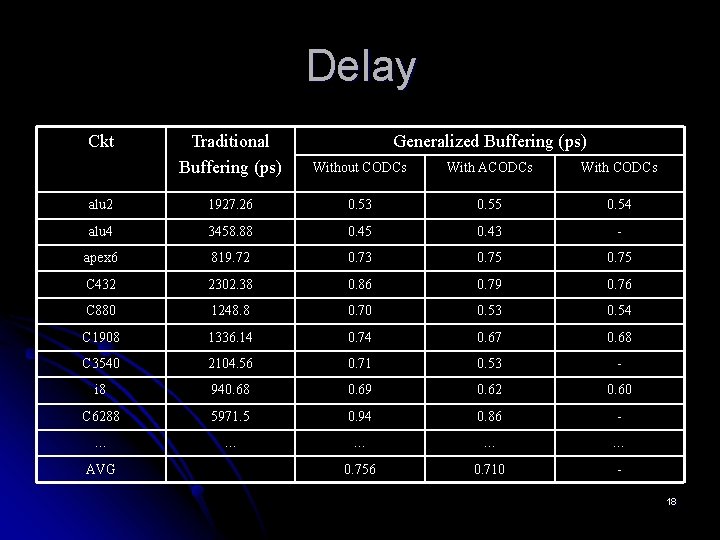
Delay Ckt Traditional Buffering (ps) Without CODCs With ACODCs With CODCs alu 2 1927. 26 0. 53 0. 55 0. 54 alu 4 3458. 88 0. 45 0. 43 - apex 6 819. 72 0. 73 0. 75 C 432 2302. 38 0. 86 0. 79 0. 76 C 880 1248. 8 0. 70 0. 53 0. 54 C 1908 1336. 14 0. 74 0. 67 0. 68 C 3540 2104. 56 0. 71 0. 53 - i 8 940. 68 0. 69 0. 62 0. 60 C 6288 5971. 5 0. 94 0. 86 - … … … 0. 756 0. 710 - AVG Generalized Buffering (ps) 18
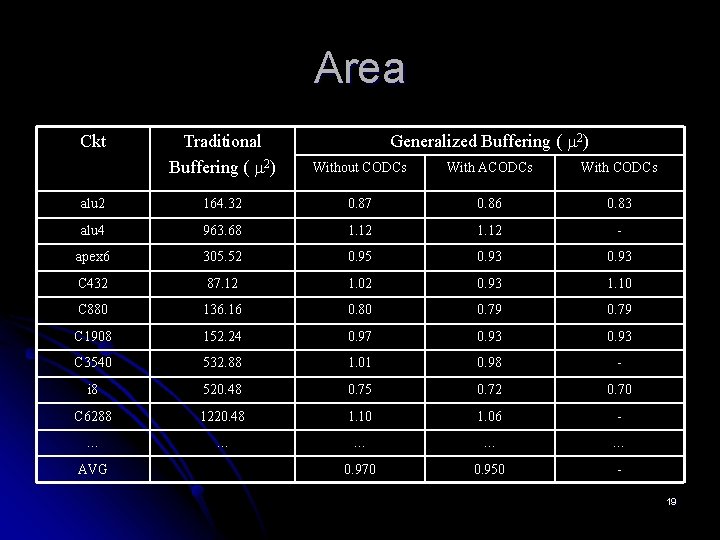
Area Ckt Traditional Buffering ( 2) Without CODCs With ACODCs With CODCs alu 2 164. 32 0. 87 0. 86 0. 83 alu 4 963. 68 1. 12 - apex 6 305. 52 0. 95 0. 93 C 432 87. 12 1. 02 0. 93 1. 10 C 880 136. 16 0. 80 0. 79 C 1908 152. 24 0. 97 0. 93 C 3540 532. 88 1. 01 0. 98 - i 8 520. 48 0. 75 0. 72 0. 70 C 6288 1220. 48 1. 10 1. 06 - … … … 0. 970 0. 950 - AVG Generalized Buffering ( 2) 19
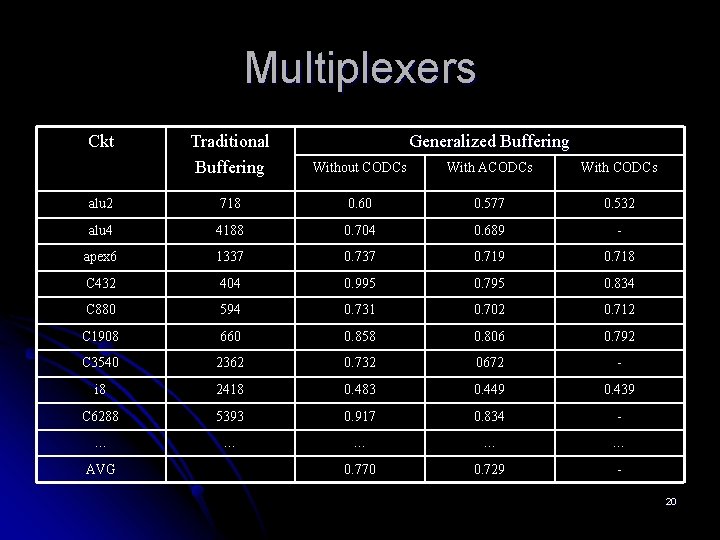
Multiplexers Ckt Traditional Buffering Without CODCs With ACODCs With CODCs alu 2 718 0. 60 0. 577 0. 532 alu 4 4188 0. 704 0. 689 - apex 6 1337 0. 719 0. 718 C 432 404 0. 995 0. 795 0. 834 C 880 594 0. 731 0. 702 0. 712 C 1908 660 0. 858 0. 806 0. 792 C 3540 2362 0. 732 0672 - i 8 2418 0. 483 0. 449 0. 439 C 6288 5393 0. 917 0. 834 - … … … 0. 770 0. 729 - AVG Generalized Buffering 20
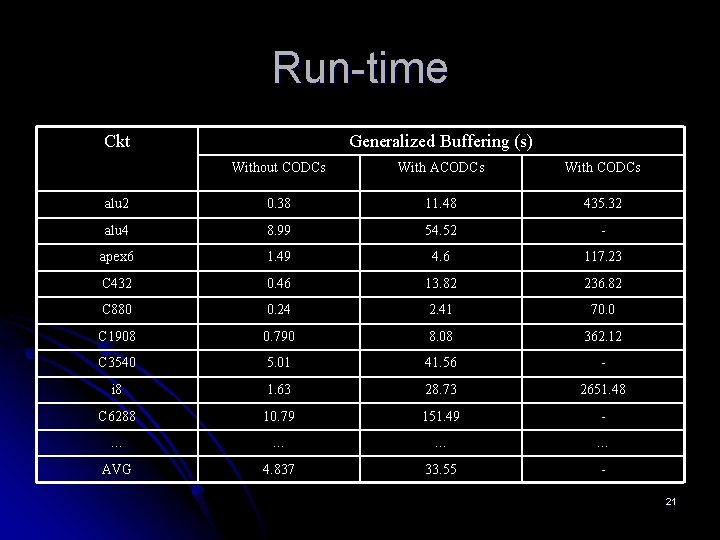
Run-time Ckt Generalized Buffering (s) Without CODCs With ACODCs With CODCs alu 2 0. 38 11. 48 435. 32 alu 4 8. 99 54. 52 - apex 6 1. 49 4. 6 117. 23 C 432 0. 46 13. 82 236. 82 C 880 0. 24 2. 41 70. 0 C 1908 0. 790 8. 08 362. 12 C 3540 5. 01 41. 56 - i 8 1. 63 28. 73 2651. 48 C 6288 10. 79 151. 49 - … … AVG 4. 837 33. 55 21
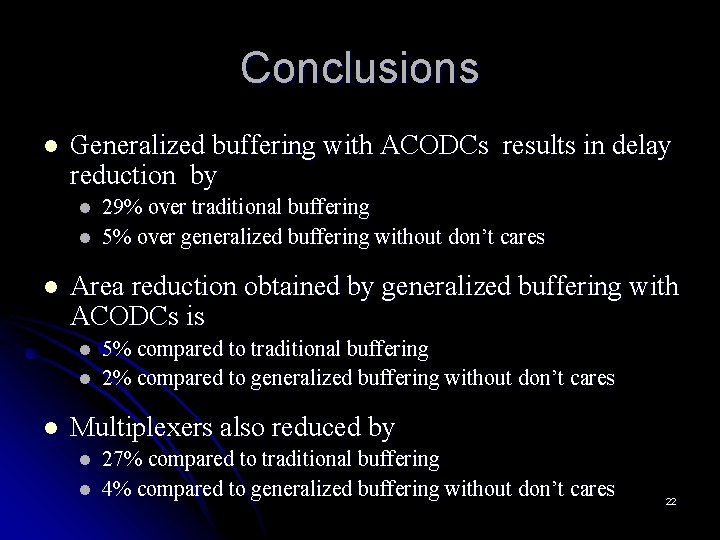
Conclusions l Generalized buffering with ACODCs results in delay reduction by l l l Area reduction obtained by generalized buffering with ACODCs is l l l 29% over traditional buffering 5% over generalized buffering without don’t cares 5% compared to traditional buffering 2% compared to generalized buffering without don’t cares Multiplexers also reduced by l l 27% compared to traditional buffering 4% compared to generalized buffering without don’t cares 22
Conclusions (contd) l l A large number of divisions were obtained for each circuit Little advantage of using CODCs over ACODCs l l Delay reduction is less than 1% Area increases by 1% Run-time is 76 X slower Can synthesize arbitrary sized circuits using partitioned ROBDDs and ACODC based division 23
Thank You!! Questions? 24
- Slides: 24