
Generalization through problem solving Part II The WallaceBolyaiGerwien
Generalization through problem solving Part II. The Wallace-Bolyai-Gerwien theorem Cut a quadrilateral into 2 halves Gergely Wintsche Mathematics Teaching and Didactic Center Faculty of Science Eötvös Loránd University, Budapest CME 12, 2012. 07. 02. – Rzeszów, Poland Gergely Wintsche
Outline 1. Dissections, examples 2. The Wallace-Bolyai-Gerwein theorem 3. Cutting a quadrilateral • The basic lemma • Triangle • Trapezoid • Quadrilateral Part II / 2 – Cut a quadrilateral into 2 halves Gergely Wintsche
The tangram Part II / 3 – Cut a quadrilateral into 2 halves Gergely Wintsche
The pentominos Part II / 4 – Cut a quadrilateral into 2 halves Gergely Wintsche
Introduction The Wallace-Bolyai-Gerwien theorem „Two figures are congruent by dissection when either can be divided into parts which are respectively congruent with the corresponding parts the other. ” (Wallace) Any two simple polygons of equal area can be dissected into a finite number of congruent polygonal pieces. Part II / 5 – Cut a quadrilateral into 2 halves Gergely Wintsche
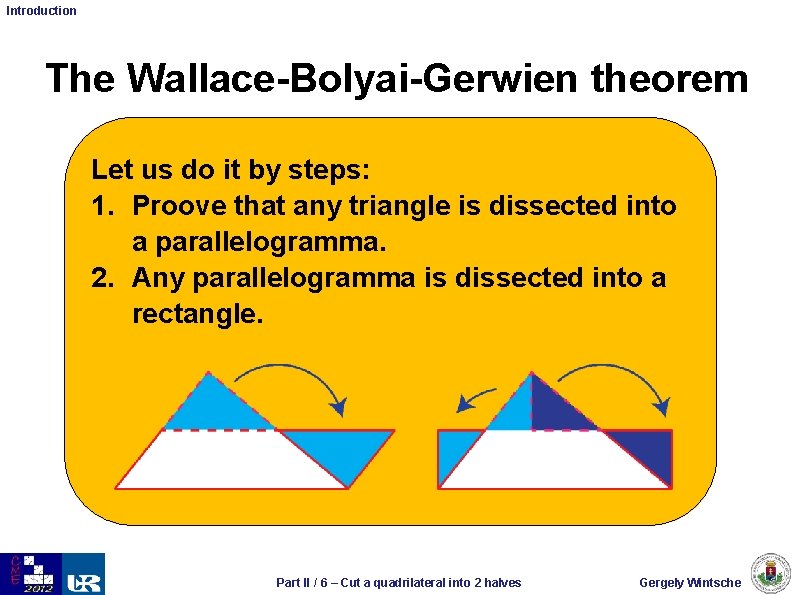
Introduction The Wallace-Bolyai-Gerwien theorem Let us do it by steps: 1. Proove that any triangle is dissected into a parallelogramma. 2. Any parallelogramma is dissected into a rectangle. Part II / 6 – Cut a quadrilateral into 2 halves Gergely Wintsche
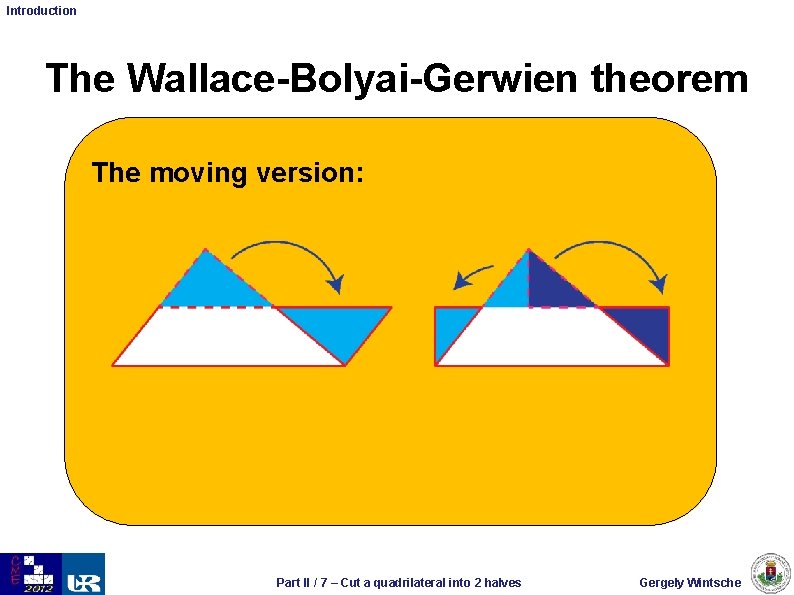
Introduction The Wallace-Bolyai-Gerwien theorem The moving version: Part II / 7 – Cut a quadrilateral into 2 halves Gergely Wintsche
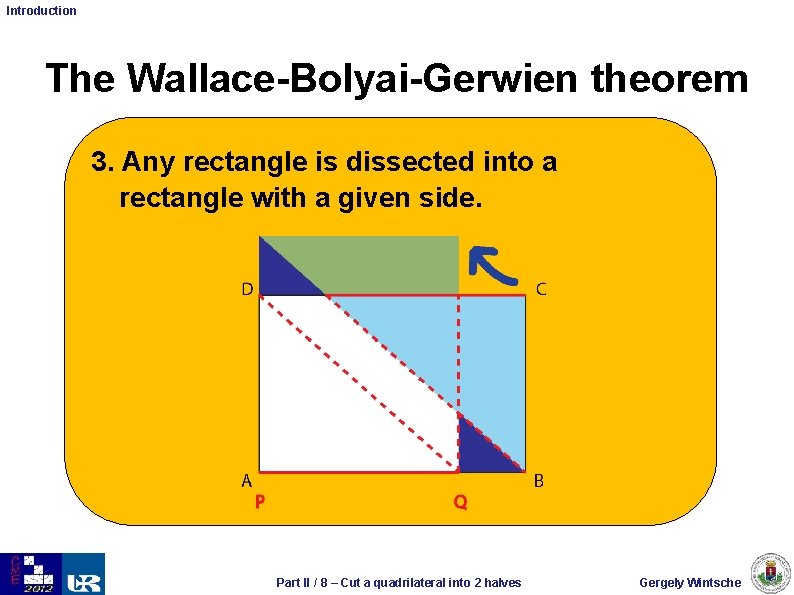
Introduction The Wallace-Bolyai-Gerwien theorem 3. Any rectangle is dissected into a rectangle with a given side. Part II / 8 – Cut a quadrilateral into 2 halves Gergely Wintsche
Introduction The Wallace-Bolyai-Gerwien theorem We are ready! 1. Let us triangulate the simple polygon. 2. Every triangle is dissected into a rectangle. 3. Every rectangle is dissected into rectangles with a same side and all of them forms a big rectangle. 4. We can do the same with the other polygon and we can tailor the two rectangles into each other. Part II / 9 – Cut a quadrilateral into 2 halves Gergely Wintsche
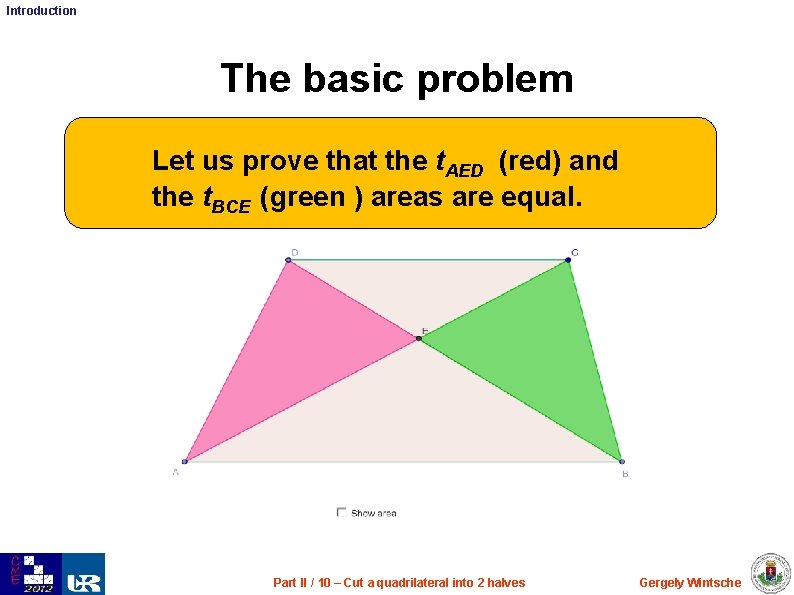
Introduction The basic problem Let us prove that the t. AED (red) and the t. BCE (green ) areas are equal. Part II / 10 – Cut a quadrilateral into 2 halves Gergely Wintsche
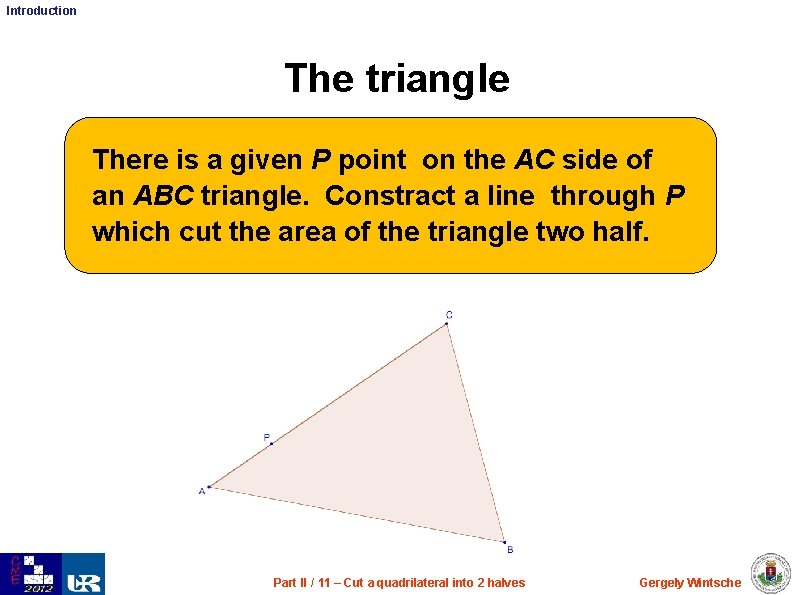
Introduction The triangle There is a given P point on the AC side of an ABC triangle. Constract a line through P which cut the area of the triangle two half. Part II / 11 – Cut a quadrilateral into 2 halves Gergely Wintsche
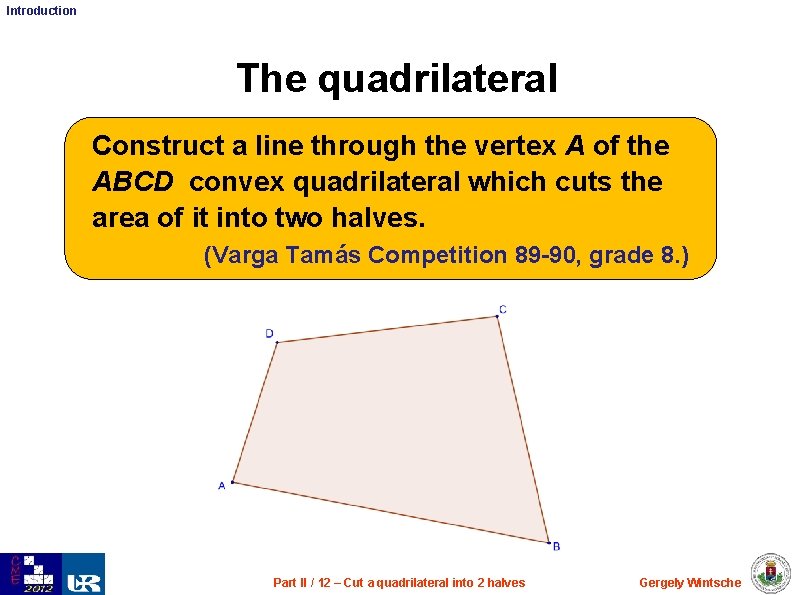
Introduction The quadrilateral Construct a line through the vertex A of the ABCD convex quadrilateral which cuts the area of it into two halves. (Varga Tamás Competition 89 -90, grade 8. ) Part II / 12 – Cut a quadrilateral into 2 halves Gergely Wintsche
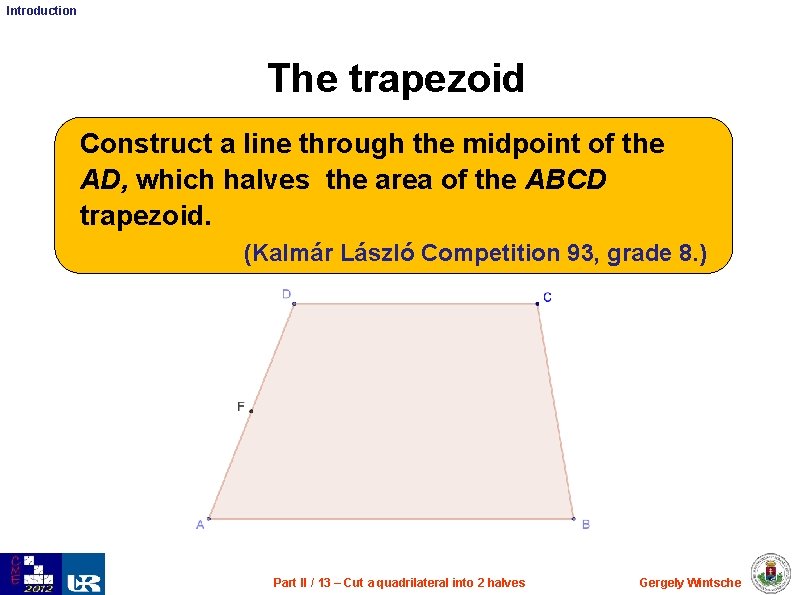
Introduction The trapezoid Construct a line through the midpoint of the AD, which halves the area of the ABCD trapezoid. (Kalmár László Competition 93, grade 8. ) Part II / 13 – Cut a quadrilateral into 2 halves Gergely Wintsche
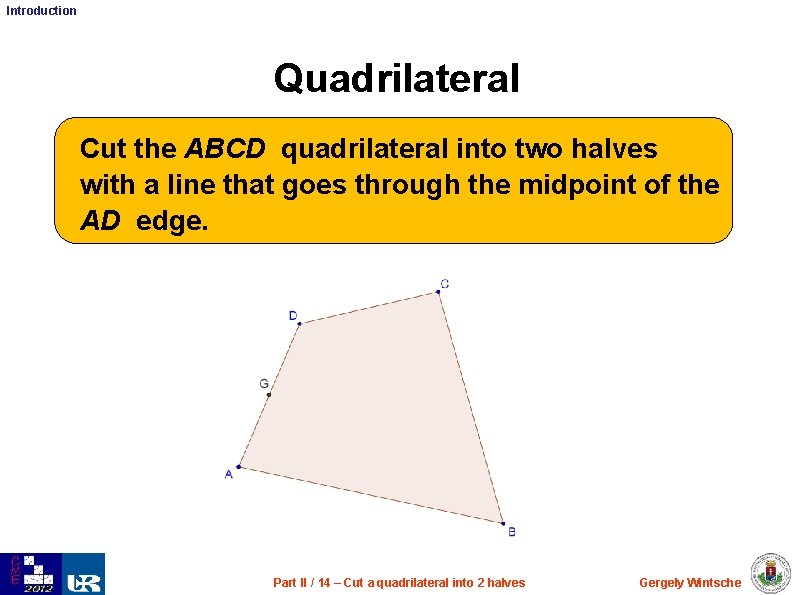
Introduction Quadrilateral Cut the ABCD quadrilateral into two halves with a line that goes through the midpoint of the AD edge. Part II / 14 – Cut a quadrilateral into 2 halves Gergely Wintsche
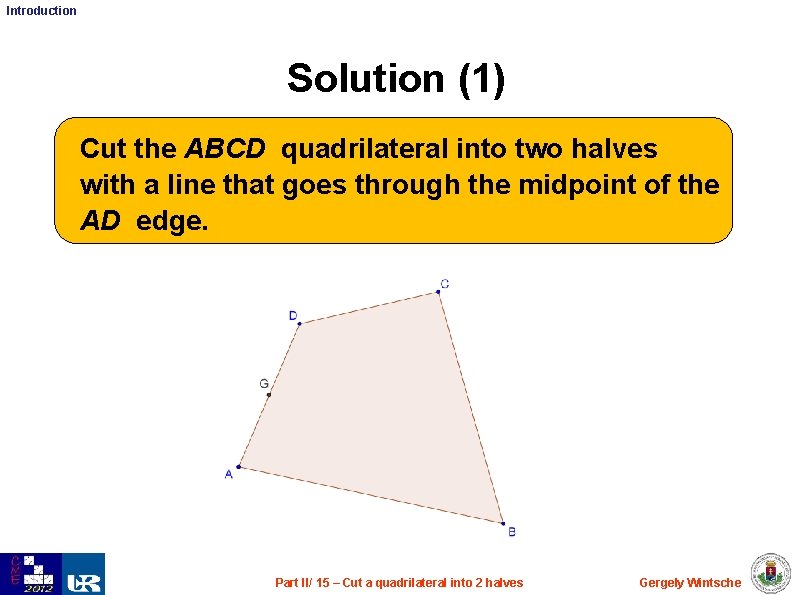
Introduction Solution (1) Cut the ABCD quadrilateral into two halves with a line that goes through the midpoint of the AD edge. Part II/ 15 – Cut a quadrilateral into 2 halves Gergely Wintsche
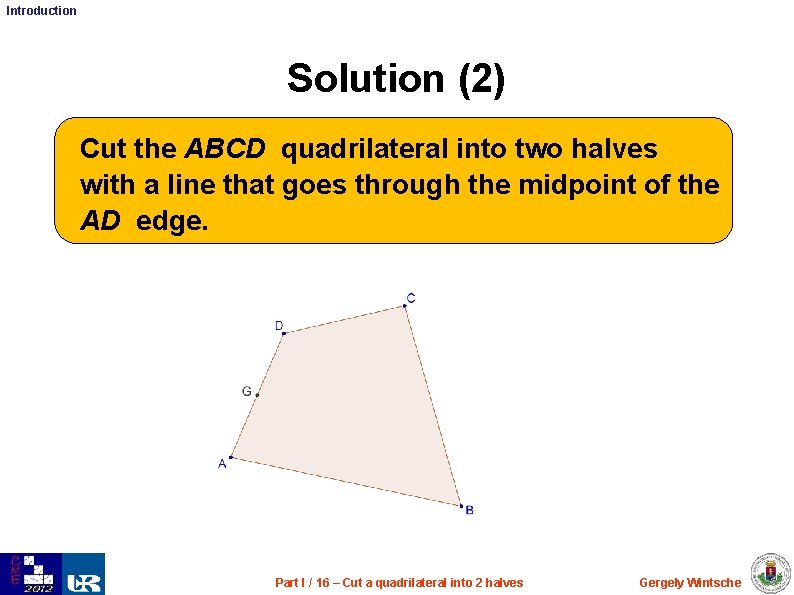
Introduction Solution (2) Cut the ABCD quadrilateral into two halves with a line that goes through the midpoint of the AD edge. Part I / 16 – Cut a quadrilateral into 2 halves Gergely Wintsche
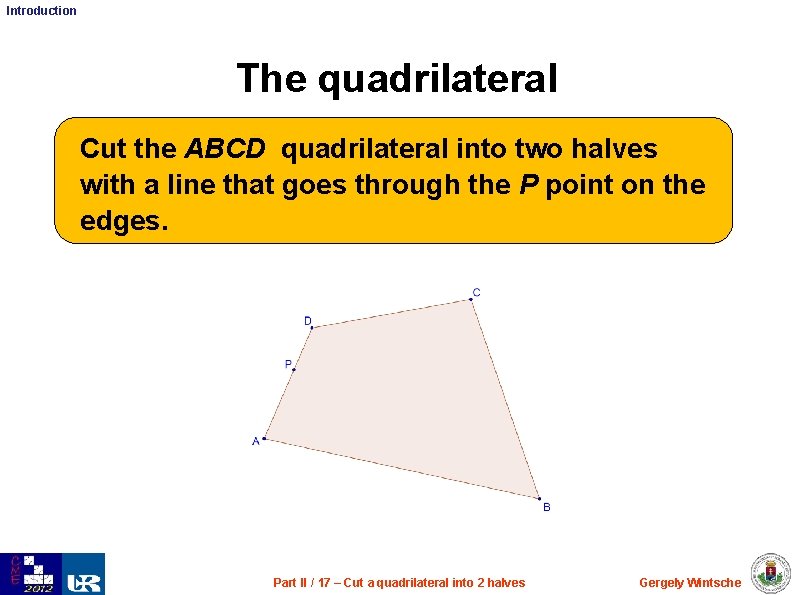
Introduction The quadrilateral Cut the ABCD quadrilateral into two halves with a line that goes through the P point on the edges. Part II / 17 – Cut a quadrilateral into 2 halves Gergely Wintsche
- Slides: 17