
General Workstation Design Principles 1 Make the workstation








- Slides: 17
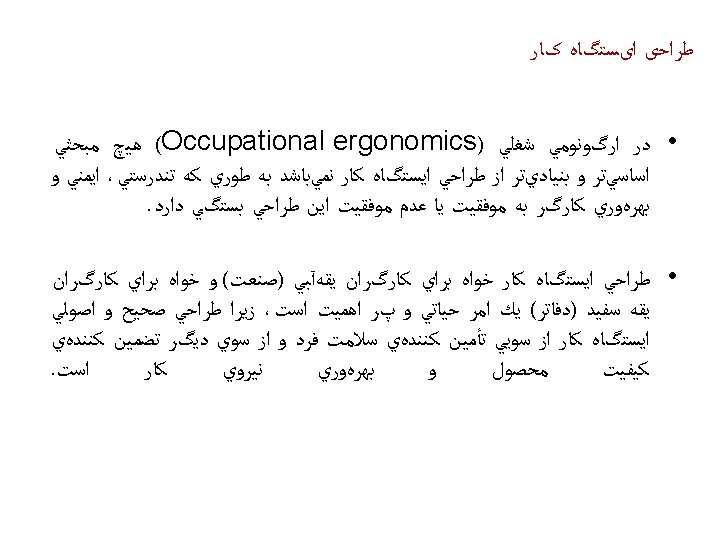
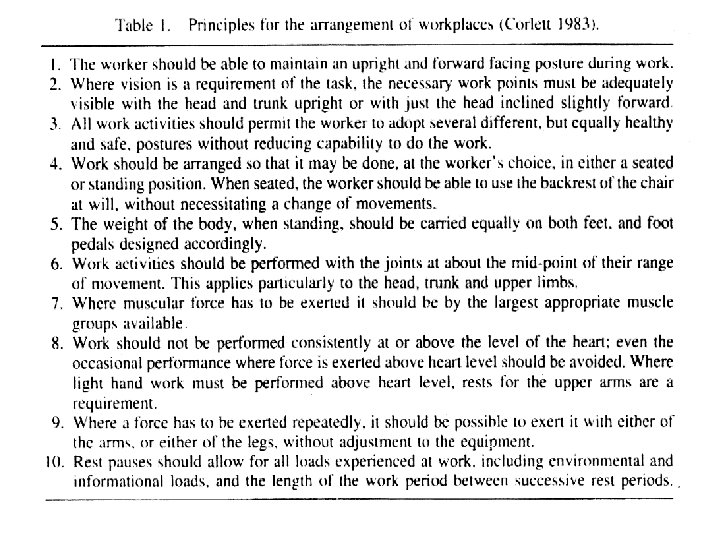
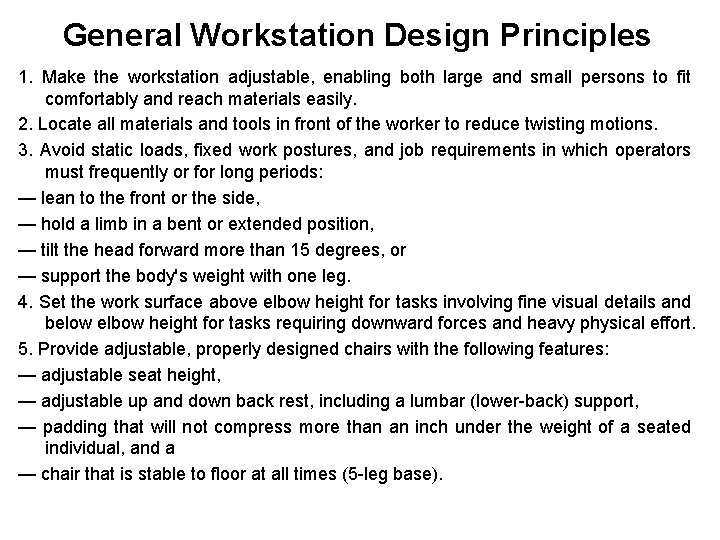
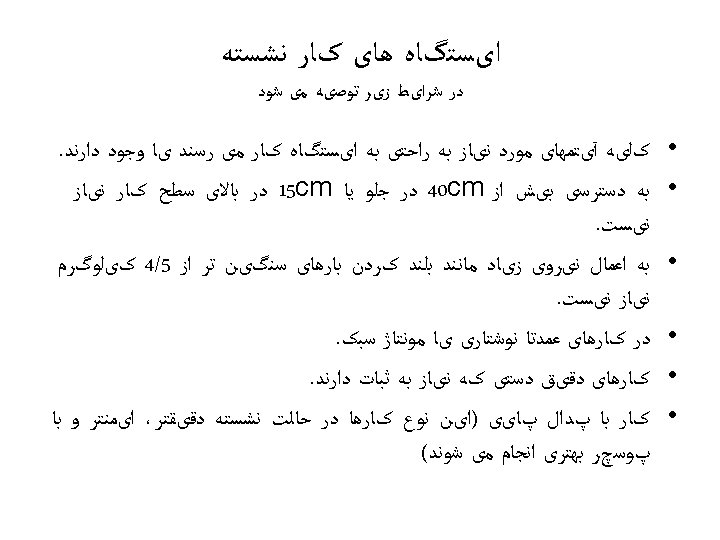
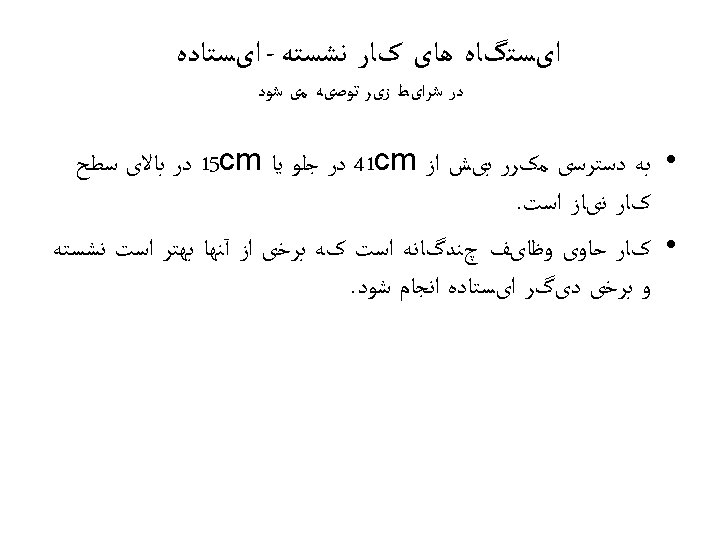
General Workstation Design Principles 1. Make the workstation adjustable, enabling both large and small persons to fit comfortably and reach materials easily. 2. Locate all materials and tools in front of the worker to reduce twisting motions. 3. Avoid static loads, fixed work postures, and job requirements in which operators must frequently or for long periods: — lean to the front or the side, — hold a limb in a bent or extended position, — tilt the head forward more than 15 degrees, or — support the body's weight with one leg. 4. Set the work surface above elbow height for tasks involving fine visual details and below elbow height for tasks requiring downward forces and heavy physical effort. 5. Provide adjustable, properly designed chairs with the following features: — adjustable seat height, — adjustable up and down back rest, including a lumbar (lower-back) support, — padding that will not compress more than an inch under the weight of a seated individual, and a — chair that is stable to floor at all times (5 -leg base).
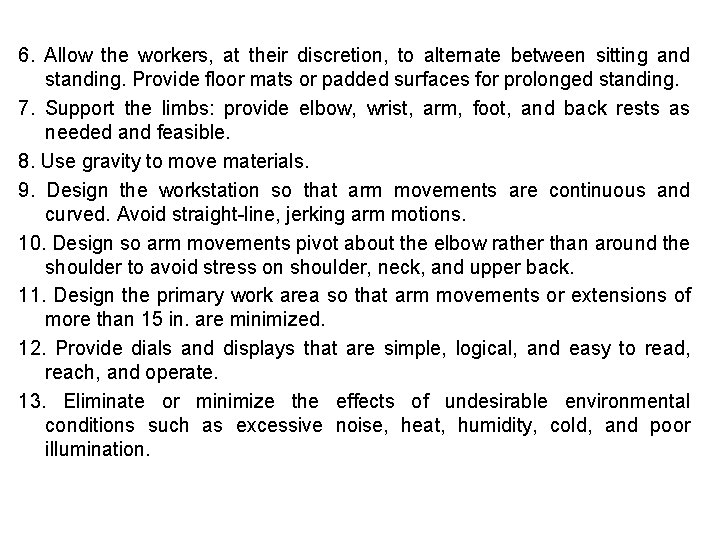
6. Allow the workers, at their discretion, to alternate between sitting and standing. Provide floor mats or padded surfaces for prolonged standing. 7. Support the limbs: provide elbow, wrist, arm, foot, and back rests as needed and feasible. 8. Use gravity to move materials. 9. Design the workstation so that arm movements are continuous and curved. Avoid straight-line, jerking arm motions. 10. Design so arm movements pivot about the elbow rather than around the shoulder to avoid stress on shoulder, neck, and upper back. 11. Design the primary work area so that arm movements or extensions of more than 15 in. are minimized. 12. Provide dials and displays that are simple, logical, and easy to read, reach, and operate. 13. Eliminate or minimize the effects of undesirable environmental conditions such as excessive noise, heat, humidity, cold, and poor illumination.