
General Veterinary Anesthesia Joanna Webb CHEM 5398 Spring
General Veterinary Anesthesia Joanna Webb CHEM 5398 Spring 2010
Outline • • History of Anesthesia Methods of Administration Mechanisms of Action Companion Animal Drugs
Goals of Anesthesia • Amnesia – Loss of memory • Immobility – Stay still • Analgesia – Pain relief • Homeostasis
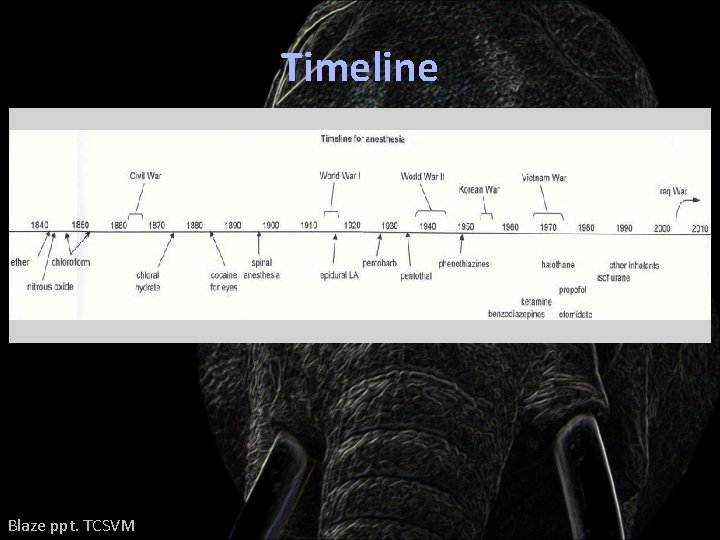
Timeline Blaze ppt. TCSVM
Methods of Administration Common: Inhalation Intravenous Intramuscular Less Common: Rectal Oral Nasal Intraperitoneal
Meyer-Overton Rule • Used to think all anesthetics worked the same way • The gas disrupted cell membrane lipids • Flaw: enantiomers of the same anesthetic have unique actions but the same physical properties (i. e. isoflurane) • Therefore, anesthetics must bind to specific proteins
Mechanism of Action • Hyperpolarize neurons • Anticholingeric: suppresses nervous system communication • Alpha-2 adrenergic receptor agonist/antagonist: suppress norepinephrine binding/release to receptor • Cardiovascular depressant • Respiratory depressant
Action Potentials: Overview • Ach is a main neurotransmitter of the autonomic NS of PNS • In the CNS, excitatory actions
Anesthesia Induction http: //www. youtube. com/watch? v=VBy. EDXs. RIFI&feature=related
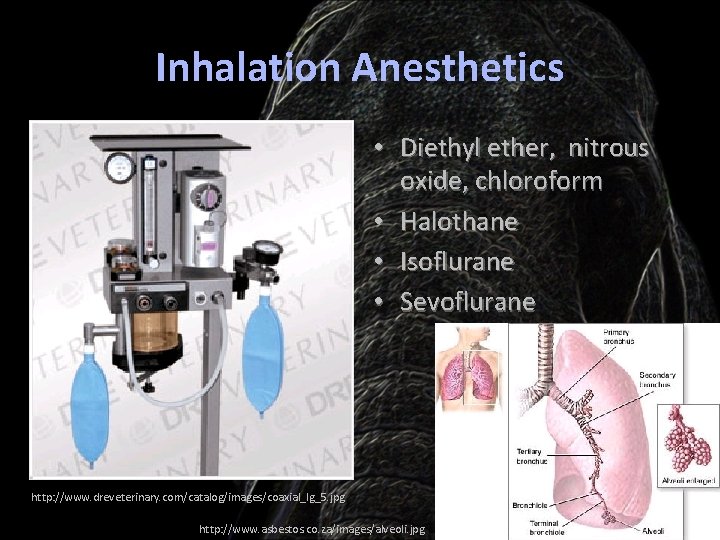
Inhalation Anesthetics • Diethyl ether, nitrous oxide, chloroform • Halothane • Isoflurane • Sevoflurane http: //www. dreveterinary. com/catalog/images/coaxial_lg_5. jpg http: //www. asbestos. co. za/images/alveoli. jpg
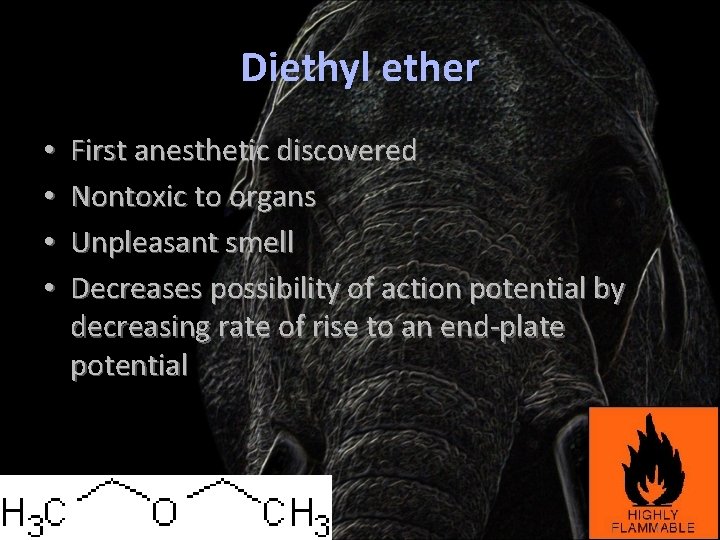
Diethyl ether • • First anesthetic discovered Nontoxic to organs Unpleasant smell Decreases possibility of action potential by decreasing rate of rise to an end-plate potential
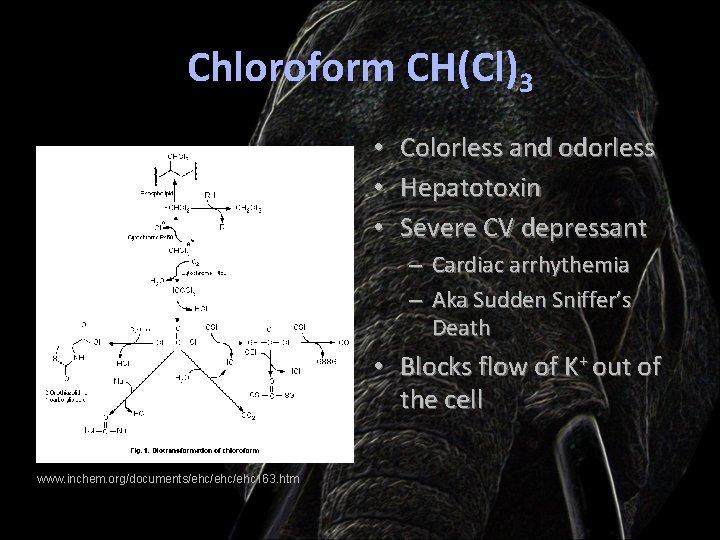
Chloroform CH(Cl)3 • • • Colorless and odorless Hepatotoxin Severe CV depressant – Cardiac arrhythemia – Aka Sudden Sniffer’s Death • Blocks flow of K+ out of the cell www. inchem. org/documents/ehc/ehc 163. htm
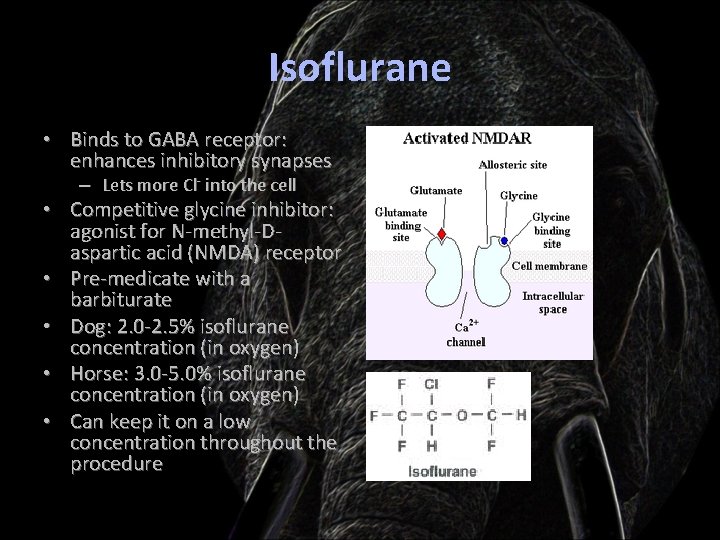
Isoflurane • Binds to GABA receptor: enhances inhibitory synapses – Lets more Cl- into the cell • Competitive glycine inhibitor: agonist for N-methyl-Daspartic acid (NMDA) receptor • Pre-medicate with a barbiturate • Dog: 2. 0 -2. 5% isoflurane concentration (in oxygen) • Horse: 3. 0 -5. 0% isoflurane concentration (in oxygen) • Can keep it on a low concentration throughout the procedure
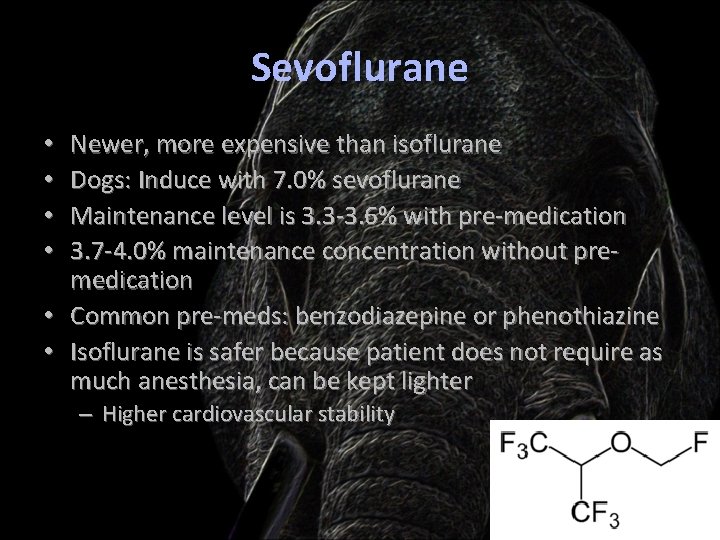
Sevoflurane Newer, more expensive than isoflurane Dogs: Induce with 7. 0% sevoflurane Maintenance level is 3. 3 -3. 6% with pre-medication 3. 7 -4. 0% maintenance concentration without premedication • Common pre-meds: benzodiazepine or phenothiazine • Isoflurane is safer because patient does not require as much anesthesia, can be kept lighter • • – Higher cardiovascular stability
Injectable anesthetics Pre-anesthetics • Mild sedative, analgesic • Acepromazine – Combine with NSAID or opiod • Medetomidine • Atipamezole Induction anesthetics • Dissociative – – Ketamine Tiletamine • Benzodiazepines – Diazepam – Zolazepam • Propofol • Barbiturates
Pharmacokinetics of Injectable Anesthetics • Partition into the highly lipophilic tissues of the brain and spinal cord • Produce rapid anesthesia • Immediate low concentrations of anesthetic in blood stream causes the drug to leave the CNS and enter the peripheral tissues via the blood • Effect can wear off in about 10 minutes unless continuously infused
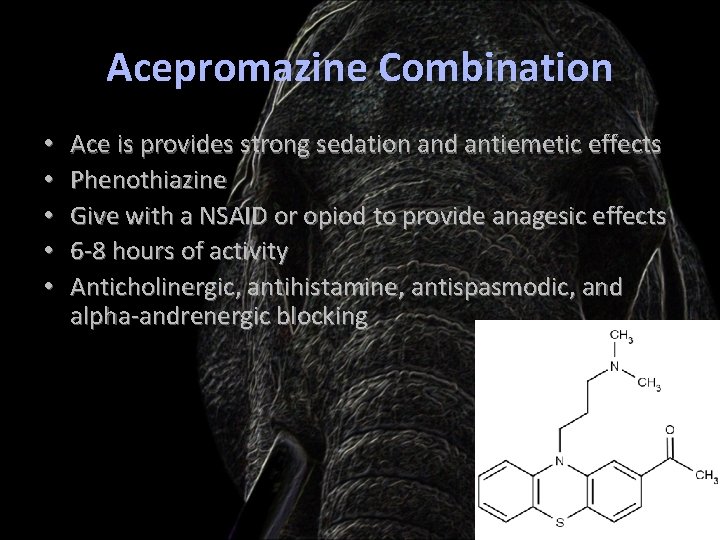
Acepromazine Combination • • • Ace is provides strong sedation and antiemetic effects Phenothiazine Give with a NSAID or opiod to provide anagesic effects 6 -8 hours of activity Anticholinergic, antihistamine, antispasmodic, and alpha-andrenergic blocking
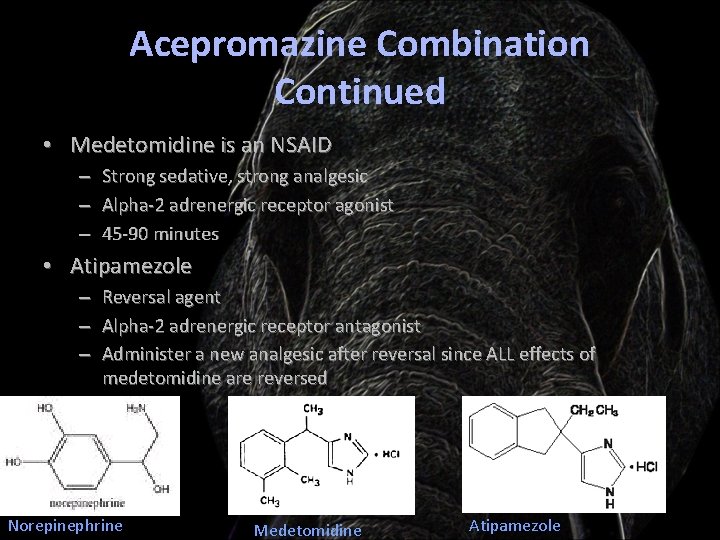
Acepromazine Combination Continued • Medetomidine is an NSAID – – – Strong sedative, strong analgesic Alpha-2 adrenergic receptor agonist 45 -90 minutes • Atipamezole – – – Reversal agent Alpha-2 adrenergic receptor antagonist Administer a new analgesic after reversal since ALL effects of medetomidine are reversed Norepinephrine Medetomidine Atipamezole
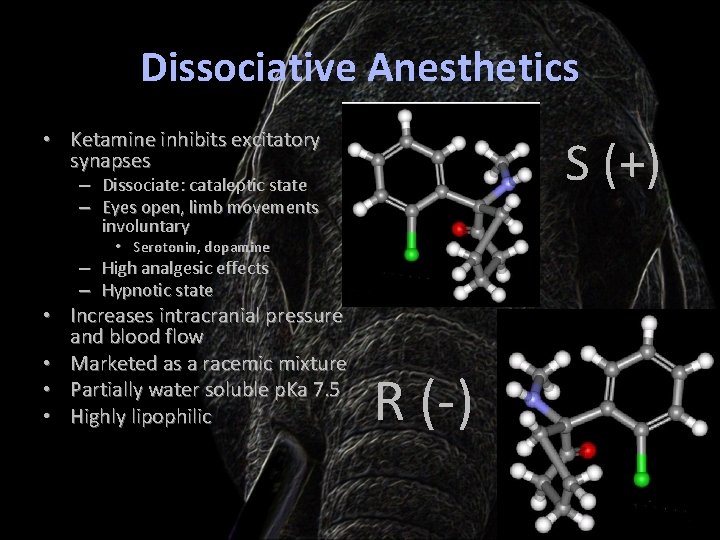
Dissociative Anesthetics • Ketamine inhibits excitatory synapses S (+) – Dissociate: cataleptic state – Eyes open, limb movements involuntary • Serotonin, dopamine – High analgesic effects – Hypnotic state • Increases intracranial pressure and blood flow • Marketed as a racemic mixture • Partially water soluble p. Ka 7. 5 • Highly lipophilic R (-)
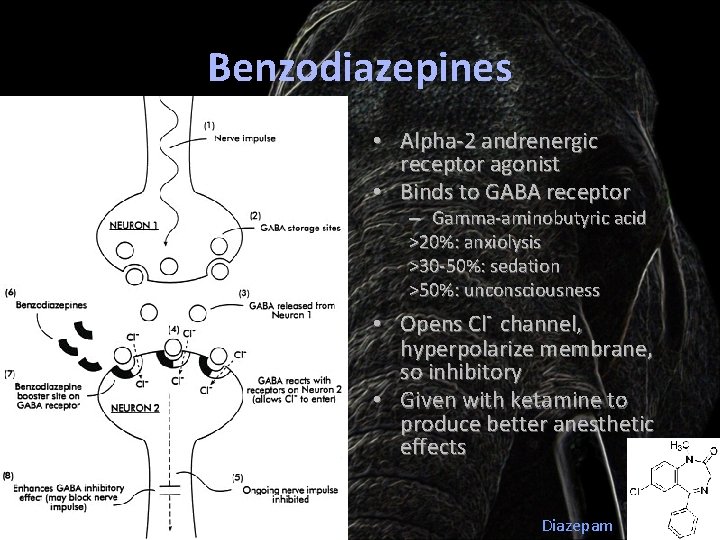
Benzodiazepines • Alpha-2 andrenergic receptor agonist • Binds to GABA receptor – Gamma-aminobutyric acid >20%: anxiolysis >30 -50%: sedation >50%: unconsciousness • Opens Cl- channel, hyperpolarize membrane, so inhibitory • Given with ketamine to produce better anesthetic effects Diazepam
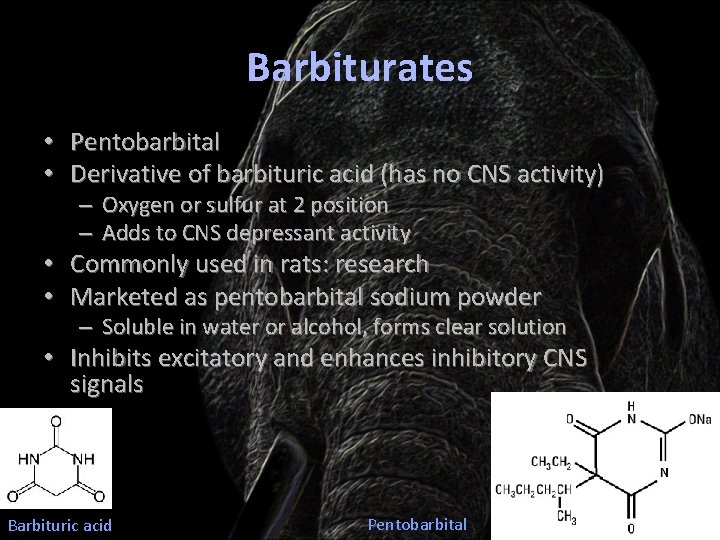
Barbiturates • Pentobarbital • Derivative of barbituric acid (has no CNS activity) – Oxygen or sulfur at 2 position – Adds to CNS depressant activity • Commonly used in rats: research • Marketed as pentobarbital sodium powder – Soluble in water or alcohol, forms clear solution • Inhibits excitatory and enhances inhibitory CNS signals Barbituric acid Pentobarbital
References • • • http: //www. metrohealthanesthesia. com/edu/ivanes/ketamine 2. htm http: //www. inchem. org/documents/ehc/ehc 163. htm http: //vetmed. duhs. duke. edu/guidelines_for_pentobarbital. htm http: //metrohealthanesthesia. com/edu/ivanes/benzos 1. htm Blaze, C. A. (2009). Veterinary anesthesia and analgesia introduction. Microsoft Powerpoint. Tufts Cummings School of Veterinary Medicine. Chloroform. 2010). Wikipedia. Retrieved (2010, April 4) from http: //en. wikipedia. org/wiki/Chloroform#Production Dickinson, R, Peterson, B. K, Banks, P. B. , Similis, C, Martiin, J. C. S. , Valenzulela, C. A. , Maze, M, Franks, N. P. (2007). Competitive inhibition at the glycine site of the N-methyl-D-aspartate receptor by the anesthetics xenon and isoflurane: evidence from molecular modeling and electrophysiology. Anesthesiology, 107(5): 756 -767. Muir, W. W. (2008): Intravenous anesthetic drugs: dissociative anesthetics. DVM 360. Retrieved (2010, April 5) End plate potentials. (2009). Wikipedia. Retrieved (2010, April 4) from http: //en. wikipedia. org/wiki/End-plate_potential University of Minnesota. Guidelines for the use of anesthetics, analgesics and tranquilizers in laboratory animals. Accessed 15 February 2010. < http: //www. ahc. umn. edu/rar/anesthesia. html#Selection>
Assigned Reading • Goodman and Gilman’s Pharmacological Basis of Therapeutics, Chapter 13, pp. 341 -363
Homework Questions • Draw the structure of propofol, the most commonly used anesthetic in the US. • Propofol is not water soluble, thus has to be constituted in an emulsion-like mixture of soybean oil, glycerol, and egg phosphatide. Circle the structural features responsible for its water insolubility. • Halothane, isoflurane and sevoflurane are commonly used inhalation anesthetics. Draw their structures • Draw and label the R and S stereoisomers of ketamine. • Which stereoisomer of ketamine has more psychic emergence? Which stereoisomer contributes more analgesic and anesthetic effects? • Thiopental (pentobarbital), thiamylal, methohexital are all derivatives of barbituric acid. Draw their structures and that of the parent structure barbituric acid.
- Slides: 24