
GENERAL USE OF GERUNDS and INFINITIVES grammar book
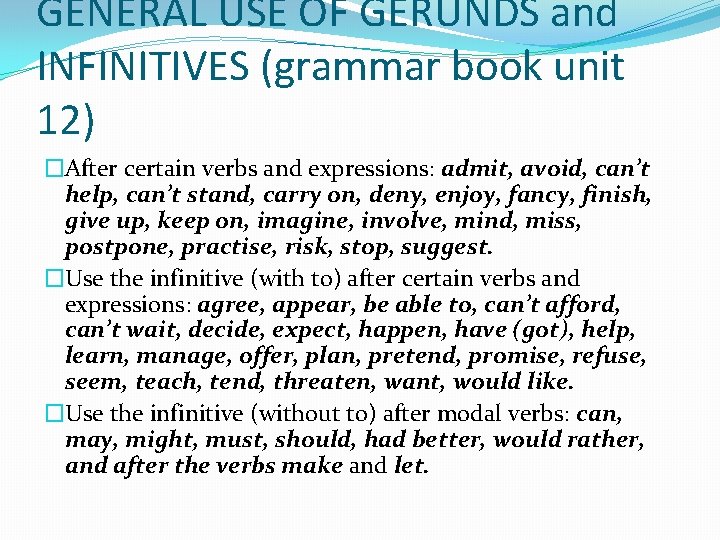
GENERAL USE OF GERUNDS and INFINITIVES (grammar book unit 12) �After certain verbs and expressions: admit, avoid, can’t help, can’t stand, carry on, deny, enjoy, fancy, finish, give up, keep on, imagine, involve, mind, miss, postpone, practise, risk, stop, suggest. �Use the infinitive (with to) after certain verbs and expressions: agree, appear, be able to, can’t afford, can’t wait, decide, expect, happen, have (got), help, learn, manage, offer, plan, pretend, promise, refuse, seem, teach, tend, threaten, want, would like. �Use the infinitive (without to) after modal verbs: can, may, might, must, should, had better, would rather, and after the verbs make and let.

Both gerund and infinitive with no/little change of meaning �Some verbs can be followed by the gerund or infinitive (with to) with no change of meaning: begin, start, continue. �Love, like, hate and prefer can also be used with either, but the gerund is more common when you are talking generally, and the infinitive when you talk about a specific occasion. Compare: I like skiing. (in general). I like to ski in February or March (specific).
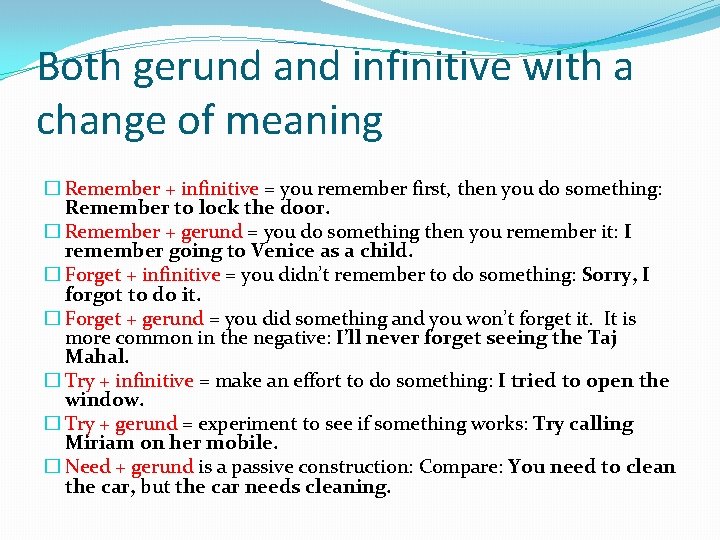
Both gerund and infinitive with a change of meaning � Remember + infinitive = you remember first, then you do something: Remember to lock the door. � Remember + gerund = you do something then you remember it: I remember going to Venice as a child. � Forget + infinitive = you didn’t remember to do something: Sorry, I forgot to do it. � Forget + gerund = you did something and you won’t forget it. It is more common in the negative: I’ll never forget seeing the Taj Mahal. � Try + infinitive = make an effort to do something: I tried to open the window. � Try + gerund = experiment to see if something works: Try calling Miriam on her mobile. � Need + gerund is a passive construction: Compare: You need to clean the car, but the car needs cleaning.
- Slides: 3