
General Toxicology Toxic Responses of the Respiratory System


- Slides: 33
General Toxicology Toxic Responses of the Respiratory System (I) Lec. 5 4 th Year 2018 -2019 University of Mustansiriyah/College of Pharmacy Department of Pharmacology & Toxicology Lecturer Rua Abbas Al-Hamdy
Objectives of this lecture are to: § determine the respiratory tract structure & function. § determine acute & chronic responses of the lung to injury.
Overview of the respiratory system: § The respiratory system has direct contact with the inhaled air. § Inhaled air contains a variety of environmental pollutant (e. g. , gas, dust, fiber & tobacco smoke). § Air also contains air borne viruses, bacteria & fungi. § The respiratory system is also exposed to inhaled drugs which are used for local or systemic effect.
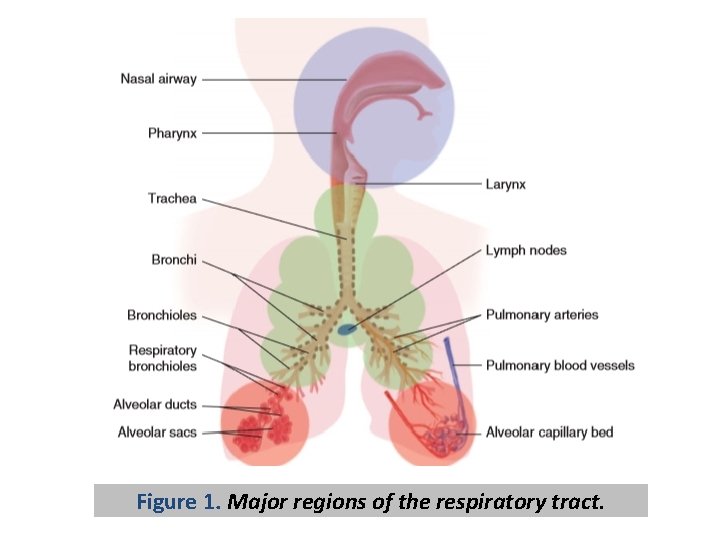
Respiratory tract structure & function: I. Oronasal passages: § The respiratory tract is divided into the upper respiratory tract (from the nostril or mouth to the pharynx) & lower respiratory track (airway passages & lung parenchyma below the pharynx) (Fig. 1). § The upper respiratory track functions to conduct, heat, humidify, filter, & chemosense incoming air. § Nasal epithelia can metabolize many foreign compounds by cytochrome P 450 & other enzymes.
§ The olfactory epithelium contains specialized chemosensory olfactory neurons located in the superior portion of the nasal passage. § The main nerve endings that perceive irritants, the chemical nociceptors also discern temperature & mechanical stress. Two protein families, the transient receptor potential (TRP) channels & the taste (TAS) receptors, perform these functions in the upper respiratory tract.
§ TRP channels are ion channels that are permeable to cations, including calcium, magnesium, & sodium. § Among the subfamilies of TRP receptors, are TRP subfamily A (TRPA) & TRP subfamily V (‘’V” for vanilloid) (TRPV). TRPA 1 & TRPV 1 are the major irritant receptors in the nasal passage & are primarily within the trigeminal nerve.
Figure 1. Major regions of the respiratory tract.
II. Conducting airways: § The conducting airways of the lower respiratory tract can be divided into: • proximal (trachea & bronchi), & • distal regions (bronchioles). § The epithelium of the proximal airway & a portion of the nasal passage has specialized cells. These cells include ciliated, mucous& basal cells. § These cells work together to form a mucous layer that traps & removes inhaled material via mucociliary clearance.
§ In humans, the bronchiolar secretoglobin cells (BSCs), previously called the Clara cell, are found mainly in the distal airways. BSCs are known to inhibit phospholipase A 2 & limit inflammation.
III. Gas exchange region: § The gas exchange region consists of terminal bronchioles, respiratory bronchioles, alveolar ducts, alveoli, blood vessels, & lung interstitium. Gas exchange occurs in the alveoli. § The alveolar epithelium consists of two cells, the alveolar type I & type II cell. § Alveolar type I cells cover 95% of the alveolar surface, & have a role in gas exchange.
§ Functions of alveolar type II cells: • They produce & secrete suractant, a mixture of lipids, & four suractant associated proteins. • They can undergo mitotic division & replace damaged type I cells. § Particles deposited in the alveolar region are removed by specialized cells, the alveolar macrophage.
Responses of the lung to injury: § Acute responses, & § Chronic responses.
Acute responses of the lung to injury: § Trigeminally mediated airway reflexes. § Bronchoconstriction, airway hyperreactivity, & neurogenic inflammation. § Acute lung injury (pulmonary edema).
Trigeminally mediated airway reflexes: § Nasal & airway irritation represents a common response to inspired toxic compounds. § Nasal irritation is mediated by irritant receptors [eg, transient receptor potential cation channel. A 1(TRPA 1)] that trigger trigeminal nerves characterized by tickling, itching & painful nasal sensations. § TRPA 1 is sensitive to several irritants including acrolein, allyl isothiocyanate, chlorine, & hydrogen peroxide.
§ If continued exposure cannot be avoided, many irritants will produce cell necrosis.
Bronchoconstriction, airway hyperreactivity & neurogenic inflammation: § Bronchoconstriction can be provoked by: • irritants (e. g. , acrolein) • cigarette smoke, • air pollutants, • cholinomimetic drugs (acetylcholine), • histamine, • prostaglandins (PGs) (mainly PGF 2α & PGD 2), & • leukotrienes.
§ Characteristic symptoms include wheezing, coughing, a sensation of chest tightness & dyspnea. § Irritants can prime the autonomic response by lowering the threshold dose of acetylcholine needed to induce bronchoconstriction. A lower threshold of acetylcholine-mediated bronchoconstriction is called airway hyperreactivity (or hyperresponsiveness). § Irritants can also stimulate TRP channels that cause neurogenic inflammation.
Acute lung injury (pulmonary edema): § Acute lung injury (both adult or infant respiratory distress syndrome) is marked by: • alveolar epithelial & endothelial cell damage, & • inflammatory cell influx. § These events lead to surfactant disruption & pulmonary edema. § Pulmonary edema produces a thickening of the alveolar capillary barrier & thereby limits O 2 & CO 2 exchange.
§ During acute lung injury, profibrotic growth factors, transforming growth factor beta 1 (TGFB 1) is activated. § When inhaled in high concentrations, acrolein, HCl, NO 2, NH 3, or phosgene may produce immediate alveolar damage leading to a rapid death. § However, these gases inhaled in lower concentrations may produce very little apparent damage in the respiratory tract.
Chronic responses of the lung to injury: § Chronic obstructive pulmonary disease (COPD) § Lung cancer § Asthma § Pulmonary fibrosis
Chronic obstructive pulmonary disease (COPD): § COPD involves an airway (bronchitis) & an alveolar (emphysema) pathology. § Chronic bronchitis is defined by the presence of sputum production & cough for at least three months in each of two consecutive years. § In emphysema, destruction of the gas-exchanging surface area results in a distended, hyperinflated lung that no longer effectively exchanges oxygen & carbon.
Lung cancer: § The increased risk of developing lung cancer for average smokers compared with nonsmokers is 8 - to 10 -fold & for heavy smokers about 20 - to 40 fold. § The main factor responsible for smoking dependence is nicotine. § The global burden is ∼ 1. 2 million cancer deaths per year, with 85% of lung cancer cases in men & 47% of lung cancer cases in women being attributable to tobacco use.
§ Arsenic, asbestos, beryllium, cadmium, chromium, & nickel have been associated with cancer of the respiratory tract.
Asthma: § Asthma is characterized clinically by attacks of shortness of breath, which is caused by narrowing of the large conducting airways (bronchi). § In allergic asthma, previous exposure to an antigen typically leads to the generation of immunoglobin E (Ig. E).
§ Upon reexposure, the antigen causes: • cross-linking of Ig. E molecules • activation of lymphocytes, eosinophils, macrophages, & mast cells • with elaboration & release of an array of cytokines, eicosanoids, histamine, tachykinins & other mediators. § Asthma has been associated with a number of occupations. § Occupational asthma can be induced by highmolecular-weight & some low-molecular-weight substances.
§ High-molecular-weight agents including flour-, cereals-, latex- or animal-derived proteins & enzymes cause sensitization through an Ig. Emediated mechanism, such as in common atopic asthma. § Many low molecular-weight agents that induce occupational asthma include acid anhydrides & platinum salts that induce asthma through an Ig. E mechanism, but most low-molecular-weight agents involve an uncertain mechanism of induction.
§ Many of the low-molecular-weight agents can cross-link biological macromolecules. These agents include: • metals (e. g. , nickel, chromium, cobalt, zinc, cadmium, & aluminum), • diisocyanates, • cleaning agents, • wood dusts, & • pesticides.
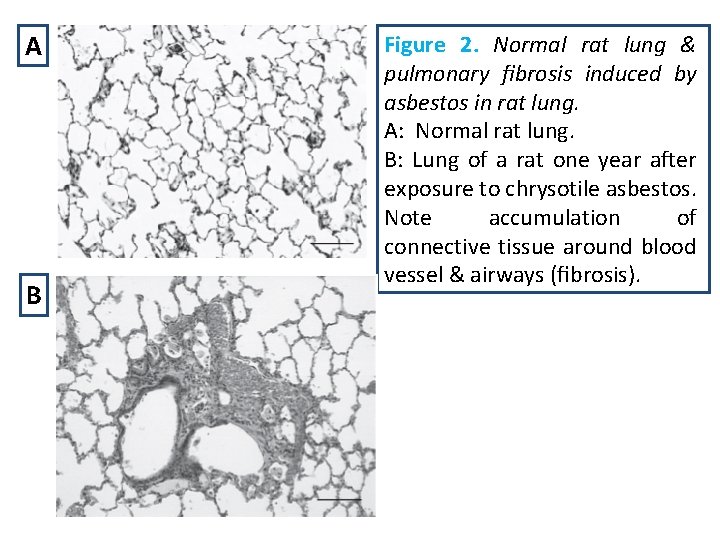
Pulmonary fibrosis: § The pathological hallmark of pulmonary fibrosis is increased focal staining of collagen fibers in the alveolar interstitium. § Excess lung collagen is usually observed not only in the alveolar interstitium but also throughout the centriacinar region, including the alveolar ducts & respiratory bronchioles (Fig. 2). § The pleural surface of the lung may also become fibrotic & together with parenchymal stiffening prevent full lung inflation.
A B Figure 2. Normal rat lung & pulmonary fibrosis induced by asbestos in rat lung. A: Normal rat lung. B: Lung of a rat one year after exposure to chrysotile asbestos. Note accumulation of connective tissue around blood vessel & airways (fibrosis).
§ The pathogenesis of pulmonary fibrosis involves epithelial cell injury & macrophage activation produced by a wide range of toxic insults. For example, macrophages can be activated by phagocytosis of crystalline silica which activates inflammasome receptor-mediated tumor necrosis factor (TNF) & interleukin 1 beta (IL 1 B) formation. § Epithelial cells & macrophages also release chemokines that recruit & activate other inflammatory cells including neutrophils & T cells.
§ These cells combine to produce excessive TGFB 1, TNF, IL 1 B, IL 13, and IL 17. Of these, TNF & TGFB 1 are major mediators in pulmonary fibrosis. § The consequence of the combined TGFB 1/3, cytokine release, & hypoxia leads to epithelial-to -mesenchymal transition in which lung epithelial cells transdifferentiate into fibroblast-like cells. These cells contribute to a larger population of myofibroblasts that arise from local mesenchymal cells, & bone marrow–derived fibrocytes.
§ The migration, proliferation, & activation of myofibroblasts contribute to excessive excellular matrix deposition that has altered collagen cross -linking. The consequence of this process is disorderly repair & substained fibrogenesis, which leads to progressive stiffness of the fibrotic lung.