
General Topology 1 Topological Space 1 1 Definitions
- Slides: 47
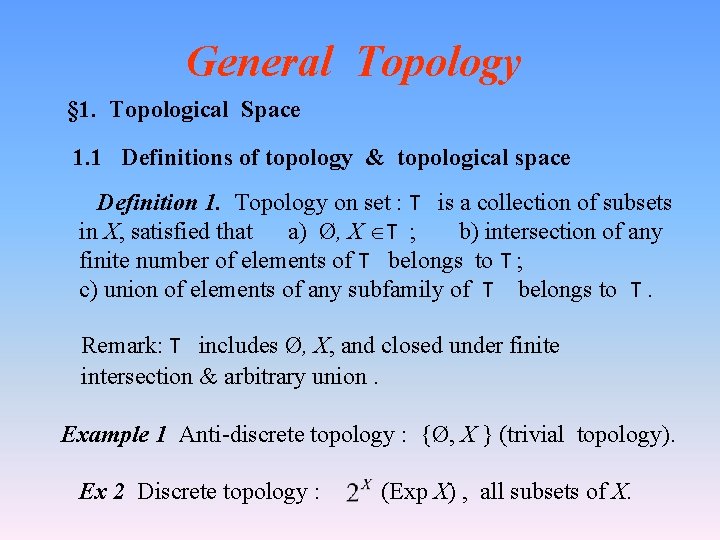
General Topology § 1. Topological Space 1. 1 Definitions of topology & topological space Definition 1. Topology on set : T is a collection of subsets in X, satisfied that a) Ø, X T ; b) intersection of any finite number of elements of T belongs to T ; c) union of elements of any subfamily of T belongs to T. Remark: T includes Ø, X, and closed under finite intersection & arbitrary union. Example 1 Anti-discrete topology : {Ø, X } (trivial topology). Ex 2 Discrete topology : (Exp X) , all subsets of X.
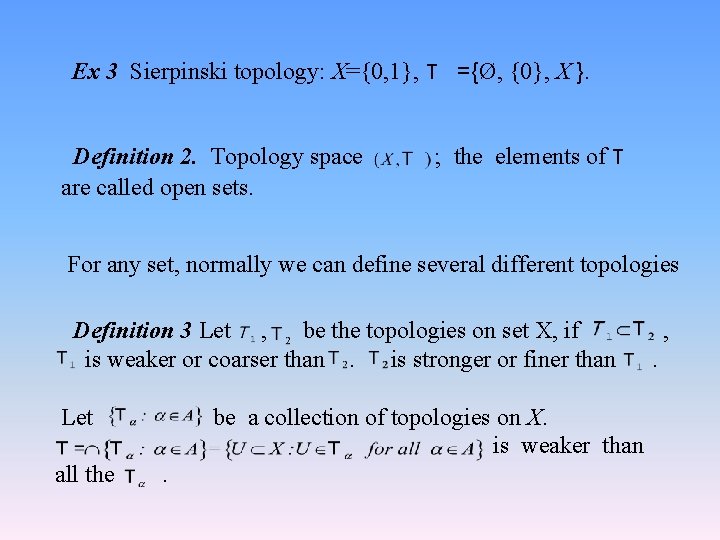
Ex 3 Sierpinski topology: X={0, 1}, T ={Ø, {0}, X }. Definition 2. Topology space are called open sets. ; the elements of T For any set, normally we can define several different topologies Definition 3 Let , be the topologies on set X, if is weaker or coarser than. is stronger or finer than Let all the be a collection of topologies on X. is weaker than. , .
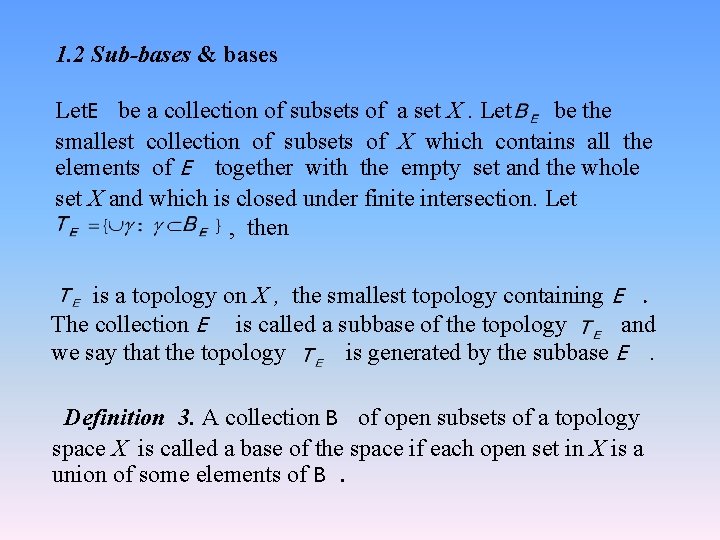
1. 2 Sub-bases & bases Let. E be a collection of subsets of a set X. Let be the smallest collection of subsets of X which contains all the elements of E together with the empty set and the whole set X and which is closed under finite intersection. Let , then is a topology on X , the smallest topology containing E. The collection E is called a subbase of the topology and we say that the topology is generated by the subbase E. Definition 3. A collection B of open subsets of a topology space X is called a base of the space if each open set in X is a union of some elements of B.
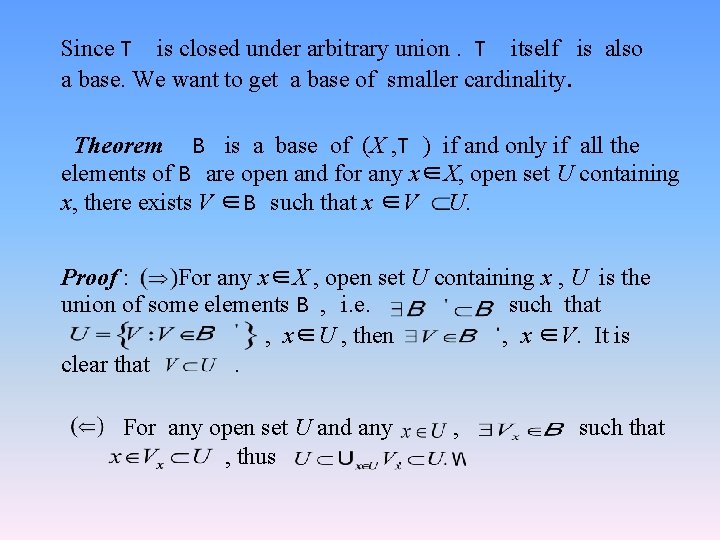
Since T is closed under arbitrary union. T itself is also a base. We want to get a base of smaller cardinality. Theorem B is a base of (X , T ) if and only if all the elements of B are open and for any x∈X, open set U containing x, there exists V ∈B such that x ∈V U. Proof : For any x∈X , open set U containing x , U is the union of some elements B , i. e. such that , x∈U , then , x ∈V. It is clear that. For any open set U and any , thus. , such that
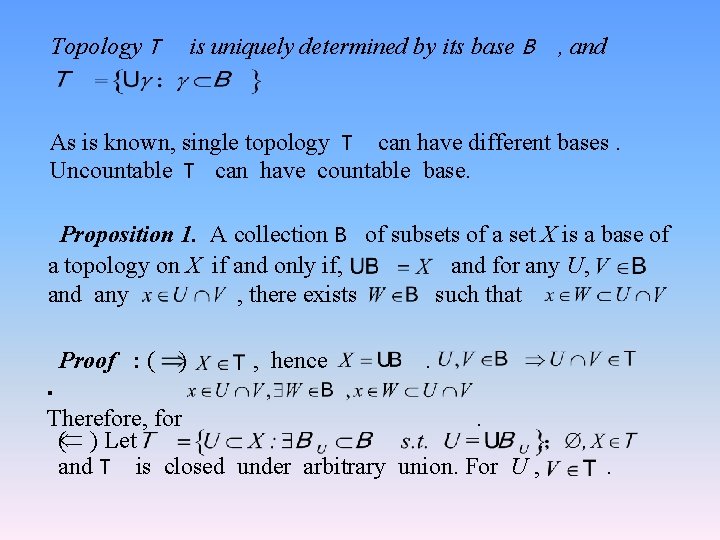
Topology T is uniquely determined by its base B , and As is known, single topology T can have different bases. Uncountable T can have countable base. Proposition 1. A collection B of subsets of a set X is a base of a topology on X if and only if, and for any U, and any , there exists such that. Proof : ( ) , hence . . Therefore, for. (Ü ) Let. and T is closed under arbitrary union. For U , .
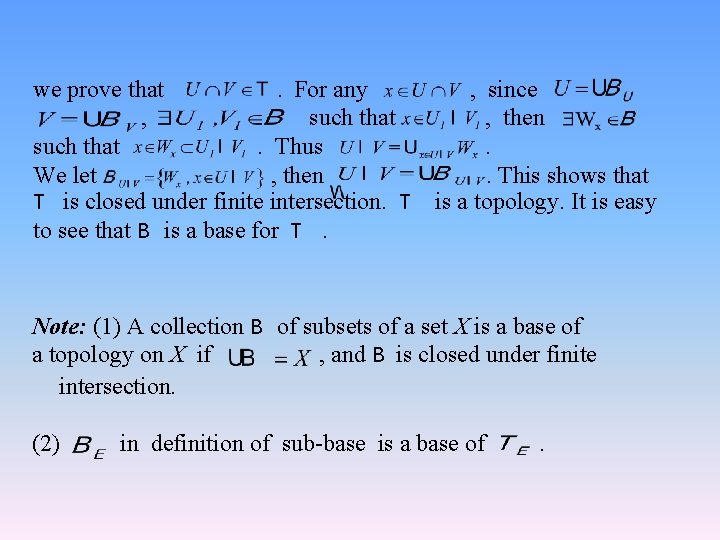
we prove that. For any , such that. Thus We let , then T is closed under finite intersection. T to see that B is a base for T. , since , then. . This shows that is a topology. It is easy Note: (1) A collection B of subsets of a set X is a base of a topology on X if , and B is closed under finite intersection. (2) in definition of sub-base is a base of .
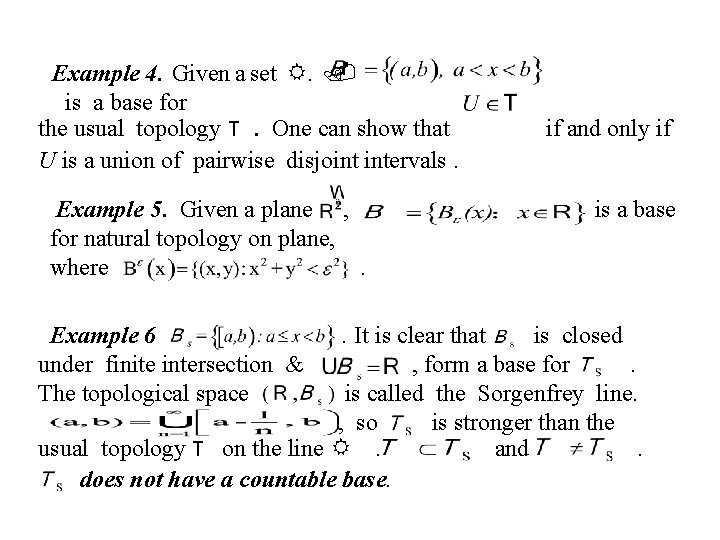
Example 4. Given a set R. . is a base for the usual topology T. One can show that U is a union of pairwise disjoint intervals. Example 5. Given a plane , for natural topology on plane, where. Example 6 under finite intersection & The topological space if and only if is a base . It is clear that is closed , form a base for. is called the Sorgenfrey line. , so is stronger than the usual topology T on the line R. and. does not have a countable base.
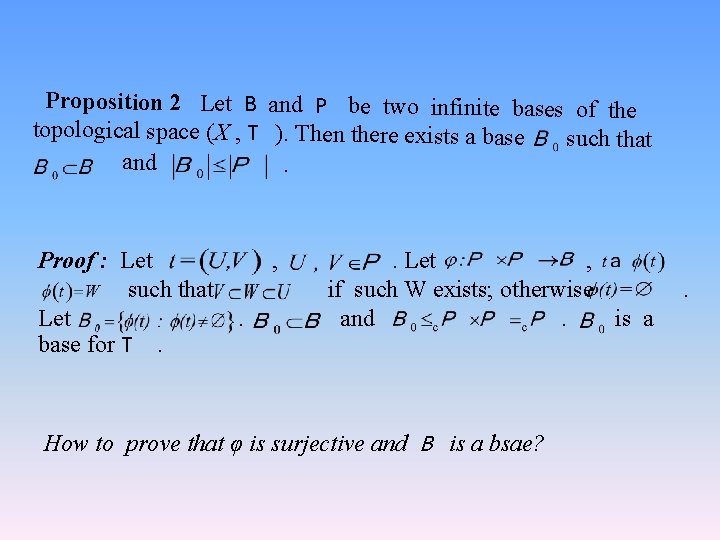
Proposition 2 Let B and P be two infinite bases of the topological space (X , T ). Then there exists a base such that and. Proof : Let such that Let base for T. , . . Let , if such W exists; otherwise and. is a How to prove that φ is surjective and B is a bsae? .
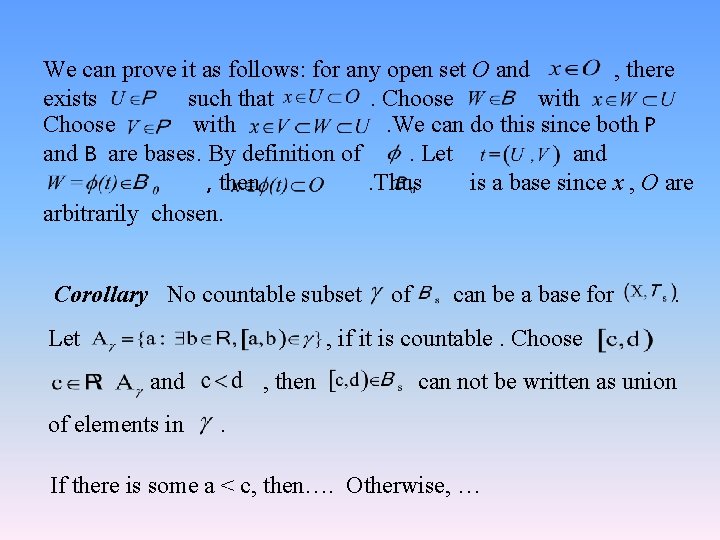
We can prove it as follows: for any open set O and , there exists such that. Choose with. We can do this since both P and B are bases. By definition of. Let and , then. Thus is a base since x , O are arbitrarily chosen. Corollary No countable subset Let of can be a base for . , if it is countable. Choose and of elements in , then can not be written as union . If there is some a < c, then…. Otherwise, …
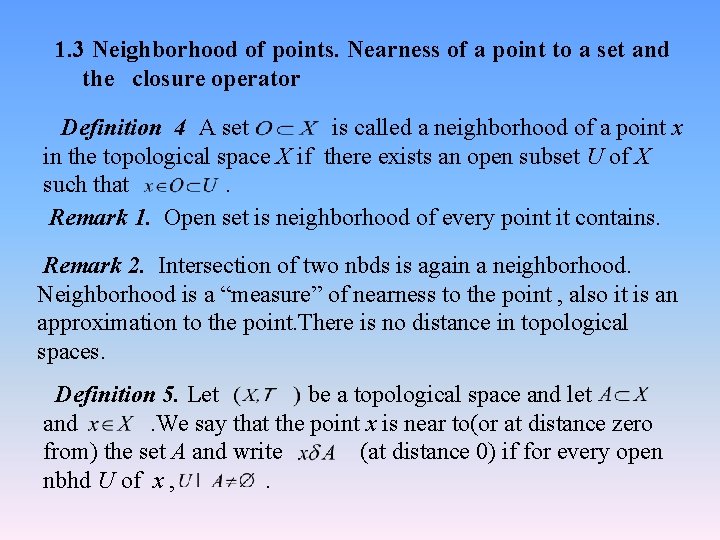
1. 3 Neighborhood of points. Nearness of a point to a set and the closure operator Definition 4 A set is called a neighborhood of a point x in the topological space X if there exists an open subset U of X such that. Remark 1. Open set is neighborhood of every point it contains. Remark 2. Intersection of two nbds is again a neighborhood. Neighborhood is a “measure” of nearness to the point , also it is an approximation to the point. There is no distance in topological spaces. Definition 5. Let be a topological space and let and. We say that the point x is near to(or at distance zero from) the set A and write (at distance 0) if for every open nbhd U of x , .
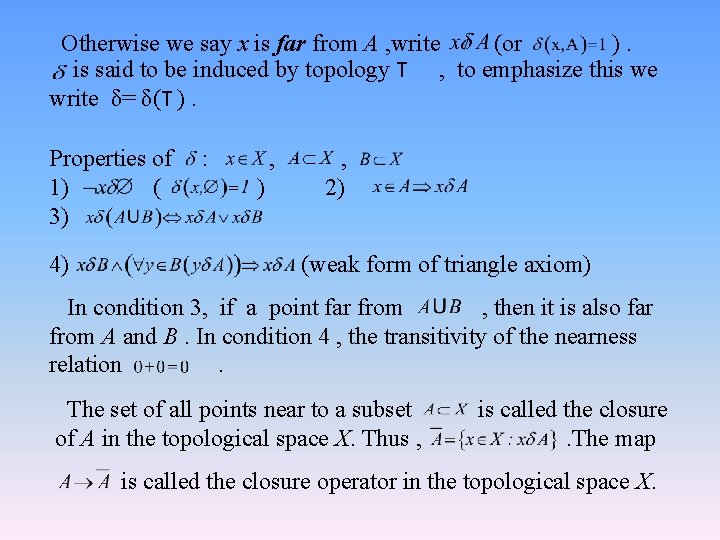
Otherwise we say x is far from A , write (or ). is said to be induced by topology T , to emphasize this we write δ= δ(T ). Properties of 1) ( 3) 4) : , ) , 2) (weak form of triangle axiom) In condition 3, if a point far from , then it is also far from A and B. In condition 4 , the transitivity of the nearness relation. The set of all points near to a subset of A in the topological space X. Thus , is called the closure. The map is called the closure operator in the topological space X.
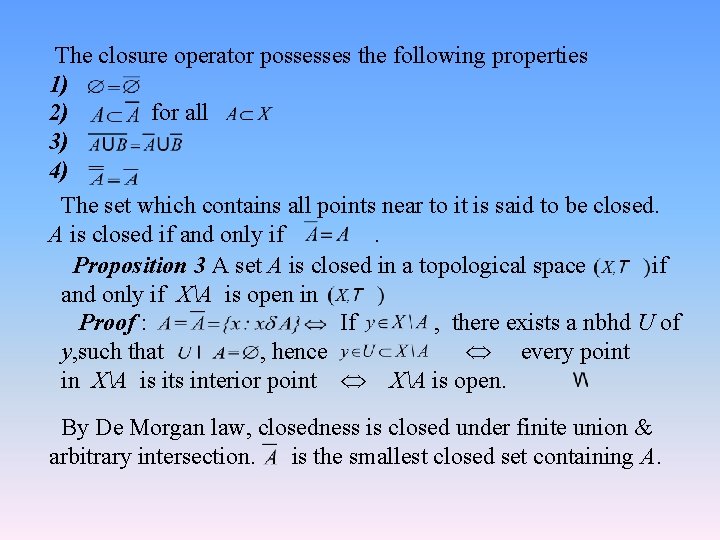
The closure operator possesses the following properties 1) 2) for all 3) 4) The set which contains all points near to it is said to be closed. A is closed if and only if. Proposition 3 A set A is closed in a topological space if and only if XA is open in Proof : If , there exists a nbhd U of y, such that , hence every point in XA is its interior point XA is open. By De Morgan law, closedness is closed under finite union & arbitrary intersection. is the smallest closed set containing A.
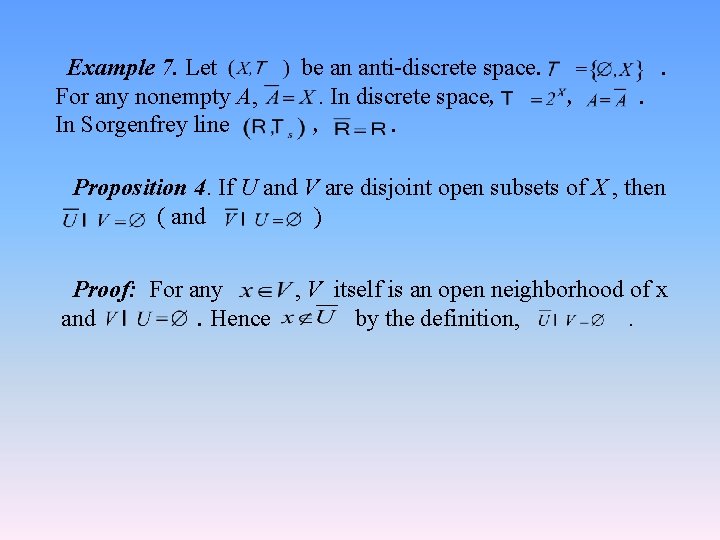
Example 7. Let For any nonempty A, In Sorgenfrey line be an anti-discrete space. . In discrete space, , . Proposition 4. If U and V are disjoint open subsets of X , then ( and ) Proof: For any and. Hence , V itself is an open neighborhood of x by the definition, .
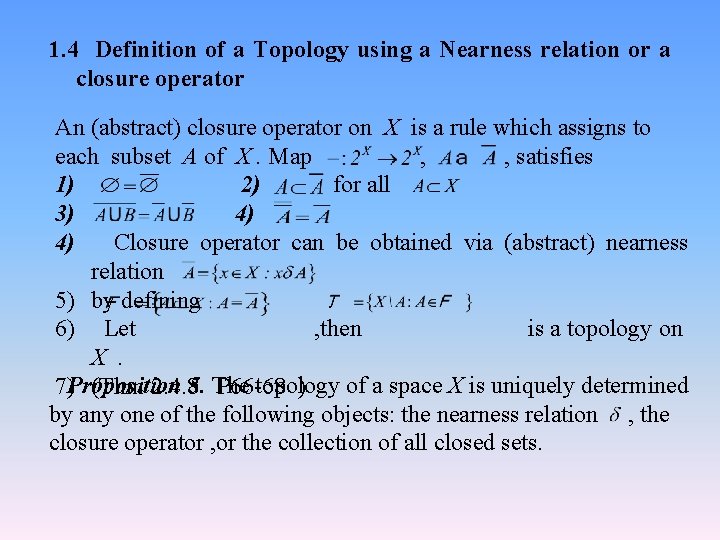
1. 4 Definition of a Topology using a Nearness relation or a closure operator An (abstract) closure operator on X is a rule which assigns to each subset A of X. Map , , satisfies 1) 2) for all 3) 4) 4) Closure operator can be obtained via (abstract) nearness relation 5) by defining. 6) Let , then is a topology on X. topology of a space X is uniquely determined 7)Proposition (Thm 2. 4. 85. The P 66 -68 ) by any one of the following objects: the nearness relation , the closure operator , or the collection of all closed sets.
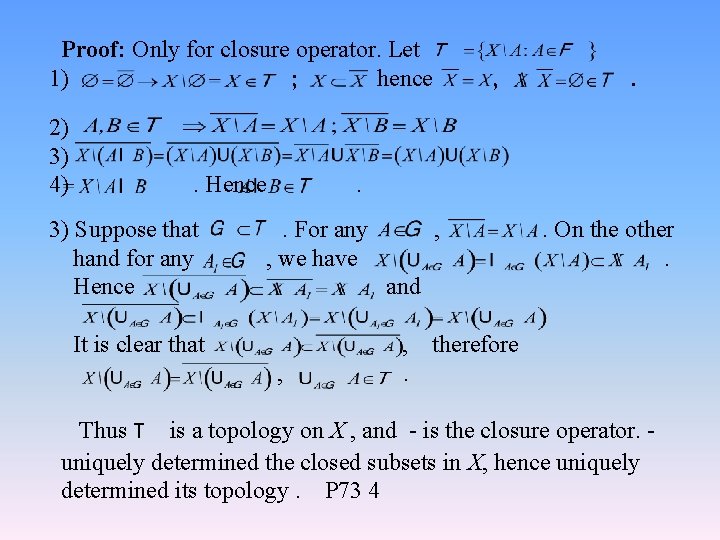
Proof: Only for closure operator. Let 1) ; hence 2) 3) 4) . Hence 3) Suppose that hand for any Hence , . . . For any , we have , . On the other. and It is clear that , , therefore. Thus T is a topology on X , and - is the closure operator. uniquely determined the closed subsets in X, hence uniquely determined its topology. P 73 4
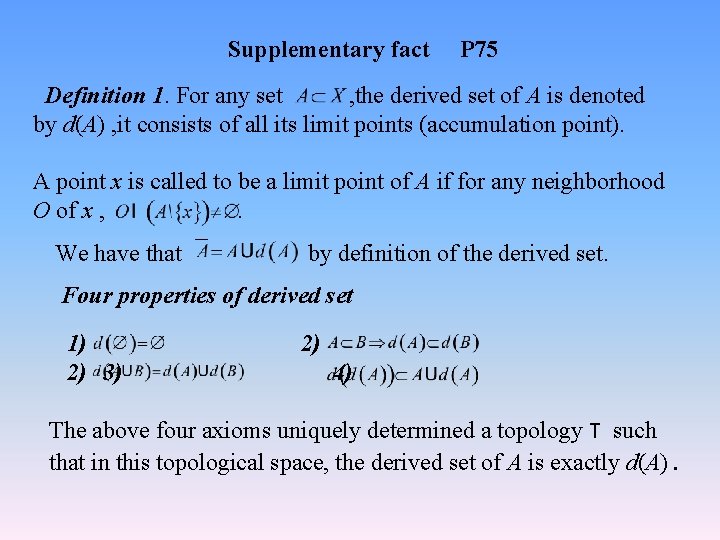
Supplementary fact P 75 Definition 1. For any set , the derived set of A is denoted by d(A) , it consists of all its limit points (accumulation point). A point x is called to be a limit point of A if for any neighborhood O of x , . We have that by definition of the derived set. Four properties of derived set 1) 2) 3) 2) 4) The above four axioms uniquely determined a topology T such that in this topological space, the derived set of A is exactly d(A).
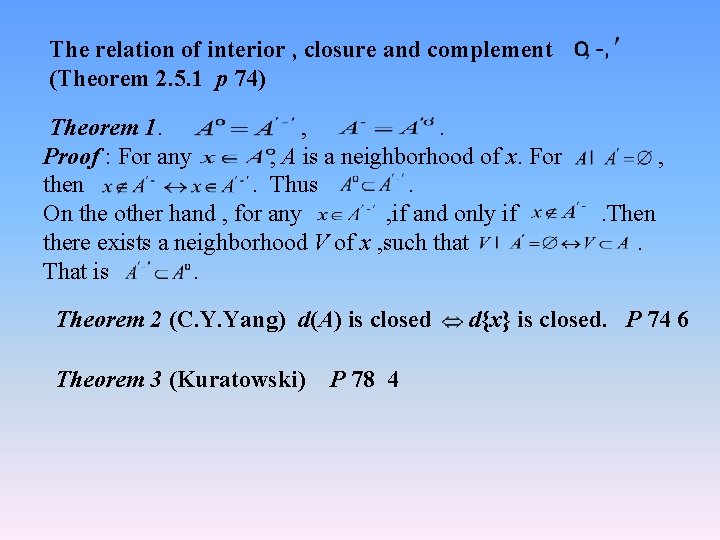
The relation of interior , closure and complement (Theorem 2. 5. 1 p 74) Theorem 1. , . Proof : For any , A is a neighborhood of x. For then. Thus. On the other hand , for any , if and only if there exists a neighborhood V of x , such that That is. Theorem 2 (C. Y. Yang) d(A) is closed Theorem 3 (Kuratowski) P 78 4 , . Then. d{x} is closed. P 74 6
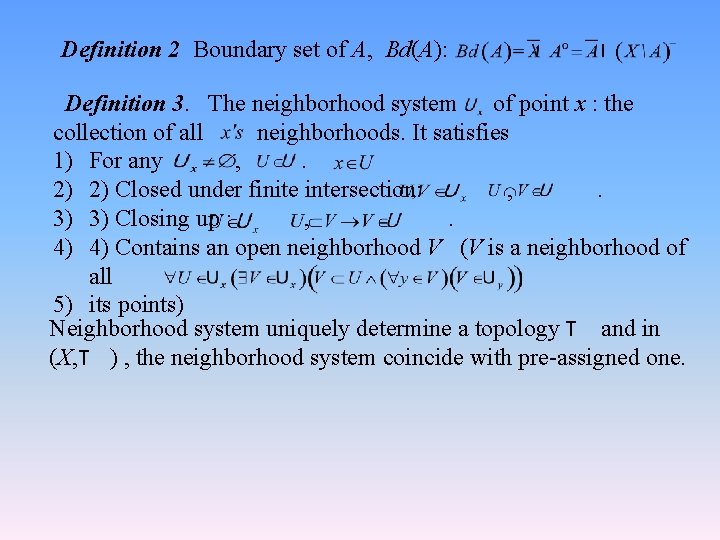
Definition 2 Boundary set of A, Bd(A): Definition 3. The neighborhood system of point x : the collection of all neighborhoods. It satisfies 1) For any , . 2) 2) Closed under finite intersection: , . 3) 3) Closing up : , . 4) 4) Contains an open neighborhood V (V is a neighborhood of all 5) its points) Neighborhood system uniquely determine a topology T and in (X, T ) , the neighborhood system coincide with pre-assigned one.
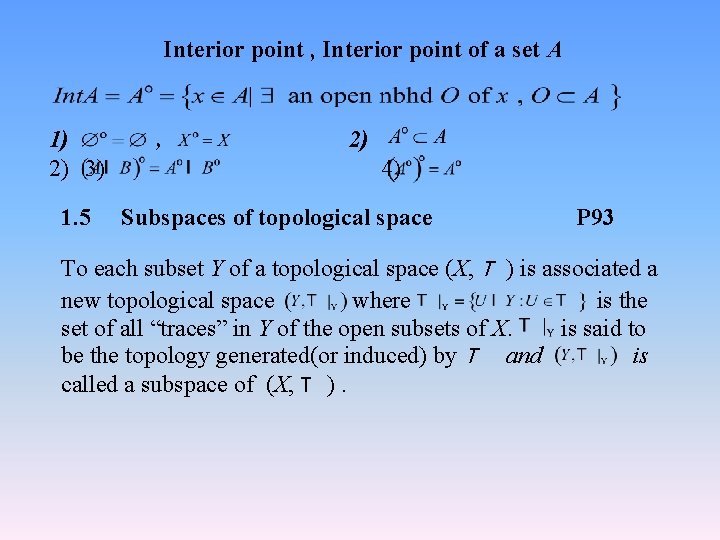
Interior point , Interior point of a set A 1) 2) 3) 1. 5 , 2) 4) Subspaces of topological space P 93 To each subset Y of a topological space (X, T ) is associated a new topological space where is the set of all “traces” in Y of the open subsets of X. is said to be the topology generated(or induced) by T and is called a subspace of (X, T ).
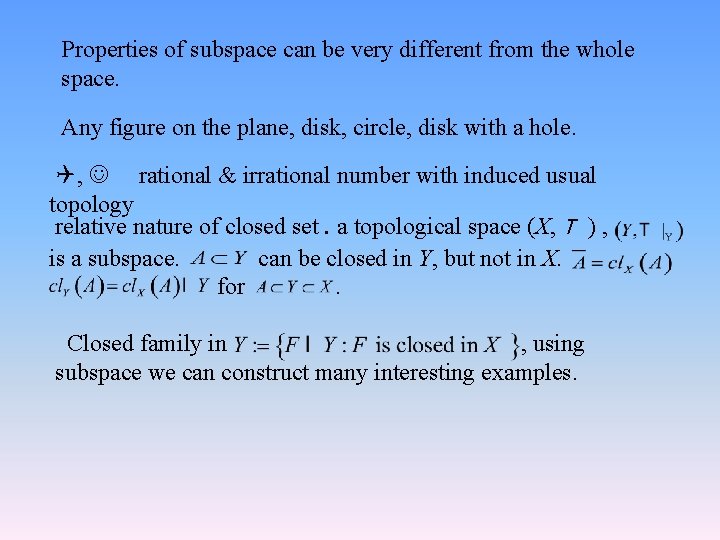
Properties of subspace can be very different from the whole space. Any figure on the plane, disk, circle, disk with a hole. Q, J rational & irrational number with induced usual topology relative nature of closed set. a topological space (X, T ) , is a subspace. can be closed in Y, but not in X. for. Closed family in , using subspace we can construct many interesting examples.
Example 8. (The Cantor perfect set) We use the word segment to refer to a set of the form and interval to refer to a set of the form. = segment , is a union of a finite number of pairwise disjoint segment. denote set obtained by removing from each segment of the middle interval. Then we will get a decreasing sequence. of the line R is called the Cantor perfect set. C is closed, has no isolated points, but does not contain any interval , uncountable and measure 0. If B is a base for (X, T subspace. ) , then P 99 2 , 9 is a base for
1. 6 The free Sum of Topological Spaces Let be a collection of topological spaces and let denote the topology of. Suppose first that the sets are pair-wise disjoint. Then is a base of a topology T on the set because B covers X and is closed with respect to finite intersection. The topological space (X, T ) is called the free sum of the spaces over. They are denoted by , . is an open subspace of X and also closed because is open. Thus the subspaces are disjoint open-closed “slices” of X. Even if some intersect, we can put in different layers as follows
Each is identical with We define the free sum This is very useful instruction. with topology to be Put any collection of space in a single space preserves many properties of its member, easy for comparison. Can not do it in the category topology groups. Linear topology spaces or other topology. Algebraic categories
1. 7 Centered Collections of Sets and Convergence in topological Spaces Definition 6. A collection (system) of subsets of a set X is said to be centered if the intersection of any finite number of its elements is nonempty: . It is clear that every element of a centered collection of sets must be nonempty. Chain of sets : then. Any chain of nonempty sets is centered x is adherent to if x belongs to the closure of each element of , . we also say that is adherent to x. Definition 7. A centered collection of subsets of a set X converges to a point in a topological space (X, T ) if for each nbhd of the point there exists an element A of the collection contained in.
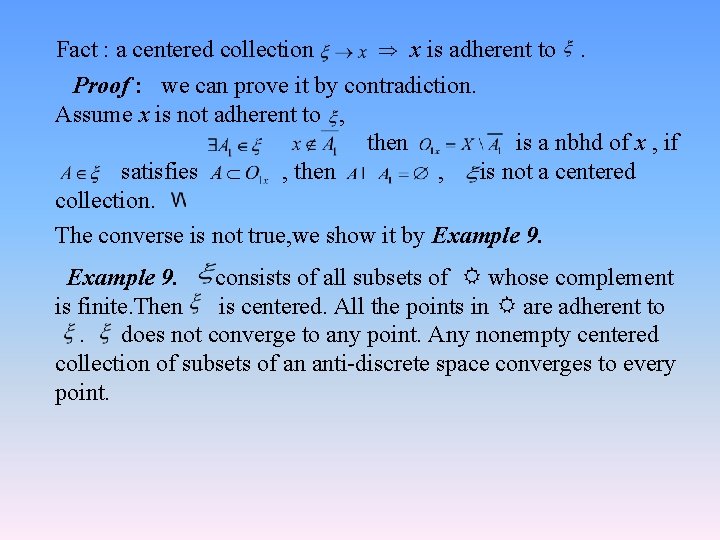
Fact : a centered collection x is adherent to. Proof : we can prove it by contradiction. Assume x is not adherent to , then is a nbhd of x , if satisfies , then , is not a centered collection. The converse is not true, we show it by Example 9. consists of all subsets of R whose complement is finite. Then is centered. All the points in R are adherent to. does not converge to any point. Any nonempty centered collection of subsets of an anti-discrete space converges to every point.
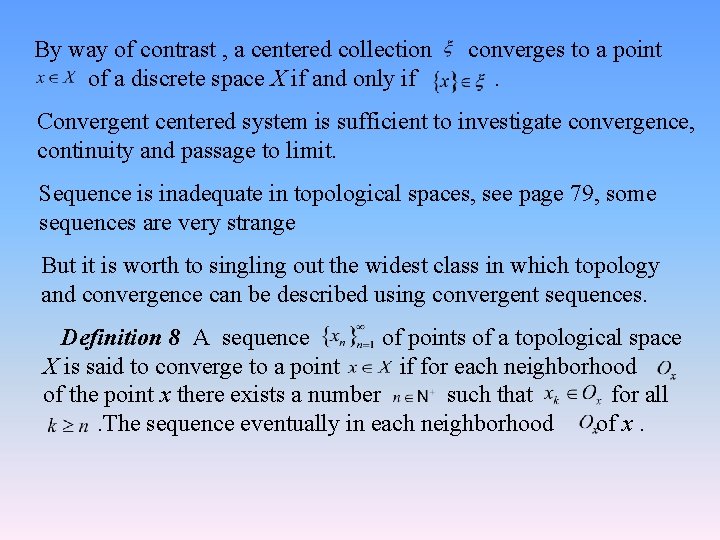
By way of contrast , a centered collection of a discrete space X if and only if converges to a point. Convergent centered system is sufficient to investigate convergence, continuity and passage to limit. Sequence is inadequate in topological spaces, see page 79, some sequences are very strange But it is worth to singling out the widest class in which topology and convergence can be described using convergent sequences. Definition 8 A sequence of points of a topological space X is said to converge to a point if for each neighborhood of the point x there exists a number such that for all. The sequence eventually in each neighborhood of x.
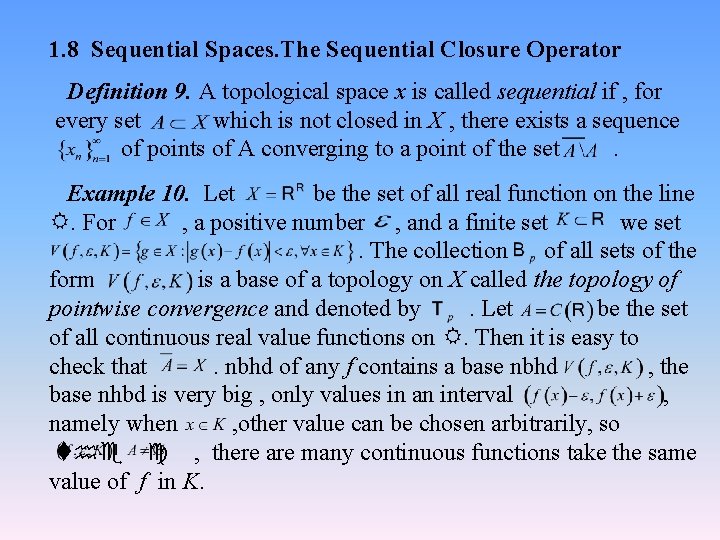
1. 8 Sequential Spaces. The Sequential Closure Operator Definition 9. A topological space x is called sequential if , for every set which is not closed in X , there exists a sequence of points of A converging to a point of the set. Example 10. Let be the set of all real function on the line R. For , a positive number , and a finite set we set. The collection of all sets of the form is a base of a topology on X called the topology of pointwise convergence and denoted by. Let be the set of all continuous real value functions on R. Then it is easy to check that. nbhd of any f contains a base nbhd , the base nhbd is very big , only values in an interval , namely when , other value can be chosen arbitrarily, so the c , there are many continuous functions take the same value of f in K.
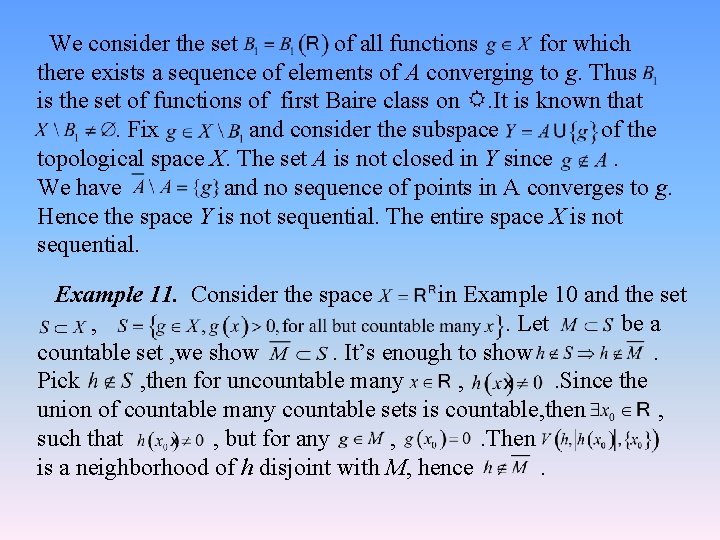
We consider the set of all functions for which there exists a sequence of elements of A converging to g. Thus is the set of functions of first Baire class on R. It is known that. Fix and consider the subspace of the topological space X. The set A is not closed in Y since. We have and no sequence of points in A converges to g. Hence the space Y is not sequential. The entire space X is not sequential. Example 11. Consider the space in Example 10 and the set , . Let be a countable set , we show. It’s enough to show. Pick , then for uncountable many , . Since the union of countable many countable sets is countable, then , such that , but for any , . Then is a neighborhood of h disjoint with M, hence.
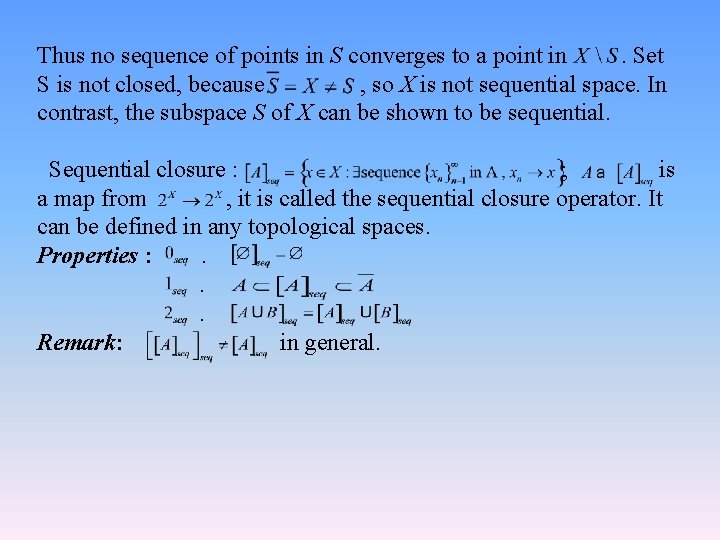
Thus no sequence of points in S converges to a point in. Set S is not closed, because , so X is not sequential space. In contrast, the subspace S of X can be shown to be sequential. Sequential closure : ; is a map from , it is called the sequential closure operator. It can be defined in any topological spaces. Properties : . . . Remark: in general.
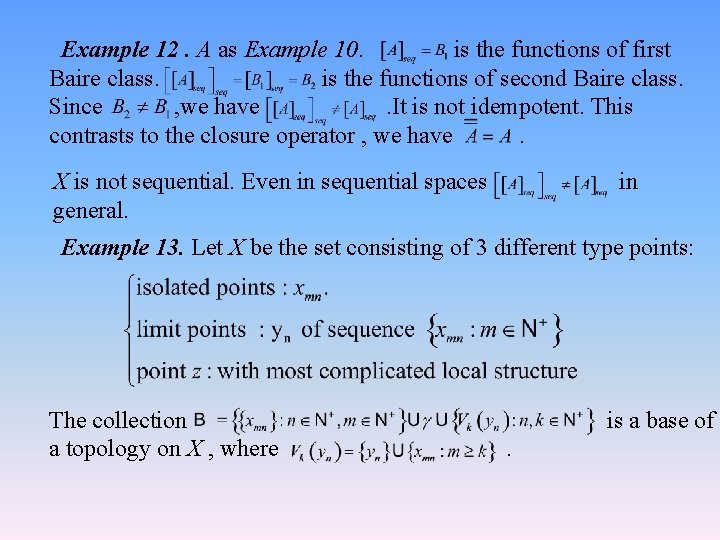
Example 12. A as Example 10. is the functions of first Baire class. is the functions of second Baire class. Since , we have. It is not idempotent. This contrasts to the closure operator , we have. X is not sequential. Even in sequential spaces general. in Example 13. Let X be the set consisting of 3 different type points: The collection a topology on X , where is a base of.
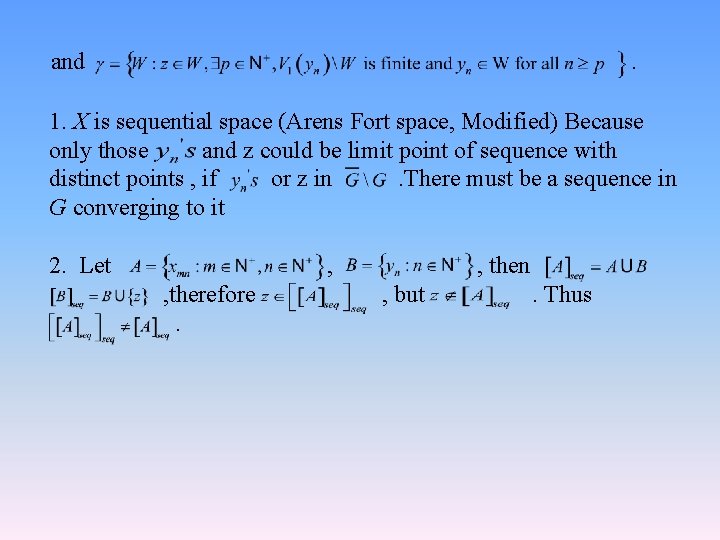
and . 1. X is sequential space (Arens Fort space, Modified) Because only those and z could be limit point of sequence with distinct points , if or z in. There must be a sequence in G converging to it 2. Let , , therefore. , then , but . Thus
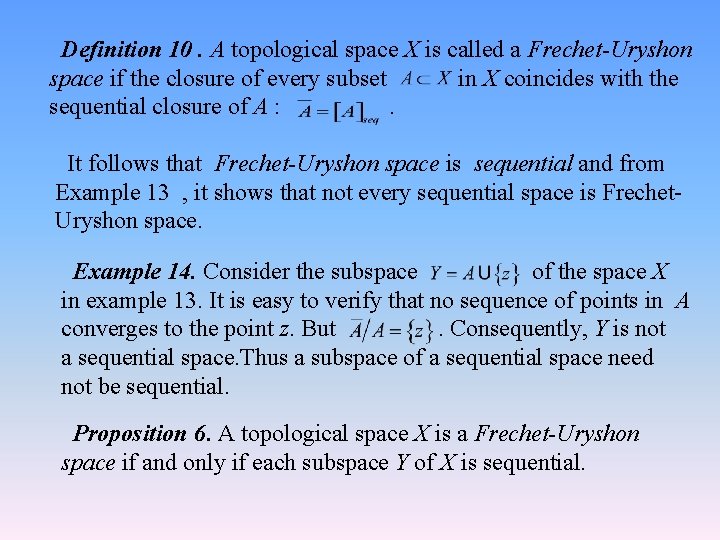
Definition 10. A topological space X is called a Frechet-Uryshon space if the closure of every subset in X coincides with the sequential closure of A : . It follows that Frechet-Uryshon space is sequential and from Example 13 , it shows that not every sequential space is Frechet. Uryshon space. Example 14. Consider the subspace of the space X in example 13. It is easy to verify that no sequence of points in A converges to the point z. But. Consequently, Y is not a sequential space. Thus a subspace of a sequential space need not be sequential. Proposition 6. A topological space X is a Frechet-Uryshon space if and only if each subspace Y of X is sequential.
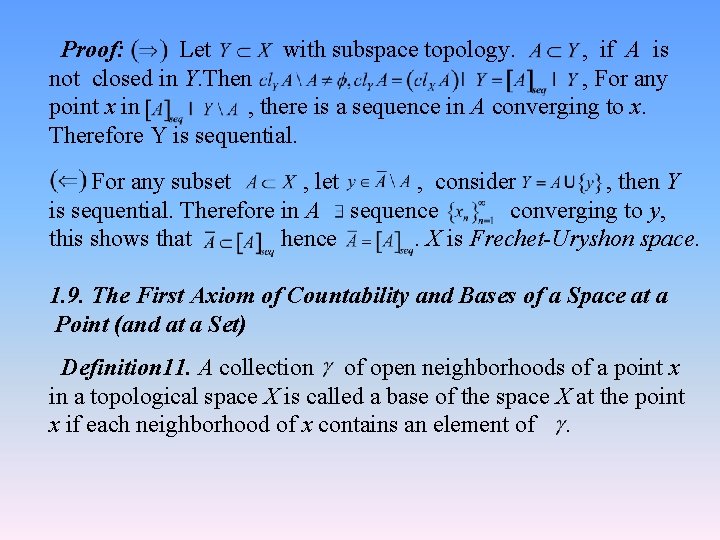
Proof: Let with subspace topology. , if A is not closed in Y. Then , For any point x in , there is a sequence in A converging to x. Therefore Y is sequential. For any subset , let , consider , then Y is sequential. Therefore in A sequence converging to y, this shows that hence. X is Frechet-Uryshon space. 1. 9. The First Axiom of Countability and Bases of a Space at a Point (and at a Set) Definition 11. A collection of open neighborhoods of a point x in a topological space X is called a base of the space X at the point x if each neighborhood of x contains an element of.
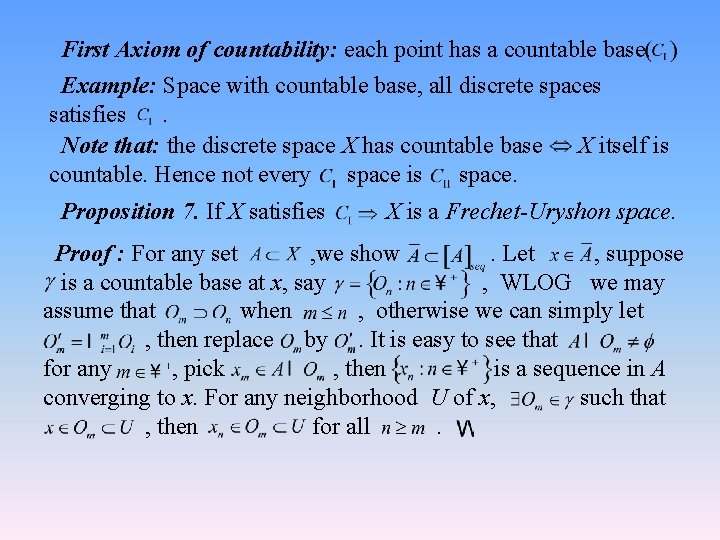
First Axiom of countability: each point has a countable base. Example: Space with countable base, all discrete spaces satisfies. Note that: the discrete space X has countable base X itself is countable. Hence not every space is space. Proposition 7. If X satisfies X is a Frechet-Uryshon space. Proof : For any set , we show. Let , suppose is a countable base at x, say , WLOG we may assume that when , otherwise we can simply let , then replace by. It is easy to see that for any , pick , then is a sequence in A converging to x. For any neighborhood U of x, such that , then for all.
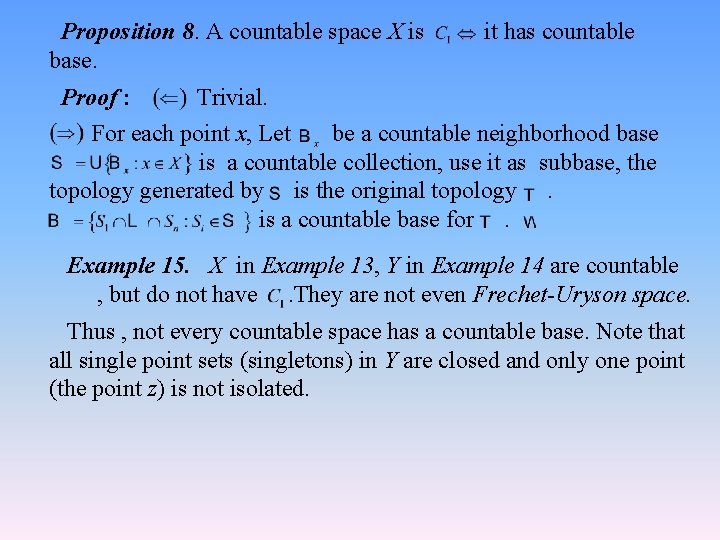
Proposition 8. A countable space X is base. it has countable Proof : Trivial. For each point x, Let be a countable neighborhood base is a countable collection, use it as subbase, the topology generated by is the original topology. is a countable base for. Example 15. X in Example 13, Y in Example 14 are countable , but do not have. They are not even Frechet-Uryson space. Thus , not every countable space has a countable base. Note that all single point sets (singletons) in Y are closed and only one point (the point z) is not isolated.
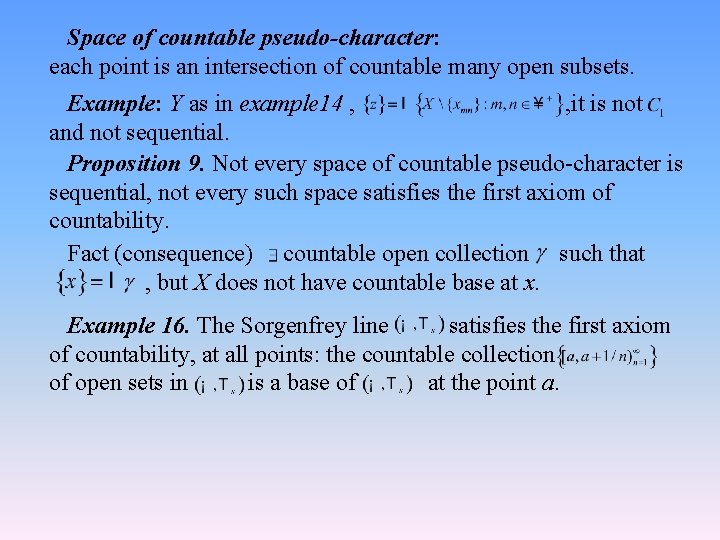
Space of countable pseudo-character: each point is an intersection of countable many open subsets. Example: Y as in example 14 , , it is not and not sequential. Proposition 9. Not every space of countable pseudo-character is sequential, not every such space satisfies the first axiom of countability. Fact (consequence) countable open collection such that , but X does not have countable base at x. Example 16. The Sorgenfrey line satisfies the first axiom of countability, at all points: the countable collection of open sets in is a base of at the point a.
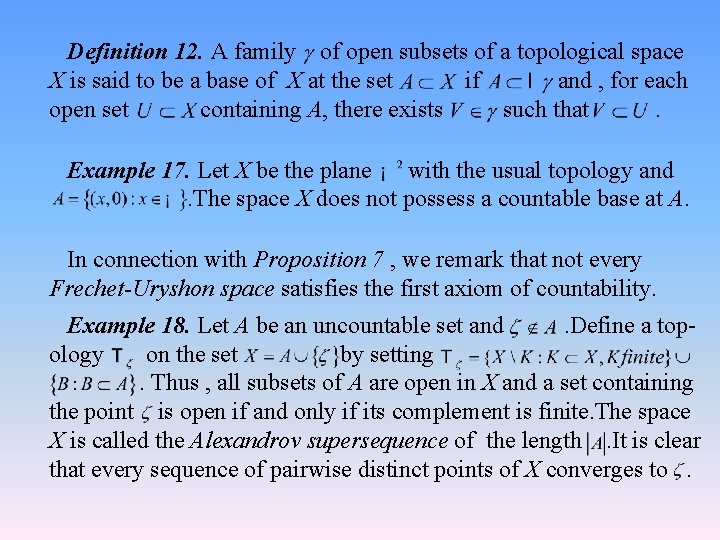
Definition 12. A family of open subsets of a topological space X is said to be a base of X at the set if and , for each open set containing A, there exists such that. Example 17. Let X be the plane with the usual topology and. The space X does not possess a countable base at A. In connection with Proposition 7 , we remark that not every Frechet-Uryshon space satisfies the first axiom of countability. Example 18. Let A be an uncountable set and. Define a topology on the set by setting. Thus , all subsets of A are open in X and a set containing the point is open if and only if its complement is finite. The space X is called the Alexandrov supersequence of the length. It is clear that every sequence of pairwise distinct points of X converges to.
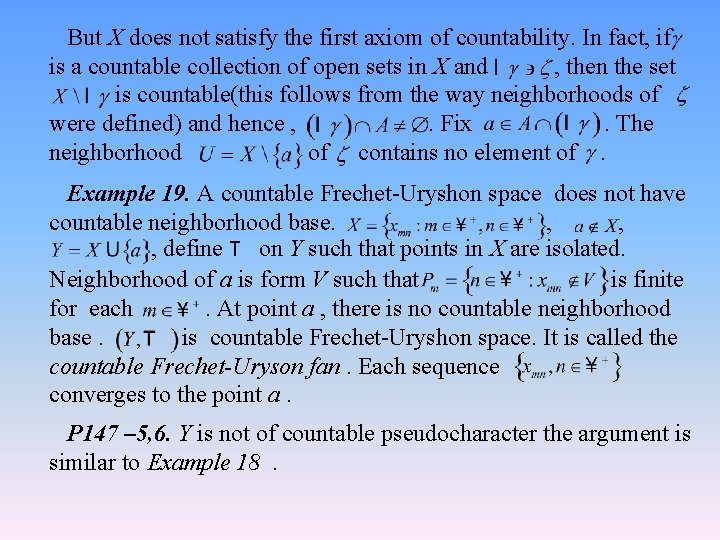
But X does not satisfy the first axiom of countability. In fact, if is a countable collection of open sets in X and , then the set is countable(this follows from the way neighborhoods of were defined) and hence , . Fix. The neighborhood of contains no element of. Example 19. A countable Frechet-Uryshon space does not have countable neighborhood base. , , , define T on Y such that points in X are isolated. Neighborhood of a is form V such that is finite for each. At point a , there is no countable neighborhood base. is countable Frechet-Uryshon space. It is called the countable Frechet-Uryson fan. Each sequence converges to the point a. P 147 – 5, 6. Y is not of countable pseudocharacter the argument is similar to Example 18.
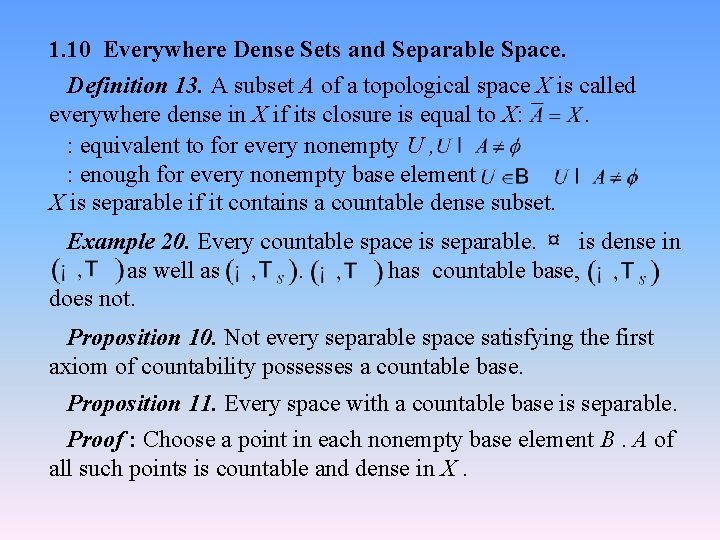
1. 10 Everywhere Dense Sets and Separable Space. Definition 13. A subset A of a topological space X is called everywhere dense in X if its closure is equal to X: . : equivalent to for every nonempty U , : enough for every nonempty base element X is separable if it contains a countable dense subset. Example 20. Every countable space is separable. is dense in as well as. has countable base, does not. Proposition 10. Not every separable space satisfying the first axiom of countability possesses a countable base. Proposition 11. Every space with a countable base is separable. Proof : Choose a point in each nonempty base element B. A of all such points is countable and dense in X.
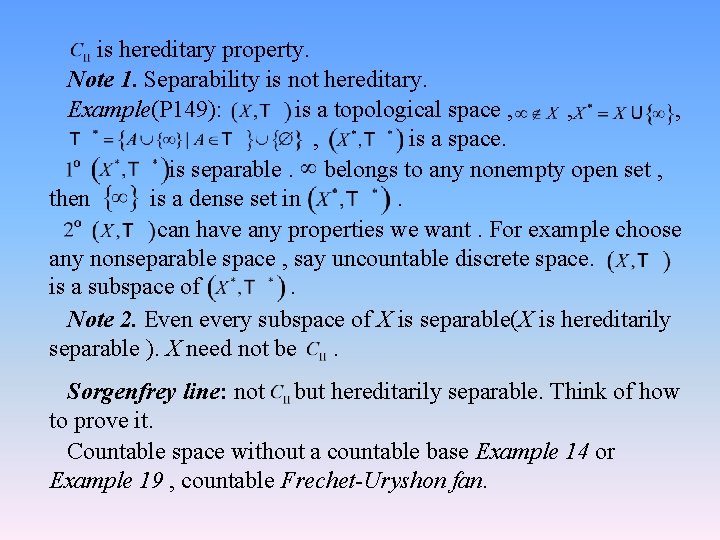
is hereditary property. Note 1. Separability is not hereditary. Example(P 149): is a topological space , , is a space. is separable. belongs to any nonempty open set , then is a dense set in. can have any properties we want. For example choose any nonseparable space , say uncountable discrete space. is a subspace of. Note 2. Even every subspace of X is separable(X is hereditarily separable ). X need not be. Sorgenfrey line: not but hereditarily separable. Think of how to prove it. Countable space without a countable base Example 14 or Example 19 , countable Frechet-Uryshon fan.
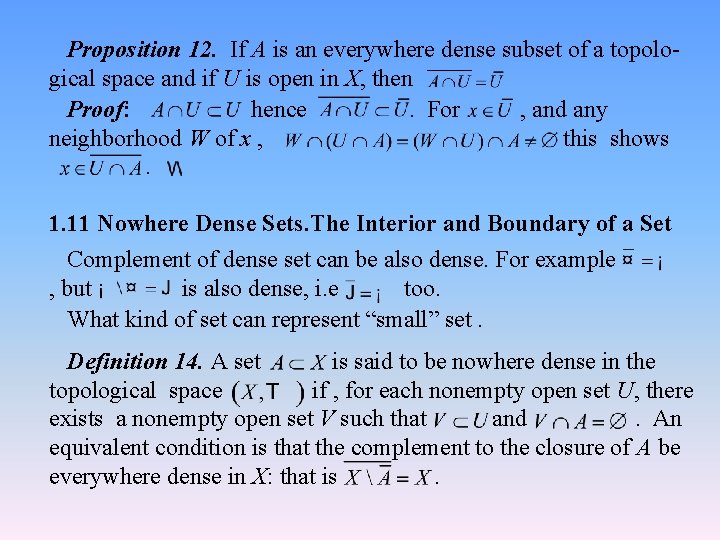
Proposition 12. If A is an everywhere dense subset of a topological space and if U is open in X, then Proof: hence. For , and any neighborhood W of x , this shows. 1. 11 Nowhere Dense Sets. The Interior and Boundary of a Set Complement of dense set can be also dense. For example , but is also dense, i. e too. What kind of set can represent “small” set. Definition 14. A set is said to be nowhere dense in the topological space if , for each nonempty open set U, there exists a nonempty open set V such that and. An equivalent condition is that the complement to the closure of A be everywhere dense in X: that is.
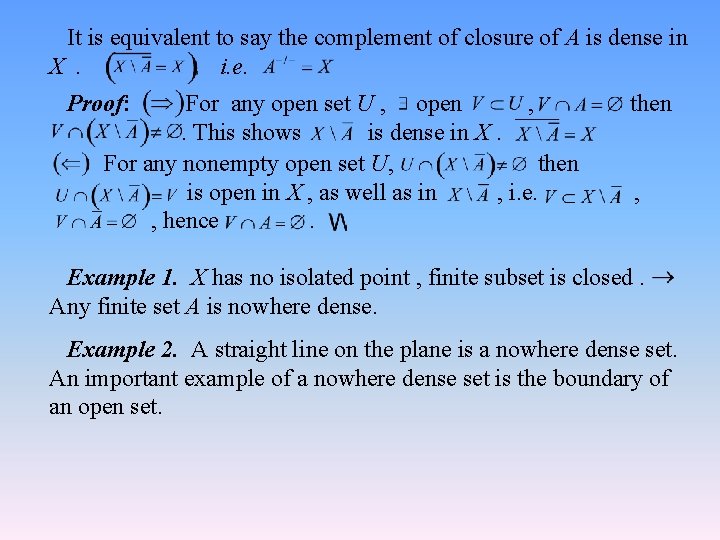
It is equivalent to say the complement of closure of A is dense in X. i. e. Proof: For any open set U , open , . This shows is dense in X. For any nonempty open set U, then is open in X , as well as in , i. e. , hence. then , Example 1. X has no isolated point , finite subset is closed. Any finite set A is nowhere dense. Example 2. A straight line on the plane is a nowhere dense set. An important example of a nowhere dense set is the boundary of an open set.
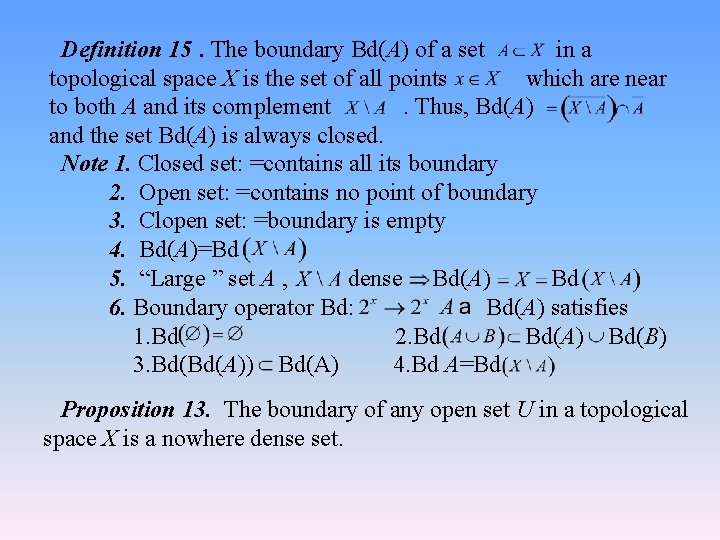
Definition 15. The boundary Bd(A) of a set in a topological space X is the set of all points which are near to both A and its complement. Thus, Bd(A) and the set Bd(A) is always closed. Note 1. Closed set: =contains all its boundary 2. Open set: =contains no point of boundary 3. Clopen set: =boundary is empty 4. Bd(A)=Bd 5. “Large ” set A , dense Bd(A) Bd 6. Boundary operator Bd: Bd(A) satisfies 1. Bd 2. Bd Bd(A) Bd(B) 3. Bd(Bd(A)) Bd(A) 4. Bd A=Bd Proposition 13. The boundary of any open set U in a topological space X is a nowhere dense set.
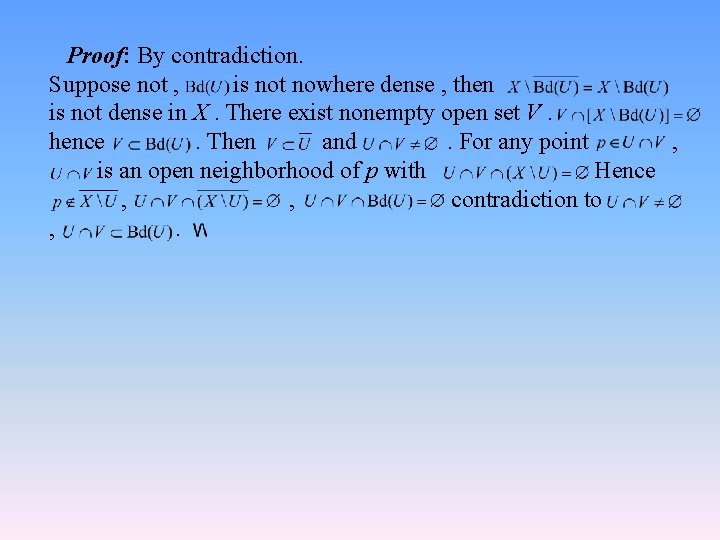
Proof: By contradiction. Suppose not , is not nowhere dense , then is not dense in X. There exist nonempty open set V. hence. Then and. For any point , is an open neighborhood of p with. Hence , , contradiction to , .
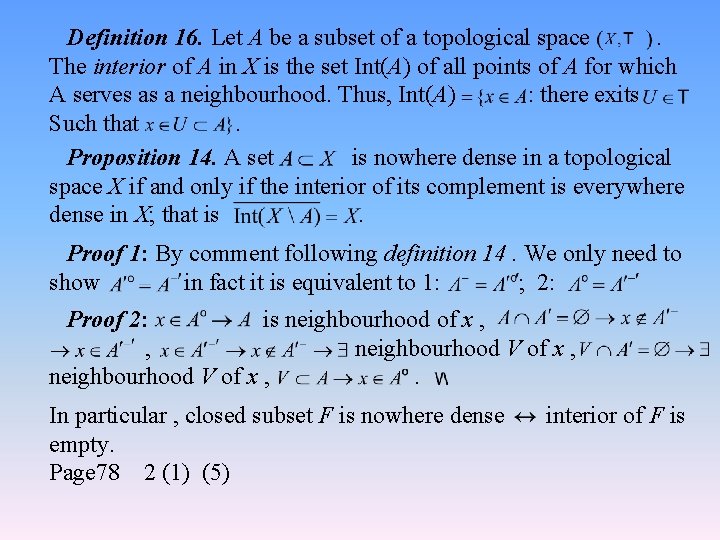
Definition 16. Let A be a subset of a topological space. The interior of A in X is the set Int(A) of all points of A for which A serves as a neighbourhood. Thus, Int(A) : there exits Such that. Proposition 14. A set is nowhere dense in a topological space X if and only if the interior of its complement is everywhere dense in X; that is. Proof 1: By comment following definition 14. We only need to show in fact it is equivalent to 1: ; 2: Proof 2: is neighbourhood of x , , neighbourhood V of x , . In particular , closed subset F is nowhere dense empty. Page 78 2 (1) (5) interior of F is
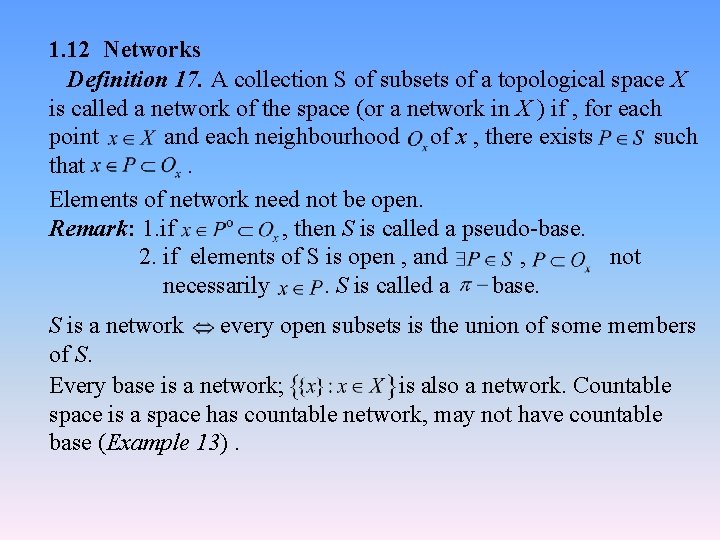
1. 12 Networks Definition 17. A collection S of subsets of a topological space X is called a network of the space (or a network in X ) if , for each point and each neighbourhood of x , there exists such that. Elements of network need not be open. Remark: 1. if , then S is called a pseudo-base. 2. if elements of S is open , and , not necessarily. S is called a base. S is a network every open subsets is the union of some members of S. Every base is a network; is also a network. Countable space is a space has countable network, may not have countable base (Example 13).
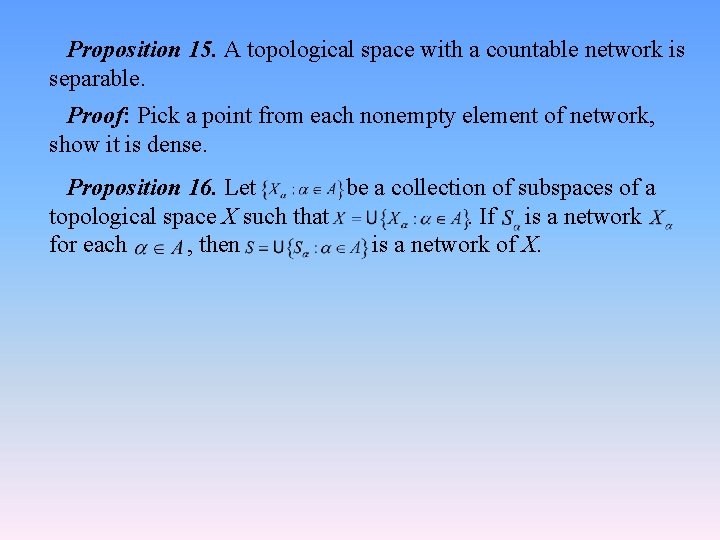
Proposition 15. A topological space with a countable network is separable. Proof: Pick a point from each nonempty element of network, show it is dense. Proposition 16. Let be a collection of subspaces of a topological space X such that. If is a network for each , then is a network of X.