
General Theory of Relativity Boundaries in Physics Today
General Theory of Relativity
‘Boundaries” in Physics • Today we start to cross a second threshold between three types of physics (common to all sciences): – Observational – Experimental – Theoretical • Each of the above relies upon the others, and none stands entirely on its own.
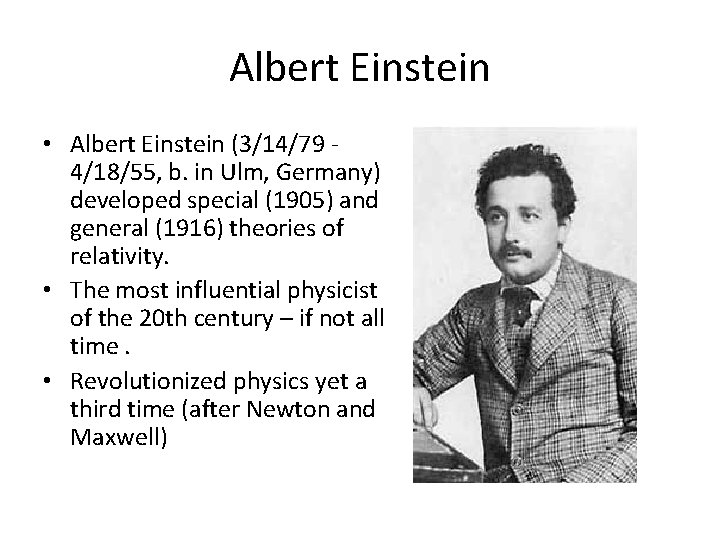
Albert Einstein • Albert Einstein (3/14/79 4/18/55, b. in Ulm, Germany) developed special (1905) and general (1916) theories of relativity. • The most influential physicist of the 20 th century – if not all time. • Revolutionized physics yet a third time (after Newton and Maxwell)
Einstein • Best known for E=mc 2 • 1905 Annus Mirabilis: • In this article he noted that Newtonian mechanics could not be – Brownian motion reconciled with – Special relativity Maxwell’s work. – Photoelectric effect • His 1905 paper “On the • Received the 1921 Nobel Prize in Physics for the Electrodynamics of photoelectric effect. Moving Bodies” was the • Established the basis for birth and source of quantum mechanics. Special relativity.
Einstein • He realized after creating Special Relativity that the principle of equivalence could also be extended to gravitational fields. • He published his General Theory of Relativity in 1916.
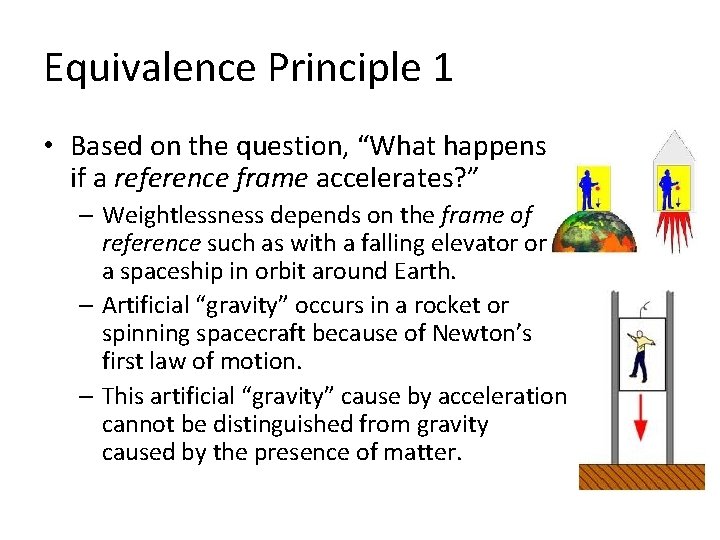
Equivalence Principle 1 • Based on the question, “What happens if a reference frame accelerates? ” – Weightlessness depends on the frame of reference such as with a falling elevator or a spaceship in orbit around Earth. – Artificial “gravity” occurs in a rocket or spinning spacecraft because of Newton’s first law of motion. – This artificial “gravity” cause by acceleration cannot be distinguished from gravity caused by the presence of matter.
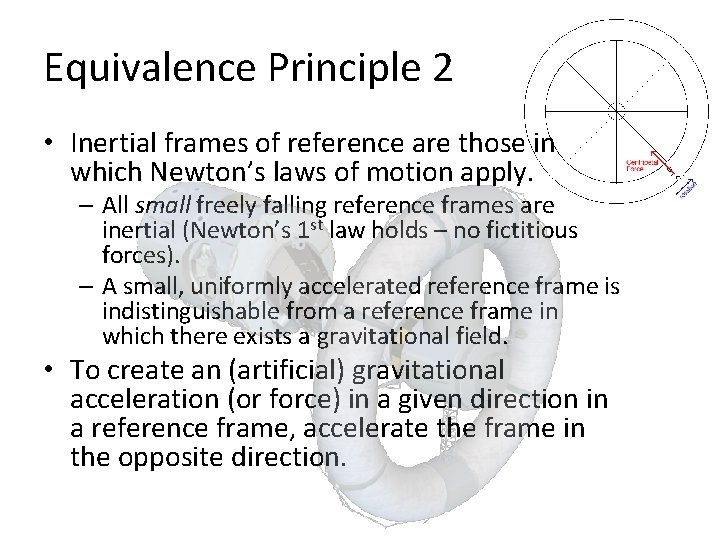
Equivalence Principle 2 • Inertial frames of reference are those in which Newton’s laws of motion apply. – All small freely falling reference frames are inertial (Newton’s 1 st law holds – no fictitious forces). – A small, uniformly accelerated reference frame is indistinguishable from a reference frame in which there exists a gravitational field. • To create an (artificial) gravitational acceleration (or force) in a given direction in a reference frame, accelerate the frame in the opposite direction.
Consequences of Equivalence Principle • Prediction: Deflection of Light’s Path – An apple thrown or light beam shot across the short axis of accelerating rocket is deflected. • Prediction: Gravitational Doppler Shift – When moving against a gravitational field, light loses energy (E = hc/λ) while speed remains constant. • Prediction: Gravitational Time Dilation – Note that λ/T = c. (Recall that λf=c and f=1/T). If λ increases, then T increases. Gravity slows clocks.
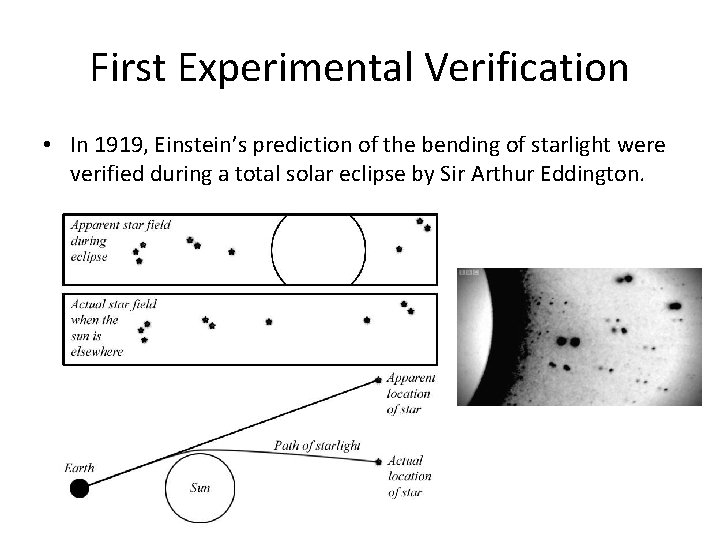
First Experimental Verification • In 1919, Einstein’s prediction of the bending of starlight were verified during a total solar eclipse by Sir Arthur Eddington.
Consequences of Matter’s Presence • Gravity distorts space, introducing fictitious forces – two apples following to Earth center. • Gravity distorts space changing world lines. – Flat space – Positively curved space – Negatively curved space • Curved space has “higher dimensionality” – consider Edwin Abbott’s Flatland
Consequences of Space Curvature • Flat or zero curvature: – Triangles = 180 degrees; parallel lines are parallel; one can travel in a straight line indefinitely, space unbounded • Positive curvature: – Triangles > 180 degrees, “parallel” lines converge, travel in a straight line and end up at start, space bounded • Negative curvature: – Triangles < 180 degrees, “parallel” lines diverge, travel in a straight line indefinitely, space unbounded • “Miracles” become understandable (Abbott)
Experimental Tests of GTR • Precession of the perihelion of Mercury – Explained that not explained by classical mechanics • Deflection of star light – Verified in 1919 solar eclipse • Gravitational reddening of Sirius B – Verified by spectral studies of the white dwarf star • Gravitational waves – Verified using binary pulsar and decay of period • Global positioning systems – GTR corrections required for onboard orbiting clocks
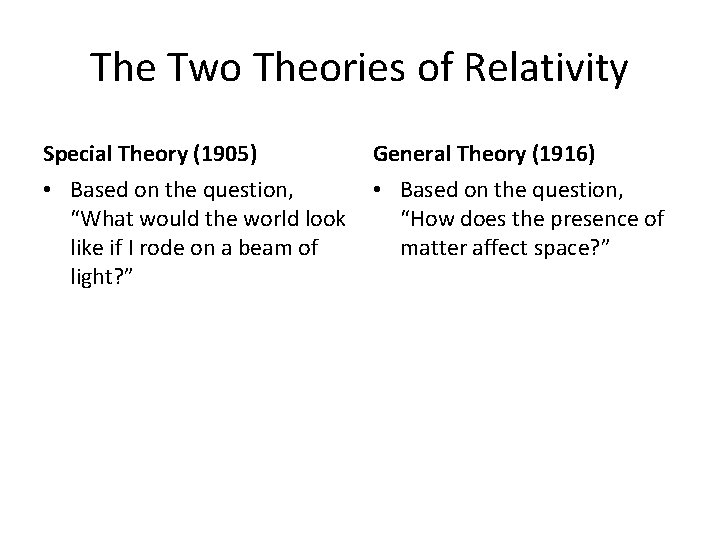
The Two Theories of Relativity Special Theory (1905) General Theory (1916) • Based on the question, “What would the world look like if I rode on a beam of light? ” • Based on the question, “How does the presence of matter affect space? ”
- Slides: 13