
general theory of ecology DEFINITIONS OF ECOLOGY Odum
- Slides: 16
general theory of ecology
DEFINITIONS OF ECOLOGY
Odum (1971) • study of the structure and function of nature
Mc. Naughton and Wolf (1973) • scientific study of the relationships between organisms and their environments
Ricklefs (1979) • study of the natural environment, particularly the interrelationships between organisms and their surroundings
Colinvaux (1986) • study of animals and plants in relation to their habits and habitats
Ehrlich and Roughgarden (1987) • study of the relationship between organisms and their physical and biological environments
Stiling (1992) • study of interactions between organisms and their environments
Dodson et al. (1998) • study of the relationships, distribution, and abundance of organisms, or groups of organisms, in an environment
Krebs (2001) • scientific study of the interactions that determine the distribution and abundance of organisms
Begon et al. (2006) • scientific study of the interactions between organisms and their environment
Gurevitch et al. (2006) • study of the relationships between living organisms and their environments, the interactions of organisms with one another, and the patterns and causes of the abundance and distribution of organisms in nature
Samuel M. Scheiner & Michael R. Willig • Study of the spatial and temporal patterns of the distribution and abundance of organisms, including causes and consequences
The domain of ecology is • the spatial and temporal patterns of the distribution and abundance of organisms, including causes and consequences.
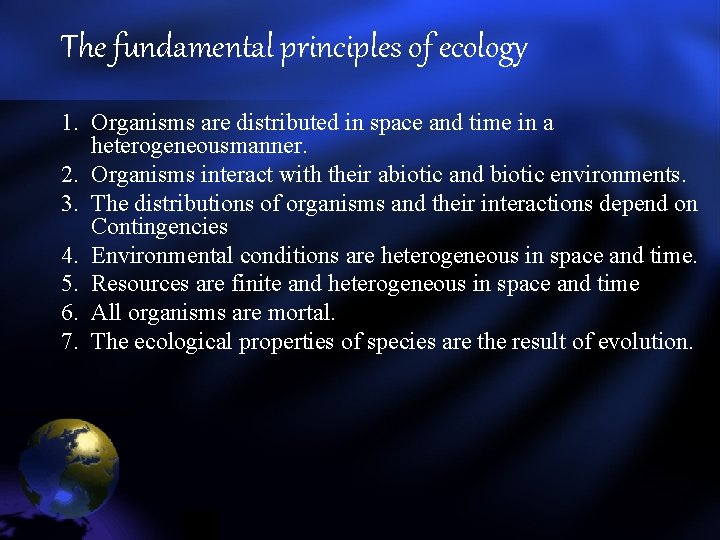
The fundamental principles of ecology 1. Organisms are distributed in space and time in a heterogeneousmanner. 2. Organisms interact with their abiotic and biotic environments. 3. The distributions of organisms and their interactions depend on Contingencies 4. Environmental conditions are heterogeneous in space and time. 5. Resources are finite and heterogeneous in space and time 6. All organisms are mortal. 7. The ecological properties of species are the result of evolution.
References • Lawton JH (1999) Are there general laws in ecology? Oikos 84: 177– 192 • Turchin P (2001) Does population ecology have general laws? Oikos 94: 17– 26 • Simberloff D (2004) Community ecology: is it time to move on? Am Nat 163: 787– 799 • Begon M, Townsend CR, Harper JL (2006) Ecology, 4 th edn. Blackwell, Oxford