
General Survey Measurement Vital Signs Chapter 9 Elsevier


- Slides: 82
General Survey, Measurement, Vital Signs Chapter 9 Elsevier items and derived items © 2012, 2008, 2004, 2000, 1996, 1992 by Saunders, an imprint of Elsevier Inc.
Chapter 9: General Survey, Measurement, Vital Signs General Survey The general survey is a study of whole person Ø Covers general health state and any obvious physical characteristics • An introduction for physical examination that will follow; should give an overall impression, a “gestalt, ” of person • Objective parameters are used to form general survey, but these apply to whole person, not just to one body system Elsevier items and derived items © 2012, 2008, 2004, 2000, 1996, 1992 by Saunders, an imprint of Elsevier Inc. Slide 9 -2
Chapter 9: General Survey, Measurement, Vital Signs General Survey Launch a general survey at moment you first encounter person Ø What leaves an immediate impression? Does person stand promptly as his or her name called and walk easily to meet you? • Or does person look sick, rising slowly or with effort, with shoulders slumped and eyes without luster or downcast? • Is hospitalized patient conversing with visitors, involved in reading or television, or lying perfectly still? • Even as you introduce yourself and shake hands, you collect data Elsevier items and derived items © 2012, 2008, 2004, 2000, 1996, 1992 by Saunders, an imprint of Elsevier Inc. Slide 9 -3
Chapter 9: General Survey, Measurement, Vital Signs General Survey Launch a general survey at moment you first encounter person (cont. ) Does person fully extend the arm, shake your hand firmly, make eye contact, or smile? Are palms dry or wet and clammy? Ø As you proceed through health history, measurements, and vital signs, note following points that will add up to general survey. Ø Consider these four areas: physical appearance, body structure, mobility, and behavior Ø Elsevier items and derived items © 2012, 2008, 2004, 2000, 1996, 1992 by Saunders, an imprint of Elsevier Inc. Slide 9 -4
Chapter 9: General Survey, Measurement, Vital Signs Objective Data Physical appearance Age: person appears his or her stated age Ø Sex: sexual development appropriate for gender and age Ø Level of consciousness: person alert and oriented, attends to your questions and responds appropriately Ø Skin color: color tone even, pigmentation varying with genetic background, skin intact with no obvious lesions Ø Elsevier items and derived items © 2012, 2008, 2004, 2000, 1996, 1992 by Saunders, an imprint of Elsevier Inc. Slide 9 -5
Chapter 9: General Survey, Measurement, Vital Signs Objective Data Physical appearance (cont. ) Facial features: symmetric with movement Ø No signs of acute distress present Ø Elsevier items and derived items © 2012, 2008, 2004, 2000, 1996, 1992 by Saunders, an imprint of Elsevier Inc. Slide 9 -6
Chapter 9: General Survey, Measurement, Vital Signs Objective Data Body structure Stature: height appears within normal range for age, genetic heritage Ø Nutrition: weight appears within normal range for height and body build; body fat distribution even Ø Symmetry: body parts look equal bilaterally and are in relative proportion Ø Posture: person stands comfortably erect as appropriate for age • Note normal “plumb line” through anterior ear, shoulder, Ø hip, patella, ankle Elsevier items and derived items © 2012, 2008, 2004, 2000, 1996, 1992 by Saunders, an imprint of Elsevier Inc. Slide 9 -7
Chapter 9: General Survey, Measurement, Vital Signs Objective Data Body structure (cont. ) Ø Exceptions • Standing toddler who has a normally protuberant abdomen (toddler lordosis) • Aging person who may be stooped with kyphosis Ø Position: person sits comfortably in chair or on bed or examining table, arms relaxed at sides, head turned to examiner Elsevier items and derived items © 2012, 2008, 2004, 2000, 1996, 1992 by Saunders, an imprint of Elsevier Inc. Slide 9 -8
Chapter 9: General Survey, Measurement, Vital Signs Objective Data Body structure (cont. ) Ø Body build, contour: proportions are correct • Arm span (fingertip to fingertip) equals height • Body length from crown to pubis roughly equal to length from pubis to sole Ø Obvious physical deformities: note any congenital or acquired defects Elsevier items and derived items © 2012, 2008, 2004, 2000, 1996, 1992 by Saunders, an imprint of Elsevier Inc. Slide 9 -9
Chapter 9: General Survey, Measurement, Vital Signs Objective Data Mobility Ø Gait: normally, base is as wide as shoulder width • Foot placement: accurate; walk smooth, even, and well- balanced; and associated movements, such as symmetric arm swing, are present • Range of motion: note full mobility for each joint, and that movement is deliberate, accurate, smooth, and coordinated • No involuntary movement Elsevier items and derived items © 2012, 2008, 2004, 2000, 1996, 1992 by Saunders, an imprint of Elsevier Inc. Slide 9 -10
Chapter 9: General Survey, Measurement, Vital Signs Objective Data Behavior Ø Facial expression: person maintains eye contact (unless a cultural taboo exists), expressions appropriate to situation, e. g. , thoughtful, serious, or smiling • Note expressions both while face is at rest and while person is talking Ø Mood and affect: person comfortable and cooperative with examiner and interacts pleasantly Elsevier items and derived items © 2012, 2008, 2004, 2000, 1996, 1992 by Saunders, an imprint of Elsevier Inc. Slide 9 -11
Chapter 9: General Survey, Measurement, Vital Signs Objective Data Behavior (cont. ) Ø Speech: articulation (ability to form words) clear and understandable • Stream of talking is fluent, with an even pace • Conveys ideas clearly • Word choice appropriate to culture and education • Person communicates in prevailing language easily by himself or herself or with interpreter Elsevier items and derived items © 2012, 2008, 2004, 2000, 1996, 1992 by Saunders, an imprint of Elsevier Inc. Slide 9 -12
Chapter 9: General Survey, Measurement, Vital Signs Objective Data Behavior (cont. ) Ø Dress: appropriate to climate, looks clean and fits body, and is appropriate to person’s culture and age group; for example, normally: • Amish women wear clothing from nineteenth century • Indian women may wear saris • Culturally-determined dress should not be labeled as bizarre by Western standards or by adult expectations Ø Personal hygiene: person appears clean and groomed appropriately for his or her age, occupation, and socioeconomic group Elsevier items and derived items © 2012, 2008, 2004, 2000, 1996, 1992 by Saunders, an imprint of Elsevier Inc. Slide 9 -13
Chapter 9: General Survey, Measurement, Vital Signs Objective Data Measurement Ø Weight • Use a standardized balance or electronic standing scale • Instruct person to remove his or her shoes and heavy • • • outer clothing before standing on scale When sequence of repeated weights is necessary, aim for approximately same time of day and same type of clothing worn each time Record weight in kilograms and pounds Show person how his or her weight matches up to recommended range for height Elsevier items and derived items © 2012, 2008, 2004, 2000, 1996, 1992 by Saunders, an imprint of Elsevier Inc. Slide 9 -14
Chapter 9: General Survey, Measurement, Vital Signs Objective Data Measurement Ø Weight (cont. ) • Compare person’s current weight with previous visit Recent weight loss may be explained by successful dieting Weight gain usually reflects overabundant caloric intake, unhealthy eating habits, and sedentary lifestyle Ø Height • Use wall-mounted device or measuring pole on scale • Align extended headpiece with top of head • Person should be shoeless, standing straight, looking straight ahead, with feet and shoulders on hard surface Elsevier items and derived items © 2012, 2008, 2004, 2000, 1996, 1992 by Saunders, an imprint of Elsevier Inc. Slide 9 -15
Chapter 9: General Survey, Measurement, Vital Signs Objective Data Measurement (cont. ) Ø Body mass index • Body mass index is practical marker of optimal weight for height and an indicator of obesity or protein-calorie malnutrition Ø Waist-to-hip ratio • Assesses body fat distribution as indicator of health risk • Obese persons with a greater proportion of fat in upper body, especially in abdomen, have android obesity • Obese persons with most of fat in hips and thighs have gynoid obesity Elsevier items and derived items © 2012, 2008, 2004, 2000, 1996, 1992 by Saunders, an imprint of Elsevier Inc. Slide 9 -16
Chapter 9: General Survey, Measurement, Vital Signs Objective Data Measurement Ø Waist-to-hip ratio (cont. ) • Waist circumference measured in inches at smallest circumference below rib cage and above iliac crest • Hip circumference measured in inches at largest circumference of buttocks In addition, waist circumference alone can be used to predict greater health risk • Measure at end of gentle expiration Elsevier items and derived items © 2012, 2008, 2004, 2000, 1996, 1992 by Saunders, an imprint of Elsevier Inc. Slide 9 -17
Chapter 9: General Survey, Measurement, Vital Signs Objective Data Vital signs Ø Temperature • Cellular metabolism requires a stable core, or “deep • • • body, ” temperature of a mean of 37. 2° C (99° F) Body maintains steady temperature through a thermostat, or feedback mechanism, regulated in hypothalamus of brain Thermostat balances heat production (from metabolism, exercise, food digestion, external factors) with heat loss (through radiation, evaporation of sweat, convection, conduction) Various routes of temperature measurement reflect body’s core temperature Elsevier items and derived items © 2012, 2008, 2004, 2000, 1996, 1992 by Saunders, an imprint of Elsevier Inc. Slide 9 -18
Chapter 9: General Survey, Measurement, Vital Signs Objective Data Vital signs Ø Temperature (cont. ) • Normal oral temperature in a resting person is 37° C (98. 6° F), with a range of 35. 8° C to 37. 3° C (96. 4° F to 99. 1° F) • Rectal measures 0. 4° C to 0. 5° C (0. 7° F to 1° F) higher • Normal temperature is influenced by: Diurnal cycle of 1° F to 1. 5° F, with trough occurring in early morning hours and peak occurring in late afternoon to early evening Menstruation cycle in women; progesterone secretion, occurring with ovulation at midcycle, causes a 0. 5° F to 1. 0° F rise in temperature that continues until menses Elsevier items and derived items © 2012, 2008, 2004, 2000, 1996, 1992 by Saunders, an imprint of Elsevier Inc. Slide 9 -19
Chapter 9: General Survey, Measurement, Vital Signs Objective Data Vital signs Ø Temperature (cont. ) • Normal temperature is influenced by: (cont. ) Exercise: moderate to hard exercise increases body temperature Age: wider normal variations occur in infant and young child due to less effective heat control mechanisms; in older adults, temperature usually lower than in other age groups, with a mean of 36. 2° C (97. 2° F) • Oral temperature accurate and convenient • Oral sublingual site has rich blood supply from carotid arteries that quickly responds to changes in inner core temperature Elsevier items and derived items © 2012, 2008, 2004, 2000, 1996, 1992 by Saunders, an imprint of Elsevier Inc. Slide 9 -20
Chapter 9: General Survey, Measurement, Vital Signs Objective Data Vital signs Ø Temperature (cont. ) • Due to environmental concerns of mercury pollution from medical waste incinerators, mercury-containing oral thermometers and sphygmomanometers are being replaced with electronic equipment Shake a mercury-free glass thermometer down to 35. 5° C (96° F) and place it at base of tongue in either of posterior sublingual pockets; not in front of tongue Instruct person to keep his or her lips closed Leave in place 3 to 4 minutes if person is afebrile, and up to 8 minutes if febrile; take other vital signs during this time Elsevier items and derived items © 2012, 2008, 2004, 2000, 1996, 1992 by Saunders, an imprint of Elsevier Inc. Slide 9 -21
Chapter 9: General Survey, Measurement, Vital Signs Objective Data Vital signs Ø Temperature (cont. ) • Wait 15 minutes if person has just taken hot or iced liquids and 2 minutes if he or she has just smoked • Electronic thermometer has the advantages of swift and accurate measurement (usually in 20 to 30 seconds) as well as safe, unbreakable, disposable probe covers Instrument must be fully charged and correctly calibrated Most children enjoy watching their temperature numbers advance on box • Axillary temperature is safe and accurate for infants and young children when environment is reasonably controlled Elsevier items and derived items © 2012, 2008, 2004, 2000, 1996, 1992 by Saunders, an imprint of Elsevier Inc. Slide 9 -22
Chapter 9: General Survey, Measurement, Vital Signs Objective Data Vital signs Ø Temperature (cont. ) • Take rectal temperature only when other routes are not practical, for example, for comatose or confused persons, for persons in shock, or for those who cannot close mouth because of breathing or oxygen tubes, wired mandible, or other facial dysfunction or if no tympanic membrane thermometer equipment is available • Wear gloves and insert lubricated rectal probe cover on an electronic thermometer only 2 to 3 cm (1 in) into adult rectum, directed toward umbilicus For a glass thermometer, leave in place for 2½ minutes Elsevier items and derived items © 2012, 2008, 2004, 2000, 1996, 1992 by Saunders, an imprint of Elsevier Inc. Slide 9 -23
Chapter 9: General Survey, Measurement, Vital Signs Objective Data Vital signs Ø Temperature (cont. ) • Disadvantages to rectal route are patient discomfort and time-consuming and disruptive nature of activity • Tympanic membrane thermometer (TMT) senses infrared emissions of tympanic membrane (eardrum) Tympanic membrane shares same vascular supply that perfuses hypothalamus (internal carotid artery) Tympanic membrane thermometer is noninvasive, nontraumatic device, extremely quick, and efficient Probe tip has shape of otoscope Gently place covered probe tip in person’s ear canal; temperature can be read in 2 to 3 seconds Elsevier items and derived items © 2012, 2008, 2004, 2000, 1996, 1992 by Saunders, an imprint of Elsevier Inc. Slide 9 -24
Chapter 9: General Survey, Measurement, Vital Signs Objective Data Vital signs Ø Temperature (cont. ) • Minimal chance of cross-contamination with tympanic thermometer because ear canal is lined with skin and not mucous membrane • This thermometer used with unconscious patients or with those who are unable or unwilling to cooperate with traditional techniques (i. e. , those in critical care units, emergency departments, recovery areas, labor and delivery units) • Tympanic thermometer has advantages of speed, convenience, safety, reduced risk of injury and infection, and noninvasiveness Elsevier items and derived items © 2012, 2008, 2004, 2000, 1996, 1992 by Saunders, an imprint of Elsevier Inc. Slide 9 -25
Chapter 9: General Survey, Measurement, Vital Signs Objective Data Vital signs Ø Temperature (cont. ) • Report temperature in degrees Celsius unless your agency uses Fahrenheit scale • Use this conversion Degrees C = 5⁄9 (F - 32) Degrees F = (9⁄5 X C) + 32 • Familiarize yourself with both scales • Note it is far easier to learn to think in centigrade scale than to take time for paper-and-pencil conversions Elsevier items and derived items © 2012, 2008, 2004, 2000, 1996, 1992 by Saunders, an imprint of Elsevier Inc. Slide 9 -26
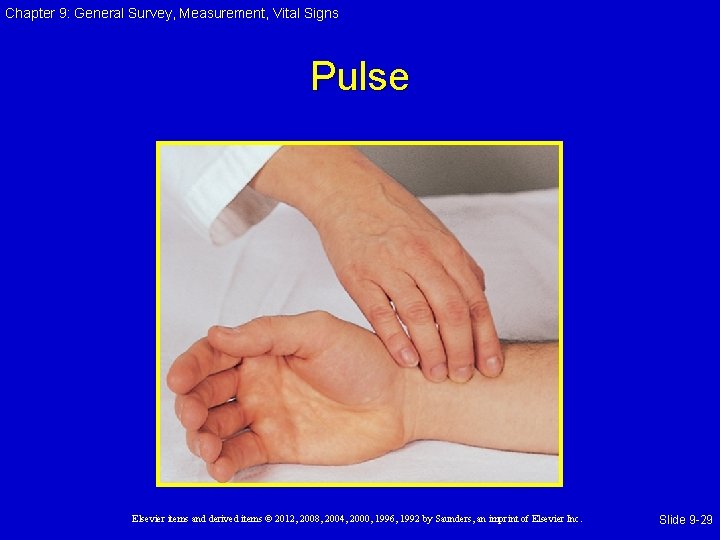
Chapter 9: General Survey, Measurement, Vital Signs Objective Data Pulse Ø Stroke volume: amount of blood every heart beat pumps into aorta • About 70 ml in adult • Force flares arterial walls and generates pressure wave, • • which felt in periphery as pulse Palpating peripheral pulse gives rate and rhythm of heartbeat, as well as local data on condition of artery Radial pulse usually palpated while vital signs measured Using pads of the first three fingers, palpate radial pulse at flexor aspect of wrist laterally along radius bone Push until strongest pulsation is felt Elsevier items and derived items © 2012, 2008, 2004, 2000, 1996, 1992 by Saunders, an imprint of Elsevier Inc. Slide 9 -27
Chapter 9: General Survey, Measurement, Vital Signs Objective Data Pulse Ø Stroke volume: amount of blood every heart beat pumps into aorta (cont. ) • If rhythm is regular, count number of beats in 30 seconds and multiply by 2. • Although 15 -second interval is frequently practiced, any one-beat error in counting results in a recorded error of four beats per minute • The 30 -second interval is most accurate and efficient when heart rates are normal or rapid and when rhythms are regular Elsevier items and derived items © 2012, 2008, 2004, 2000, 1996, 1992 by Saunders, an imprint of Elsevier Inc. Slide 9 -28
Chapter 9: General Survey, Measurement, Vital Signs Pulse Elsevier items and derived items © 2012, 2008, 2004, 2000, 1996, 1992 by Saunders, an imprint of Elsevier Inc. Slide 9 -29
Chapter 9: General Survey, Measurement, Vital Signs Objective Data Pulse Ø Stroke volume: amount of blood every heart beat pumps into aorta (cont. ) • However, if rhythm irregular, count for full minute As you begin counting interval, start your count with “zero” for first pulse felt Second pulse felt is “one, ” and so on • Assess pulse, including Rate Rhythm Force Elasticity Elsevier items and derived items © 2012, 2008, 2004, 2000, 1996, 1992 by Saunders, an imprint of Elsevier Inc. Slide 9 -30
Chapter 9: General Survey, Measurement, Vital Signs Objective Data Heart rate Ø In resting adult, normal heart rate range is 60 to 100 beats per minute (bpm) • Rate normally varies with age, and is more rapid in infancy and childhood and moderate during adult and older years • Rate also varies with gender; after puberty, females have slightly faster rate than males In adult, a heart rate less than 60 bpm is bradycardia This occurs normally in well-trained athlete whose heart muscle develops along with skeletal muscles • Stronger, more efficient heart muscle pushes out a larger stroke volume with each beat, thus requiring fewer beats per minute to maintain a stable cardiac output Elsevier items and derived items © 2012, 2008, 2004, 2000, 1996, 1992 by Saunders, an imprint of Elsevier Inc. Slide 9 -31
Chapter 9: General Survey, Measurement, Vital Signs Objective Data Heart rate (cont. ) Ø In resting adult, normal heart rate range is 60 to 100 bpm (cont. ) • A more rapid heart rate, over 100 bpm, is tachycardia Occurs normally with anxiety or with increased exercise to match body’s demand for increased metabolism Elsevier items and derived items © 2012, 2008, 2004, 2000, 1996, 1992 by Saunders, an imprint of Elsevier Inc. Slide 9 -32
Chapter 9: General Survey, Measurement, Vital Signs Objective Data Rhythm Ø Rhythm of pulse normally has an even tempo • Sinus arrhythmia: one irregularity commonly found in • • children and young adults Here heart rate varies with respiratory cycle, speeding up at peak of inspiration and slowing to normal with expiration Inspiration momentarily causes a decreased stroke volume from left side of heart To compensate, heart rate increases If any other irregularities are felt, auscultate heart sounds for a more complete assessment Elsevier items and derived items © 2012, 2008, 2004, 2000, 1996, 1992 by Saunders, an imprint of Elsevier Inc. Slide 9 -33
Chapter 9: General Survey, Measurement, Vital Signs Objective Data Force Ø Force of pulse is strength of heart’s stroke volume • Weak, thready pulse reflects a decreased stroke volume (e. g. , as occurs with hemorrhagic shock) • Full, bounding pulse denotes increased stroke volume, as with anxiety, exercise, and some abnormal conditions • Pulse force recorded using three-point scale 3+ full, bounding 2+ normal 1+ weak, thready 0 Absent • Some agencies use a four-point scale Elsevier items and derived items © 2012, 2008, 2004, 2000, 1996, 1992 by Saunders, an imprint of Elsevier Inc. Slide 9 -34
Chapter 9: General Survey, Measurement, Vital Signs Objective Data Elasticity Ø With normal elasticity, artery feels springy, straight, resilient Respirations Ø Normally, person’s breathing is relaxed, regular, automatic, and silent • Because most people are unaware of their breathing, do not mention that you will be counting respirations, because sudden awareness may alter normal pattern • Instead, maintain your position of counting radial pulse and unobtrusively count respirations Elsevier items and derived items © 2012, 2008, 2004, 2000, 1996, 1992 by Saunders, an imprint of Elsevier Inc. Slide 9 -35
Chapter 9: General Survey, Measurement, Vital Signs Objective Data Respirations (cont. ) • Count for 30 seconds, or full minute if you suspect an • • • abnormality Avoid 15 -second interval; the result can vary by a factor of + or - 4, which is significant with small number Also, a fairly constant ratio of pulse rate to respiratory rate exists, which is about 4: 1 Normally, both pulse and respiratory rates rise as a response to exercise or anxiety Elsevier items and derived items © 2012, 2008, 2004, 2000, 1996, 1992 by Saunders, an imprint of Elsevier Inc. Slide 9 -36
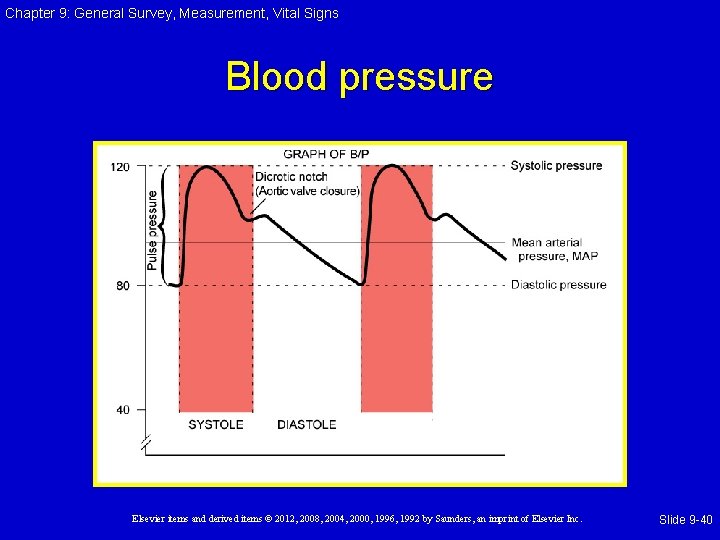
Chapter 9: General Survey, Measurement, Vital Signs Objective Data Blood pressure Ø Blood pressure (BP) is force of blood pushing against side of its container, vessel wall • Strength of push changes with event in cardiac cycle • Systolic pressure: maximum pressure felt on artery during left ventricular contraction, or systole • Diastolic pressure: elastic recoil, or resting, pressure that blood exerts constantly between each contraction • Pulse pressure: difference between systolic and diastolic Reflects stroke volume • Mean arterial pressure (MAP): pressure forcing blood into tissues, averaged over cardiac cycle Elsevier items and derived items © 2012, 2008, 2004, 2000, 1996, 1992 by Saunders, an imprint of Elsevier Inc. Slide 9 -37
Chapter 9: General Survey, Measurement, Vital Signs Objective Data Blood pressure (cont. ) Ø Average BP in young adult is 120/80 mm Hg; varies normally with many factors, such as: • Age: gradual rise through childhood and into adult years • Gender: after puberty, females show a lower BP than males; after menopause, females higher than males • Race: African American adult’s BP usually higher than white person’s of same age The incidence of hypertension is twice as high in African Americans as in whites; reasons for difference not understood fully but appear to be due to genetic heritage and environmental factors Elsevier items and derived items © 2012, 2008, 2004, 2000, 1996, 1992 by Saunders, an imprint of Elsevier Inc. Slide 9 -38
Chapter 9: General Survey, Measurement, Vital Signs Objective Data Blood pressure Ø Average BP in young adult is 120/80 mm Hg; varies normally with many factors, such as: (cont. ) • Diurnal rhythm: daily cycle climbs to high in late • • • afternoon or early evening and declines to an early morning low Weight: higher in obese persons Emotions: momentarily rises with fear, anger, and pain as a result of stimulation of the sympathetic nervous system Stress: elevated in persons feeling continual tension because of lifestyle, occupational stress, or life problems Elsevier items and derived items © 2012, 2008, 2004, 2000, 1996, 1992 by Saunders, an imprint of Elsevier Inc. Slide 9 -39
Chapter 9: General Survey, Measurement, Vital Signs Blood pressure Elsevier items and derived items © 2012, 2008, 2004, 2000, 1996, 1992 by Saunders, an imprint of Elsevier Inc. Slide 9 -40
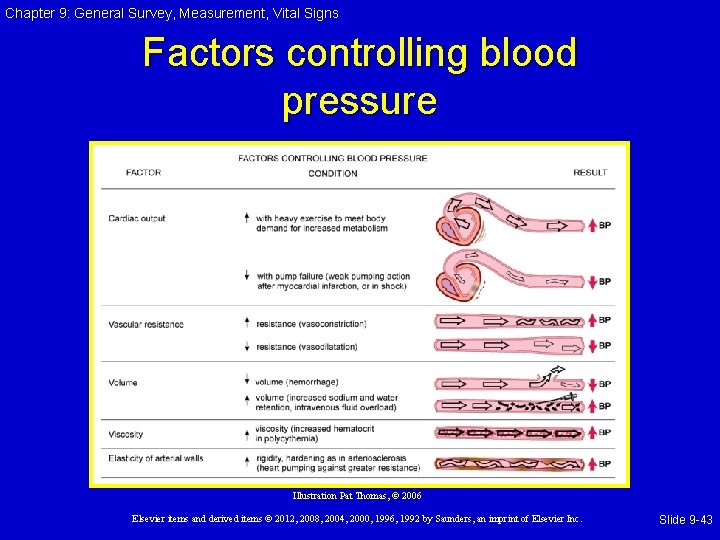
Chapter 9: General Survey, Measurement, Vital Signs Objective Data Blood pressure (cont. ) Ø Level of BP determined by five factors • Cardiac output: if heart pumps more blood into blood • • • vessels, pressure on container walls increases Peripheral vascular resistance: opposition to blood flow through arteries; when vessels becomes smaller or constricted pressure needed to push becomes greater Volume of circulating blood: refers to how tightly blood is packed into arteries; increasing contents in vessels increases pressure Viscosity: “thickness” of blood determined by its formed elements, blood cells; when contents thicker, pressure increases Elsevier items and derived items © 2012, 2008, 2004, 2000, 1996, 1992 by Saunders, an imprint of Elsevier Inc. Slide 9 -41
Chapter 9: General Survey, Measurement, Vital Signs Objective Data Blood pressure (cont. ) Ø Level of BP determined by five factors (cont. ) • Elasticity of vessel walls: when vessels stiff and rigid, pressure needed to push increases Ø Blood pressure measured with stethoscope and aneroid sphygmomanometer • Aneroid gauge subject to drift and must be recalibrated at least once each year and must rest at zero • Cuff is inflatable bladder inside a cloth cover • Width of rubber bladder should equal 40% of circumference of person’s arm; length of bladder should equal 80% of this circumference Elsevier items and derived items © 2012, 2008, 2004, 2000, 1996, 1992 by Saunders, an imprint of Elsevier Inc. Slide 9 -42
Chapter 9: General Survey, Measurement, Vital Signs Factors controlling blood pressure Illustration Pat Thomas, © 2006 Elsevier items and derived items © 2012, 2008, 2004, 2000, 1996, 1992 by Saunders, an imprint of Elsevier Inc. Slide 9 -43
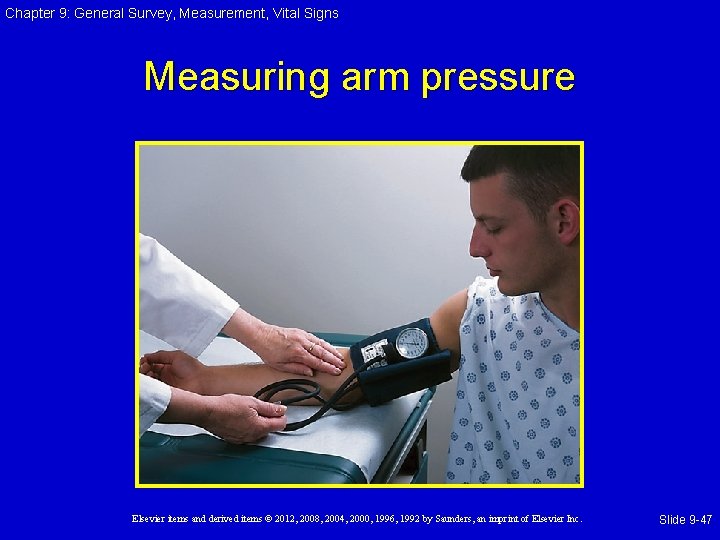
Chapter 9: General Survey, Measurement, Vital Signs Objective Data Arm pressure Ø Person may be sitting or lying, with bare arm supported at heart level • Palpate brachial artery; with cuff deflated, center it about 2. 5 cm (1 in) above brachial artery and wrap it evenly • Now palpate brachial or radial artery • Inflate cuff until artery pulsation obliterated and then 20 to 30 mm Hg beyond This will avoid missing an auscultatory gap, when Korotkoff’s sounds disappear during auscultation • Deflate cuff quickly and completely; wait 15 to 30 seconds before reinflating so blood trapped in veins can dissipate Elsevier items and derived items © 2012, 2008, 2004, 2000, 1996, 1992 by Saunders, an imprint of Elsevier Inc. Slide 9 -44
Chapter 9: General Survey, Measurement, Vital Signs Objective Data Arm pressure (cont. ) • Place bell of stethoscope over site of brachial artery, • • • making a light but airtight seal Diaphragm endpiece usually adequate, but bell designed to pick up low-pitched sounds of blood pressure reading So if you have a bell, use it Rapidly inflate cuff to maximal inflation level you determined. Then deflate the cuff slowly and evenly, about 2 mm Hg per heartbeat Note points at which you hear first appearance of sound, muffling of sound, and final disappearance of sound Elsevier items and derived items © 2012, 2008, 2004, 2000, 1996, 1992 by Saunders, an imprint of Elsevier Inc. Slide 9 -45
Chapter 9: General Survey, Measurement, Vital Signs Objective Data Arm pressure (cont. ) • These are phases I, IV, and V of Korotkoff’s sounds • For all age-groups, fifth Korotkoff phase now used to define diastolic pressure • However, when a variance greater than 10 to 12 mm Hg exists between phases IV and V, record both phases along with systolic reading • Clear communication is important because results significantly affect diagnosis and planning of care Elsevier items and derived items © 2012, 2008, 2004, 2000, 1996, 1992 by Saunders, an imprint of Elsevier Inc. Slide 9 -46
Chapter 9: General Survey, Measurement, Vital Signs Measuring arm pressure Elsevier items and derived items © 2012, 2008, 2004, 2000, 1996, 1992 by Saunders, an imprint of Elsevier Inc. Slide 9 -47
Chapter 9: General Survey, Measurement, Vital Signs Objective Data Orthostatic, or postural vital signs Ø Take serial measurements of pulse and blood pressure when: • You suspect volume depletion • Person known to have hypertension or taking antihypertensive medications • Person reports fainting or syncope Ø Have person rest supine for 2 or 3 minutes, take baseline readings of pulse and BP, and then repeat with person sitting and then standing Ø For person who is too weak or dizzy to stand, assess BP supine and then sitting with legs Elsevier items and derived items © 2012, 2008, 2004, 2000, 1996, 1992 by Saunders, an imprint of Elsevier Inc. dangling Slide 9 -48
Chapter 9: General Survey, Measurement, Vital Signs Objective Data Orthostatic, or postural vital signs Ø Take serial measurements of pulse and blood pressure when: (cont. ) • Position changed from supine to standing, normally slight • • • decrease (less than 10 mm Hg) in systolic pressure may occur Record BP by using even numbers Also record person’s position, arm used, and cuff size, if different from standard adult cuff Record pulse rate and rhythm, noting whether pulse is regular Elsevier items and derived items © 2012, 2008, 2004, 2000, 1996, 1992 by Saunders, an imprint of Elsevier Inc. Slide 9 -49
Chapter 9: General Survey, Measurement, Vital Signs Objective Data Thigh pressure Ø When BP measured at arm excessively high, compare it with thigh pressure to check for coarctation of aorta (congenital form of narrowing) • Particularly in adolescents and young adults • Normally, thigh pressure higher than that in arm • If possible, turn person into prone position on abdomen • Wrap large cuff around lower third of thigh, centered over popliteal artery on back of the knee • Auscultate popliteal artery for reading • Normally, systolic value is 10 to 40 mm Hg higher in thigh than in arm, and diastolic pressure is same Elsevier items and derived items © 2012, 2008, 2004, 2000, 1996, 1992 by Saunders, an imprint of Elsevier Inc. Slide 9 -50
Chapter 9: General Survey, Measurement, Vital Signs Objective Data Developmental Competence Infants and children Ø General survey • Physical appearance, body structure, mobility: note same • • • basic elements as with adult, with consideration to age and development Behavior: note response to stimuli and level of alertness appropriate for age Parental bonding: note child’s interactions with parents, that parent and child show a mutual response and are warm and affectionate, appropriate to child’s condition Parent provides appropriate physical care of child and promotes new learning Elsevier items and derived items © 2012, 2008, 2004, 2000, 1996, 1992 by Saunders, an imprint of Elsevier Inc. Slide 9 -51
Chapter 9: General Survey, Measurement, Vital Signs Objective Data Developmental Competence Infants and children (cont. ) Ø Measurements • Weight: weigh infant on a platform-type balance scale • By age 2 or 3 years, use upright scale • Length: until age 2, measure infant’s body length supine by using horizontal measuring board • Hold head in midline; extend legs momentarily by holding the knees together and pushing them down until legs are flat on table Avoid using tape measure along infant’s length because this inaccurate Elsevier items and derived items © 2012, 2008, 2004, 2000, 1996, 1992 by Saunders, an imprint of Elsevier Inc. Slide 9 -52
Chapter 9: General Survey, Measurement, Vital Signs Objective Data Developmental Competence Infants and children Ø Measurements (cont. ) • For age 2 or 3, measure child’s height by standing child • • • against pole on platform scale or back against a flat ruler taped to the wall Physical growth is perhaps best index of a child’s general health Child’s height and weight recorded at every health care visit to determine normal growth patterns Results plotted on growth charts based on data from National Center for Health Statistics (NCHS) Elsevier items and derived items © 2012, 2008, 2004, 2000, 1996, 1992 by Saunders, an imprint of Elsevier Inc. Slide 9 -53
Chapter 9: General Survey, Measurement, Vital Signs Objective Data Developmental Competence Infants and children Ø Measurements (cont. ) • Healthy childhood growth is continuous but uneven, with • • rapid growth spurts occurring during infancy and adolescence Results more reliable when comparing numerous growth measures over a long time These charts also compare individual child against general population Use your judgment and consider genetic background of small-for-age child Explore growth patterns of parents and siblings Elsevier items and derived items © 2012, 2008, 2004, 2000, 1996, 1992 by Saunders, an imprint of Elsevier Inc. Slide 9 -54
Chapter 9: General Survey, Measurement, Vital Signs Objective Data Developmental Competence Infants and children Ø Measurements (cont. ) • Be aware that statistical averages for U. S. charts based • • • on norms for white children and may not necessarily generalize to other ethnic groups Studies indicate that black children weigh less than white children during first 2 years of life, but afterward black children tend to be taller and heavier than white children Asian children (particularly girls) are found to be shorter and lighter than white counterparts Race-specific standards are needed before judgments can be made about growth of infants and children Elsevier items and derived items © 2012, 2008, 2004, 2000, 1996, 1992 by Saunders, an imprint of Elsevier Inc. Slide 9 -55
Chapter 9: General Survey, Measurement, Vital Signs Objective Data Developmental Competence Infants and children Ø Measurements (cont. ) • Otherwise an excessive number of African American • • • infants or Asian children may be judged below normal when they actually may be normal for their own population groups Head circumference: measure infant’s head circumference at birth and at each well visit up to age 2 years and then yearly up to 6 years Circle tape around head at prominent frontal and occipital bones; widest span is correct Plot measurement on standardized growth charts Elsevier items and derived items © 2012, 2008, 2004, 2000, 1996, 1992 by Saunders, an imprint of Elsevier Inc. Slide 9 -56
Chapter 9: General Survey, Measurement, Vital Signs Objective Data Developmental Competence Infants and children Ø Measurements (cont. ) • Compare infant’s head size with that expected for age • Series of measurements more valuable than single figure to show rate of head growth • Newborn’s head measures about 32 to 38 cm (average around 34 cm) and about 2 cm larger than chest circumference • Chest grows at faster rate than cranium; between 6 months and 2 years, both measurements about same, and after age 2 chest circumference greater than head circumference Elsevier items and derived items © 2012, 2008, 2004, 2000, 1996, 1992 by Saunders, an imprint of Elsevier Inc. Slide 9 -57
Chapter 9: General Survey, Measurement, Vital Signs Objective Data Developmental Competence Infants and children Ø Measurements (cont. ) • Measurement of chest circumference is valuable in a comparison with head circumference, but not necessarily by itself • Encircle tape around chest at nipple line • It should be snug, but not so tight it leaves a mark Elsevier items and derived items © 2012, 2008, 2004, 2000, 1996, 1992 by Saunders, an imprint of Elsevier Inc. Slide 9 -58
Chapter 9: General Survey, Measurement, Vital Signs Objective Data Developmental Competence Infants and children (cont. ) Ø Vital signs • Measure vital signs with same purpose and frequency as you would in an adult • With infant, reverse order of vital sign measurement to respiration, pulse, and temperature Taking a rectal temperature may cause infant to cry, thus masking normal resting values • Preschooler’s normal fear of body mutilation increased with any invasive procedure • Whenever possible, avoid rectal route and take a tympanic, inguinal, or axillary temperature • Measuring adolescent same as with adult Elsevier items and derived items © 2012, 2008, 2004, 2000, 1996, 1992 by Saunders, an imprint of Elsevier Inc. Slide 9 -59
Chapter 9: General Survey, Measurement, Vital Signs Objective Data Developmental Competence Infants and children (cont. ) Ø Temperature • Tympanic measurement useful with toddlers who squirm at restraint needed for rectal route, and useful with preschoolers not yet able to cooperate for oral temperature • Tympanic measurement so rapid that it is usually over before child realizes it • Inguinal route safer than rectal site; results may be closer to core temperature than axillary site because inguinal area has rich supply of blood vessels Elsevier items and derived items © 2012, 2008, 2004, 2000, 1996, 1992 by Saunders, an imprint of Elsevier Inc. Slide 9 -60
Chapter 9: General Survey, Measurement, Vital Signs Objective Data Developmental Competence Infants and children Ø Temperature (cont. ) • Axillary route safer and more accessible than rectal • • • route; however, its accuracy and reliability have been questioned When axillary route used, place tip well into axilla, and hold child’s arm close to body Use oral route when child old enough to keep mouth closed; usually at age 5 or 6, although some 4 -year-old children can cooperate When available, use an electronic thermometer because it is unbreakable and it registers quickly Elsevier items and derived items © 2012, 2008, 2004, 2000, 1996, 1992 by Saunders, an imprint of Elsevier Inc. Slide 9 -61
Chapter 9: General Survey, Measurement, Vital Signs Objective Data Developmental Competence Infants and children Ø Temperature (cont. ) • Use rectal route with infants or with other age groups when other routes are not feasible, such as with the child who is unable to cooperate, agitated, unconscious, critically ill, or prone to seizures • Infant may be supine or side lying, with examiner’s hand flexing knees up onto the abdomen When supine, cover boy’s penis with diaper An infant also may lie prone across adult’s lap • Separate buttocks with one hand, and insert lubricated electronic rectal probe no farther than 2. 5 cm (1 in); insertion any deeper risks rectal perforation Elsevier items and derived items © 2012, 2008, 2004, 2000, 1996, 1992 by Saunders, an imprint of Elsevier Inc. Slide 9 -62
Chapter 9: General Survey, Measurement, Vital Signs Objective Data Developmental Competence Infants and children Ø Temperature (cont. ) • Normally, rectal temperatures measure higher in infants and young children than in adults, with an average of 37. 8° C (100° F) at 18 months • Also, temperature normally may be elevated in late afternoon, after vigorous playing or after eating Elsevier items and derived items © 2012, 2008, 2004, 2000, 1996, 1992 by Saunders, an imprint of Elsevier Inc. Slide 9 -63
Chapter 9: General Survey, Measurement, Vital Signs Objective Data Developmental Competence Infants and children (cont. ) Ø Pulse • Palpate or auscultate an apical rate with infants and • • • toddlers In children older than 2, use radial site Count pulse for a full minute to take into account normal irregularities, such as sinus arrhythmia Heart rate normally fluctuates more with infants and children than adults from exercise, emotion, and illness Respirations Watch infant’s abdomen for movement, because infant’s respirations normally more diaphragmatic than thoracic Elsevier items and derived items © 2012, 2008, 2004, 2000, 1996, 1992 by Saunders, an imprint of Elsevier Inc. Slide 9 -64
Chapter 9: General Survey, Measurement, Vital Signs Objective Data Developmental Competence Infants and children Ø Blood pressure • In children aged 3 and older, and in younger children at • • risk, measure a routine BP at least annually For accurate measurement in children, make some adjustment in choice of equipment and technique Most common error is to use incorrect size cuff Cuff width must cover two thirds of upper arm, and cuff bladder must completely encircle it Use a pediatric-sized endpiece on stethoscope to locate sounds Elsevier items and derived items © 2012, 2008, 2004, 2000, 1996, 1992 by Saunders, an imprint of Elsevier Inc. Slide 9 -65
Chapter 9: General Survey, Measurement, Vital Signs Objective Data Developmental Competence Infants and children Ø Blood pressure (cont. ) • If possible, allow crying infant to become quiet for 5 to 10 • • • minutes before measuring the BP; crying may elevate the systolic pressure by 30 to 50 mm Hg Use disappearance of sound (phase V Korotkoff) for diastolic reading in children In children, height more strongly correlated with BP than age New charts avoid misclassification as normotensive or hypertensive of children who are at extremes of normal growth Elsevier items and derived items © 2012, 2008, 2004, 2000, 1996, 1992 by Saunders, an imprint of Elsevier Inc. Slide 9 -66
Chapter 9: General Survey, Measurement, Vital Signs Objective Data Developmental Competence Infants and children Ø Blood pressure (cont. ) • For children of same age, BP classified as 90 th and 95 th percentiles lower for very short children, whereas tall children given higher normal range • Children younger than 3 years have such small arm vessels that it is difficult to hear Korotkoff’s sounds with a stethoscope Instead, use an electronic BP device that uses oscillometry, such as Dinamap, and gives digital readout for systolic, diastolic, and MAP and pulse Or use a Doppler ultrasound device to amplify sounds Elsevier items and derived items © 2012, 2008, 2004, 2000, 1996, 1992 by Saunders, an imprint of Elsevier Inc. Slide 9 -67
Chapter 9: General Survey, Measurement, Vital Signs Objective Data Developmental Competence Aging adult Ø General survey • Physical appearance: by eighth and ninth decades, body contour sharper, with more angular facial features, and body proportions redistributed • Posture: general flexion occurs by eight or ninth decade • Gait: older adults often use a wider base to compensate for diminished balance, arms may be held out to help balance, and steps may be shorter or uneven Elsevier items and derived items © 2012, 2008, 2004, 2000, 1996, 1992 by Saunders, an imprint of Elsevier Inc. Slide 9 -68
Chapter 9: General Survey, Measurement, Vital Signs Objective Data Developmental Competence Aging adult (cont. ) Ø Measurement • Weight: appears sharper in contour with more prominent bony landmarks than younger adult • Weight decreases during 80 s and 90 s; this factor more evident in males, because of greater muscle shrinkage • Distribution of fat also changes during 80 s and 90 s; even with good nutrition, subcutaneous fat lost from face and periphery (especially the forearms), whereas additional fat deposited on abdomen and hips Elsevier items and derived items © 2012, 2008, 2004, 2000, 1996, 1992 by Saunders, an imprint of Elsevier Inc. Slide 9 -69
Chapter 9: General Survey, Measurement, Vital Signs Objective Data Developmental Competence Aging adult Ø Measurement (cont. ) • Height: by 80 s and 90 s, many people shorter than they were in their 70 s • Results from shortening in spinal column, from thinning of vertebral disks, shortening of individual vertebrae, and from postural changes of kyphosis and slight flexion in knees and hips • Because long bones do not shorten with age, overall body proportion looks different: shorter trunk with relatively long extremities Elsevier items and derived items © 2012, 2008, 2004, 2000, 1996, 1992 by Saunders, an imprint of Elsevier Inc. Slide 9 -70
Chapter 9: General Survey, Measurement, Vital Signs Objective Data Developmental Competence Aging adult (cont. ) Ø Vital signs • Temperature: changes in body’s temperature regulatory • • • mechanism leave aging person less likely to have fever, but at greater risk for hypothermia Temperature is less reliable index of older person’s true health state; sweat gland activity is also diminished. Pulse: normal range of heart rate is 60 to 100 bpm, but rhythm may be slightly irregular Radial artery may feel stiff, rigid, and tortuous in older person, although does not necessarily imply vascular disease in heart or brain Elsevier items and derived items © 2012, 2008, 2004, 2000, 1996, 1992 by Saunders, an imprint of Elsevier Inc. Slide 9 -71
Chapter 9: General Survey, Measurement, Vital Signs Objective Data Developmental Competence Aging adult Ø Vital signs (cont. ) • Increasingly rigid arterial wall needs faster upstroke of blood, so pulse is actually easier to palpate • Respirations: aging causes decrease in vital capacity and decreased inspiratory reserve volume You may note shallower inspiratory phase and an increased respiratory rate • Blood pressure: aorta and major arteries tend to harden with age • As heart pumps against a stiffer aorta, systolic pressure increases, leading to widened pulse pressure Elsevier items and derived items © 2012, 2008, 2004, 2000, 1996, 1992 by Saunders, an imprint of Elsevier Inc. Slide 9 -72
Chapter 9: General Survey, Measurement, Vital Signs Objective Data Developmental Competence Aging adult Ø Vital signs (cont. ) • In many older people, both systolic and diastolic pressures increase, making it difficult to distinguish normal aging values from abnormal hypertension Elsevier items and derived items © 2012, 2008, 2004, 2000, 1996, 1992 by Saunders, an imprint of Elsevier Inc. Slide 9 -73
Chapter 9: General Survey, Measurement, Vital Signs Objective Data Developmental Competence Additional techniques Ø Measurement of oxygen saturation • Pulse oximeter a noninvasive method to assess arterial • • • oxygen saturation (Sp. O 2) Sensor attached to person’s finger or earlobe has diode that emits light and detector measures relative amount of light absorbed by oxyhemoglobin (Hb. O 2) and unoxygenated (reduced) hemoglobin (Hb) Compares ratio of light emitted to light absorbed and converts this ratio into percentage of oxygen saturation Because it only measures light absorption of pulsatile flow, result arterial oxygen saturation Elsevier items and derived items © 2012, 2008, 2004, 2000, 1996, 1992 by Saunders, an imprint of Elsevier Inc. Slide 9 -74
Chapter 9: General Survey, Measurement, Vital Signs Objective Data Developmental Competence Additional techniques Ø Measurement of oxygen saturation (cont. ) • Healthy person with no lung disease and no anemia • • • normally has an Sp. O 2 of 97% to 98% Select appropriate pulse oximeter probe Finger probe spring loaded and feels like clothespin attached to finger but does not hurt At lower oxygen saturations, earlobe probe more accurate and less affected by peripheral vasoconstriction Elsevier items and derived items © 2012, 2008, 2004, 2000, 1996, 1992 by Saunders, an imprint of Elsevier Inc. Slide 9 -75
Chapter 9: General Survey, Measurement, Vital Signs Objective Data Developmental Competence Additional techniques Ø Doppler technique • In many situations, pulse and BP measurement • • • enhanced by using an electronic device, Doppler ultrasonic flowmeter Technique works by a principle that sound varies in pitch in relation to distance between sound source and listener; pitch higher when distance small, and pitch lowers as distance increases In this case, sound source is blood pumping through artery in rhythmic manner Handheld transducer picks up changes in sound frequency as blood flows and ebbs and it amplifies them Elsevier items and derived items © 2012, 2008, 2004, 2000, 1996, 1992 by Saunders, an imprint of Elsevier Inc. Slide 9 -76
Chapter 9: General Survey, Measurement, Vital Signs Objective Data Developmental Competence Additional techniques Ø Doppler technique (cont. ) • Listener hears whooshing pulsatile beat • Doppler technique used to locate peripheral pulse sites • For BP measurement, Doppler technique augment Korotkoff’s sounds • Through this technique, you can evaluate sounds that are hard to hear with stethoscope, such as those in critically ill individuals with a low BP, in infants with small arms, and in obese persons in whom sounds are muffled by layers of fat Elsevier items and derived items © 2012, 2008, 2004, 2000, 1996, 1992 by Saunders, an imprint of Elsevier Inc. Slide 9 -77
Chapter 9: General Survey, Measurement, Vital Signs Objective Data Developmental Competence Additional techniques Ø Doppler technique (cont. ) • Also, proper cuff placement is difficult on obese person’s cone-shaped upper arm • In this situation, you can place cuff on more even forearm and hold Doppler probe over radial artery • For either location, use following procedure Apply coupling gel to transducer probe Turn Doppler flowmeter on Touch probe to skin, holding probe perpendicular to artery A pulsatile whooshing sound indicates location of artery May need to rotate probe, but maintain contact with skin Elsevier items and derived items © 2012, 2008, 2004, 2000, 1996, 1992 by Saunders, an imprint of Elsevier Inc. Slide 9 -78
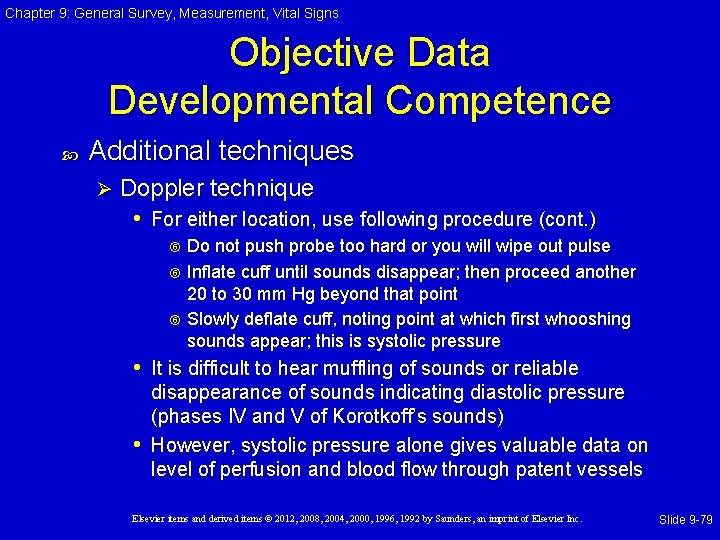
Chapter 9: General Survey, Measurement, Vital Signs Objective Data Developmental Competence Additional techniques Ø Doppler technique • For either location, use following procedure (cont. ) Do not push probe too hard or you will wipe out pulse Inflate cuff until sounds disappear; then proceed another 20 to 30 mm Hg beyond that point Slowly deflate cuff, noting point at which first whooshing sounds appear; this is systolic pressure • It is difficult to hear muffling of sounds or reliable disappearance of sounds indicating diastolic pressure (phases IV and V of Korotkoff’s sounds) • However, systolic pressure alone gives valuable data on level of perfusion and blood flow through patent vessels Elsevier items and derived items © 2012, 2008, 2004, 2000, 1996, 1992 by Saunders, an imprint of Elsevier Inc. Slide 9 -79
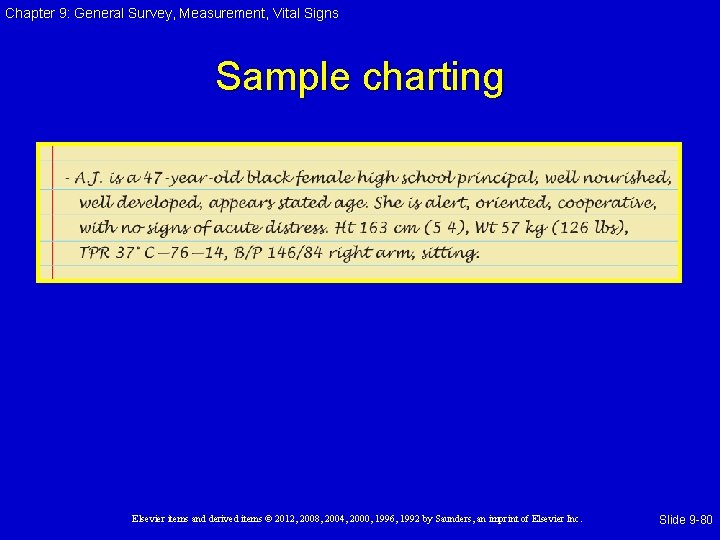
Chapter 9: General Survey, Measurement, Vital Signs Sample charting Elsevier items and derived items © 2012, 2008, 2004, 2000, 1996, 1992 by Saunders, an imprint of Elsevier Inc. Slide 9 -80
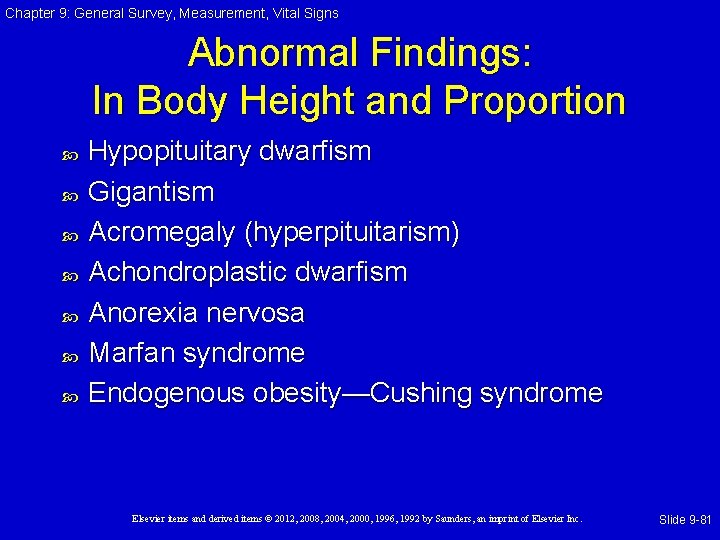
Chapter 9: General Survey, Measurement, Vital Signs Abnormal Findings: In Body Height and Proportion Hypopituitary dwarfism Gigantism Acromegaly (hyperpituitarism) Achondroplastic dwarfism Anorexia nervosa Marfan syndrome Endogenous obesity—Cushing syndrome Elsevier items and derived items © 2012, 2008, 2004, 2000, 1996, 1992 by Saunders, an imprint of Elsevier Inc. Slide 9 -81
Chapter 9: General Survey, Measurement, Vital Signs Abnormal Findings: Abnormalities in Blood Pressure Hypotension Hypertension Elsevier items and derived items © 2012, 2008, 2004, 2000, 1996, 1992 by Saunders, an imprint of Elsevier Inc. Slide 9 -82