
General Supervision Developing an Effective System Implications for
- Slides: 24
General Supervision: Developing an Effective System Implications for States U. S. Department of Education Office of Special Education Programs
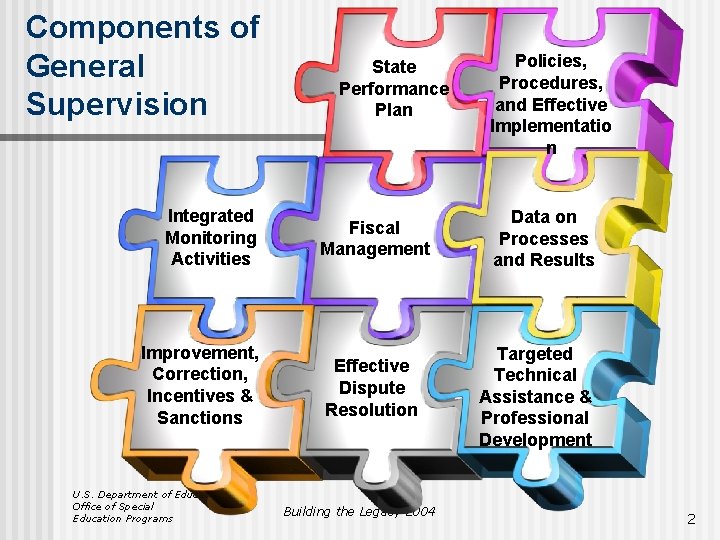
Components of General Supervision Integrated Monitoring Activities Improvement, Correction, Incentives & Sanctions U. S. Department of Education Office of Special Education Programs State Performance Plan Fiscal Management Effective Dispute Resolution Building the Legacy 2004 Policies, Procedures, and Effective Implementatio n Data on Processes and Results Targeted Technical Assistance & Professional Development 2
Integrated System of General Supervision OSEP first presented concept at 2004 National Accountability Conference; Revisited at NAC 2006 n OSEP/RRC/NECTAC Planning Meeting November 2006 n NCSEAM draft “Developing and Implementing an Effective System of General Supervision”, Fall 2006 n Kansas City meeting, December 2006 n U. S. Department of Education Office of Special Education Programs Building the Legacy 2004 3
The components Each of the Big 8 is required by IDEA, GEPA, etc. n Most states have established independent components n States typically develop their own models for meeting general supervision requirements n U. S. Department of Education Office of Special Education Programs Building the Legacy 2004 4
Why an “Integrated System”? n General Supervision system must be accountable for: improving educational results and functional outcomes n ensuring that public agencies meet program requirements n U. S. Department of Education Office of Special Education Programs Building the Legacy 2004 5
Why an “Integrated System”? n To be effective, components must connect n interact n articulate n inform each other n U. S. Department of Education Office of Special Education Programs Building the Legacy 2004 6
How can a state use the General Supervision paper? What are the “Big 8”? n What is the “evidence” to demonstrate a component is part of General Supervision system? n U. S. Department of Education Office of Special Education Programs Building the Legacy 2004 7
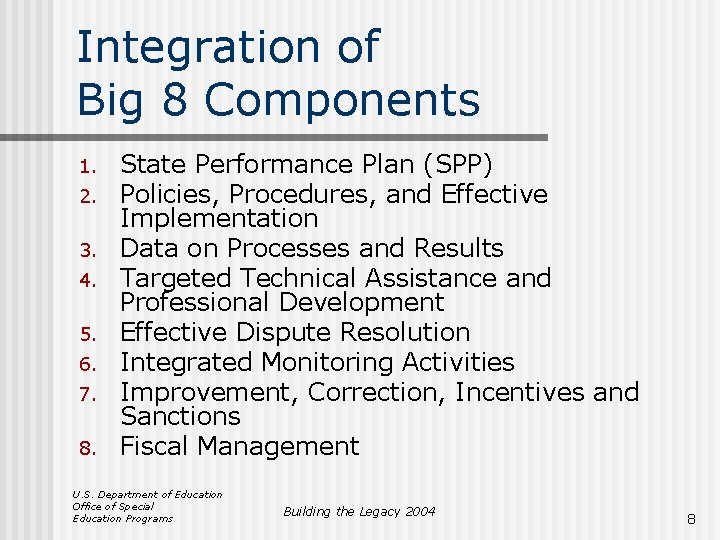
Integration of Big 8 Components 1. 2. 3. 4. 5. 6. 7. 8. State Performance Plan (SPP) Policies, Procedures, and Effective Implementation Data on Processes and Results Targeted Technical Assistance and Professional Development Effective Dispute Resolution Integrated Monitoring Activities Improvement, Correction, Incentives and Sanctions Fiscal Management U. S. Department of Education Office of Special Education Programs Building the Legacy 2004 8
This Session State Performance Plan (SPP) n Policies, Procedures and Effective Implementation n Data on Processes and Results n Integrated Monitoring Activities n U. S. Department of Education Office of Special Education Programs Building the Legacy 2004 9
Discussion Successes? Remaining challenges? n Questions, issues? n Other evidences? n Further suggestions? n U. S. Department of Education Office of Special Education Programs Building the Legacy 2004 10
State Performance Plan Blueprint for systems change n All other components must be integrated with SPP n U. S. Department of Education Office of Special Education Programs Building the Legacy 2004 11
Policies, Procedures and Effective Implementation n n Aligned with IDEA Include descriptions of n n activities to identify noncompliance methods for requiring correction of noncompliance range of sanctions to enforce correction establish and maintain specifications for highly qualified personnel U. S. Department of Education Office of Special Education Programs Building the Legacy 2004 12
Policies, Procedures and Effective Implementation n n Local educational agency (LEA) policies and procedures aligned with those of state LEA policies and procedures designed and implement to improve results LEA policies and procedures personnel adequately prepared State and LEAs have written policies and procedures in place, including assurances Required memoranda of understanding (MOUs) in place and current U. S. Department of Education Office of Special Education Programs Building the Legacy 2004 13
Discussion Successes? Remaining challenges? n Questions, issues? n Other evidences? n Further suggestions? n U. S. Department of Education Office of Special Education Programs Building the Legacy 2004 14
Data on Processes and Results n Collection and verification 618 n Dispute resolution n Previous monitoring reports n Other n n Examination and analyses Areas of state concern n Clusters of related indicators n U. S. Department of Education Office of Special Education Programs Building the Legacy 2004 15
Data on Processes and Results n Reporting Annual Performance Report (APR) (state) n LEA performance against state targets n Status determination n Improvement n n Data are used to plan and revise activities U. S. Department of Education Office of Special Education Programs Building the Legacy 2004 16
Discussion Successes? Remaining challenges? n Questions, issues? n Other evidences? n Further suggestions? n U. S. Department of Education Office of Special Education Programs Building the Legacy 2004 17
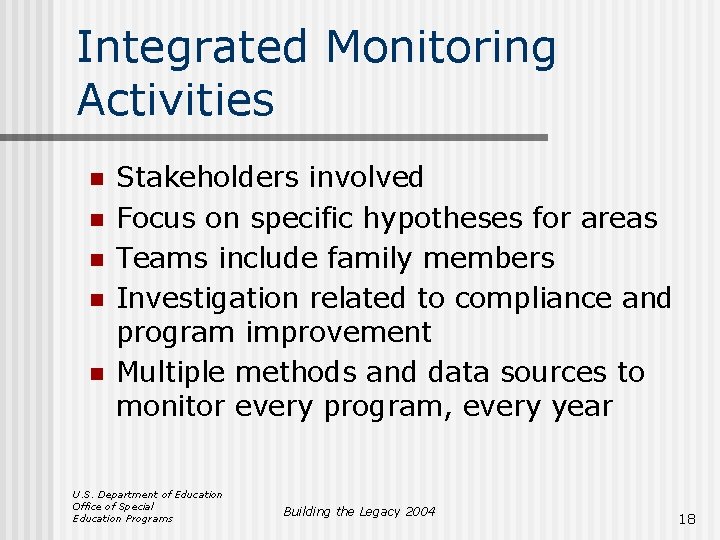
Integrated Monitoring Activities n n n Stakeholders involved Focus on specific hypotheses for areas Teams include family members Investigation related to compliance and program improvement Multiple methods and data sources to monitor every program, every year U. S. Department of Education Office of Special Education Programs Building the Legacy 2004 18
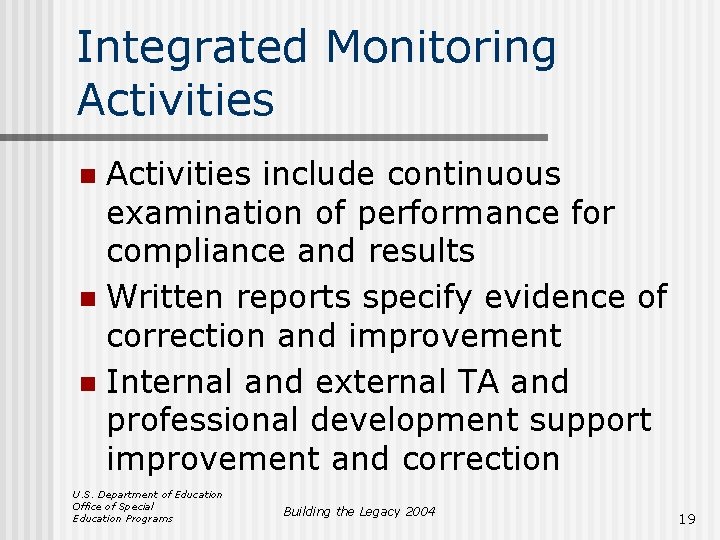
Integrated Monitoring Activities include continuous examination of performance for compliance and results n Written reports specify evidence of correction and improvement n Internal and external TA and professional development support improvement and correction n U. S. Department of Education Office of Special Education Programs Building the Legacy 2004 19
Discussion Successes? Remaining challenges? n Questions, issues? n Other evidences? n Further suggestions? n U. S. Department of Education Office of Special Education Programs Building the Legacy 2004 20
Putting the Puzzle Together n Use the General Supervision paper to: Self-evaluate your state’s Big 8 components n Improve connections among components to strengthen your General Supervision system. n U. S. Department of Education Office of Special Education Programs Building the Legacy 2004 21
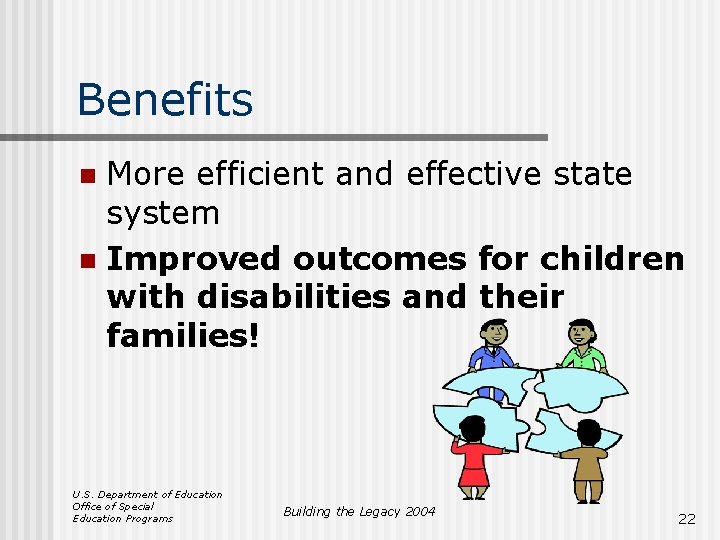
Benefits More efficient and effective state system n Improved outcomes for children with disabilities and their families! n U. S. Department of Education Office of Special Education Programs Building the Legacy 2004 22
Web Resources n National Center for Special Education Accountability Monitoring http: //www. monitoringcenter. lsuhsc. edu/ n Regional Resource and Federal Center Network http: //www. rrfcnetwork. org • SPP/APR guidance materials n OSEP Technical Assistance Network U. S. Department of Education Office of Special Education Programs Building the Legacy 2004 23
Contact Information n Ruth Ryder ruth. ryder@ed. gov n Gregg Corr gregg. corr@ed. gov U. S. Department of Education Office of Special Education Programs Building the Legacy 2004 24