
General Relativity General Relativity Principle of equivalence There


- Slides: 26
General Relativity
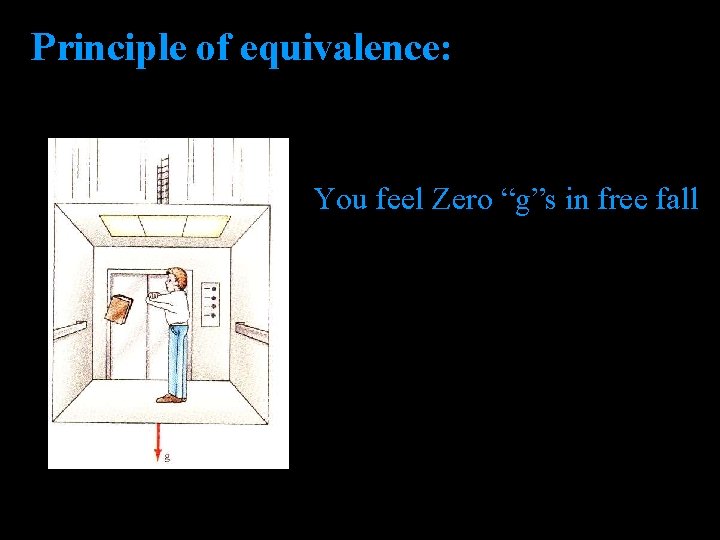
General Relativity Principle of equivalence: There is no experiment that will discern the difference between the effect of gravity and the effect of acceleration. Or… Gravitational and inertial mass are equivalent.
Principle of equivalence: On Earth: In space: a = 9. 8 m/s/s
Principle of equivalence: You feel Zero “g”s in free fall
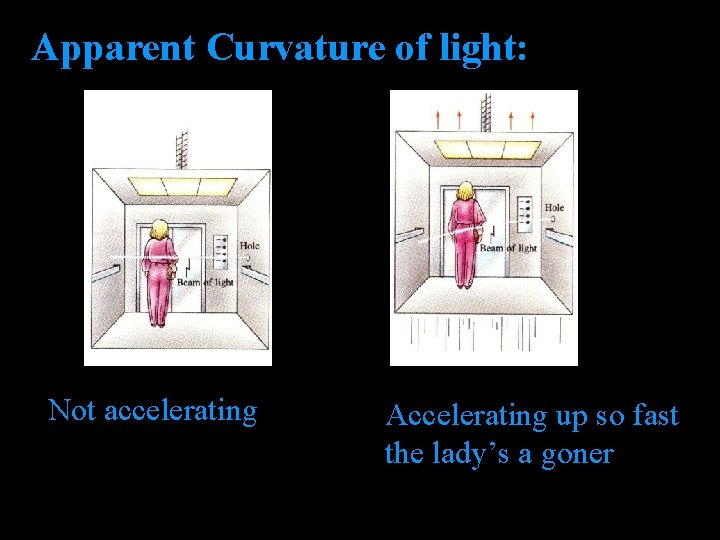
Apparent Curvature of light: Not accelerating Accelerating up so fast the lady’s a goner
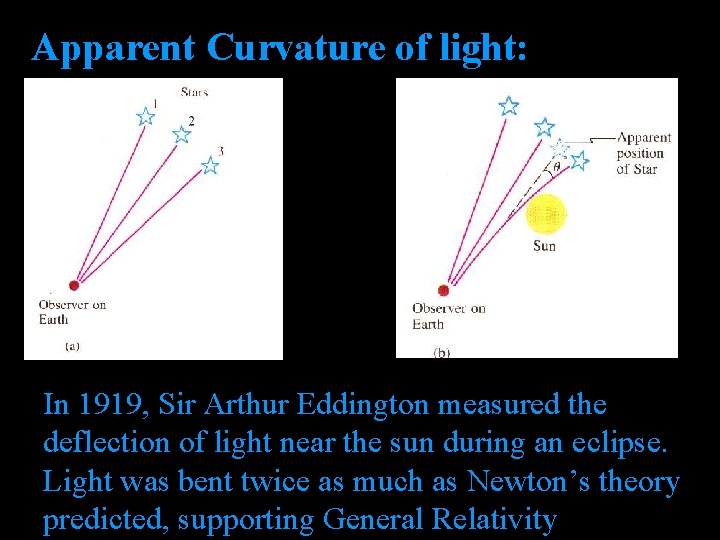
Apparent Curvature of light: In 1919, Sir Arthur Eddington measured the deflection of light near the sun during an eclipse. Light was bent twice as much as Newton’s theory predicted, supporting General Relativity
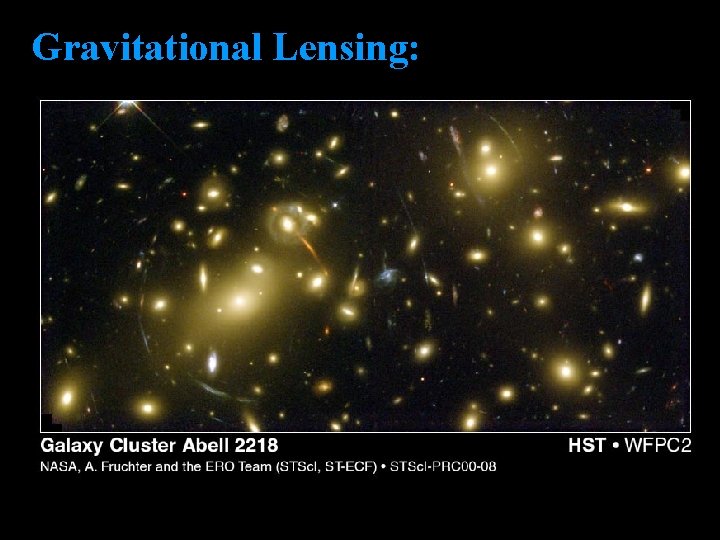
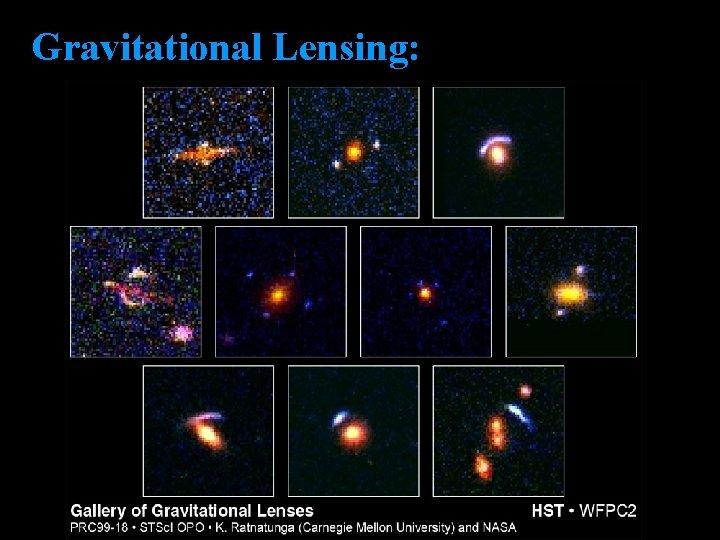
Gravitational Lensing:
Gravitational Lensing:
Curvature of Space: Now that you understand that gravity bends light… Understand that it does not. Light travels in a straight line. The space itself near a massive object is curved. Light is the absolute. It travels at the speed of light. It travels in a straight line. Do not adjust your television set… Re-adjust your brain.
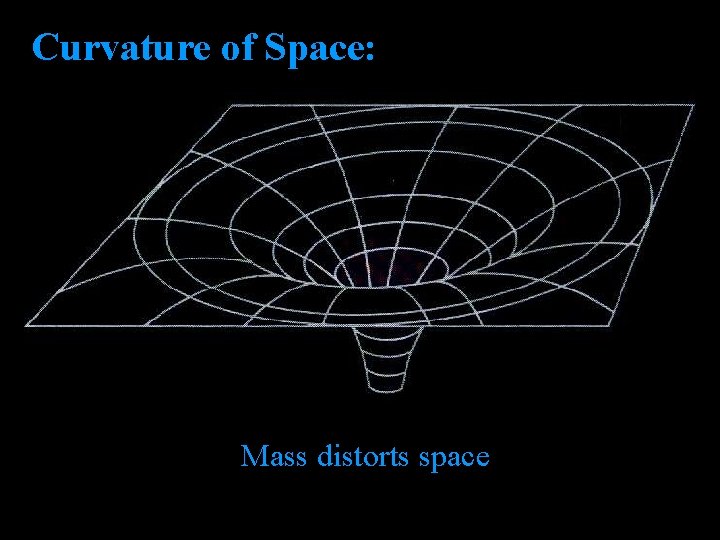
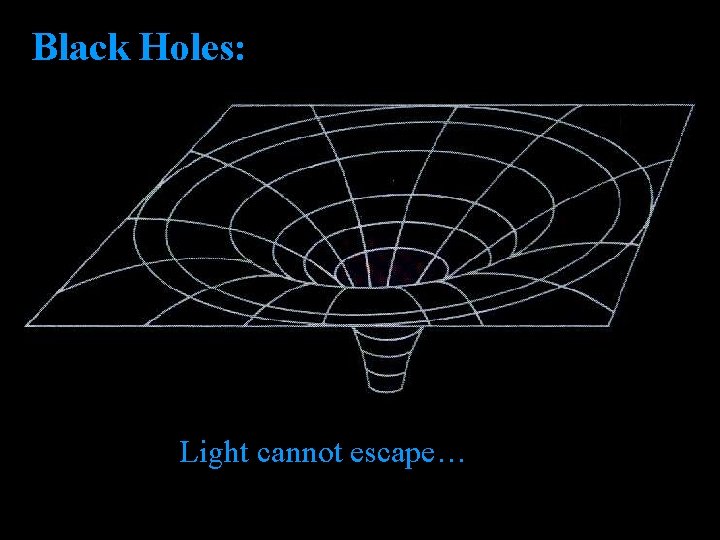
Curvature of Space: Mass distorts space
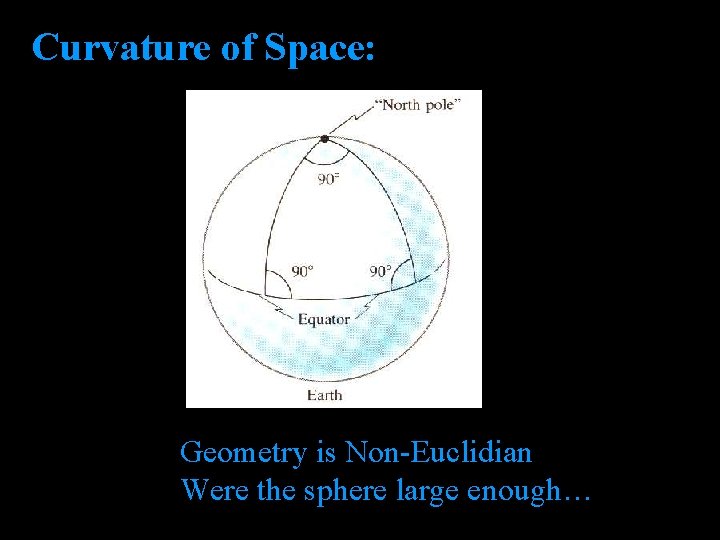
Curvature of Space: Geometry is Non-Euclidian Were the sphere large enough…
Black Holes: Light cannot escape…
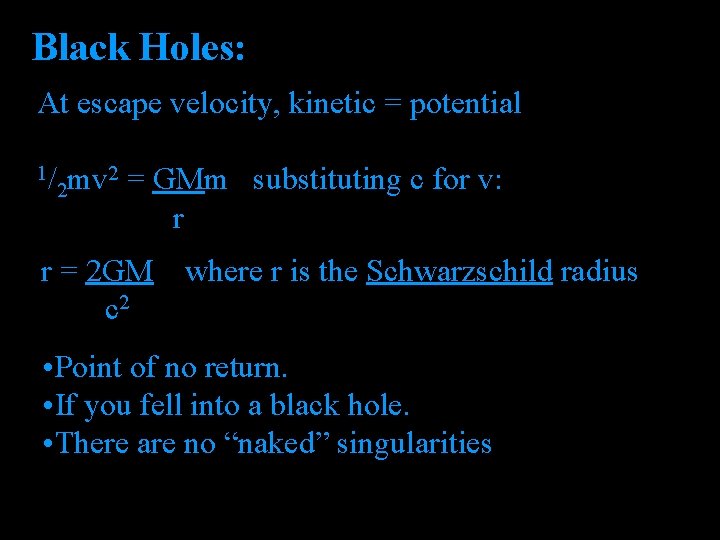
Black Holes: At escape velocity, kinetic = potential 1/ 2 = GMm substituting c for v: mv 2 r r = 2 GM where r is the Schwarzschild radius c 2 • Point of no return. • If you fell into a black hole. • There are no “naked” singularities
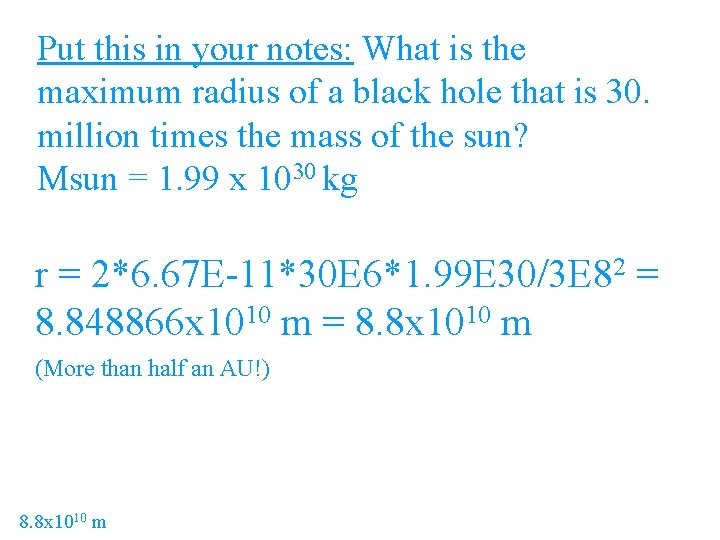
Put this in your notes: What is the maximum radius of a black hole that is 30. million times the mass of the sun? Msun = 1. 99 x 1030 kg r = 2*6. 67 E-11*30 E 6*1. 99 E 30/3 E 82 = 8. 848866 x 1010 m = 8. 8 x 10¹⁰ m (More than half an AU!) 8. 8 x 10¹⁰ m
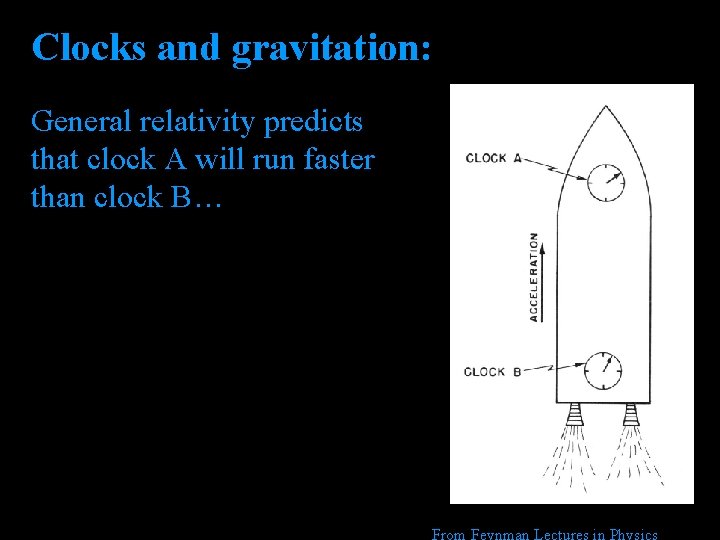
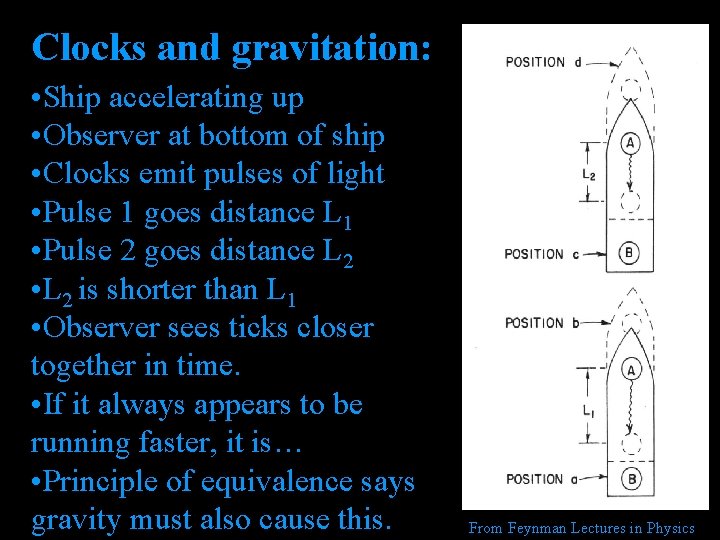
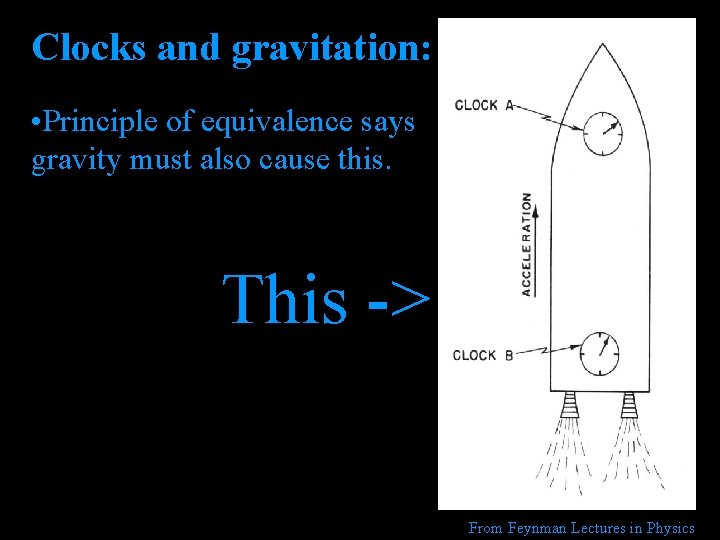
Clocks and gravitation: General relativity predicts that clock A will run faster than clock B… From Feynman Lectures in Physics
Clocks and gravitation: • Ship accelerating up • Observer at bottom of ship • Clocks emit pulses of light • Pulse 1 goes distance L 1 • Pulse 2 goes distance L 2 • L 2 is shorter than L 1 • Observer sees ticks closer together in time. • If it always appears to be running faster, it is… • Principle of equivalence says gravity must also cause this. From Feynman Lectures in Physics
Clocks and gravitation: • Principle of equivalence says gravity must also cause this. This -> From Feynman Lectures in Physics
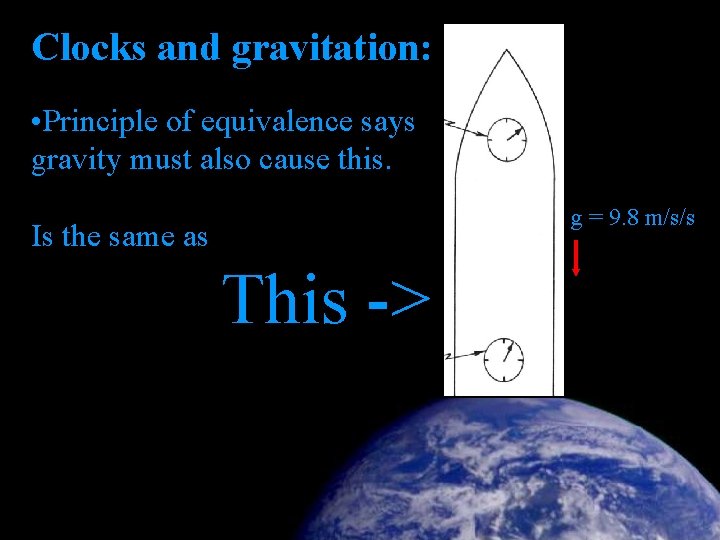
Clocks and gravitation: • Principle of equivalence says gravity must also cause this. g = 9. 8 m/s/s Is the same as This -> From Feynman Lectures in Physics
Clocks and gravitation: • Gravity affects the rate clocks run • High clocks run faster • Low clocks run slower • The twin paradox • Flying in a circle paradox • Red shifted radiation from Quasars
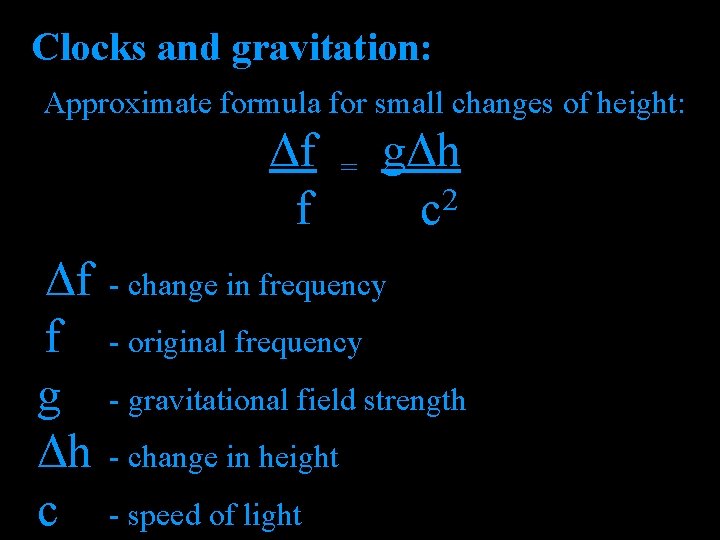
Clocks and gravitation: Approximate formula for small changes of height: Δf f g Δh c = gΔh c 2 - change in frequency - original frequency - gravitational field strength - change in height - speed of light
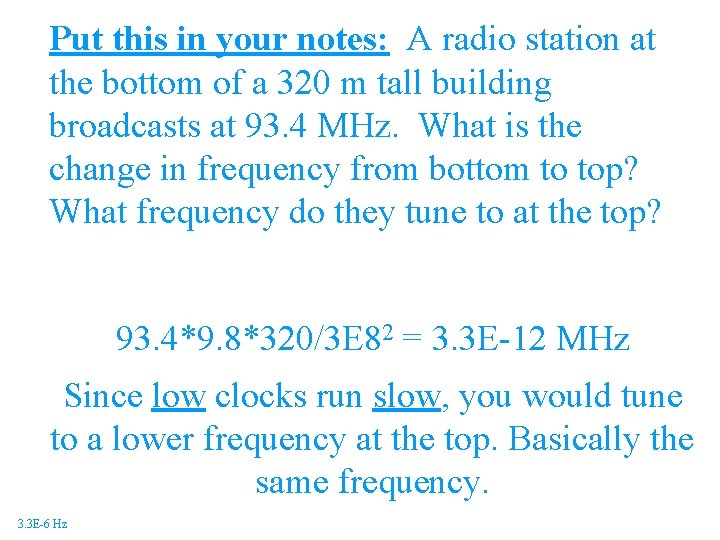
Put this in your notes: A radio station at the bottom of a 320 m tall building broadcasts at 93. 4 MHz. What is the change in frequency from bottom to top? What frequency do they tune to at the top? 93. 4*9. 8*320/3 E 82 = 3. 3 E-12 MHz Since low clocks run slow, you would tune to a lower frequency at the top. Basically the same frequency. 3. 3 E-6 Hz
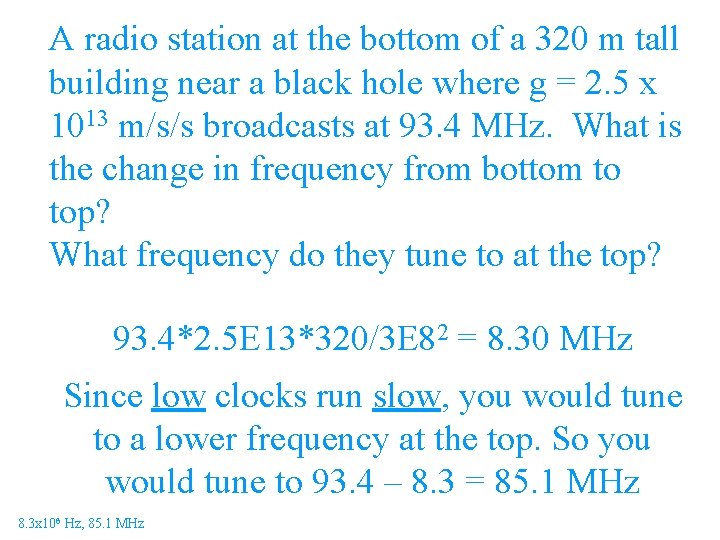
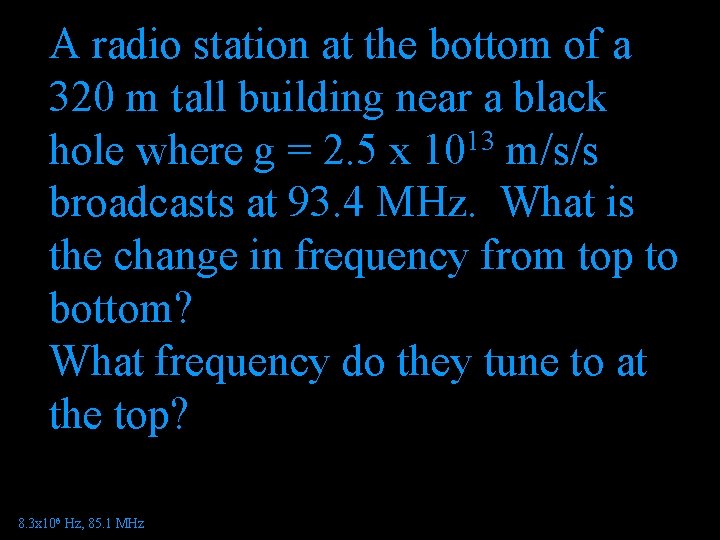
A radio station at the bottom of a 320 m tall building near a black hole where g = 2. 5 x 10¹³ m/s/s broadcasts at 93. 4 MHz. What is the change in frequency from bottom to top? What frequency do they tune to at the top? 93. 4*2. 5 E 13*320/3 E 82 = 8. 30 MHz Since low clocks run slow, you would tune to a lower frequency at the top. So you would tune to 93. 4 – 8. 3 = 85. 1 MHz 8. 3 x 10⁶ Hz, 85. 1 MHz
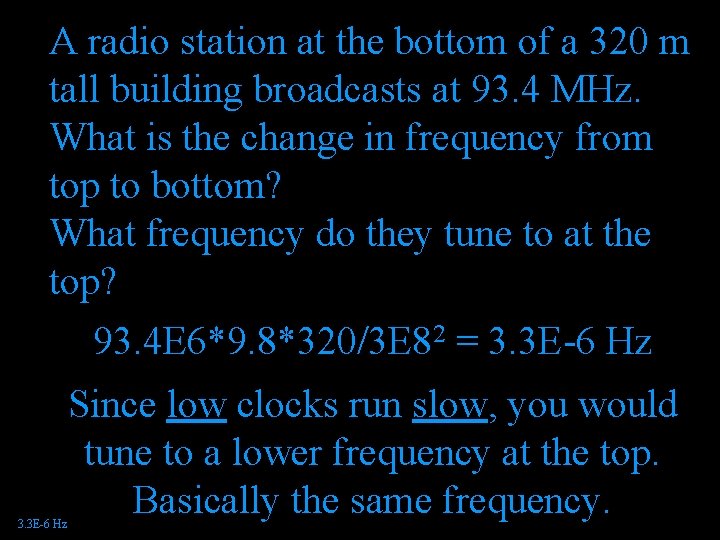
A radio station at the bottom of a 320 m tall building broadcasts at 93. 4 MHz. What is the change in frequency from top to bottom? What frequency do they tune to at the top? 93. 4 E 6*9. 8*320/3 E 82 = 3. 3 E-6 Hz Since low clocks run slow, you would tune to a lower frequency at the top. Basically the same frequency.
A radio station at the bottom of a 320 m tall building near a black hole where g = 2. 5 x 10¹³ m/s/s broadcasts at 93. 4 MHz. What is the change in frequency from top to bottom? What frequency do they tune to at the top? 8. 3 x 10⁶ Hz, 85. 1 MHz
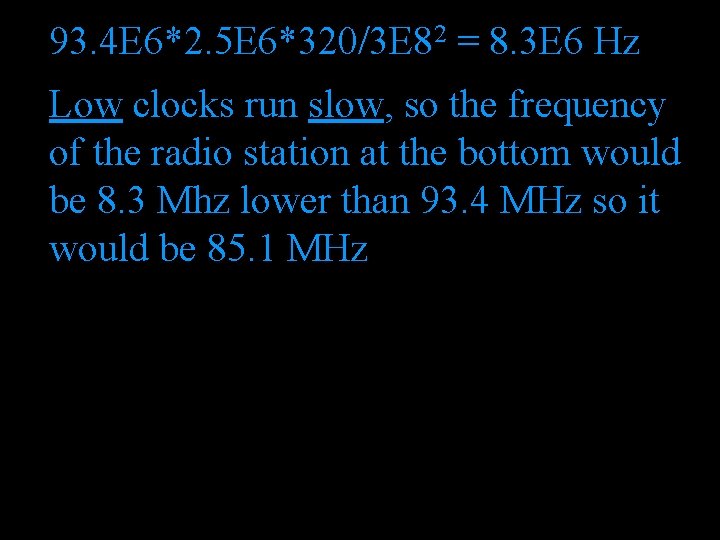
93. 4 E 6*2. 5 E 6*320/3 E 82 = 8. 3 E 6 Hz Low clocks run slow, so the frequency of the radio station at the bottom would be 8. 3 Mhz lower than 93. 4 MHz so it would be 85. 1 MHz
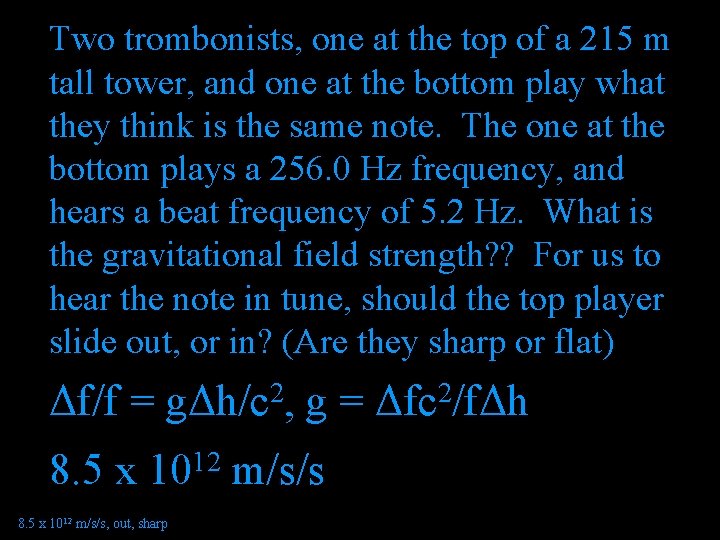
Two trombonists, one at the top of a 215 m tall tower, and one at the bottom play what they think is the same note. The one at the bottom plays a 256. 0 Hz frequency, and hears a beat frequency of 5. 2 Hz. What is the gravitational field strength? ? For us to hear the note in tune, should the top player slide out, or in? (Are they sharp or flat) Δf/f = gΔh/c 2, g = Δfc 2/fΔh 8. 5 x 10¹² m/s/s, out, sharp