
General Relativity and Applications 3 Cosmology Edmund Bertschinger
General Relativity and Applications 3. Cosmology Edmund Bertschinger MIT Department of Physics and Kavli Institute for Astrophysics and Space Research
Focus on Two Cosmological Questions How do we measure the geometry of space? What might dark energy be, and how might we find out? 2
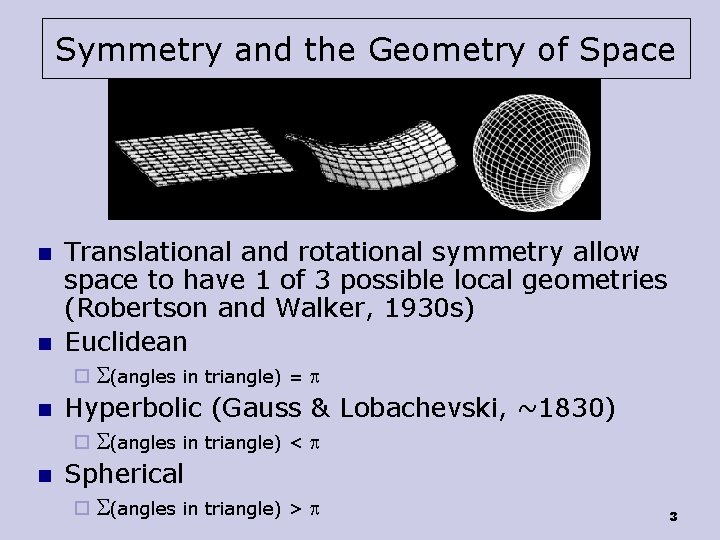
Symmetry and the Geometry of Space n n Translational and rotational symmetry allow space to have 1 of 3 possible local geometries (Robertson and Walker, 1930 s) Euclidean ¨ S(angles in triangle) = p n Hyperbolic (Gauss & Lobachevski, ~1830) ¨ S(angles in triangle) < p n Spherical ¨ S(angles in triangle) > p 3
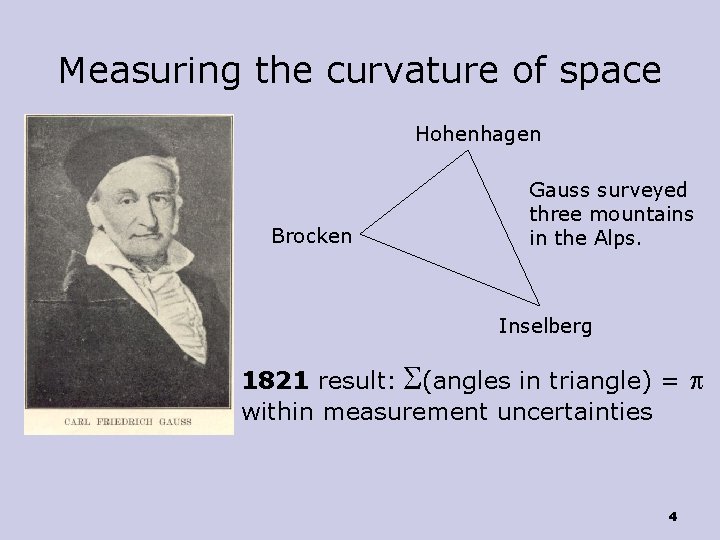
Measuring the curvature of space Hohenhagen Brocken Gauss surveyed three mountains in the Alps. Inselberg 1821 result: S(angles in triangle) = p within measurement uncertainties 4
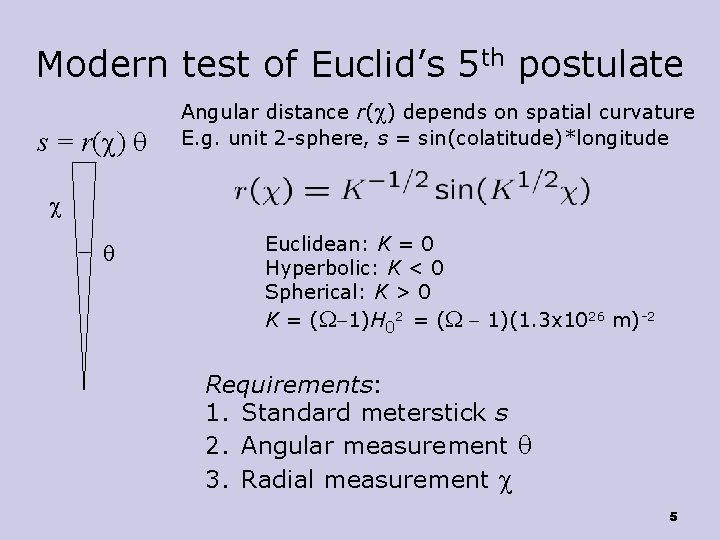
Modern test of Euclid’s 5 th postulate s = r(c) q Angular distance r(c) depends on spatial curvature E. g. unit 2 -sphere, s = sin(colatitude)*longitude c q Euclidean: K = 0 Hyperbolic: K < 0 Spherical: K > 0 K = (W-1)H 02 = (W - 1)(1. 3 x 1026 m)-2 Requirements: 1. Standard meterstick s 2. Angular measurement q 3. Radial measurement c 5
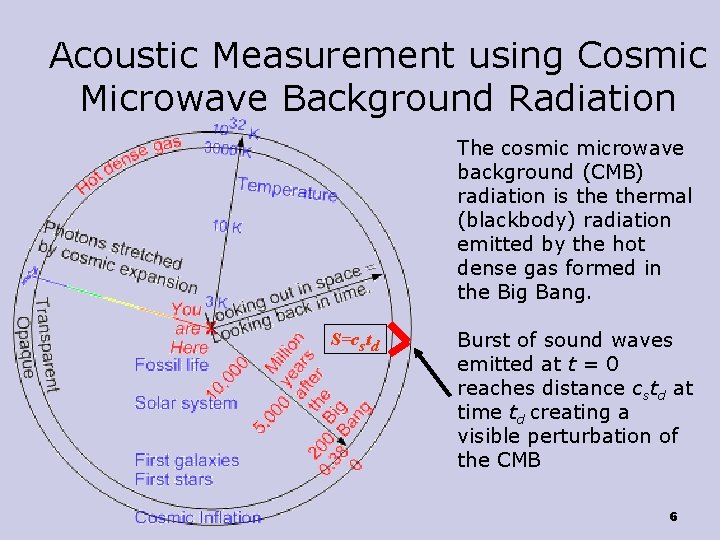
Acoustic Measurement using Cosmic Microwave Background Radiation The cosmic microwave background (CMB) radiation is thermal (blackbody) radiation emitted by the hot dense gas formed in the Big Bang. S=cstd Burst of sound waves emitted at t = 0 reaches distance cstd at time td creating a visible perturbation of the CMB 6
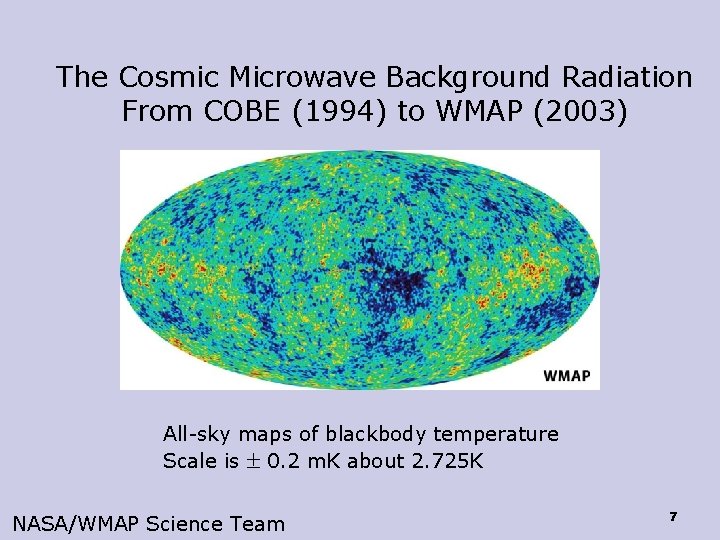
The Cosmic Microwave Background Radiation From COBE (1994) to WMAP (2003) All-sky maps of blackbody temperature Scale is 0. 2 m. K about 2. 725 K NASA/WMAP Science Team 7
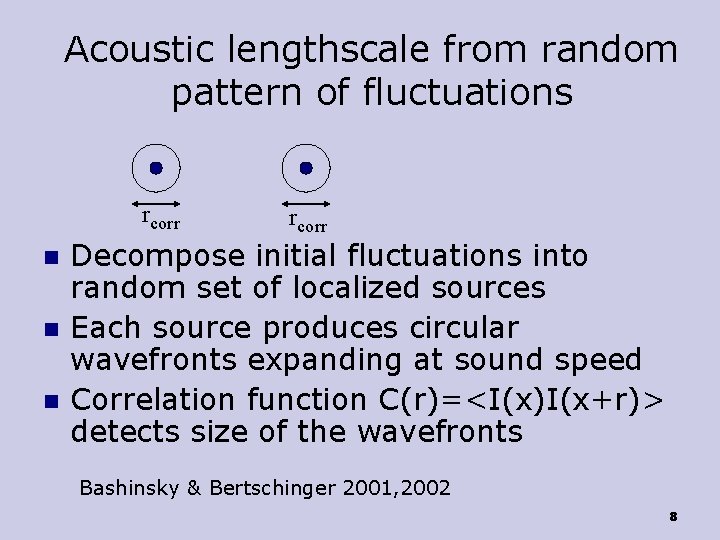
Acoustic lengthscale from random pattern of fluctuations rcorr n n n rcorr Decompose initial fluctuations into random set of localized sources Each source produces circular wavefronts expanding at sound speed Correlation function C(r)=<I(x)I(x+r)> detects size of the wavefronts. Bashinsky & Bertschinger 2001, 2002 8
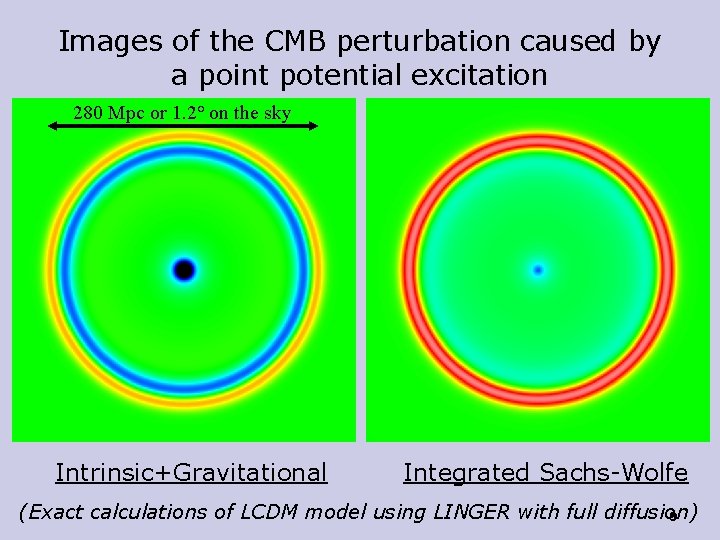
Images of the CMB perturbation caused by a point potential excitation 280 Mpc or 1. 2° on the sky Intrinsic+Gravitational Integrated Sachs-Wolfe (Exact calculations of LCDM model using LINGER with full diffusion) 9
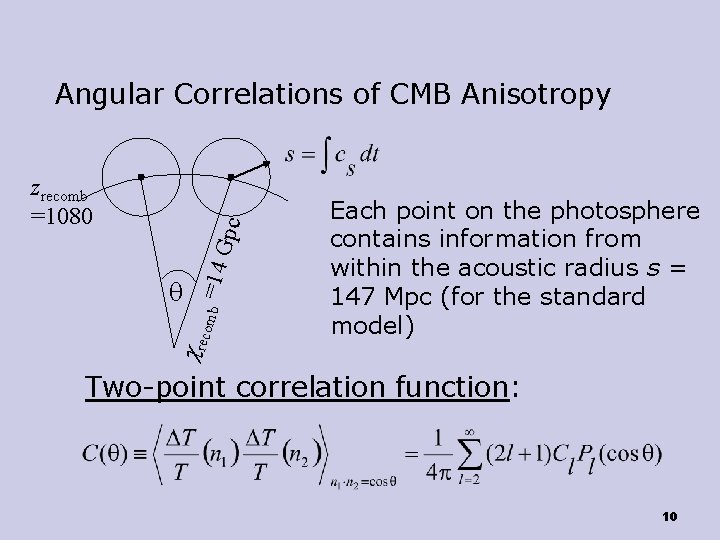
Angular Correlations of CMB Anisotropy b Each point on the photosphere contains information from within the acoustic radius s = 147 Mpc (for the standard model) cre com q =14 Gpc zrecomb =1080 Two-point correlation function: 10
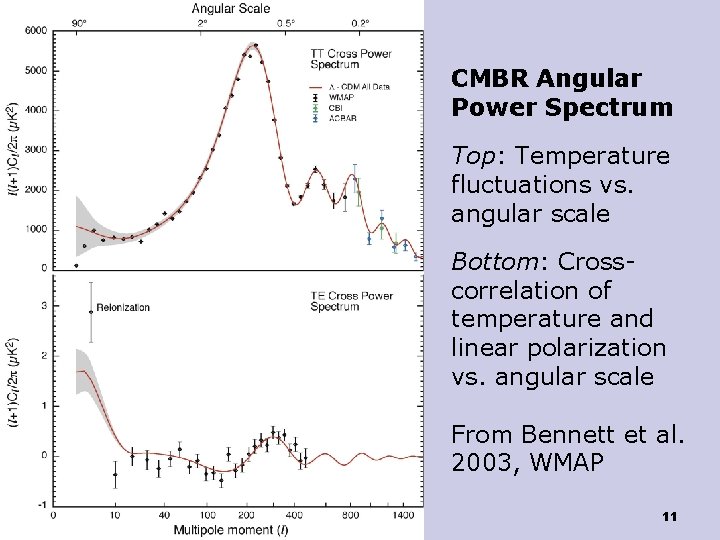
CMBR Angular Power Spectrum Top: Temperature fluctuations vs. angular scale Bottom: Crosscorrelation of temperature and linear polarization vs. angular scale From Bennett et al. 2003, WMAP 11
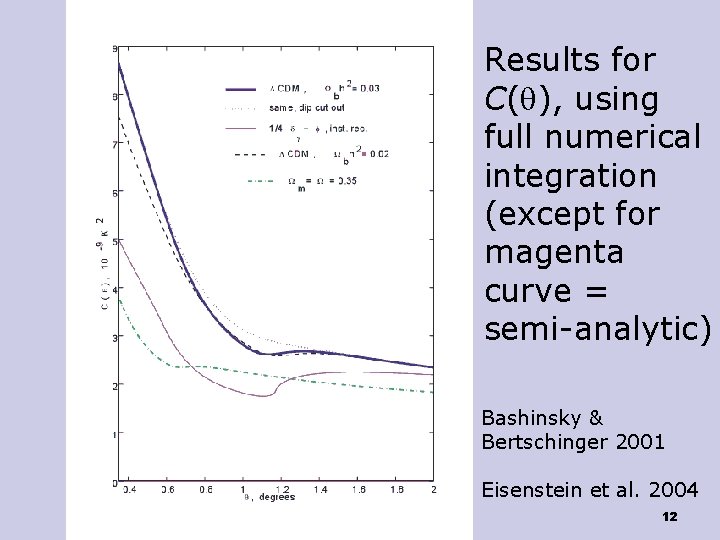
Results for C(q), using full numerical integration (except for magenta curve = semi-analytic) Bashinsky & Bertschinger 2001 Eisenstein et al. 2004 12
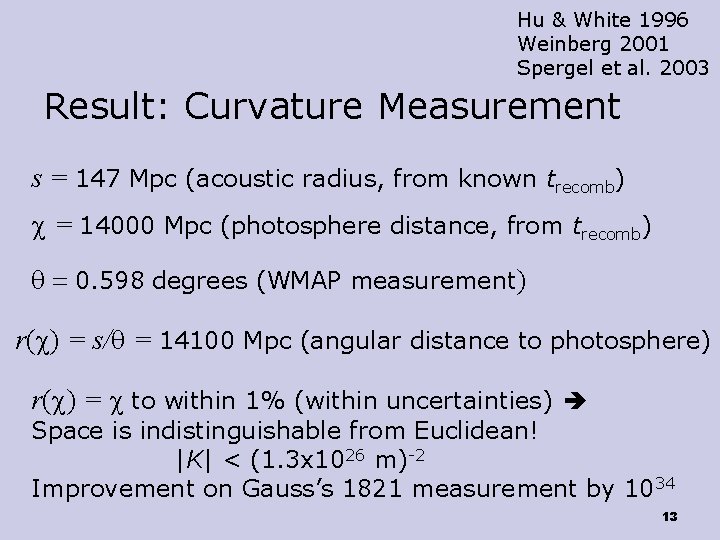
Hu & White 1996 Weinberg 2001 Spergel et al. 2003 Result: Curvature Measurement s = 147 Mpc (acoustic radius, from known trecomb) c = 14000 Mpc (photosphere distance, from trecomb) q = 0. 598 degrees (WMAP measurement) r(c) = s/q = 14100 Mpc (angular distance to photosphere) r(c) = c to within 1% (within uncertainties) Space is indistinguishable from Euclidean! |K| < (1. 3 x 1026 m)-2 Improvement on Gauss’s 1821 measurement by 10 34 13
Focus on Two Cosmological Questions How do we measure the geometry of space? What might dark energy be, and how might we find out? 14
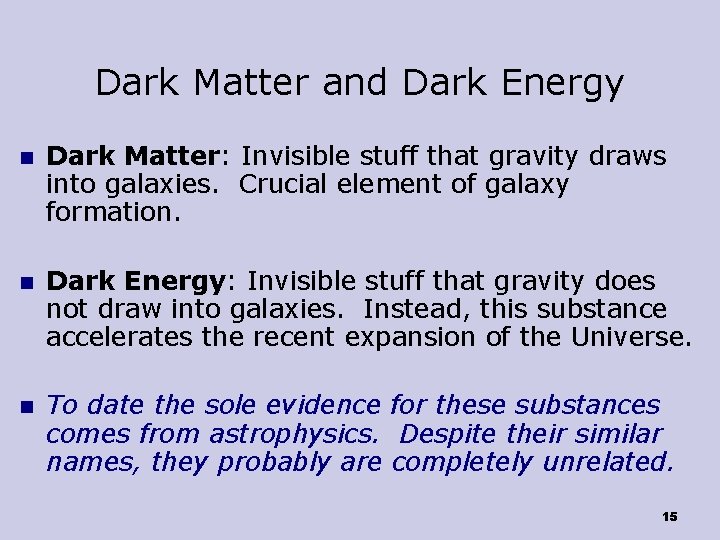
Dark Matter and Dark Energy n Dark Matter: Invisible stuff that gravity draws into galaxies. Crucial element of galaxy formation. n Dark Energy: Invisible stuff that gravity does not draw into galaxies. Instead, this substance accelerates the recent expansion of the Universe. n To date the sole evidence for these substances comes from astrophysics. Despite their similar names, they probably are completely unrelated. 15
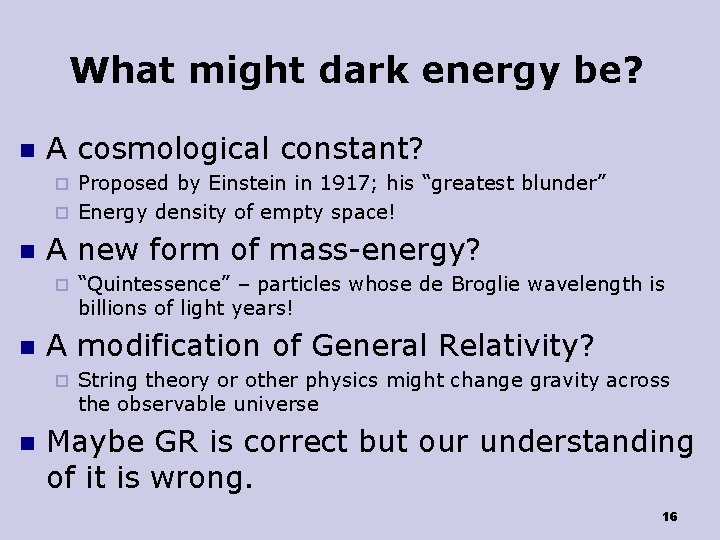
What might dark energy be? n A cosmological constant? Proposed by Einstein in 1917; his “greatest blunder” ¨ Energy density of empty space! ¨ n A new form of mass-energy? ¨ n A modification of General Relativity? ¨ n “Quintessence” – particles whose de Broglie wavelength is billions of light years! String theory or other physics might change gravity across the observable universe Maybe GR is correct but our understanding of it is wrong. 16
How might we find out? n Geometric methods “Expansion history of the Universe” measured using distance and redshift of tracer objects. ¨ Dark energy has repulsive gravity causing the expansion to accelerate. ¨ Supernovae, “baryon acoustic oscillations” ¨ n Perturbation methods Measure how primordial density perturbations grow with time. ¨ Dark energy’s repulsive gravity slows down growth of perturbations. ¨ Galaxy clusters, weak gravitational lensing ¨ 17
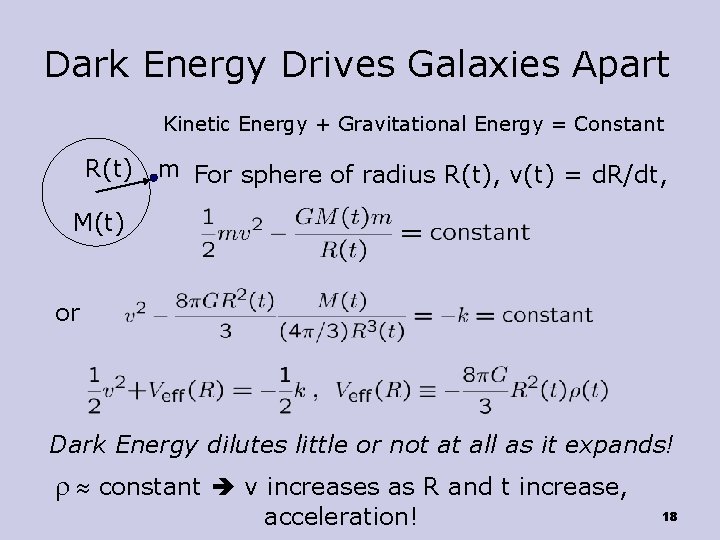
Dark Energy Drives Galaxies Apart Kinetic Energy + Gravitational Energy = Constant R(t) m For sphere of radius R(t), v(t) = d. R/dt, M(t) or Dark Energy dilutes little or not at all as it expands! r constant v increases as R and t increase, acceleration! 18
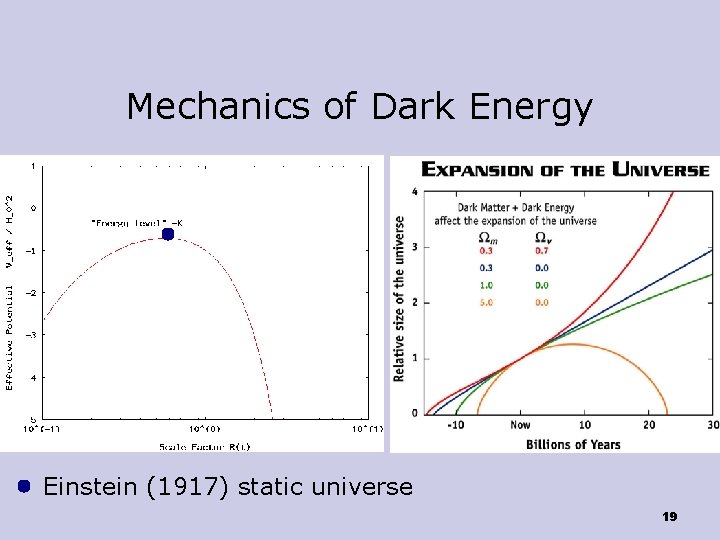
Mechanics of Dark Energy Einstein (1917) static universe 19
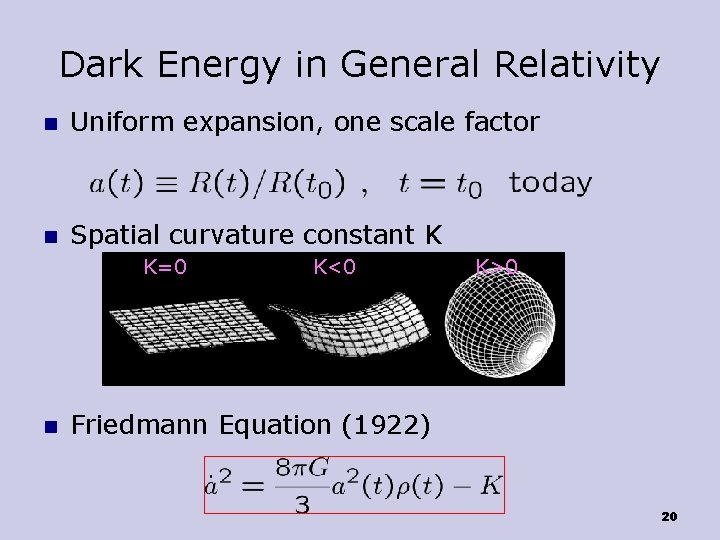
Dark Energy in General Relativity n Uniform expansion, one scale factor n Spatial curvature constant K K=0 n K<0 K>0 Friedmann Equation (1922) 20
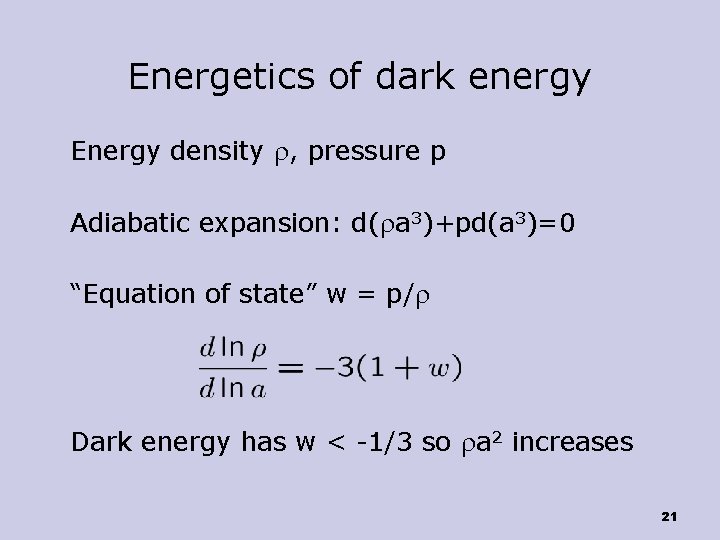
Energetics of dark energy Energy density r, pressure p Adiabatic expansion: d(ra 3)+pd(a 3)=0 “Equation of state” w = p/r Dark energy has w < -1/3 so ra 2 increases 21
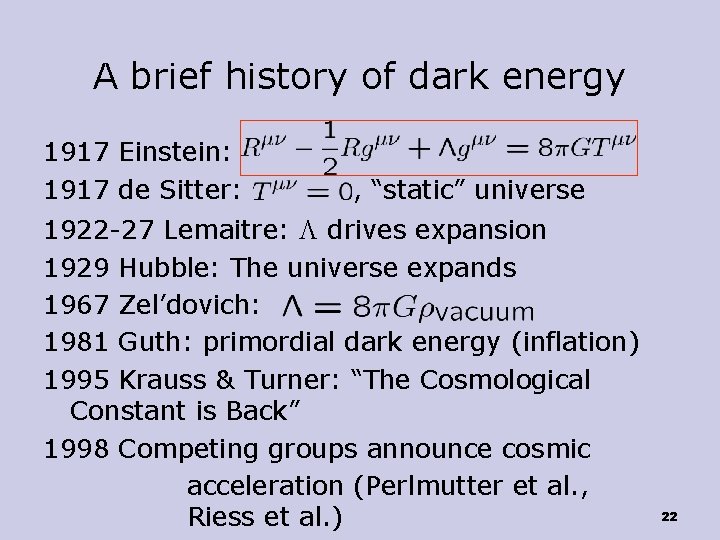
A brief history of dark energy 1917 Einstein: 1917 de Sitter: , “static” universe 1922 -27 Lemaitre: L drives expansion 1929 Hubble: The universe expands 1967 Zel’dovich: 1981 Guth: primordial dark energy (inflation) 1995 Krauss & Turner: “The Cosmological Constant is Back” 1998 Competing groups announce cosmic acceleration (Perlmutter et al. , Riess et al. ) 22
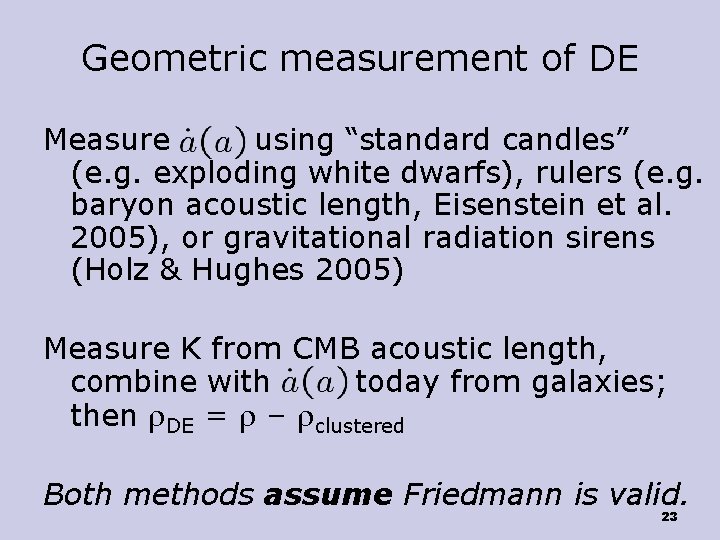
Geometric measurement of DE Measure using “standard candles” (e. g. exploding white dwarfs), rulers (e. g. baryon acoustic length, Eisenstein et al. 2005), or gravitational radiation sirens (Holz & Hughes 2005) Measure K from CMB acoustic length, combine with today from galaxies; then r. DE = r – rclustered Both methods assume Friedmann is valid. 23
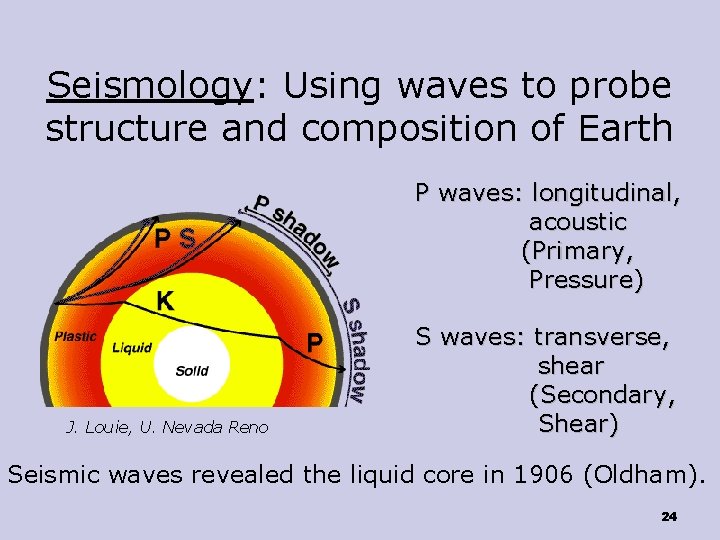
Seismology: Using waves to probe structure and composition of Earth P waves: longitudinal, acoustic (Primary, Pressure) J. Louie, U. Nevada Reno S waves: transverse, shear (Secondary, Shear) Seismic waves revealed the liquid core in 1906 (Oldham). 24
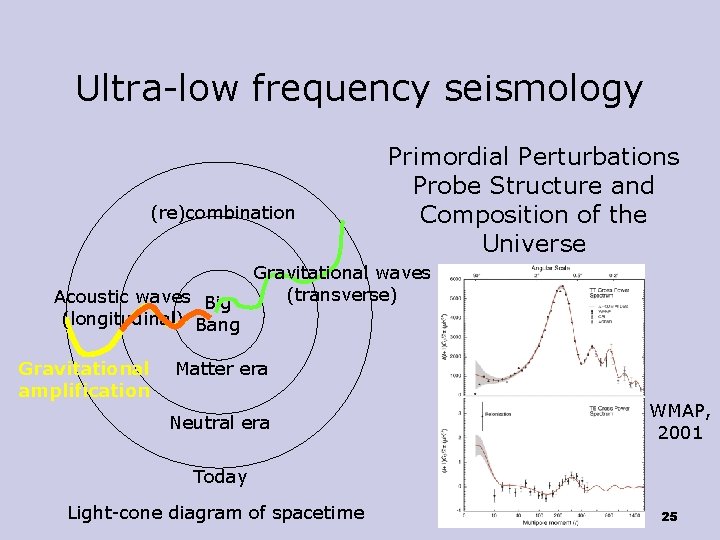
Ultra-low frequency seismology (re)combination Acoustic waves Big (longitudinal) Bang Gravitational amplification Primordial Perturbations Probe Structure and Composition of the Universe Gravitational waves (transverse) Matter era Neutral era WMAP, 2001 Today Light-cone diagram of spacetime 25
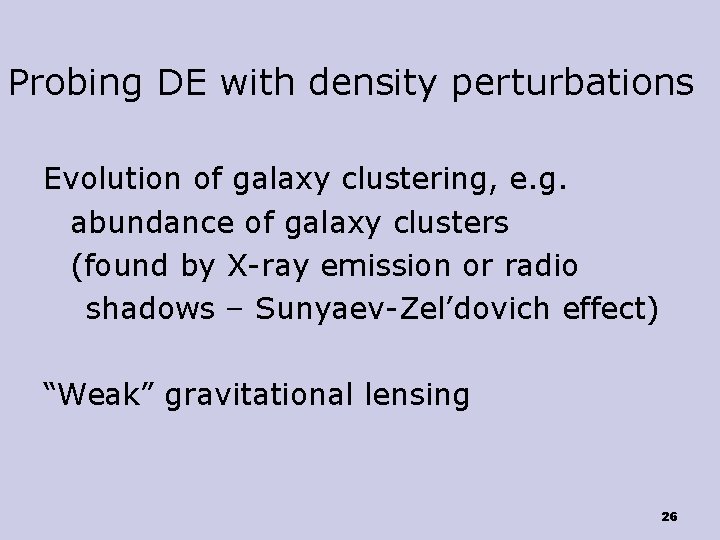
Probing DE with density perturbations Evolution of galaxy clustering, e. g. abundance of galaxy clusters (found by X-ray emission or radio shadows – Sunyaev-Zel’dovich effect) “Weak” gravitational lensing 26
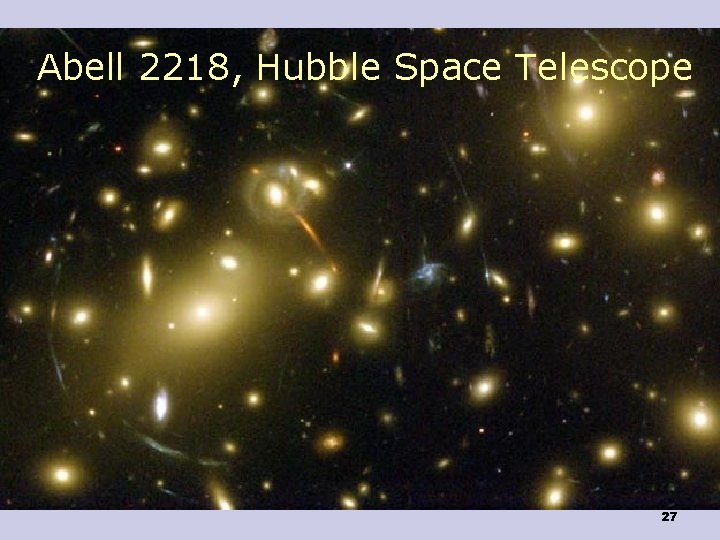
Abell 2218, Hubble Space Telescope 27
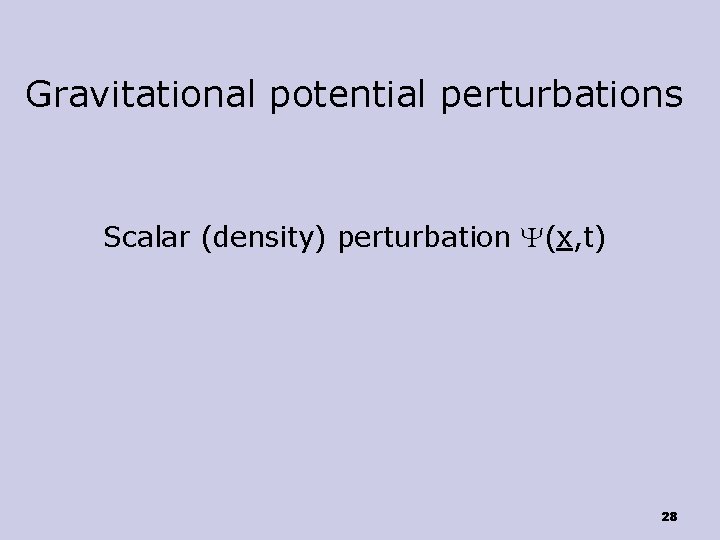
Gravitational potential perturbations Scalar (density) perturbation Y(x, t) 28
Fundamental assumptions of theoretical cosmology More general than GR Spacetime has effectively 4 dimensions and on scales of Gpc is approximately homogeneous, isotropic, and uniformly expanding. Light travels along null geodesics. Some theory of gravity holds (e. g. General Relativity) 29
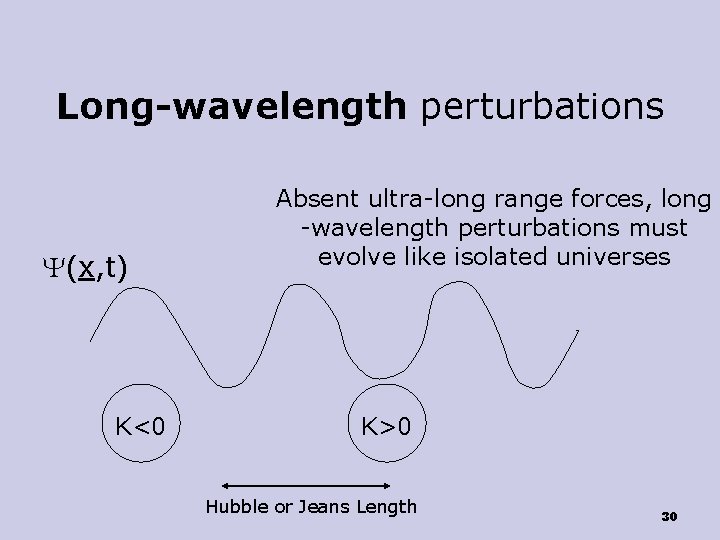
Long-wavelength perturbations Y(x, t) K<0 Absent ultra-long range forces, long -wavelength perturbations must evolve like isolated universes K>0 Hubble or Jeans Length 30
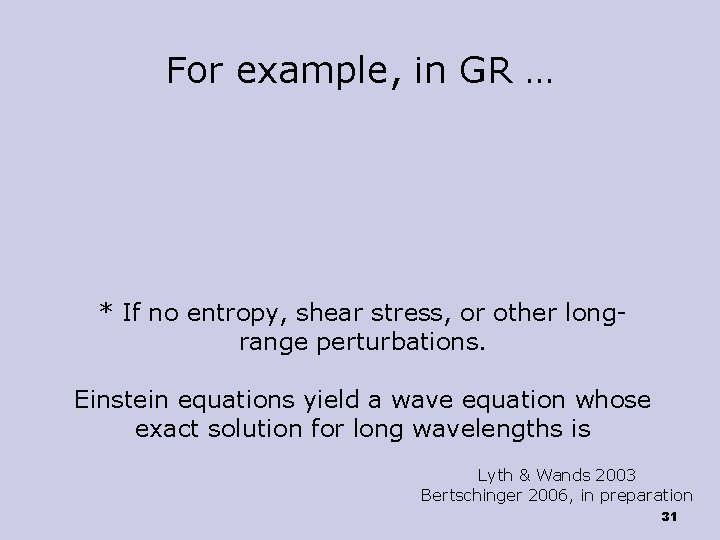
For example, in GR … * If no entropy, shear stress, or other longrange perturbations. Einstein equations yield a wave equation whose exact solution for long wavelengths is Lyth & Wands 2003 Bertschinger 2006, in preparation 31
Perturbations, or homogenous evolution? This solution exactly matches the unperturbed evolution a Robertson. Walker universe, provided that the Friedmann equation holds! Long-wavelength perturbations = Robertson-Walker + Friedmann 32
Consequences Perturbation evolution measures the same thing as standard candles/rulers, unless: Pressure or stress forces act Other long-range forces act 33
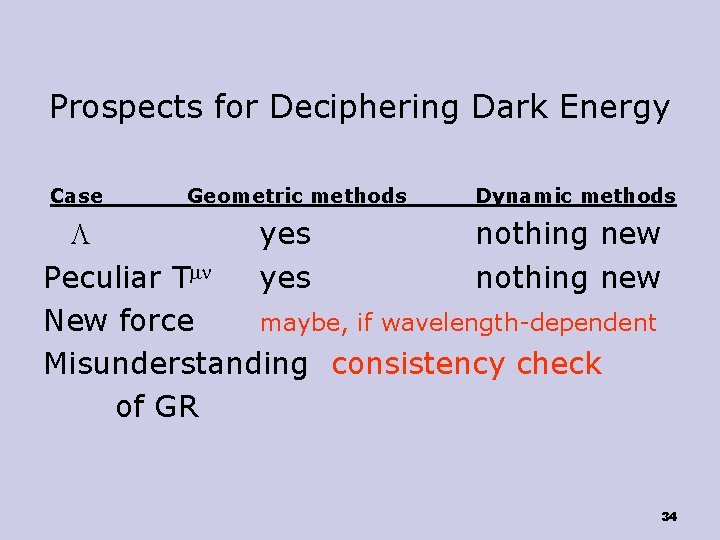
Prospects for Deciphering Dark Energy Case Geometric methods Dynamic methods L yes nothing new Peculiar Tmn yes nothing new New force maybe, if wavelength-dependent Misunderstanding consistency check of GR 34
We don’t know what the dark energy is! But we want to find out! n n n Why is the energy density of the vacuum so small, when virtual particles should make it huge? If not Huge, why not Zero? Why is dark energy comparably abundant to matter today, when it was negligible 10 billion years ago? Why now? What is the ultimate fate of our Universe? 35
- Slides: 35