
General Rate Case Cycle Workshop For Californias 4
- Slides: 18
General Rate Case Cycle Workshop For California’s 4 major energy investor-owned utilities (PG&E, SCE, SDG&E, and So. Cal. Gas) Facilitators: Elaine Lau, Electric Costs Section, Energy Division Belinda Gatti, Natural Gas Section, Energy Division January 11, 2017 1
Background and Purpose 2
Purpose • To explore options to facilitate the timely completion of General Rate Case (GRC) proceedings and other related major rate proceedings, including the – Safety Model Assessment (SMAP) Proceeding, – Risk Assessment and Mitigation Phase (RAMP) proceeding, and – PG&E’s Gas Transmission and Storage (GT&S) proceeding. 3
Background • In September 2015, Office of Ratepayer Advocates (ORA), San Diego Gas & Electric Company (SDG&E), and Southern California Gas Company (So. Cal. Gas) filed a petition for modification of D. 14 -12 -025, to change the current three-year GRC cycle to a four-year GRC cycle. • In June 2016, D. 16 -06 -005 rejected the petition for modification and retained the current three-year GRC cycle. 4
Background • The decision directed Energy Division to hold a workshop within six months to explore options, including moving to a longer GRC cycle, to facilitate the timely completion of GRC and related proceedings, such as SMAP, RAMP, and PG&E’s GTS. • The decision also noted the importance of examining these issues to help facilitate smoother workload flow processes, in addition to the timely and efficient processing of all these proceedings. • Energy Division shall provide a report following the workshop. 5
Background Ordering Paragraph 2 of D. 16 -06 -005 states, “The Commission’s Energy Division shall hold a workshop within six months of today’s date to explore options, including moving toward a longer general rate case (GRC) cycle, to facilitate the timely completion of GRC and related proceedings, and to provide a report following the workshop. ” 6
Morning Discussion Topic Challenges to the Timely Processing of GRCs within the current Rate Case Plan 7
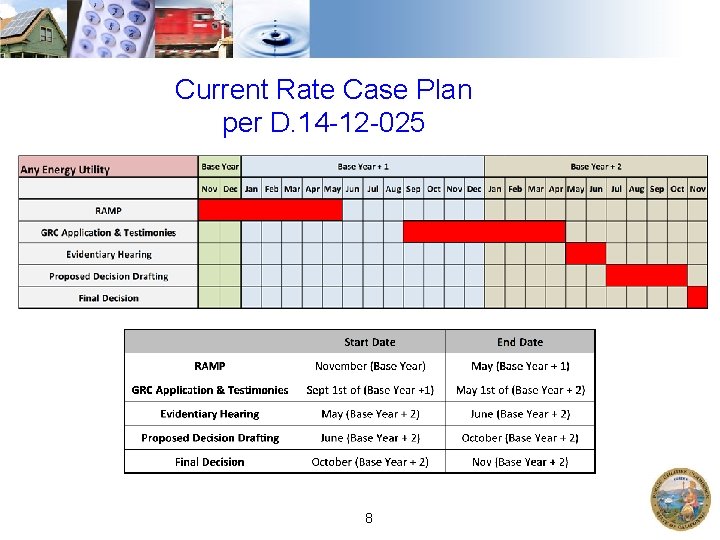
Current Rate Case Plan per D. 14 -12 -025 8
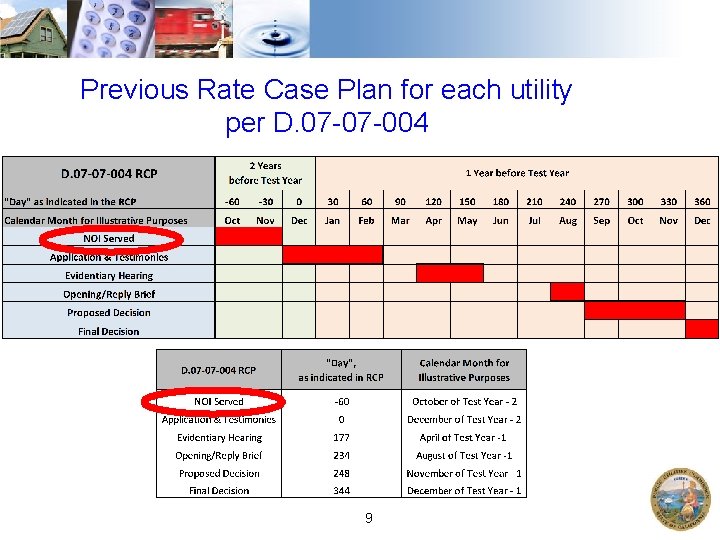
Previous Rate Case Plan for each utility per D. 07 -07 -004 9
History: Last ten years of GRC proceedings • Since PG&E’s 2007 GRC until SDG&E/So. Cal. Gas’ 2016 GRC, GRC final decisions were issued an average of 225 days after the first date of the test year. – For GRCs with settled test year revenue requirement, the decisions were issued an average of 146 days after the test year. – For GRCs that is fully litigated, the decisions were issued an average of 288 days after the test year. • The delay in GRC decisions are due to many reasons. • One of the reason is the concurrent filing of GRC applications. • The longest delays in this period were for the 2012 GRCs of SCE and SDG&E/So. Cal. Gas because the Commission reviewed GRCs from two major IOUs concurrently. Additionally, both GRCs were fully litigated. 10
Energy Division’s Proposal Streamline review of GRC filings between all major utilities: • Joint Comparison Exhibit outlining all the parties’ position drafted before evidentiary hearings • Uniform Results of Operations user input format • Uniform Summary of Earnings table format • Standardized labelling of testimony – IOUs label their testimonies according to a standard index. – The index would reference a standard chapter/exhibit number for testimony supporting a certain class of expenses. • (For PG&E) Consolidated PG&E Gas GRC: Combine the review of GT&S and Gas Distribution 11
Afternoon Discussion Topic Exploring the Pros and Cons of a 3 -year versus a 4 -year GRC Cycle 12
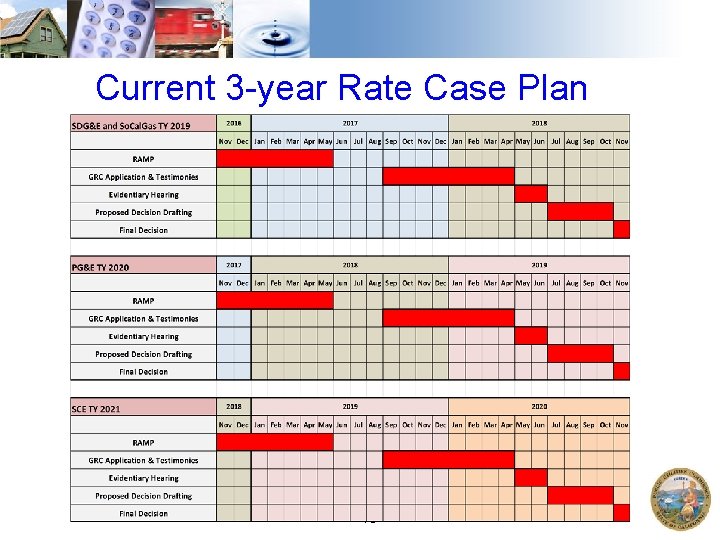
Current 3 -year Rate Case Plan 13
Concurrent Proceedings under the Current 3 -year RCP • SMAP Phase 2 is in progress – Estimated Schedule: Nov 2016 thru 2017 • Next PG&E GT&S would be filed in 2017 for Test Year 2019, for rates effective 2019 -2021 (3 years). • Under the current 3 -year GRC cycle, – SMAP Phase 2 overlaps with SDG&E’s RAMP and SCE’s 2018 GRC – PG&E’s GT&S proceedings will always overlap with So. Cal. Gas/SDG&E’s GRC proceedings (e. g. Test Year 2019) 14
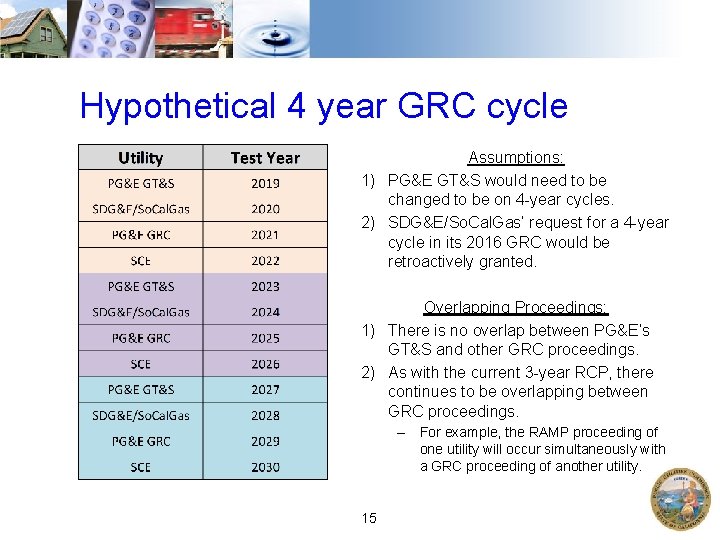
Hypothetical 4 year GRC cycle Assumptions: 1) PG&E GT&S would need to be changed to be on 4 -year cycles. 2) SDG&E/So. Cal. Gas’ request for a 4 -year cycle in its 2016 GRC would be retroactively granted. Overlapping Proceedings: 1) There is no overlap between PG&E’s GT&S and other GRC proceedings. 2) As with the current 3 -year RCP, there continues to be overlapping between GRC proceedings. – For example, the RAMP proceeding of one utility will occur simultaneously with a GRC proceeding of another utility. 15
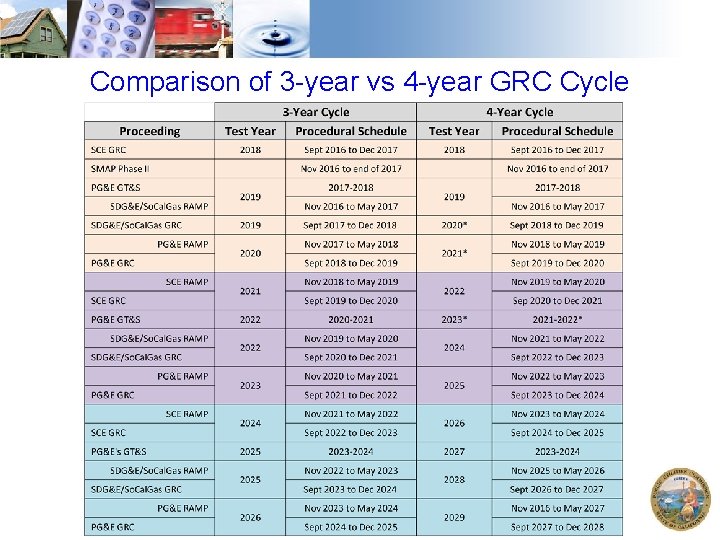
Comparison of 3 -year vs 4 -year GRC Cycle 16
Energy Division’s Observations • Under the current 3 -year GRC cycle, PG&E’s GT&S proceedings will always overlap with SDG&E/So. Cal. Gas’ GRC proceedings. • A 4 -year GRC cycle would eliminate the overlapping of GRCs and PG&E’s GT&S, but RAMP proceedings would still overlap with a GRC or a GT&S proceedings. • Challenges to the timely processing of GRC proceedings may still exist in a 4 -year GRC Rate Cycle framework. • With a 4 -year GRC cycle, there is more uncertainty to the forecasts of attrition year expenditures, due to the extra length of time in between test year forecasts. – There would be more reliance on post-test year ratemaking mechanism. – In recent GRC filings (PG&E 2017 and SCE 2018), the attrition year revenue requirements have higher % increases compared to test year revenue requirements. 17
Questions? 18