
General presentation of Eurocode 7 on Geotechnical design


- Slides: 39
General presentation of Eurocode 7 on ‘Geotechnical design’ Roger FRANK Ecole nationale des ponts et chaussées Laboratoire Navier - CERMES, Paris 1
1. The ‘Structural Eurocodes’ programme 2. Contents of Eurocode 7 3. Ultimate limit states 4. Serviceability limit states 5. Liaisons. Associated standards Conclusions (6. Implementation in the various countries) 2
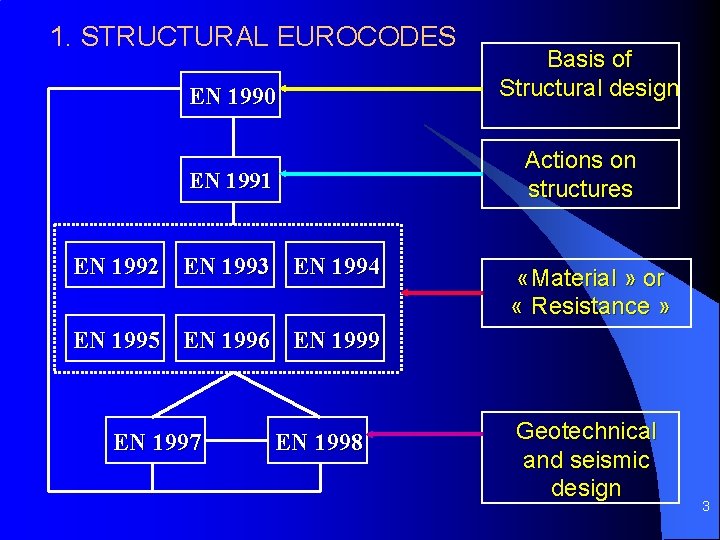
1. STRUCTURAL EUROCODES EN 1990 Basis of Structural design Actions on structures EN 1991 EN 1992 EN 1993 EN 1994 «Material » or « Resistance » EN 1995 EN 1996 EN 1999 EN 1997 EN 1998 Geotechnical and seismic design 3
l l l Ultimate limit state concern - the safety of people - the safety of the structure Serviceability limit state concern - the functioning of the structure - the comfort of people - the appearance of the structure The selected design situation shall be sufficiently severe and so varied as to encompass all conditions which can reasonably be foreseen to occur during the execution and use of the structure 4
2. Eurocode 7 – Geotechnical design (2004 -2007) l EN 1997 -1 : 2004 - Part 1 : General rules l EN 1997 -2 : 2007 - Part 2 : Ground investigation and testing l A new structure is presently being drafted (for 2016 -2022…) 5
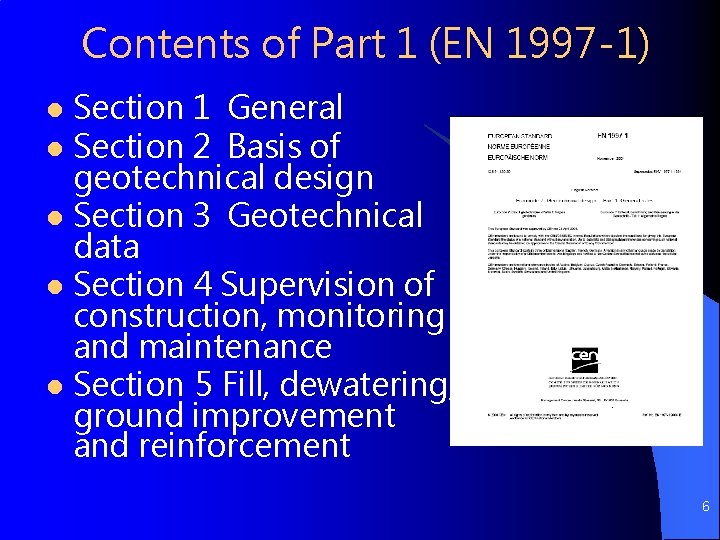
Contents of Part 1 (EN 1997 -1) Section 1 General l Section 2 Basis of geotechnical design l Section 3 Geotechnical data l Section 4 Supervision of construction, monitoring and maintenance l Section 5 Fill, dewatering, ground improvement and reinforcement l 6
l Section 6 Spread foundations l Section 7 Pile foundations l Section 8 Anchorages l Section 9 Retaining structures l Section 10 Hydraulic failure l Section 11 Site stability l Section 12 Embankments 7
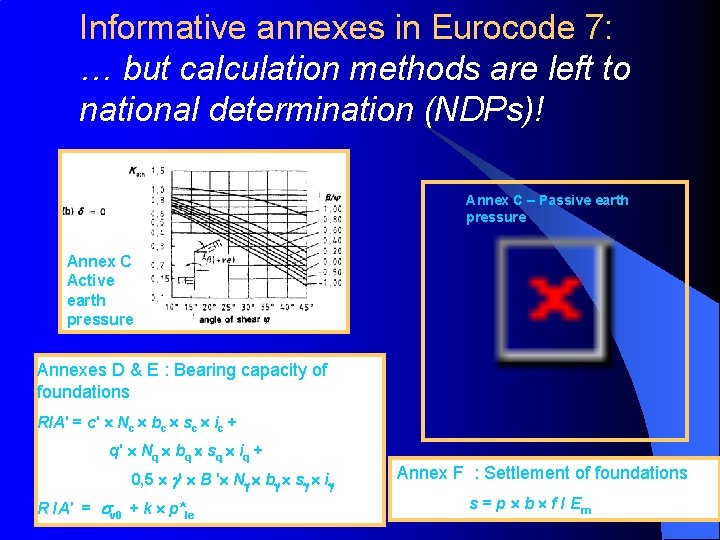
Informative annexes in Eurocode 7: … but calculation methods are left to national determination (NDPs)! Annex C – Passive earth pressure Annex C Active earth pressure Annexes D & E : Bearing capacity of foundations R/A' = c' Nc bc sc ic + q' Nq bq sq iq + 0, 5 ' B ' N b s i R /A' = v 0 + k p*le Annex F : Settlement of foundations s = p b f / Em 8
Revision of Eurocode 7 : 2016 -2022 l l l Eurocode 7 - Part 1 : General rules Eurocode 7 - Part 2 : Ground investigation and testing (≈ identical) Eurocode 7 - Part 3 : General rules 1 General 2 Slopes, cuttings, and embankments 3 Spread foundations 4 Pile foundations 5 Retaining walls 6 Anchors 7 Reinforced soil structures 8 Ground improvement 9
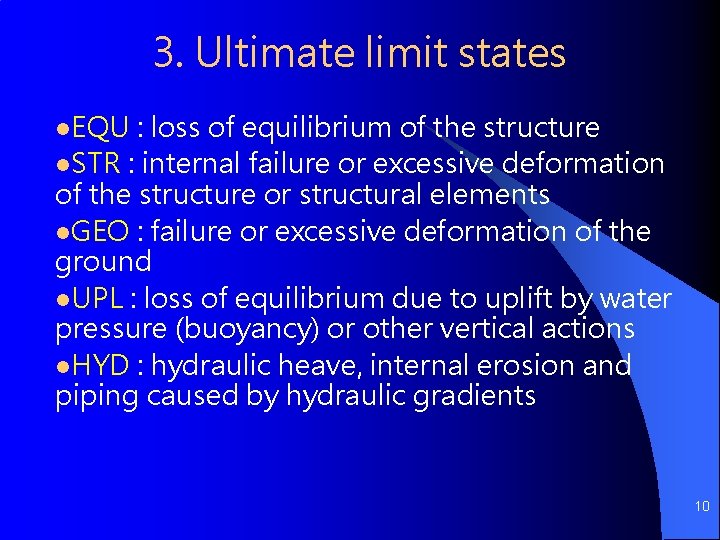
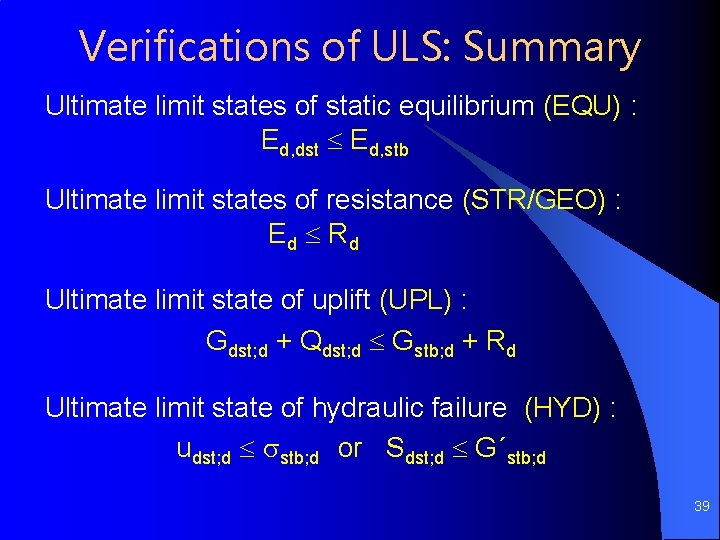
3. Ultimate limit states l. EQU : loss of equilibrium of the structure l. STR : internal failure or excessive deformation of the structure or structural elements l. GEO : failure or excessive deformation of the ground l. UPL : loss of equilibrium due to uplift by water pressure (buoyancy) or other vertical actions l. HYD : hydraulic heave, internal erosion and piping caused by hydraulic gradients 10
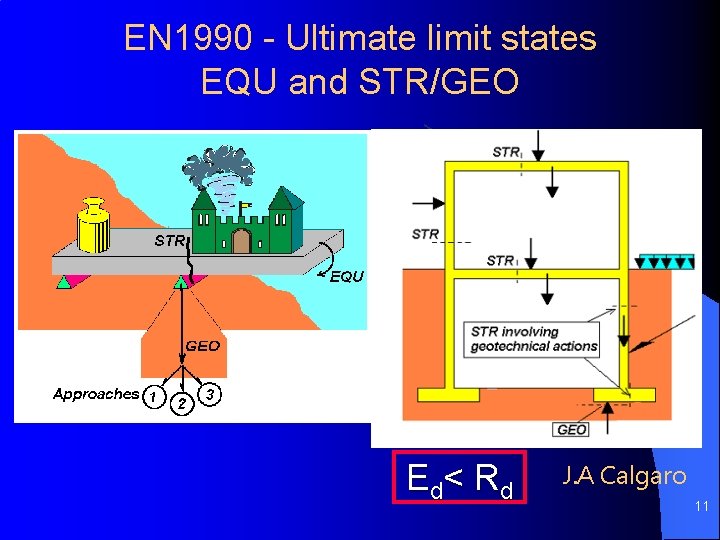
EN 1990 - Ultimate limit states EQU and STR/GEO E d< R d J. A Calgaro 11
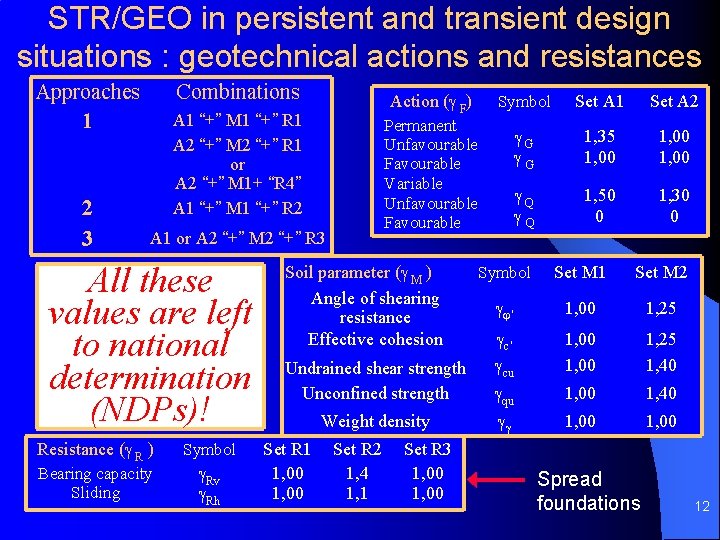
STR/GEO in persistent and transient design situations : geotechnical actions and resistances Approaches 1 2 3 Combinations Action ( F) A 1 “+” M 1 “+” R 1 A 2 “+” M 2 “+” R 1 or A 2 “+” M 1+ “R 4” A 1 “+” M 1 “+” R 2 Resistance ( R ) Bearing capacity Sliding Symbol Rv Rh Set A 1 Set A 2 G G 1, 35 1, 00 Q Q 1, 50 0 1, 30 0 Permanent Unfavourable Favourable Variable Unfavourable Favourable A 1 or A 2 “+” M 2 “+” R 3 All these values are left to national determination (NDPs)! Symbol Soil parameter ( M ) Angle of shearing resistance Effective cohesion Symbol Set M 1 Set M 2 ’ 1, 00 1, 25 Undrained shear strength Unconfined strength c’ cu 1, 00 1, 25 1, 40 qu 1, 00 1, 40 Weight density 1, 00 Set R 1 1, 00 Set R 2 1, 4 1, 1 Set R 3 1, 00 Spread foundations 12
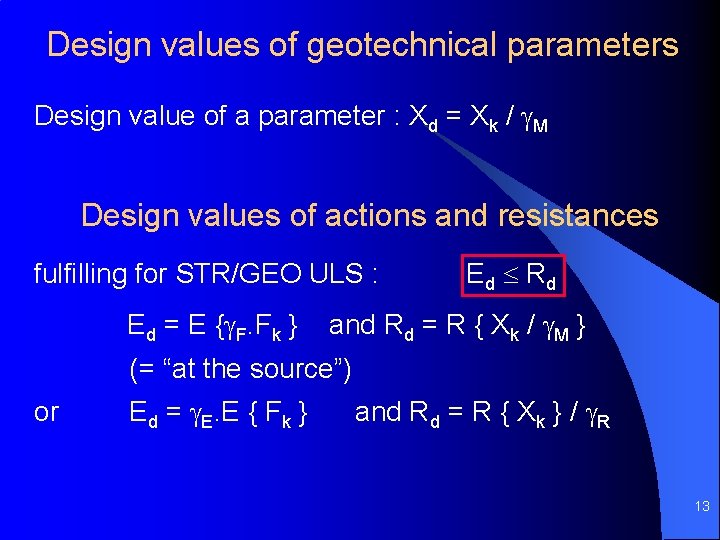
Design values of geotechnical parameters Design value of a parameter : Xd = Xk / M Design values of actions and resistances fulfilling for STR/GEO ULS : Ed = E { F. Fk } Ed Rd and Rd = R { Xk / M } (= “at the source”) or Ed = E. E { Fk } and Rd = R { Xk } / R 13
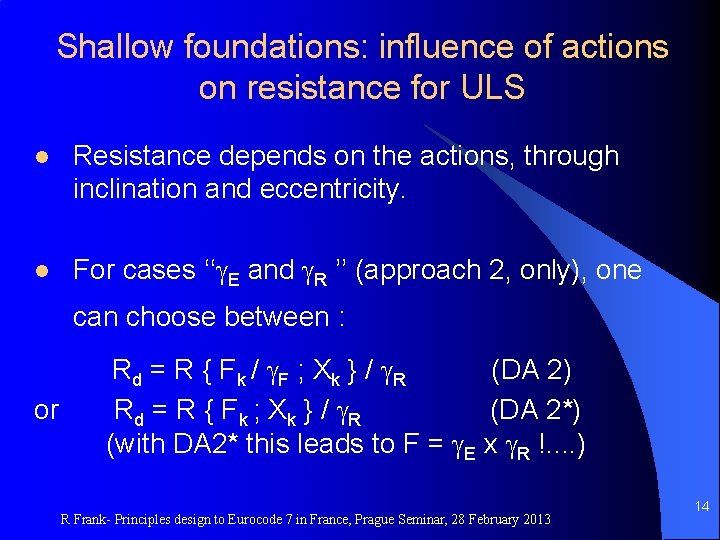
Shallow foundations: influence of actions on resistance for ULS l Resistance depends on the actions, through inclination and eccentricity. l For cases ‘‘ E and R ’’ (approach 2, only), one can choose between : or R d = R { F k / F ; X k } / R (DA 2) R d = R { F k ; X k } / R (DA 2*) (with DA 2* this leads to F = E x R !. . ) R Frank- Principles design to Eurocode 7 in France, Prague Seminar, 28 February 2013 14
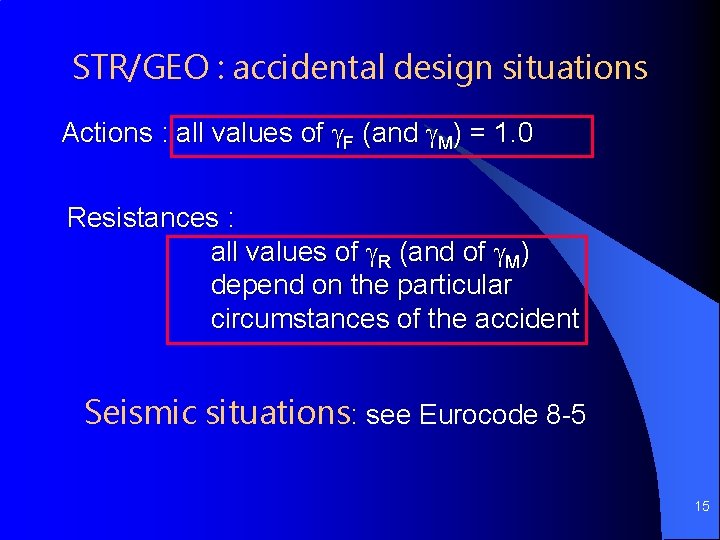
STR/GEO : accidental design situations Actions : all values of F (and M) = 1. 0 Resistances : all values of R (and of M) depend on the particular circumstances of the accident Seismic situations: see Eurocode 8 -5 15
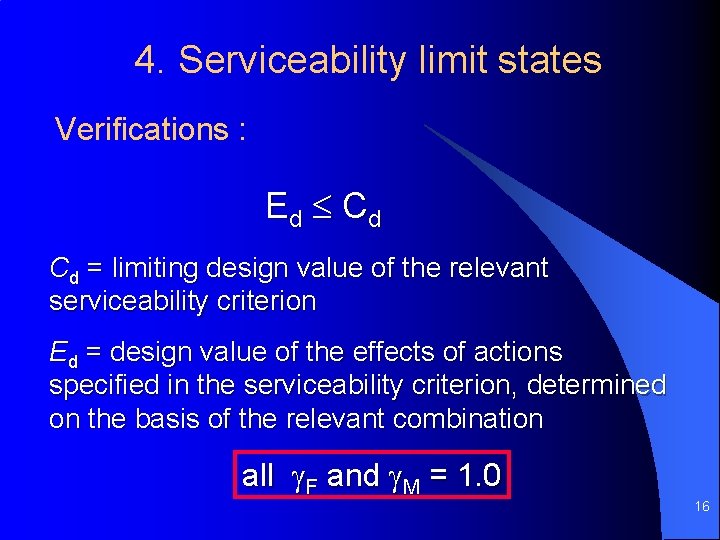
4. Serviceability limit states Verifications : Ed Cd Cd = limiting design value of the relevant serviceability criterion Ed = design value of the effects of actions specified in the serviceability criterion, determined on the basis of the relevant combination all F and M = 1. 0 16
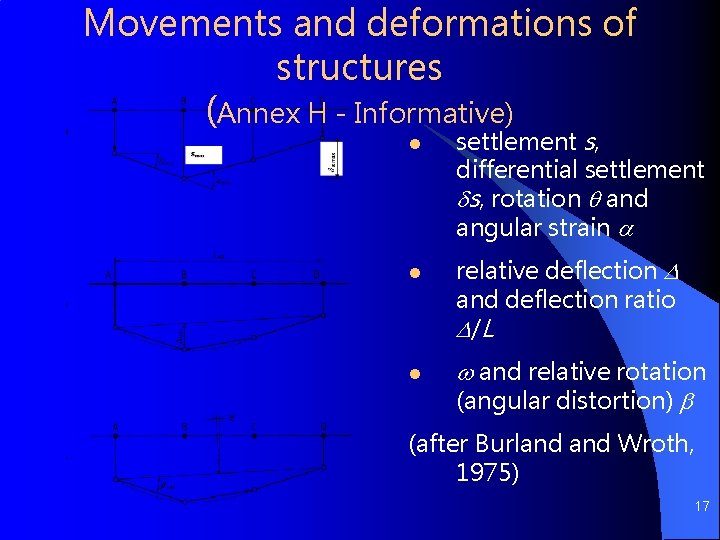
Movements and deformations of structures (Annex H - Informative) l settlement s, differential settlement s, rotation and angular strain l relative deflection and deflection ratio /L l and relative rotation (angular distortion) (after Burland Wroth, 1975) 17
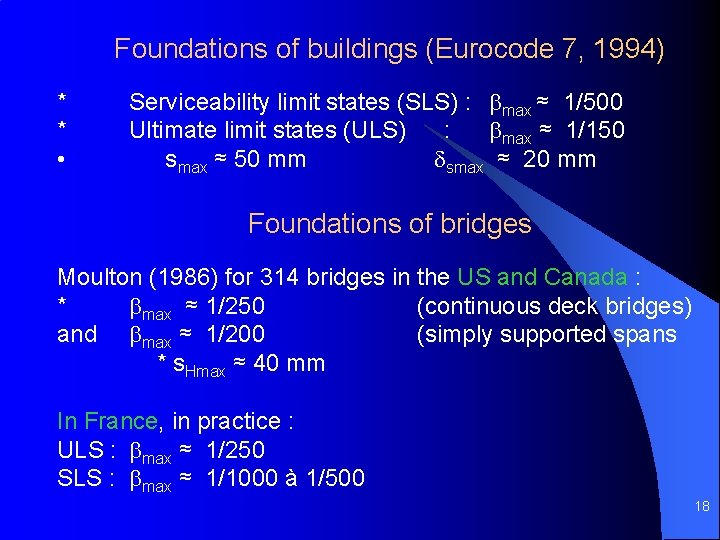
Foundations of buildings (Eurocode 7, 1994) * * • Serviceability limit states (SLS) : bmax ≈ 1/500 Ultimate limit states (ULS) : bmax ≈ 1/150 smax ≈ 50 mm dsmax ≈ 20 mm Foundations of bridges Moulton (1986) for 314 bridges in the US and Canada : * bmax ≈ 1/250 (continuous deck bridges) and bmax ≈ 1/200 (simply supported spans * s. Hmax ≈ 40 mm In France, in practice : ULS : bmax ≈ 1/250 SLS : bmax ≈ 1/1000 à 1/500 18
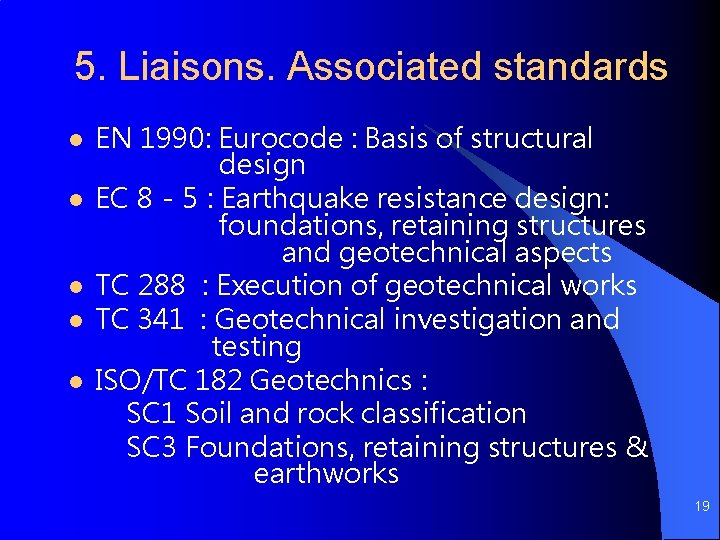
5. Liaisons. Associated standards l l l EN 1990: Eurocode : Basis of structural design EC 8 - 5 : Earthquake resistance design: foundations, retaining structures and geotechnical aspects TC 288 : Execution of geotechnical works TC 341 : Geotechnical investigation and testing ISO/TC 182 Geotechnics : SC 1 Soil and rock classification SC 3 Foundations, retaining structures & earthworks 19
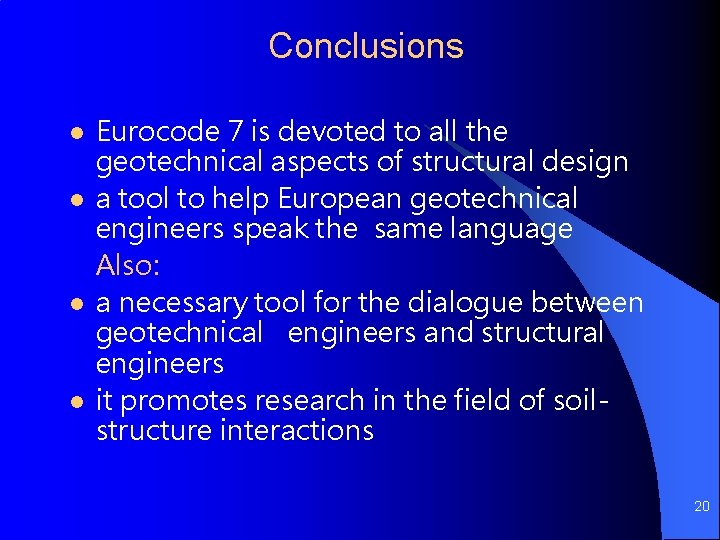
Conclusions l l Eurocode 7 is devoted to all the geotechnical aspects of structural design a tool to help European geotechnical engineers speak the same language Also: a necessary tool for the dialogue between geotechnical engineers and structural engineers it promotes research in the field of soilstructure interactions 20
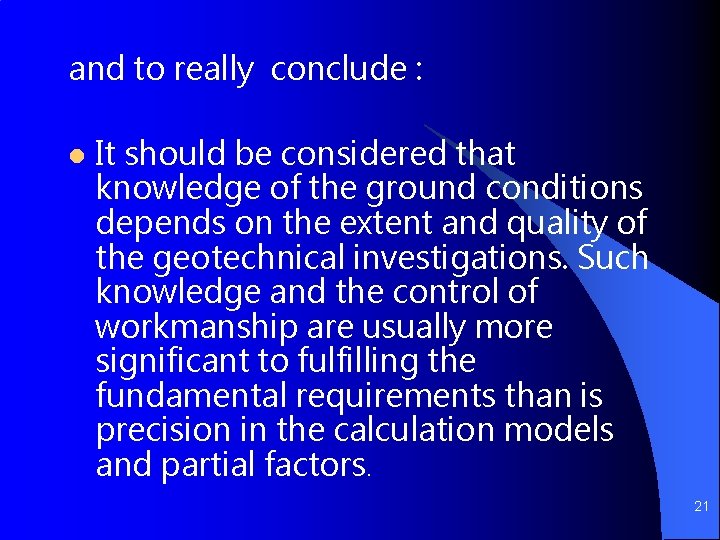
and to really conclude : l It should be considered that knowledge of the ground conditions depends on the extent and quality of the geotechnical investigations. Such knowledge and the control of workmanship are usually more significant to fulfilling the fundamental requirements than is precision in the calculation models and partial factors. 21
Thank you for your attention ! 22
23
6. Implementation in the various countries 24
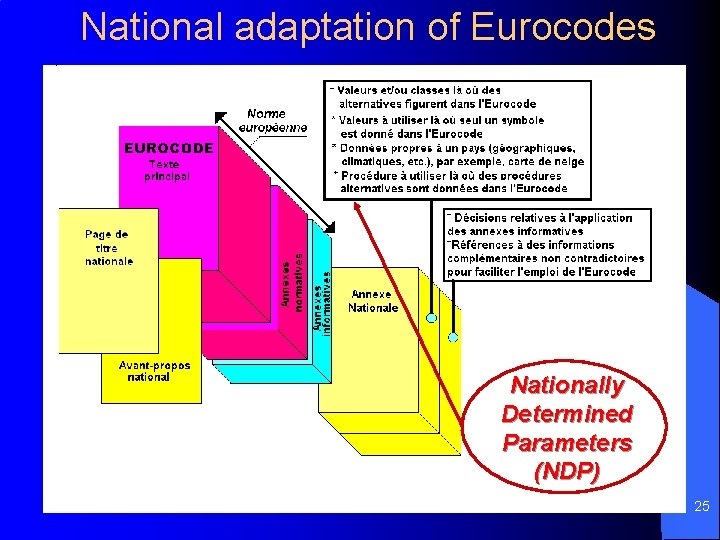
National adaptation of Eurocodes Nationally Determined Parameters (NDP) 25
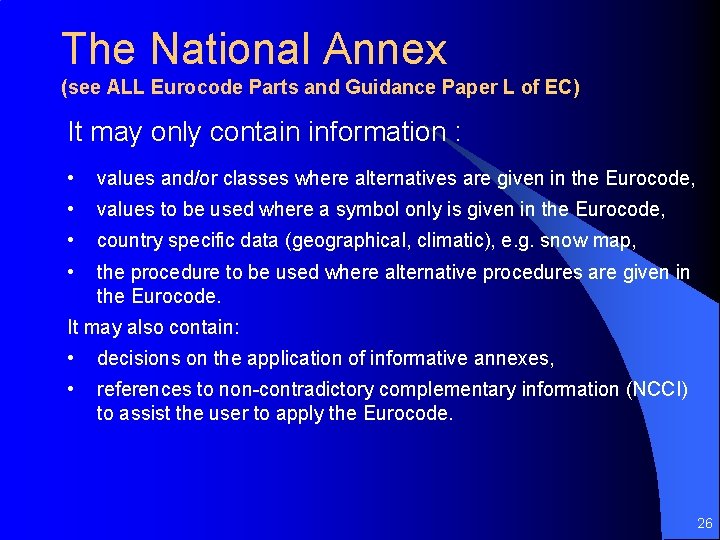
The National Annex (see ALL Eurocode Parts and Guidance Paper L of EC) It may only contain information : • values and/or classes where alternatives are given in the Eurocode, • values to be used where a symbol only is given in the Eurocode, • country specific data (geographical, climatic), e. g. snow map, • the procedure to be used where alternative procedures are given in the Eurocode. It may also contain: • decisions on the application of informative annexes, • references to non-contradictory complementary information (NCCI) to assist the user to apply the Eurocode. 26
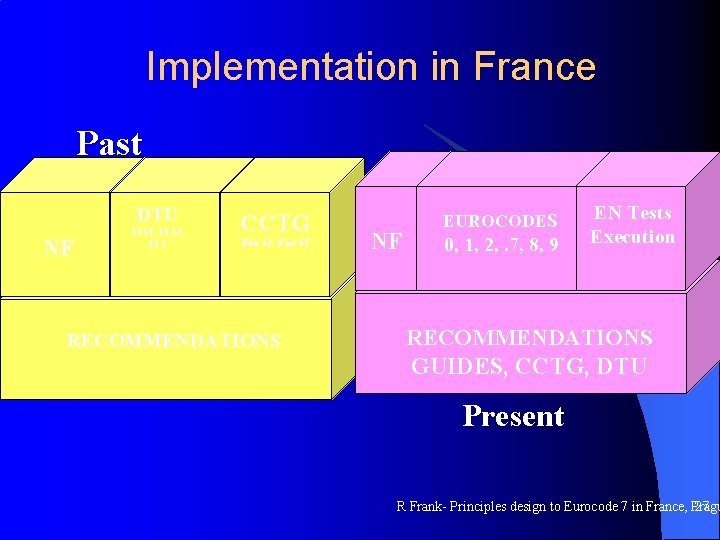
Implementation in France Past DTU NF 13. 11, 13. 12, 13. 2 CCTG Fasc 62, Fasc 68 RECOMMENDATIONS NF EUROCODES 0, 1, 2, . 7, 8, 9 EN Tests Execution RECOMMENDATIONS GUIDES, CCTG, DTU Present R Frank- Principles design to Eurocode 7 in France, Pragu 27
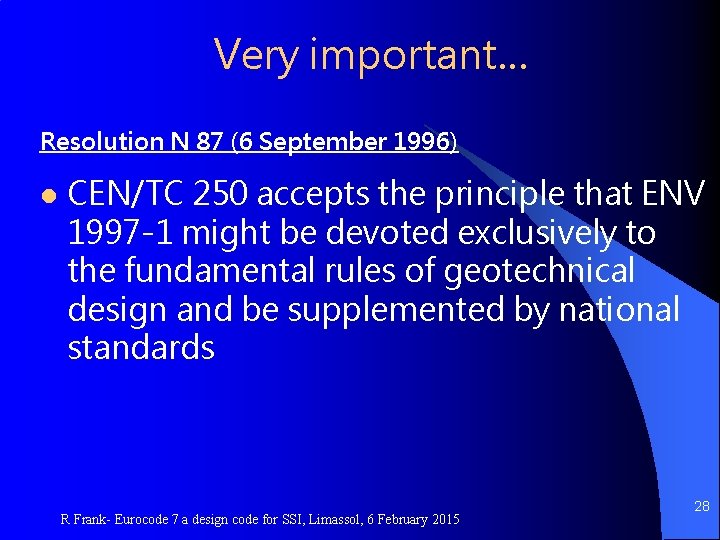
Very important… Resolution N 87 (6 September 1996) l CEN/TC 250 accepts the principle that ENV 1997 -1 might be devoted exclusively to the fundamental rules of geotechnical design and be supplemented by national standards R Frank- Eurocode 7 a design code for SSI, Limassol, 6 February 2015 28
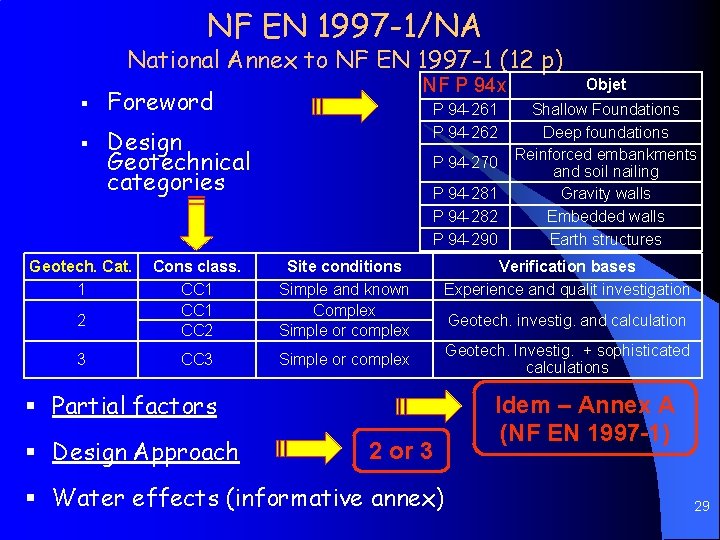
NF EN 1997 -1/NA National Annex to NF EN 1997 -1 (12 p) § § Foreword Design Geotechnical categories Geotech. Cat. 1 2 3 NF P 94 x Objet P 94 -261 P 94 -262 Shallow Foundations Deep foundations Reinforced embankments and soil nailing Gravity walls Embedded walls Earth structures P 94 -270 P 94 -281 P 94 -282 P 94 -290 Cons class. CC 1 CC 2 Site conditions Simple and known Complex Simple or complex CC 3 Simple or complex Verification bases Experience and qualit investigation § Partial factors § Design Approach 2 or 3 § Water effects (informative annex) Geotech. investig. and calculation Geotech. Investig. + sophisticated calculations Idem – Annex A (NF EN 1997 -1) 29
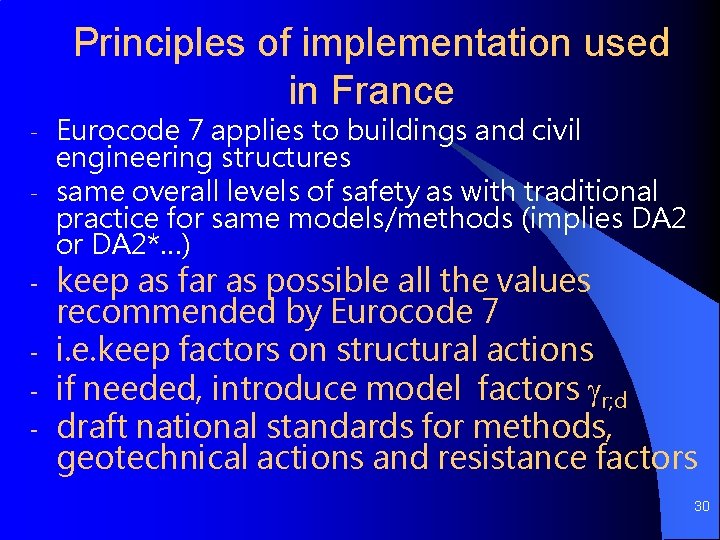
Principles of implementation used in France - - Eurocode 7 applies to buildings and civil engineering structures same overall levels of safety as with traditional practice for same models/methods (implies DA 2 or DA 2*…) keep as far as possible all the values recommended by Eurocode 7 i. e. keep factors on structural actions if needed, introduce model factors r; d draft national standards for methods, geotechnical actions and resistance factors 30
STR/GEO : persistent and transient design situations l l The National Annexes states that Design Approach 2 (or 2*) is recommended for application of Eurocode 7 in France. Design Approach 3 is also allowed for overall stability analyses, for the global stability analysis of reinforced embankments or nailed earth structures and for numerical analyses of soilstructure interaction. 31
Choices open in Eurocode 7 French NAs NCCI (Foundations) 1) Design approach 2 or 2* (for ULS in persistent and transient design situations) 2) Shallow foundations : little changes 3) Piles : Introduction of correlation factors x value for Rk and ‘alternative method’ 4) Real challenge : SLS settlement calculation ONLY for SLS? 32
Some extra slides… R Frank- Eurocode 7 a design code for SSI, Limassol, 6 February 2015 33
EN 1990 – EUROCODE : BASIS OF STRUCTURAL DESIGN Section 3 Principles of limit states design EN 1990 is based on the l limit state concept used in conjunction with the l partial factor method 34
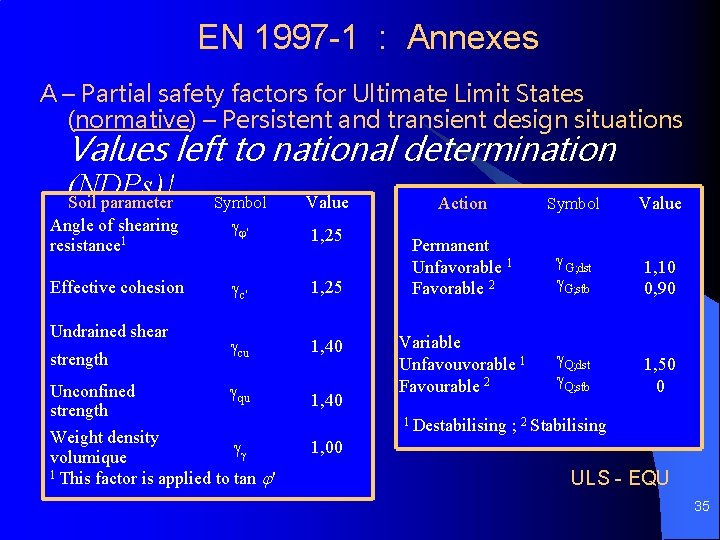
EN 1997 -1 : Annexes A – Partial safety factors for Ultimate Limit States (normative) – Persistent and transient design situations Values left to national determination (NDPs)! Soil parameter Angle of shearing resistance 1 Effective cohesion Undrained shear strength Unconfined strength Symbol Value ’ 1, 25 cu 1, 40 qu 1, 40 Weight density volumique 1 This factor is applied to tan ' Action Symbol Value Permanent Unfavorable 1 Favorable 2 G; dst G; stb 1, 10 0, 90 Variable Unfavouvorable 1 Favourable 2 Q; dst Q; stb 1, 50 0 1 Destabilising ; 2 Stabilising 1, 00 ULS - EQU 35
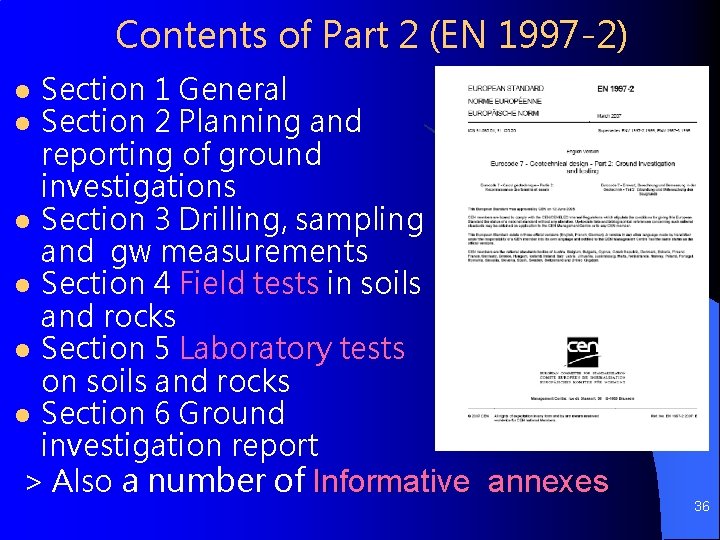
Contents of Part 2 (EN 1997 -2) Section 1 General Section 2 Planning and reporting of ground investigations l Section 3 Drilling, sampling and gw measurements l Section 4 Field tests in soils and rocks l Section 5 Laboratory tests on soils and rocks l Section 6 Ground investigation report > Also a number of Informative annexes l l 36
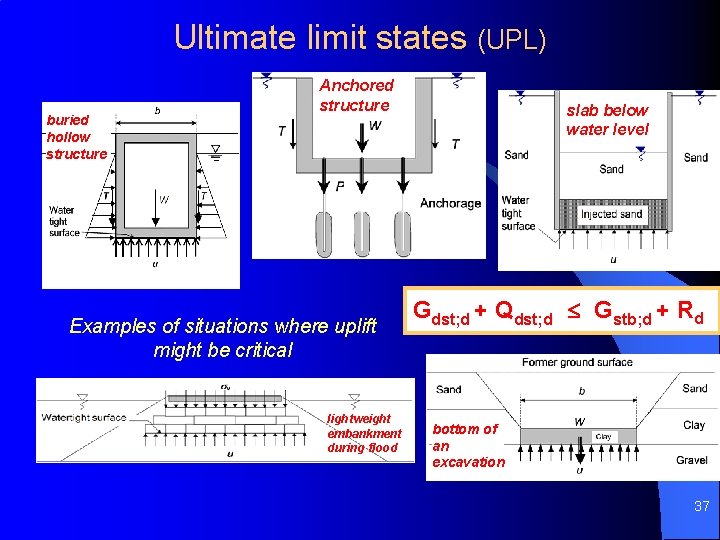
Ultimate limit states (UPL) buried hollow structure Anchored structure Examples of situations where uplift might be critical lightweight embankment during flood slab below water level Gdst; d + Qdst; d Gstb; d + Rd bottom of an excavation 37
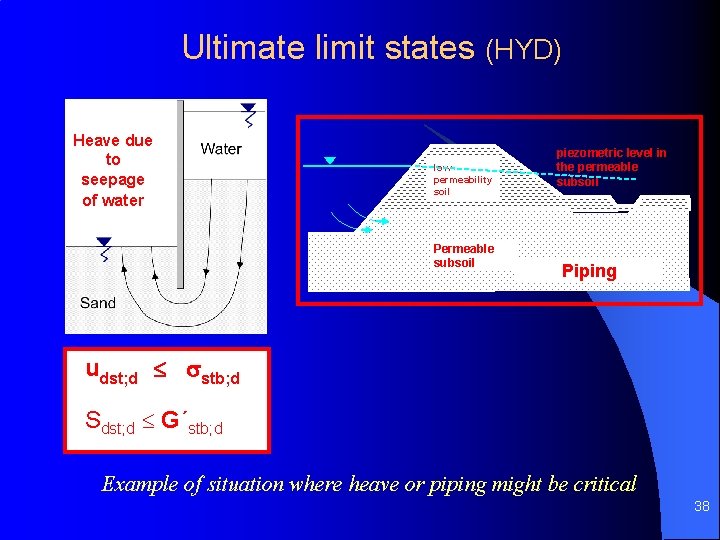
Ultimate limit states (HYD) Heave due to seepage of water low permeability soil Permeable subsoil piezometric level in the permeable subsoil Piping udst; d stb; d Sdst; d G´stb; d Example of situation where heave or piping might be critical 38
Verifications of ULS: Summary Ultimate limit states of static equilibrium (EQU) : Ed, dst Ed, stb Ultimate limit states of resistance (STR/GEO) : Ed Rd Ultimate limit state of uplift (UPL) : Gdst; d + Qdst; d Gstb; d + Rd Ultimate limit state of hydraulic failure (HYD) : udst; d sstb; d or Sdst; d G´stb; d 39